Categories
Reviews, News and Commentary

Shakespearean Disappointment

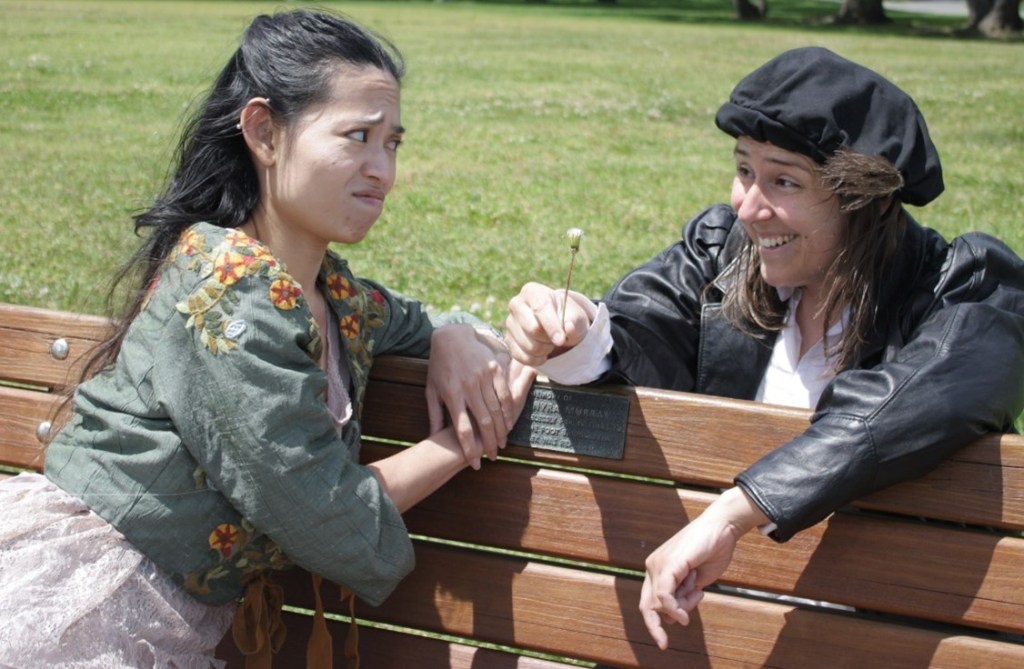
Phoebe McKellar (Juliet) and Theo Dāvid (Romeo) Photo: Andi Crown

Review by Malcolm Calder

Romeo and Juliet

By William Shakespeare

Auckland Theatre Company

Director – Benjamin Kilby-Henson

Design – Dan Williams

Lighting – Filament Eleven 11

Costumes – Daniella Salazar

Sound – Robin Kelly

With Ryan Carter, Liam Coleman, Theo Dāvid, Courteney Eggleton, Jesme Faa’auuga, Isla Mayo, Miriama McDowell, Phoebe McKellar, Jordan Mooney, Meramanji Odedra, Beatriz Romilly and Amanda Tito

Waterfront Theatre – until 9 August

Review by Malcolm Calder

This is a brave attempt by ATC to broaden its audience base and provide a path for younger performers.  And when you’re doing that, a good Shakespeare is a fairly safe bet as it can probably do quite well with younger audiences, meet the needs of traditional adherents and will no doubt fare well with a schools audience.  And ATC is to be acknowledged for that.

Unfortunately, when one looks at the larger theatrical picture, this Romeo and Juliet doesn’t really fare very well.  Especially as a major production by one of this country’s more significant professional companies.  However ATC’s production standards remain fairly high and are arguably this production’s saving grace. 

This Romeo and Juliet is set in a 1960s Verona and I get that – not such a silly idea.  The the overall design is consistent and sometimes works very well indeed with the themes Director Benjamin Kilby-Henson is articulating – youth, love and lyricism.  Chapeaus are due to the entire creative team and his production looks and feels quite stunning.

Dan Williams has generated a well-executed, three-dimensional set, largely articulated with reductive arches, derived some mobility from a well-used billiard table and unusually introduced what looks like a painter’s scaffold that trucks about a Veronian ballroom that is ‘under renovation’ and elsewhere too.  It makes for a splendidly unusual balcony scene.

I wasn’t in Verona in the 1960s, however I did own a pair of vertically-striped trousers a decade later, so I give costumier Daniella Salazar’s costumes a big thumbs up too.  Her use of colour is at times subtle and nuanced and the differences she has drawn between Montague and Capulet families are finely drawn.  Of particular note is the ballroom scene.

But it was the lighting and the soundscape that were the standouts for me.   The Filament 11 designers have introduced some dramatic and highly effective lighting that echoes the sentiments of Shakespeare’s words and the emotions highlighted by the director.  It is also pleasing to see ATC using effective sound reinforcement for actors who often spend more time in front of cameras and on more intimate venues these days than on the comparatively largish Waterfront’s stage.

However, Miriama McDowell aside, the cast struggled with Shakepeare’s words, couplet-ridden though they are

In fact, the whole casting process seemed somehow –  odd.  Generational differences were blurred, there was a rather strange mix of accents, some characters seemed to fit the context while others didn’t, and I’m still trying to work out why there were so many varied approaches.

Music may be the food of love but, as the director has noted, poetic verse is its very life force. Romeo only addresses Juliet in verse and she does likewise.  But sustaining this is very difficult indeed.

Apart from occasional flashes, especially with some of the longer speeches, the net result was one where authority and credibility were just – missing.   At one point it seemed like I was watching a youth company of younger kiwis imagining a Verona they had never visited.   

Miriama McDowell (Whaea Lawrence), however, was very much the exception, actually speaking Shakespeare’s words rather than matching the prevalent declamations of others. Theo Dāvid (Romeo) matched her to some extent leading one to wonder whether their work with the now-long-gone Popup Globe had anything to do with this.

There were a number of unanswered quibbles too: why, for example, did Friar Lawrence became a ‘Whaea’ in this production.  If this really were set in 1960s Tauranga and there two gangs at war with each other it could make sense.  But it is a term never uttered in in Verona in the 1960s.  And perhaps a bit of undersheet nudity was a way of  the simpering unreality of Paris, but that didn’t work for me either.

So thanks for the effort ATC.  But Romeo and Juliet was a disappointment for me.

Categories
Reviews, News and Commentary

Peter Cleverly: The artist revealed

Reviewed by John Daly-Peoples

Peter Cleverly: Between Transience and Eternity

Alistair Fox

Quentin Wilson Publishing

RRP $60

Reviewed by  John Daly-Peoples

Peter Cleverly has rarely shown his work in Auckland galleries apart from a few times the early 1990’s, so for many his work is unknown apart from images in publications.

However, a new book, “Peter Cleverly: Between Transience and Eternity” by Alistair Fox will correct this.

The heavily illustrated book traces the artists career from the 1980’s to the present with images of his work across more than four decades.

These four decades of art practice have seen him developing a personal style partly influenced by other New Zealand artists as well as his personal, response to his environment –  physical, social and political.

His early work was predominantly figurative but from the 1990’s these were replaced with landscapes, often with texts and then. more recently the  inclusion of figurative elements again.

His work, particularly early on was influenced in different ways by Toss Woollaston, and McCahon.

McCahon probably influenced his palette and his use of text but he may have also gained an understanding of McCahon’s approach. Unlike many artists influenced by McCahon he referenced A C Cotton’s book “Geomorphology” which was a prime source for both artists and Cleverly uses Cottons illustrations and shapes. He also used objects such as the pitcher as symbols in his work.

Other influences include New Zealand artists Bill Sutton and Tony Fomison while the importance of several international artists  such as George Baselitz, Mimmo Paladino and David Salle and appears to  have adapted their thinking about art.

His early landscapes owe much to McCahon shapes in “Six Days in Nelson and Canterbury while interiors such as “Still life kitchen Oamaru” are Post Impressionist distilled though Woollaston.

Peter Cleverly, All twenty-nine

His figurative work often dwells on mortality and death. “All Twenty-nine” his response to the death of 29 miners at Pike River. Here and in many other works the artist has a personal and visceral approach to his subject.

This is also seen in “Couriers” featuring two distorted hanging figures – is reaction to the incarceration of drug couriers Lorraine and Aaron Cohen. Often his figures are something  between flayed corpses and angels.

Peter Cleverly, Seadog

Cleverly has developed his own distinctive iconography including a dog shape/face which serves a range of emotional and symbolic purposes as in “Seadog”. 

The book is a very readable account of the artists varied life which has had an impact on the way he sees the world and the influences on his practice as well as an understanding of the artists thoughts and motivations.

Categories
Reviews, News and Commentary

Dick Frizzell’s picaresque memoir of the artist as a young man

Reviewed by John Daly-Peoples

Hastings. A boy’s own adventure

Dick Frizzell

Massey University Press

RRP $37.00

Reviewed by John Daly-Peoples

Many geniuses are recognized early on in their lives. Mozart had written 10 symphonies by the time he was 14, Pablo Picasso was turning out some skilful nudes when he was 14 and  Dick Frizzell did a drawing of Christopher Lee as Frankenstein’s monster at the same age.

However, neither Mozart nor Picasso wrote a decent autobiography about growing up which is where Frizzell has the edge over the other two.

His new book recounting his early years, “Hastings, A boy’s own adventure” is an entertaining set of stories which probably mirrors the life and times of many young men growing up in provincial New Zealand in the 1950’s and 60’s. It was a time of complete freedom when young men like Frizzell were learning the first of life’s lessons and enjoying life’s experiences.

In thirty chapters Frizzell recounts his adventures which provide  portraits of his family, descriptions of Hastings and sketches of his encounters with the day-to-day activities he was immersed in. Through these he  manages to provide an insight into his growing awareness and understanding of the world around him, conjuring up the experience of most young boys of his age, encountering the world of adults – aunts, uncles, family friends and  teachers.

We also get a sense of how he became Dick Frizzell the artist  with a mother who had been to art school  and taught him some artistic skills and a father who was well read and a technically accomplished engineer with his own enquiring and adventurous nature.  There are also his experiences of the landscape – Te Mata Peak and the farms of relatives where he worked or holidayed  There is also his love of  comics and movies, his interest in working environments and workmen It’s what we see in his artwork – a celebration of landscape and culture, history and everyday objects.

Frizzell says of these early years “I felt that I had the town covered: our Parkvale kingdom, Uncle George’s market gardens, Aunty Molly’s frock shop, Dad’s freezing works, my high school . . . the town was pretty much ring fenced by Frizzell’s! And I was there growing up with it. Rock ’n’ roll came along, the town became a city, Fantasyland was built, hoodlums trashed the Blossom festival, I learnt the Twist in the Labour and Trades Hall . . . everything I took within me towards adulthood came from Hastings.”

‘If I’d been asked to vote on it I would’ve said I’d landed at the centre of the universe. Standing on our corner of Sylvan Road and Victoria Street, with Te Mata Peak, the Tukituki River and the mad wilderness of Windsor Park to the back of me and the distinctly non-wilderness of Cornwall Park and the misty vista of the Ruahines in front of me, I was the master of all I could barely survey.”

We learn about his jobs, the same that probably every youth got living in Hastings – spells at the Tomoana Freezing Works (where his father worked) and at the Wattie’s canning factory.

But while his portraits of his mother and father and the likes  of his aunts Molly and Nora the figure which we most appreciate is the author with his achievements, blunders, successes and failures.

While the artist may have gained the image as the suave man about town. his early encounters with the opposite sex by his own accounts were less prepossessing. He recounts his inauspicious attempt at the seduction of Bunny as well as his fleeing from the amorous advances of the older Trixie.

It’s a coming-of-age book which will resonate with many older readers with its half-remembered tales of family life, friendships  and growing awareness of one’s place in the world.

To subscribe or follow New Zealand Arts Review site – www.nzartsreview.org.

The “Follow button” at the bottom right will appear and clicking on that button  will allow you to follow that blog and all future posts will arrive on your email.

Or go to https://nzartsreview.org/blog/, Scroll down and click “Subscribe”

Categories
Reviews, News and Commentary

Shakespeare in the Park: A cold blooded tragedy and a highly promising comedy

Auckland Shakespeare in the Park 2025

A Shoreside Theatre production

Pumphouse Amphitheatre

(if wet – Pumphouse Theatre)

Richard III

By William Shakespeare

Dir Catherine Boniface

Jan 22, 23, 24, 28, 31, Feb 1, 5, 6, 9, 11, 13, 15

The Taming of the Shrew

By William Shakespeare

Dir Mags Delaney-Moffat

Jan 23, 29, 30, Feb 4, 7, 8, 10, 12, 14

Review by Malcolm Calder

22 January 2024

Richard, Duke of Gloucester (Chris Raven) surrounded by his friends, perceived rivals
and even some who survived his ascension to the throne

Tragedy is a commonly used euphemism in theatre for when lots of people die.  Richard III doesn’t quite reach Titus proportions, but it has to be up there and this particular production is in good company.

It is part of Shoreside Theatre’s annual Shakespeare in the Park series, now in its 29th iteration, and staged at the delightful, terraced, outdoor amphitheatre adjacent to Lake Pupuke at Takapuna’s Pumphouse theatre.

Rather than try and recreate Shakespeare’s historical setting and fail, Director Catherine Boniface has chosen to locate her Richard III in a seedy but sartorially splendid 1930s London.  Her program notes suggest the setting is reminiscent of Peaky Blinders – and, yes, there were some artfully angled flat caps on display.  Gangland in a word.  It works too, largely because it is analogously appropriate to the dastardly deeds that Richard, Duke of Gloucester got up to towards the end of the the English Civil Wars.

I won’t even begin to list all the deaths he generates.  Suffice to say it’s a lot – one might even suggest he ‘eliminated’ his way to the top.  And misogynistically too because, as far as I recall, all those who died were males.  Something to do with lineage in those dastardly days when York’s rose challenged that of Lancaster and the distaff lines were those who suffered the pain and of loss.

Richard, of course, received his final comeuppance and the reference to Leicester reminded me that his remains were eventually discovered under a carpark there only 15 years ago.

Chris Rather played Richard with a suavely cool and assured arrogance, his ambition plainly on display, and even his disintegrating final days were well handled.  He was a standout for me in 2024’s Measure for Measure and it was good to see him progress to the Richard role.  The supporting roles more than served to enhance and focus attention on Richard’s dominance but the standout for me this time was Suzie Sampson as Lady Margaret – subtle, nuanced and very, very professional.

The period setting on a simple stage is fairly stark but allowed the inclusion of some delightful props – the wooden Lancaster bomber, the pistols and, of course, the costumes.  I could swear the ghoulishly severed head with spectacles intact was still dripping blood.  Although I did wonder if the prominently held and waved cigarettes may have in fact been vapes.

On balance, another competent and highly entertaining part of the Shakespeare in the Park series.

Conversely the comedic Taming of the Shrew is the very antithesis of Richard.  Its content, gender-neutral casting and the fact that it is performed by what is effectively Shoreside’s youth company mean it would be facetious to compare the two.

Katerina (Matilda Chua) and Petrucio (Heather Warne) in The Taming of the Shrew

The plot itself of Shrew is well-known.  In overly-simple words, Lucentio loves Bianca but cannot court her until her shrewish older sister Katerina marries. The eccentric Petrucio marries the reluctant Katerina and uses guile and trickery to render her an obedient wife.  Lucentio marries Bianca and, in a contest at the end, Katerina proves to be a most obedient wife.  The end !

There is probably a moral in there somewhere but the play is almost like a minefield for actors with cross-cuts of double entendre, split-second timing and that all important factor – suspension of disbelief. Shrew calls for a closer understanding of, and appreciation of the nuance in Shakespeare’s words coupled with the timing that is essential to pull this off revealing the farce beneath.  Without them the humour just doesn’t work.

And that is where director Mags Delaney-Moffat is to be congratulated on clearly focussing her youthful and highly-promising cast.  They work as an ensemble, there are laughs aplenty and the work that has gone into achieving them is clearly on display.  

It would seem churlish to single out anyone but the work of Heather Warne (Petrucio) is almost upstaged at times by the wit, humour and general antics, and indeed the timing and presence, of Lizzie Morris as her ‘man’-servant Grumio.  And, despite a demure start, Matilda Chua (Katerina) grows in confidence as true love with Petrucio eventually blossoms.

But there are many highlights and both director and cast are to be congratulated.

The annual two-play Shoreside season is now firmly established on the Auckland theatrical calendar in this, its 29th season.

Note: If wet, transfers indoors.

To subscribe or follow New Zealand Arts Review site – www.nzartsreview.org.

The “Follow button” at the bottom right will appear and clicking on that button  will allow you to follow that blog and all future posts will arrive on your email.

Or go to https://nzartsreview.org/blog/, Scroll down and click “Subscribe”

Categories
Reviews, News and Commentary

The dark world of “Hamlet” from Opera Australia

Reviewed by John Daly-Peoples

Act I Hamlet Image Keith Saunders

Opera Australia

Hamlet,

Brett Dean , Music

Matthew Jocelyn, Libretto 

Until August 9

Reviewed by John Daly-Peoples

“or not to be “, are the first lines we hear from Hamlet in Opera Australia’s latest offering by composer Brett Dean and librettist Matthew Jocelyn. They are of course a clip from one of the plays most well know soliloquies – “To be or not to be, that is the question”.

That question is

“Whether ’tis nobler in the mind to suffer

The slings and arrows of outrageous fortune,

Or to take arms against a sea of troubles”

In other words act now or prevaricate.

Hamlet never answers his own question and delays taking action to revenge the death of his father. In a typical revenge tragedy of the time that revenge would be quickly and simply exacted but his  equivocation is a sign of his own mental illness or his inconsistent political decision-making which ultimately leads to the death of multiple individuals.

Hamlet doesn’t even speak the words of the soliloquy that is left to a player from the theatre troupe, later in the play.

The opera explores questions of Hamlet’s mental state, how it impacts on his relationship with other members of court, his friends and his betrothed, Ophelia.

Librettist Mathew Jocelyn has done this by cleverly concentrating on some key lines and phrases while Brett Dean has produced a musical landscape which creates moods, emotional portraits and dramatic moments. The score is largely percussion with raw and unusual sounds along with traditional instruments pushed to their limits, providing an edginess and inventiveness to the work.

Director Neil Armfield has realised the visions of Dean and Jocelyn with an impressive production employing a stellar class including Allan Clayton who has performed the leading role at Glyndebourne and the Met. This is an opera which seems as relevant today as it was 400 years ago.

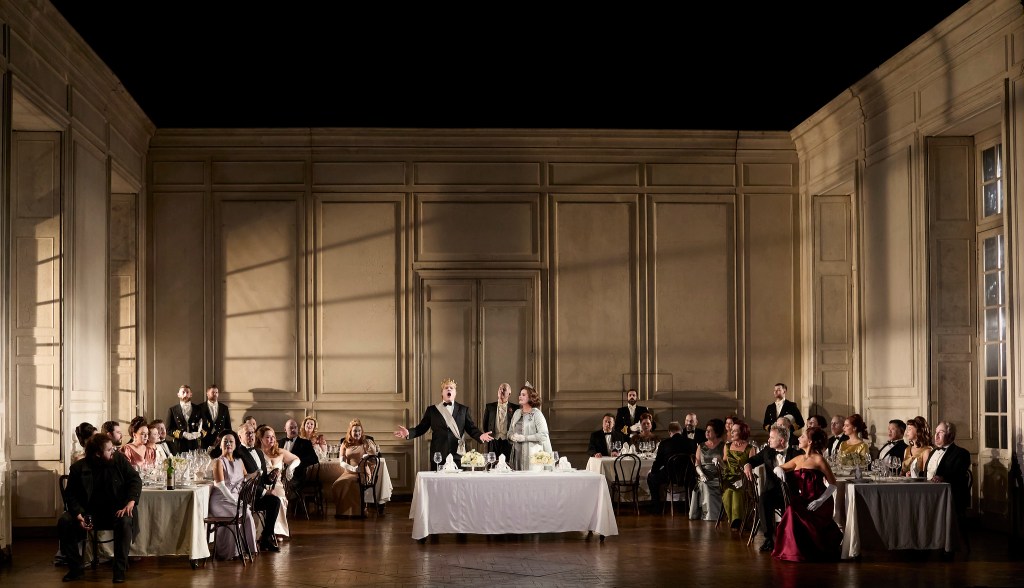
The opening scene, which is replicated in the final duel scene is the main hall in Elsinore where the new King Claudius and Gertrude enter for a banquet. Hamlet, looking remarkably like Peter Jackson  prowls the room in his ‘inky cloak’, gets his own bottle of wine and makes sharp comments about his mother and new father. Along with his brusque complaints there is also a playfulness when he greets his friends Horatio and Marcellus

One becomes aware of the conflict within the work. Is Hamlet actually mad or is it a ploy  which he uses. There are a number of scenes where the theme of pretence, subterfuge  and acting are cleverly developed by Jocelyn. This  notion of reality and artifice is seen at its most powerful in the Players scene where Hamlet adds some lines to the fictional “Murder of Gonzaga” play.

.One of the clever approaches that Jocelyn uses is to repeat particular words and phrases, giving emphasis to them so they become striking mantras

Allan Clayton’s Hamlet is very different from most theatrical versions, there is little that is princely or all that perceptive about him – he is a man burdened with a task, angry with most of those about him and lacking in empathy. He is in a dark world of his own making and that is conveyed through Brett Deans oppressive and stressful music.

It conveys something of the internal melancholy of Hamlet and Clayton’s rough tenor makes one aware of his struggles as he flails physically and vocally with his feelings and (in) actions. His approach to revenge is insipid compared to the pesky Laertes (Nicholas Jones) who leaps at the opportunity of dispatching Hamlet.

Much of Hamlet, as with many of Shakespeare’s plays is focussed on the nature and the future of the royal family and by implication, the future of the state, with reference to the  legitimacy of Claudius and Gertrude and the rottenness of the state of Denmark.

Hamlet (Allan Clayton) and Ghost of his Father (Jud Arthur) Image Keith Saunders

Many of the scenes are brilliantly staged. When the ghost of his father (Jud Arthur) appears to Hamlet it is in a surreal setting worthy of Salvador Dali. The Frankenstein-like figure moves slowly across the stage, a beam of light cuts across the stage from a door giving onto a misty swirling nether world. The ghost tells Hamlet of the need for revenge as the quivering woodwinds and tentative percussion aid his growling voice. The relationship between the two becomes particularly  physical as the two embrace.

Lorina Gore’s  Ophelia gives a splendid performance as she expressed love, confusion and ultimately madness. Her performance was particularly touching in her mad scene where, having strewn herbs around the stage, she proceeded to beat her breast and used her strangled voice along with the sharp strings of the orchestra to convey her fragile mental state. Her cries were accompanied by a small female chorus situated high in the boxes who initially shouted their concerns but then became a choir of angels.

Ophelia (Lorina Gore), Guildenstern (Christopher Lowery) & Rosencrantz (Russell Harcourt) Image Keith Saunders

Rod Gilfry as the guilty Claudius stepping into his new role as king was able to convey his own ambivalent position with a voice which ranged from the rough to the benign while Catherine Carby’s Gertrude duets with her son and Ophelia were taut with genuine feeling.

Kanen Breen’s supercilious bureaucrat, Polonius was excellent with his finger clicking insistence, and Samuel Dundas as Horatio, the only likable character in the opera, gave an intelligent and perceptive performance.

Most of the characters were white faced, as though already embalmed but it was Jud Arthurs monstrous, white figure and his penetrating bass which made the most impression. Arthur was also magnificent as the cocky, philosophical Gravedigger.

The two foppish counter tenors, Rosencrantz (Russell Harcourt) and Guildenstern (Christopher Lowrey) looking like the artwork, Gilbert and George added an element of comedy as well another dimension to the notion of artifice.

The set designed by Ralph Myers with its changing structures was something of a metaphor for the changing veneers, masks and stratagems of the characters while the lighting by Peter Harrison provided many moments of visual drama.