Categories
Reviews, News and Commentary

(Gen)-X rated Satire

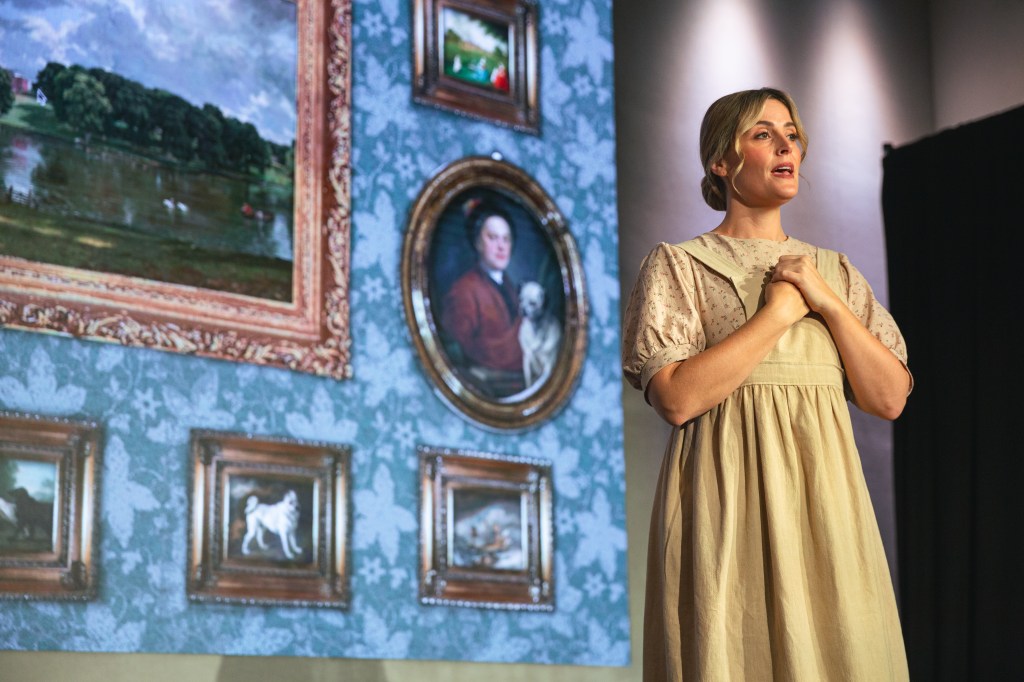
Zoe Triggs, Mika Austin, and Lizzie Buckton in HR The Musical
Photo: Jinki Cambronero (she/they)

HR The Musical

A Performance Revue

Created and directed by Amy Mansfield

Artsense Productions

Part of the 2024 NZ Comedy Festival

With Mika Austin, Zoe Triggs, Lizzie Buckton & Amy Mansfield

SM Simon Todd

Rangatira, Q Theatre

Review by Malcolm Calder

14 May 2024

This delightful little show had an outstanding run in the summer series at Q.  So much so that it has popped up again on the national 2024 Comedy Festival circuit.  HR The Musical has some very, very funny lines and lyrics and confirms Amy Mansfield as genuine talent in the field.  It has now finished its return run at Q in Auckland but Wellington and Christchurch audiences still have something to look forward to.

So if you are in either city, don’t miss it.

Despite the principal title, the subtitle is far more appropriate (and barely hides a satire on itself) –  HR is very much a contemporary and wickedly comedic Performance Revue.  And a good one too.  But you’re looking for a plot or story, then forget it.  This is a series of sketches …and it works.

Set in amorphously non-specific workplaces, the cast of four have a lot of fun with some delightful lyrics, at times bitingly so.  Mansfield has a genuine skill at finding rhymes and rhythms and then delivering them with a scattergun regularity.  Standout for me was undoubtedly the ‘Mansplaining’ scene, but only narrowly losing out to the ‘Coalition of Chaos’.

She takes aim at the meaninglessness that enshrouds many of today’s workplace practices.  Y’know … the term for ‘personnel’ (which used to be about employment) soon became ‘people operations’ in the cyborg workplaces that seem to have flowered in our endemic post neo-liberal economic era.  The audience got it, and got it well, as the term was morphed into ‘human resources’, ‘recruitment and selection’, ‘performance management’, ‘learning and development’, ‘succession planning’, ‘onboarding’ and a myriad of other clichaic terms – don’t get me started on teams and team-building.  Each is instantly recognisable to its target audience.  Couple that with a close familiarity with the attitudes and processes that underpin employment and you have an audience that relates to many of the painfully recognisable and satirically drawn characters, and they get it even more. And therein lies the principal reason for this production’s success.   Audiences relate.

In keeping with this, Mansfield’s music covers a range of styles, necessarily scattergun at times, but none are inappropriate.  It is held together by a keyboard supported by a couple of guitars and even a plastic flute or two.

It would seem to me that the southern venues for HR The Musical may be a tad on the small side.  In Wellington particularly !

However, it also struck me that HR The Musical is something of a work in progress.  Its final scene starts to hint at querying why the workplace is the way it is.  It would be fascinating to see Mansfield explore this further.

Christchurch 16-18 May, Little Andromeda

Wellington 21-22 May, Te Auaha
Categories
Reviews, News and Commentary

Mansfield Park: The Future Looks Bright

Review by Malcolm Calder

Ashlyn Tymms (Fanny Price in Mansfield Park) Photo Lewis Ferris

Mansfield Park
Music by Jonathan Dove
Libretto by Alasdair Middleton
Based on the novel Mansfield Park by Jane Austen
Director, Rebecca Meltzer
Maestro Concertatore, Brad Cohen
A New Zealand Opera production
Settlers Country Manor, Waimauku
Sunday, 21 April
With
Ashlyn Tymms (Fanny Price)
Kristin Darragh (Lady Bertram)
Robert Tucker (Sir Thomas Bertram)
Sarah Mileham (Maria Bertram)
Michaela Cadwgan (Julia Bertram)
Joel Amosa (Edmund Bertram)
Andrea Creighton (Aunt Norris)
Joanna Foote (Mary Crawford)
Taylor Wallbank (Henry Crawford)
Andrew Grenon (Mr Rushworth)
And
Soomin Kim and David Kelly (piano for four hands)

The incoming General Director of New Zealand Opera Brad Cohen has described Mansfield Park as a touchstone for the future. And judging by this offering of Mansfield Park, opera-lovers have a rather
fascinating future to look forward to.

Jonathan Dove’s score is contemporary, which may prove difficult for some but it points to an operatic future that is to be lauded and, unlike last year’s perhaps controversial Unruly Tourists, retains some links to literary tradition.


Mansfield Park is a two-act, 18 chapters adaptation of Jane Austen’s early 19th century novel. It takes a few liberties with the original but retains the essential context of the Crawford family and their grand old country pile in which familial mores, social positioning and aspirations are played out. Alasdair Middleton’s libretto deftly and succinctly summarises these in the very first chapter as being about ‘profit, pride, position, posterity and prestige’.


Remote niece, Fanny Price, is recently fostered into this social setting ‘for her betterment’ before patriarch Sir Henry soon departs for the family’s sugar plantation in Antigua. It soon becomes apparent that a simmering undercurrent of familial disputes, bad-mouthing, marital intrigues and
backstabbing are revealed before eventual resolution is reached. Through all this the quiet, reserved and subservient Fanny, grows with increasing maturity to become a shining example of all that is good, honest and true.


Mounted in semi-rural splendour of the main reception room at Settlers Country Manor at Waimauku near Kumeu, this initial offering is a chamber opera in the true sense of the word. There is no purpose-built stage as such and it is performed on and around a tiny elevated space measuring
perhaps 5m x 4m. Importantly for the future, this production is readily portable, relatively inexpensive to produce and could be easily mounted in a wide range of suitable spaces all over the
country.


Director Rebecca Meltzer copes with the questionable acoustics and difficult shape of the room by tossing out any hint of grand opera and uses the tiny performance space to elicit performances of nuance and subtlety from a 10-strong ensemble supported only by a single piano played by four hands. The entire reception hall (set up with rows of chairs for about 300) is used for entrances, exits and even voices from the rear of the room. Meltzer even allows more than just hints of that
actor’s stock in-trade – improvisation.


The effect is to offer a new and vibrantly different connection for audiences who are almost invited to become a part of the Crawford family either as flies on the wall, or perhaps imagining themselves as auxiliary staff or even just as close observers. Proximity to the performers induces intimacy and connection, something hammered home at one point when an audience member becomes part of the action on the stage.


This is a genuine and uniformly strong ensemble cast that feeds off, balances and enhances each other so it is no surprise that, as a unit, it was genuinely strong. Some of the lyrics were occasionally lost in the acoustics but these were readily overcome through the availability of a QR code enabling the audience to read them if required.


But it was Sydney-based mezzo Ashlyn Tymms who captured the room especially when Fanny’s low-key presence in the first act grows to increasing prominence in the second. Tymm’s delivered two strong arias at the top of the second act and then seemed to go from strength to strength leaving us in no doubt whatsoever that Fanny Price was unquestionably good, honest and true.

As such, it certainly affords NZ Opera opportunity to connect with new audiences in new ways and perhaps in new locations.