John Daly-Peoples
Niue’s Hikulagi Sculpture Park: A Global Microcosm
Sited in the middle of the natural rainforest of the Pacific Island of Niue is a physically small but conceptually monumental installation / treatise on global environment concerns, the Hikulagi Sculpture Park.
The Hikulagi Park was established in 1996 by members of the then Tahiono Arts Collective, a small group of artists including Mark Cross. Many had returned to their Pacific home, countering the trend of urban drift that has devastated many rural and island populations in the Pacific.
Several acres of land south of the eastern village of Liku were at the artists’ disposal and, while being ideal for the purpose of the artists’ environmental concerns, it was also ironically surrounded by the pristine rainforest which once covered the now degraded land.
The park’s concept embraces the sentiment that an island is analogous to Planet Earth in microcosm, and so is intended to encourage discussion on issues such as, pollution, climate change and human co-existence. It is a place where the intrinsic and unique qualities of Niuean Culture and environment can be shared with the world while attracting attention to Niue through the medium of contemporary sculpture, a medium seen nowhere else in the Pacific Islands.
Its intention is to do this through audience participation and the predominant utilisation of the found object; that is to say, the artists and community make sculpture from the inorganic waste created by contemporary consumer society.
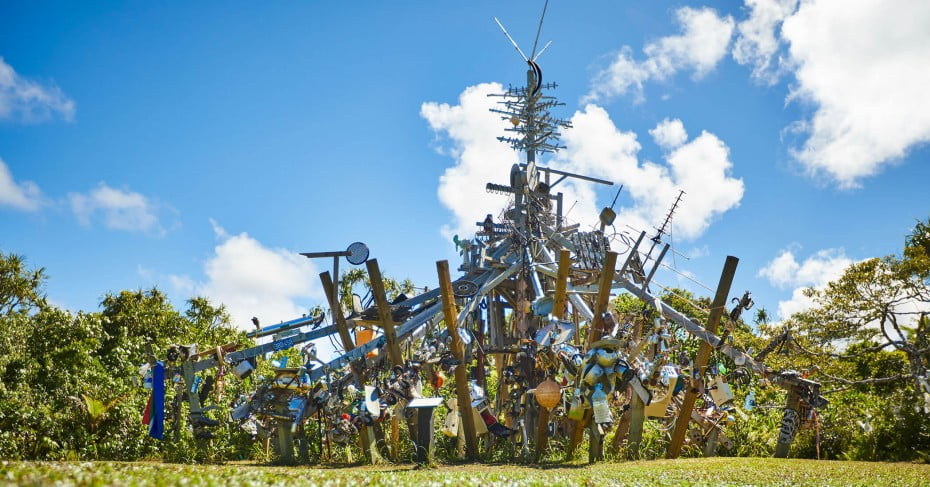
With this in mind, the centrepiece of the park is the monumental sculpture called ‘Protean Habitat’ which epitomises the ideals behind the Hikulagi Sculpture Space. On-going and interactive, it is an art project that does not have any perception of a finite conclusion. Based on a wooden substructure, it is an assemblage sculpture fundamentally constructivist in its utilisation of the found object that can easily be attached with the most basic of tools, enabling passers-by to add their own input.
In its state of ever-changing growth the sculpture reflects the state of the world and the refuse that humanity is accumulating in its juggernaut consumerist path to who-knows-where. This vagueness of direction and final outcome of humanity are then reflected in the unexpected directions the sculpture will take during its growth and the fact that it will grow ad infinitum.
The first sculpture to be erected at the park in 1996 was by Niuean returnee Mikoyan Vekula, who grew up in Wellington. His ‘Odesyk’ is a six-metre semicircle of six totem poles of native Kafika hardwood decorated intricately with cut and inverted beer cans. The circle is completed by limestone rocks known as Makatea throughout Polynesia. Resisting the Polynesian artist trend of introspection in his imagery, Vekula draws from a number of indigenous cultures including Australian, American and Celtic .The totems in this esoterically titled sculpture depict a family, with the guardians on each end of the semicircle and the four children in the middle. At the centre of the circle is a bench intended for the viewer’s contemplation and meditation.
Several more ephemeral artworks have been created by artists who just happen to be passing through Niue. A good example is ‘Web’, a sculpture created by environmental artist Meri Heitala from Helsinki which has been made by stringing telephone wire, spider-web-like, between two coconut trees while attaching drink can tear tabs, which suggests captured insects. In this way, such ephemeral sculptures are encouraged to enlist the input from visiting artists who may not have the time to create something more permanent.
A recent project that is more of an enclosure than a sculpture is ‘Sale’s Fale’, an ongoing project in memory of the Niue High School art teacher and sculpture park co-founder Charles Jessop who passed away in 2012. The sculpture is in the form of a monumental montage constructed by the Niue community through the biennial competition ‘The Charles Jessop Memorial Sculpture Prize’
The Hikulagi Sculpture space to date is being created through the voluntary labour of various individuals and businesses on Niue. Initial funding at its inception was provided by the Pacific Development and Conservation Trust as well as the then Aus-Aid Cultural Fund. The space has been supported by Reef Shipping, The New Zealand High Commission to Niue and Niue Tourism has helped with some construction and on-going maintenance.
Protean Habitat is an ongoing monumental assemblage in an ever-changing state of growth and decay, not unlike all life on the planet Earth. It has an interactive element whereby the public are invited to add their own sub-sculptures to the substructure leaving their small indelible mark on the growth of the main construction.
Mark Cross who has had over 40 years of association with the Island of Niue says “I have been alert to the layers upon layers of humanity that has come and gone leaving small elements of their lives making a small community into a living protean organism. In such an isolated community this awareness becomes more acute and then you realize what you are experiencing is a microcosm of the whole world. So, in its state of ever-changing growth, the sculpture reflects the state of the world and the refuse that humanity is accumulating in its juggernaut consumerist path to who knows where. This vagueness of direction and the final outcome of humanity is then reflected in the unpredictable directions the sculpture will take during its growth and the fact that it may or may not grow ad infinitum.”
The concept behind the Hikulagi Sculpture Park has links to the Watts Towers in Los Angles and Palais Ideal in Hauterives, France.
The Watts Towers are a collection of 17 interconnected sculptural, structures, built by Simon Rodia over a period of 33 years from 1921 to 1954. The Palais Ideal is a series of constructions built by postman. Ferdinand Cheval over 33 years 1879–1912 in Hauterives, France.
A new project will involve the internationally recognised sculptor Chris Booth who has produced more than twenty large scale sculptures around the world. The sculptor travelled to Niue in 2023 when he ascertained the potential sculptural medium of rocks and stones as well as meeting with potential collaborators such as the leading weavers in the village of Liku,
As weaving is the most dynamic artform existing in Niue today Chris has identified with it and master weavers Enele Kaiuha and Ahi Makaea-Cross have agreed to collaborate and transfuse ideas that may influence the design of the sculpture. This collaboration will in turn enable the project managers to interest the wider community in becoming involved both in a practical way (the collection of rocks and stones) and as an audience in the construction of the sculpture and the finished work. We also anticipate that the schools both primary and secondary to be involved from the outset to the completion, the project being a unique opportunity for the children to be exposed to contemporary art practice if not being more closely involved in its construction.
In 2024 he again travelled to Niue in September to try to decide on a more definite concept for the sculpture. Prior to his arrival the Broadcasting Corporation of Niue (BCN) offered the project a cyclone damaged, 8 metre diameter, aluminium satellite dish which could be inverted to form a dome structure. This would support around 1700 150mm rocks from the quarry while another 500 or so weathered beach rocks would provide a contrast to the more jagged quarry stone which would be employed to create the patterns used in the “tia” coil weaving technique (placemats, bowls etc). The use of the satellite dish also fits within the strong Hikulagi ethos of the re and upcycling of obsolete consumer and industrial materials as an environmental statement.




 New Zealand Arts Review