Categories
Reviews, News and Commentary

A mesmerizing performance by Chloe Chua with the Auckland Philharmonia

Reviewed by John Daly-Peoples
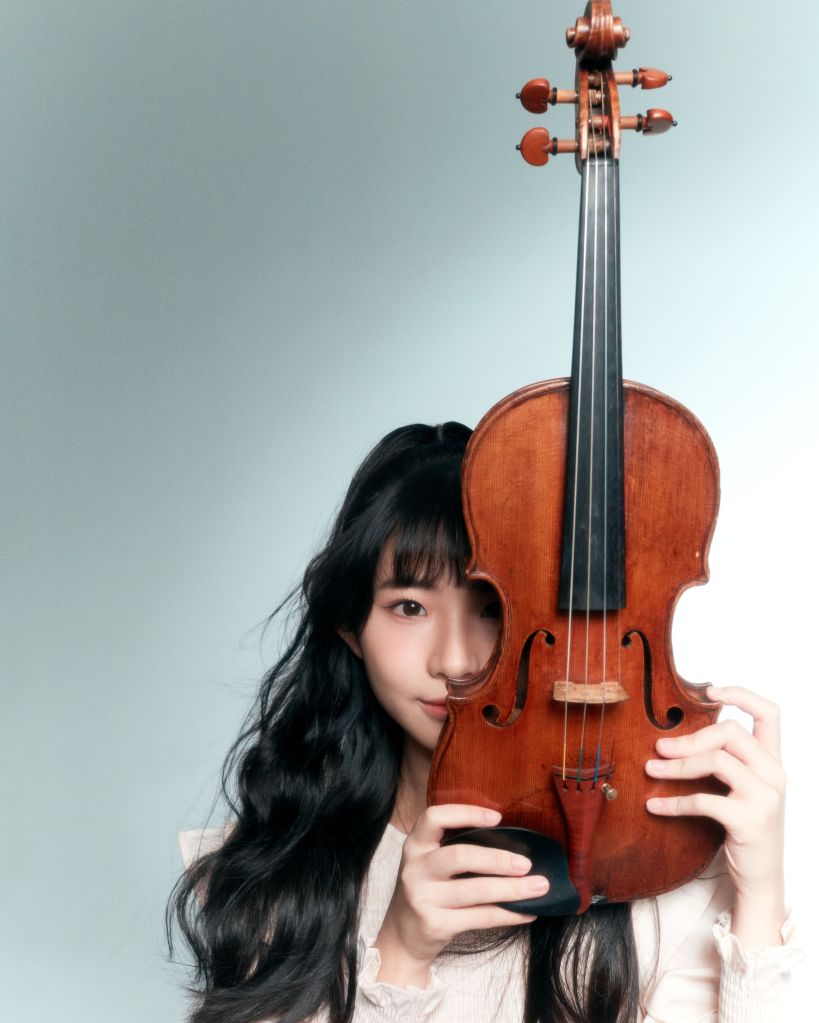
Chloe Chua Image: Joel Low

Tchaikovsky’s Violin

Auckland Philharmonia

Auckland Town Hall

September 26

Reviewed by John Daly-Peoples

The major work in the latest Auckland Philharmonia’s concert was Tchaikovsky’s Violin Concerto with soloist Chloe Chua who came with well-established credentials having won the Yehudi Menuhin International Competition for Young Violinists when she was 11.

It was immediately clear that she was an exceptional player with a self-contained, flawless approach to playing. But as well as a technical virtuosity she displayed an emotional sensitivity.

With her playing she maintained a distance from the orchestra, with an internal focus and much of the time she seemed to be in a reverie.

The concerto according to many who have played the work since it was composed is notoriously difficult to play, as it requires exceptional technical mastery of various techniques like double stopping and arpeggios as well as playing at a fast pace for extended periods.

Chua manged the piece effortlessly, notably with the cadenza where she was masterful in her control and delivery. Her playing was impressive with a technical brilliance as well as providing and intelligent and sympathetic interpretation of the music.

After the dramatic display in the first movement her delivery of the second movement revealed the sweet lyricism before she performed a range of tones, textures and tempos, continually testing the limits of the violin.

Throughout the work she was a whirlwind of musical dynamism and it was miracle that she didn’t collapse at the end of the work.

While she may have given a spirited performance of the Violin concerto receiving rounds of applause it was her mercurial version of Amazing Grace which showed another aspect of her approach. Her playing of the work and her variations were mesmerizing and by turns anguished, sprightly and whimsical.

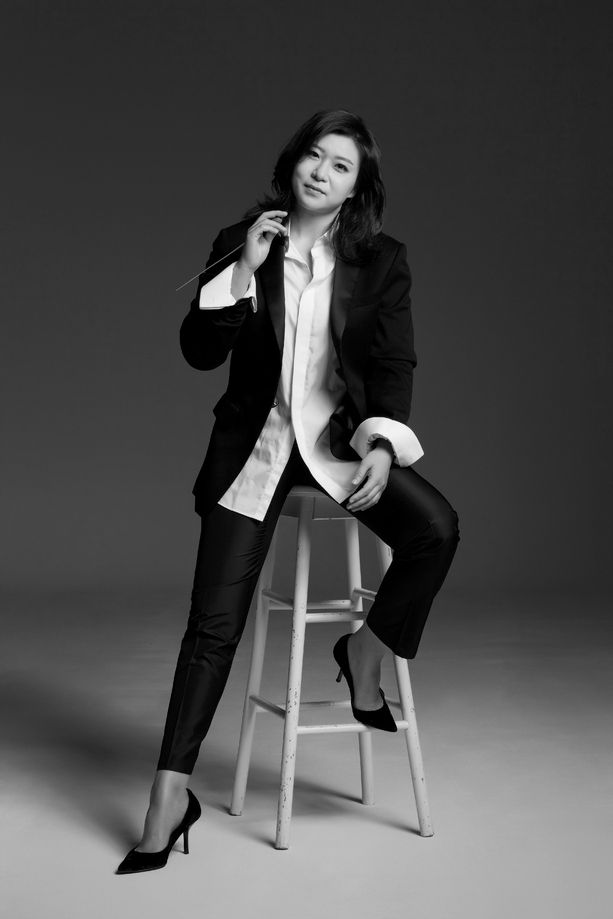
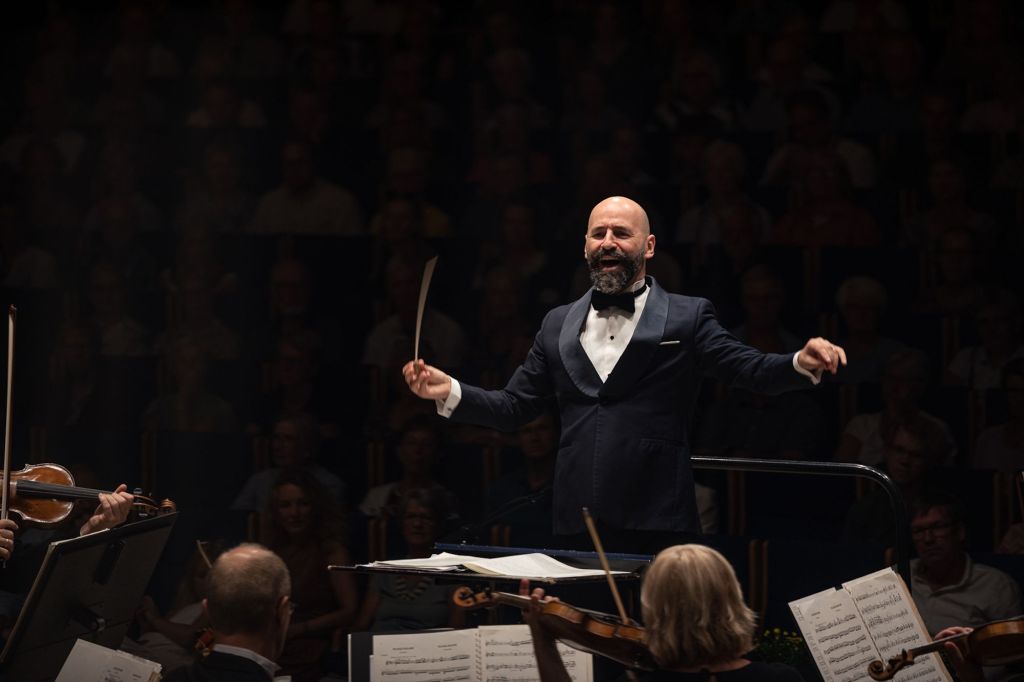
Sung as ever conducted with dramatic flourishes as well as intensive elegant hand gestures and at other times seemed to exude an electrical force directed at the orchestra.

Franz von Suppe who was a rival of Strauss in producing Viennese light music provided the opening piece on the programme with his “Morning Noon and Night in Vienna Overture” which features waltz and polka rhythms, reflecting Viennese musical traditions. The work was originally the incidental music to a comic play “Morning Noon and Night in Vienna” which captures the vibrant atmosphere of Vienna through its three distinct sections.

The opening section featured an impressive cello solo, following on from a brass chorale. The solo, played by a meticulous Ashley Brown was like a mini cello concerto imbedded in the work and consisted of a lengthy Viennese style melody accompanied by the harp.

The work had several dynamic dance sequences which had the orchestra racing at a hectic pace, barely contained by conductor, Shiyeon Sung.

With Haydn’s  Symphony No 93, the first of his London Symphonies Sung showed brilliant control of the orchestra allowing each of the instruments to shine and ensuring  the drama and contrasts of the work were clear and that the intricate and unusual dynamics of the work were allowed to evolve, slowly revealing the beauty of the work.

The final work on the programme was Stravinsky’s “Divertissement from The Fairy Kiss” a ballet he composed in 1928 based on the Hans Christian Anderson tale and dedicated to the memory of Tchaikovsky.

Each of the four sections used elements of Tchaikovsky’s piano works and songs including a reference to one of his preludes in the first movement and in the final minutes of the last movement he quotes Tchaikovsky’s song, “None But The Lonely Heart”.

The music featured magical and unusual sounds and was filled with drama and lively movement which conveyed a sense of narrative and the creation of character. Though not as novel as his other ballet music Sung was able to reveal the works lyricism and romanticism shaping the music with elegant hand gestures

To subscribe or follow New Zealand Arts Review site – www.nzartsreview.org.

The “Follow button” at the bottom right will appear and clicking on that button  will allow you to follow that blog and all future posts will arrive on your email.

Or go to https://nzartsreview.org/blog/, Scroll down and click “Subscribe”
Categories
Reviews, News and Commentary

Auckland Philharmonia’s Brahms 3 and a masterly James Ehnes

Reviewed by John daly-Peoples

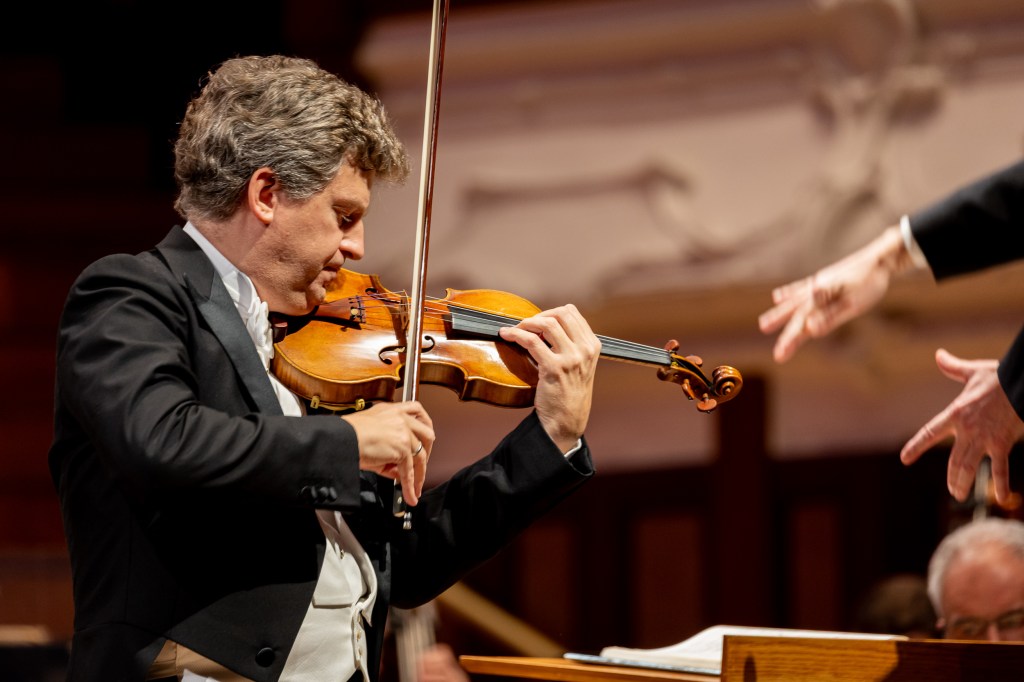
James Ehnes Photo Sav Schulman

Brahms 3

Auckland Philharmonia

Auckland Town Hall

February 27

Reviewed by John Daly-Peoples

The “Brahms 3”concert began with Romanian composer Gyorgy Legeti’s “Concert Romanesc” written in 1951. The work opens with joyous images of landscape studded with hints of folk music. These passages combined humour and experimentation, qualities which inhabit much of his later music.

From the middle of the piece there were more sombre sounds, as though confronting the history of his country as well as the suffering and death of his parents in Auschwitz during World War II.

As the work became darker and bleaker there was a whirling dance of death moving to a finale where the whole orchestra exploded with lively, suffocating sounds.

Following his performance last week James Ehnes’ performance of Bartok’s “Violin Concerto No 1” was highly anticipated. He did not disappoint. With the soulful opening movement he was initially joined by Andrew Beere and Lauren Bennett before others from the string section joined, adding to the density and complexity of Ehnes’ playing.

Following on from the strings, the woodwinds provided a slightly unsettling voice and even as the orchestra gained in intensity, Ehnes’ violin rose up , soaring above the sounds of the orchestra with some strident sounds which were reflected in Ehnes’ rigid  demeanour and exacting playing.

From the second movement on, his playing style changed, taking on a more passionate and expressive approach with some more hectic, gypsy-like playing as he battled against the sweep of the growling orchestra. However, even when he was frantically playing there was a sense of his being totally in control.

With his mastery of the violin, his skilful changes in pace, and tone the audience  was treated to a display by a consummate violinist.

While Ehnes received a rapturous ovation for the Bartok it was his encore, Eugene Ysaÿe’s “Violin Sonata No.3 ‘Ballade” .that got a tumultuous reception. The solo work dedicated to the Romanian violinist and composer George Enescu which was beautifully structured requires an intelligent and skilful player – all the qualities that Ehnes was able to bring to the piece.

The big work on the programme was the Brahms “Symphony No 3, a work which is full of marvellous melodies but which is something of an enigmatic work.

In many ways it is a forerunner of the impressionist works of Debussy and Ravel reflecting the interest of the Impressionist artists of the late nineteenth century. Much of the music is linked to visions of landscape, light and shade, colours and texture.

These images parallel a world of emotions and feelings, the composers inner and exterior worlds mingling. In building  a structure based on these links Brahms explores the nature if the human condition. This is very evident in the final movement with its passages of drama and tumult suggesting natural forces as well as the inner turmoil of love and passion.

The final works on the programme, three of Brahm’s Hungarian Dances had Conductor Bellincampi conducting at breakneck speed and while he spent much of his time dancing on the podium the orchestra were swept up by the music and carried along by its own impetus.

Bellincampi used the dances to book-end a farewell to the orchestra’s Music Librarian, Robert Johnson who has worked at the orchestra for over thirty years.

To subscribe or follow New Zealand Arts Review site – www.nzartsreview.org.

The “Follow button” at the bottom right will appear and clicking on that button  will allow you to follow that blog and all future posts will arrive on your email.

Or go to https://nzartsreview.org/blog/, Scroll down and click “Subscribe”

Categories
Reviews, News and Commentary

APO’s Romantic Journeys

Reviewed by John Daly-Peoples

Johannes Moser

Auckland Philharmonia

Romantic Journeys

Auckland Town Hall

November 21

Reviewed by John Daly-Peoples

The opening and closing works on the APO’s Romantic Journeys programme featured travelogues from Tchaikovsky and Schumann. Tchaikovsky Capriccio Italien is a record of one of his  trips to Italy whileSchumann’s Symphony No.3 ‘Rhenish’ was written in response to a journey along the Rhine and a visit to Cologne.

Tchaikovsky travelled many times to Italy, partly to escape the Russian winter and it was on one of these trips that he was inspired to compose his Capriccio Italien partly inspired by Carnivale, of which he wrote – “seeing the public raging on the Corso, you are convinced that no matter how strangely the joy of the local crowd manifests itself, it is nevertheless sincere and unconstrained,”

A  blaze of horns opens the work,like a curtain being lifted to reveal a colourful panorama of landscape, cities and spectacle. There are some slow and precise passages before we hear traces of folk music which introduce a sense of Italian life with lively  and charming dance melodies and bugle calls.

This was followed by a fast-paced tarantella-like sequence with the lively strings and woodwinds allowing the composer to capture the ebullient moods of the people as they danced through Carnivale  from dawn to dusk.

Throughout the work with its changing, colours and tempos there is a sense of the composer delighting in parading these sounds which would be new to a Northern European  audience

Schumann’s Symphony No 3 (Rhenish) is a portrait of the Rhine but it can be seen as part of the nationalist ethos which had been developing since the end of the Napoleonic  Wars and was particularly strong in the Rhineland.

From the opening fanfare, there is a sense of celebration of the land, the buildings and the people. The Rhine is central to this depiction and the music paints a picture of the flowing river indicated by the sinuous sounds and overlapping melodies of the orchestra.

The work is like a musical diary depicting the changing landscape as the composer passes through towns and villages capturing his changing impressions.

The voluptuous second movement also has landscape images – clouds, fields and activity, all highlighted with bursts of dramatic brass while the third continues with descriptive passages which are increasingly jaunty.

The fourth movement is  full of majestic sounds and is a description of the composers visit to Cologne Cathedral, the largest in Germany. The building was still in its unfinished state, surrounded by scaffolding, the two massive spires yet to be installed. It would still have provided an impressive scene and the music conveys that sense of size and grandeur, with traces of liturgical and choral music. The full range of the brass instruments provided  the orchestral texture and the movement climaxed in a massive, repeated fanfare for brass and winds.

With the finale, the vibrancy of the first movement was revisited emphasising the rhythms, giving the music a headlong movement that drove the Symphony to its thrilling, conclusion.

Between the two descriptive works the orchestra played Tchaikovsky’s Variations on a Rococo Theme with German / Canadian cellist Johannes Moser who replaced Edgar Moreau.

Moser glided  effortlessly through the work revelling in the interplay with the orchestra in a tantalising display which emphasised aspects of the sophisticated composition. He made use of the various solo sections  to show an understanding of the work as well  displaying his extraordinary technical skills.

He was able to combine, as did Tchaikovsky, an understanding of the romanticism of the Rococo theme as well as debt to Mozart which gives the work its spectacle in the way that cello and orchestra intertwine. The theme was dissected and re-formed in different guises with Moser seemingly finding new opportunities in the melodies as well as exploring its tones, and textures.

Categories
Reviews, News and Commentary

The APO’s 2025 Season revealed

John Daly-Peoples

Principal Guest Conductor, Shiyeon Sung Credit Yongbin Park

Auckland Philharmonia Orchestra 2025

John Daly-Peoples

The  Auckland Philharmonia has just released its 2025 Season, of forty concerts featuring some of the world’s most-important artists including violinist James Ehnes, Spanish pianist Javier Perianes, guitarist JIJI, cellist Daniel Müller-Schott, and conductor Pierre Bleuse.

Javier Perianes Credit Julia Severinsen

The opening concert will feature New Zealander Claire Cowan’s “My Alphabet of Life”, Beethoven’s ‘Emperor’ Piano Concerto and  Strausstone-poem,Ein Heldenleben. All of the following concerts will provide a similar mixture of the great classics along with new and surprising works from the classical period and more recent compositions.

There will be a complete performance of Ravel’s ballet, Daphnis et Chloé.as well as  a selection from The Creatures of Prometheus, Beethoven’s only published ballet.

Other major works will include performances of Beethoven’s  Symphony No.5, Tchaikovsky’s Symphony No 5 and Mahler’s Symphony No 3 with mezzo-soprano Deborah Humble.

Principal Guest Conductor, Shiyeon Sung will conduct fellow Korean Clara-Jumi Kang, playing Tchaikovsky’s Violin Concerto, and Mozart’s Piano Concerto No.21 performed by British pianist Benjamin Grosvenor, who was recently named in Gramophone magazine’s list of the 50 greatest all-time pianists.  

The New Zealand Herald Premier Series will include major symphonic works by Elgar, Brahms, Shostakovich, Wagner, Mozart, and Tchaikovsky, as well as some rarely programmed gems by Ravel, Respighi, Liszt, Schoenberg and Grieg, complemented by music from leading New Zealand composers Claire Cowan, Kenneth Young and Louise Webster.

There will also be the New Zealand premiere of Sir James MacMillan’s newest concerto ‘Ghosts’, an Auckland Philharmonia co-commission with the London Symphony Orchestra, Melbourne Symphony Orchestra, Singapore Symphony Orchestra, Royal Stockholm Philharmonic Orchestra and St. Louis Symphony Orchestra.

The Canadian violinist James Ehnes will return for a two-week residency, performing two of the most demanding works in the violinist’s arsenal –  Bartók’s Violin Concerto No.1 and Brahms’ Violin Concerto.

Pierre Bleuse

Other soloists include Korean guitarist JIJI, German cellist Daniel Müller-Schott, Sylvia Jiang and Alexander Gavrylyu. There will also be several visiting conductors leading the orchestra including Pierre Bleuse, Karl-Heinz Steffens and Jun Märkl.

The Classic Series of five concerts will feature major masterpieces, such as Mendelssohn’s ‘Scottish’ Symphony, Haydn’s Symphony No.93, Tchaikovsky’s Violin Concerto and Brahms’ Piano Concerto No.2.

The Pub Charity Opera in Concert production of Verdi’s La traviata will see Giordano Bellincampi exploring the raw dramatic power of this sublime score with a celebrated New Zealand and Australian cast; including Amina Edris as Violetta, Oliver Sewell, as her lover Alfredo, and Phillip Rhodes as Germont.

The multifaceted Baroque & Beyond series will be returning with two concerts directed by Concertmaster Andrew Beer that celebrate the masters of the Baroque era from Handel’s Water Music to works by Sir Michael Tippett along with Baroque masters Biber and Corelli and 20th century composers Bloch and Respighi.

In 2025 the music of the movies will be heard  in Art of the Score: The Music of Hans Zimmer. Hans Zimmer is one the most influential film composers of all time and is behind the iconic scores for Interstellar, Inception, The Dark Knight Trilogy and themes from Pirates of the Caribbean and Gladiator. Audiences will be taken on a journey through Zimmer’s music, presented by Australian Art of the Score podcasters and film buffs, Andrew Pogson and Dan Golding, with Nicholas Buc on the podium.

Matariki with Ria Hall will be a popular night to celebrate the Māori New Year. One of Aotearoa’s most compelling and thoughtful voices, Ria Hall, will join forces with the the orchestra to recreate her evocative songs ‘They Come Marching’, ‘Te Ahi Kai Pō’, and ‘Black Light’, with a magnificent symphonic soundscape.   

Bic Runga Credit Tom Grut

Bic Runga with Auckland Phil will feature Runga performing such classics as ‘Something Good’, ‘Precious Things’ and ‘Bursting Through’, reimagined together with a full orchestra, this will be an extraordinary evening of musical fusion.

There will be a  fun-filled interactive show featuring New Zealand’s beloved canine icon, Hairy Maclary’s Greatest Hits presented by Jackie Clarke, and a captivating show for the whole family starring everyone’s favourite duo, Wallace & Gromit, at Wallace & Gromit in Concert. including The Wrong Trousers screened in full.

Season brochures are available online from aucklandphil.nz or by phoning Auckland Philharmonia Ticketing on (09) 623 1052

Categories
Reviews, News and Commentary

Mt Eden Chamber Music Festival

Reviewed by John Daly-Peoples

James Jin (violin), Xing Wang (piano) and Dominic Lee (cello)

Mt Eden Chamber Music Festival

Eden Arts

Mt Eden Village Centre Church

September 6 – 8

Reviewed by John Daly-Peoples

Now in its ninth year the Mt Eden Chamber Music Festival organised  by the local community arts group, Eden Arts has presented high quality performances by some of the country’ s leading musical groups and major talent including NZ Trio and NZ Barok.

These concerts have been programmed by Simeon Broom, the Festival’s Artistic Director who is a violinist with the New Zealand Symphony Orchestra  and Cathy Manning of Eden Arts.

Its most recent concert series featured Shostakovich’s Piano Trio No 2, Dvorak’s Piano Concerto No 3, Debussy’s Sonata in G Minor for violin and Piano, Brahms’ Piano Quartet No 3 as well as a concert of works for trombone quartet including pieces by Beethoven, Bruckner, Chaulk, Webern Apon and Seroki.

The four major works on the programme all see composers responding to major crisis in their lives – personal, domestic  and political, using music as a means of self-expression as well as communicating their ideas and emotions.

The Shostakovich Piano Trio and Dvorak Piano Concerto were both played by Xing Wang (piano), James Jin (violin) and Dominic Lee (cello) giving each of the works a very different tone.

The Shostakovich was written in 1944 following on from his Symphony No 7 which was his reaction to the horrors of the Second World War and the Siege of Leningrad and which was his personal expression of his  resistance to fascism.

Some of these same aspects are to be found in the Piano Trio along with reference to his friend Ivan Sollertinsky who had recently died and who is credited with introducing Shostakovich to new music including the work of Mahler.

The opening, chilling tomes of the Lee’s cello  were followed by the lamenting sounds of Jin’s violin and the dignified piano of Wang. The trio became more animated with the anguished conversation between  the strings set against the ruthless tones of the piano. Here the strings seemed to be particularly raw expressing anger and torment.

The second movement began with a slightly more joyful tone with its dance-like melody but this soon became more excited with a harsh pizzicato sequence from the strings, soaring above the pianos more restrained sounds.

There followed a death knell, the cello paying homage to Sollertinsky with a passionate voice.

In the final section Shostakovich used a Jewish melody but the celebratory nature of the work was played as a dirge, full of an increasingly frantic distress.

The undertones of the mournful cello and the tense violin become something  of a metaphor for the lost and abandoned. Here Lee took on an active performance role lifting himself out of his seat in an agitated manner.

There is also a dark and brooding element in Dvorak’s Piano Trio  which may be a reflection of the composer’s grief over the recent death of his mother and the early death of  three of his children.

The group displayed an understanding of the work with its subtle nuances of tone and its dramatic chiaroscuro giving the work  an alternating drama, liveliness and introspection.

 The opening of the work was filled with swirling eddies of sound conjuring up images of landscape  that he evoked in many of his previous works. Here the , the grandeur of the vision expressed a contemplative mood.

The work was full of passage of tight  precision and the trio was able to  express the   passion in music with some delightful passages such as  the springlike opening of the second movement as well as some unexpected inflections and intricate rhythms.

The three instrument  developed and expanded these early melodies creating some languorous vistas  with some of the melodies beautifully expressed  by Lees’s cello which led to an unexpected conclusion.

Much of the playing of the violin and cello took on an elegance  which saw  the two  instruments  interweaving in a conversation which alternated between the formal and the combative.

Simeon Broom (violin), Katherine Austin (piano), James Tennant (cello)Helen Lee (viola)

Debussy wrote the Sonata in G Minor for violin and Piano in 1917 at a time when France was grieving its losses in The Great War and at a time when the composer was aware of his imminent death,

Simeon Broom’s violin soared and floated above Katherine Austin’s piano which went from the dramatic to the lethargic, her intrusions like  a scudding cloud and Broom’s violin explored some rapturous melodies.

The second movement brought some colourful and sprightly dancing  melodies from Broom with some jittery playing from Austin, the instruments vying for innovation and spectacle.

Austin delivered brilliant passages of insistent piano into which Broom inserted a bird-like romanticism and then some  marvellous playing involving double stopping and intricate playing.

For the Brahms Piano Quartet No 3 Austin and Broom were joined with Helen Lee (viola) and James Tennant (cello). The work  is filled with drama, yearning  and reflection as he was close to Robert Schumann and  was shocked by his mentors attempted suicide. But he was also drawn to Schumann’s wife Clara and probably felt conflicted about that relationship.

The work also captures much of his romantic angst which can also be seen in Goethe’s “Young Werther” and the paintings of Caspar Friedrich.

The opening sobbing sounds of the instruments and the plucked sounds of the viola suggesting tears set the scene for the work  with frantic strings morphing into a more contemplative mood.

There were passages where the piano alluded to joyful times as well as distant love. Then the strings erupted is waves of sound suggesting the turbulent life and mind of the young composer. There were also passionate outbursts creating an image of the lonely hero caught in a storm.

Many of the passage see Brahms creating a sense of light and dark, joy and sadness with soulful conversations between the cello and violin as well as a delicate romanticism  carefully outlined by Austins piano.

The work ends with some robust playing as the instruments seemed to spiral out of control with some  dynamic connections between the four players before  moving onto a reflective sequence and terse conclusion.

To subscribe or follow New Zealand Arts Review site – www.nzartsreview.org.

The “Follow button” at the bottom right will appear and clicking on that button  will allow you to follow that blog and all future posts will arrive on your email.

Or go to https://nzartsreview.org/blog/, Scroll down and click “Subscribe”

Categories
Reviews, News and Commentary

NZ Trio’s “Unquiet Dream”

Reviewed by John Daly-Peoples

Amalia Hall, Sarah Watkins and Ashley Brown Image Chris Watson

NZ Trio

Unquiet Dream

Auckland Concert Chamber

May 19

Reviewed by John Daly-Peoples

With their latest concert “Unquiet Dream” the NZ Trio have shown again their ability to deliver concerts featuring music which is innovative as well as drawing on the established canon. This approach shows an intelligent and sophisticated approach to chamber music  which makes their concerts  always rewarding.

The first work on the programme was  Benjamin Britten’s “Introduction and Allegro for Piano Trio”, a very early work in which the young composer  was trying out his approaches to the modernist music which was then beginning to take an interest in.

The work opened with the instruments tentatively seeking out an elusive  melody, playing various sequences which overlapped and intersected as though the composer was assembling his musical structure out of disparate elements.

Many of these sequences were ethereal, touching on the flickering images of water, wind, shadows and scudding clouds. This search for physicality was reflected in the physicality of the playing of the instruments – the blunt striking of the piano and the sharp rasps of the violin and cello.

In Chris Cree Browns  “The Second Triumvirate”  he imagines each of the instruments having its own language  with which they engage in communications  which range from the  simple human conversations  to the more intricate interactions of animal and bird sounds. All these interchanges there are filled dramatic echoes and reverberations.

Lera Auerbach’s  “Trio No2 Triptych” is sub-titled “This mirror has three faces” and she says of the work that “one can look at three different faces or roles of the same person or at three different personalities”.

So, each of the instruments takes on an aspect of the personality which can be in conflict or in harmony with the other. This psychoanalytic approach hints at the idea of multiple personalities or the different faces a person presents – the public, the private or the intimate.

The work is filled with shifting dynamics. Simple sequences develop and change, minimalist statements escalate to create bold and adventurous musical forms.

Shards of music coalesce and then disperse, in surreal juxtaposition, the various elements leaving the image of the person unresolved.

Where  things seem to fall apart in Auerbach’s piece there is a very different outcome with Mendelsohn’s “Piano Trio in D Minor”. With this piece the Trio was focussed on drawing all the elements together to create a symphonic sweep for one of his great “songs without words” providing the work with an emotional richness and depth.

The work hints at the composer’s own desires and struggles using the instruments to create a narrative in which he is by turns heroic, romantic and despondent.  

Throughout the work pianist Sarah Watkins provided the measured mainstay with both a delicacy and vividness of expression. Amalia Hall’s violin  provided a range of emotion from the sensuous to the dramatic and Ashley Brown’s cello ranged from the melancholic to the agitated.

With their playing they were able to capture the romanticism, the wistfulness and the drama of the work as well as effortlessly  incorporating references to  the composers his own Midsummer Night’s Dream and the that of Bach.

Categories
Reviews, News and Commentary

Barton and Brodsky

Reviewed by John Daly-Peoples

Auckland Arts Festival

Barton and Brodsky

Auckland Concert Chamber

May 22

Reviewed by John Daly-Peoples

It seems misleading  to describe the didgeridoo as a primitive instrument. The sounds it makes fit well within the scope of much contemporary music, there is  complexity to their playing and they have an extraordinary musical history which parallels the history of many European instruments.

The instrument’s voice also seems to connect with the land and the history of the Aboriginal  people with a deep spirituality .

The opening of the recent Barton and Brodsky concert heard that voice as  the rumble of  the didgeridoo  welled up from the underworld to fill the Auckland Concert Chamber. This was didgeridoo of William Barton joining the string quarter for a remarkable concert of music, where the instrument contributed to several of the works.

Barton performed in Peter Sculthorpe’s “String Quartet No 11 “Jabiru Dreaming” which describes the Australian landscape and its animal life. His fitful and variable  breathing  gave a sense of the breath of life which giving soul to the land, and the sharp bursts of sound mapped out the patterns of landscape and geology. The strings contributed sharp shrill sounds of bird life and the murmurs of the bush.

In” Minjerribah” by Robert Davidson which paints a picture of the North Stradbroke Island Bartons didgeridoo again  provided a sense of the timeless landscape while the strings created  an almost romantic vision with evocative sounds of bird life,  the shrill of cicadas, waves churning over beaches, deep blue skies and sun.

Barton also made a major contribution to the concert with his own composition “Square Circles beneath the Red Desert Sand” which he introduced walking from the rear of the hall channelling the spirits and the song lines of Australia, the sounds of his  voice echoed by the strings.  His singings took the form of a ritual, like the chants of many religions. Here along with the savage strings of the quartet, the sounds of the European instruments and didgeridoo showed the power of music to provide memory and narrative  reaching across cultures.

Before the two works featuring the didgeridoo, the quartet played Henry Purcell’s early “Fantasia No 5 in D Minor” with all the elegance the work requires with Paul Cassidy’s viola adding a deep sonorous tone.

This finely crafted work was in marked contrast to the main work on the programme, “Janacek’s  String Quartet No 11”. This work is subtitled “Intimate Letters” and is a musical representation of some 700 letters sent between Janáček and Kamila Stösslová which represented the composer’s intense emotions in  that doomed  relationship.

Passages of the work were played at not much more than a whisper which were then punctuated by dramatic piecing sounds from the strings as though representing the turmoil of  the composer’s mind. In many of the sequences, violinist Krysia Ocostowicz led the group with her insistent playing and in the final movement played with a fevered urgency mirroring that of the composer.

The group also  played Stravinsky’s “Three Pieces for String Quartet” which was written after his ballet music for Petrushka and owes much to folk music , the carnival and snippets recalling Latin chants.

They also played Salina Fisher’s “Torino – Echoes of the Putorino”. The putorino is  a Māori instrument which can produce sounds as varied as a trumpet or a flute which the group were able to replicate. But while they were able to produce the sounds of the instrument, they were also imitating the sounds of the New Zealand bush and the native birds with the bright strings achieving the sound of several birds including the kiwi.

With Andrew Ford’s “String Quartet No 7: Eden Ablaze” which was a memorial and requiem to the Australian bush fires of 2019 / 20 the group captured the drama of the event, visions of the devastated landscape and the flight of the animals.  There were surging sounds of the combined strings as well high-pitched sounds of distress while  the didgeridoo provided a plaintive background.

To subscribe or follow New Zealand Arts Review site – www.nzartsreview.org.

The “Follow button” at the bottom right will appear and clicking on that button  will allow you to follow that blog and all future posts will arrive on your email.

Or go to https://nzartsreview.org/blog/, Scroll down and click “Subscribe”