Reviewed by John Daly-Peoples
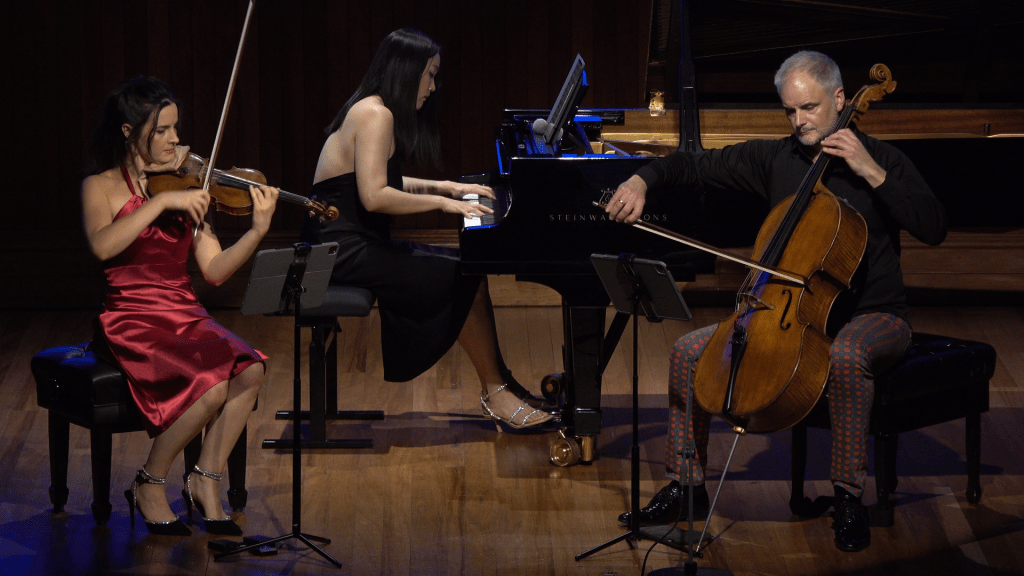
NZ Trio
Triptych 3: Untamed Hope
Auckland Concert Chamber
November 17
Reviewed by John Daly-Peoples
NZ Trio as well as being one of the finest groups of players in Australasia are also one of the most innovative and inspiring with their stimulating programmes. This was clear in their latest concert, “Untamed Hope” which featured four women composers from New Zealand, England, Germany and the USA with works spanning three centuries.
The title of the concert, “Untamed Hope”: probably alludes to the fact that at least three of the women were constrained in some way by the environments in which they began their musical careers. Their hopes of being able to be in the concert hall on equal terms with their male counterparts was largely tamed by that environment.
The opening work was English composer Ethel Smyth’s Trio in D minor, a work written when she was twenty-two having left the England to study in Leipzig. At the time she met many contemporary composers including Clara Schumann and Brahms.
The first movement could even have been written by Brahms, which was apparent in the sinuous playing of Somi Kim who was accompanied by delicate melodies from the strings. Initially violin and cello were in harmony with the piano but then their playing began to diverge, with each of the instruments developing their own musical themes.
Parts of the second movement seem to be based on a folk song (French or English) with theme passed between the three instruments, all suggesting a soulful introspection as well as displaying the composers sophisticated writing.
Third movement entitled “Leid” had many aspects of the “song without word” with hints of a Scottish dance melody played by Amalia Hall
The dramatic finale saw a long passage by the piano with the strings entering, playing a Hungarian-like tragic theme.
Eve Bedggood’s Ukiyo 浮世 –The Floating World relates to the Japanese concept of “the floating world” which evokes an imagined universe of wit, stylishness, and extravagance, a state which was often experienced through theatre, song, stories and pictures.
Bedggood says of the notion of “the simplicity of just existing and immersing yourself in the floating world or sense of calm is something I think music and other art forms can evoke”.
Much of the work had musical images of floating, flowing and meditation states with the work opened with dark rumbles from the piano suggesting sombre depths with strains of the violin and cello making interventions .
We heard exciting glissando from the Amelia Hall’s violon and careful, controlled repetition from Ashley Brown cello, while many of the sequences saw an almost minimalist backing with the scudding sounds of the strings hovering above.
The work was like a reverie, the various themes creating dreamlike images much like those of many Japanese prints of an earlier period.
The American Joan Tower’s “Trio Cavny” opened with some tingling high notes from the piano with the violin and cello responding with equally high-pitched sounds creating a taut musical mood. A following sequence saw Somi Kim creating crashing waves of sound leading to a tension between the three instruments which then played independently of each other before arriving at a point of intense harmonisation.
The music ranged from the soundtrack of a horror movie to a musical version of the Doppler Effect to the sounds of sympathetic voices in minimalist mediation.
The final work on the program was Fanny Mendelssohn’s Piano Trio in D Minor. It is a beautifully conceived work with the violin and cello flowing around the energetic displays of Somi Kim
Amalia Hall provided both a delicacy and sharpness with her playing, contrasting with Ashley Browns sedate cello.
The introspective and reflective second movement which opens with a romantic sequence from the piano contained elements of waltz tunes while the third suggested elements of German folk song.
In the final movement the three players displayed a vigorous drive and energy, beginning with some mesmerising playing by Kim before Hall and Brownjoined in creating an eloquent dialogue, leading to repeated motifs to end the work with an optimistic conclusion
The group announced that cellist Ashley Brown will be leaving the group to take an appointment as Principal Cellist with the Auckland Philharmonia Orchestra next year. He has been involved with the trio since its founding twenty-three years ago and his presence with the trio will be greatly missed.
 New Zealand Arts Review