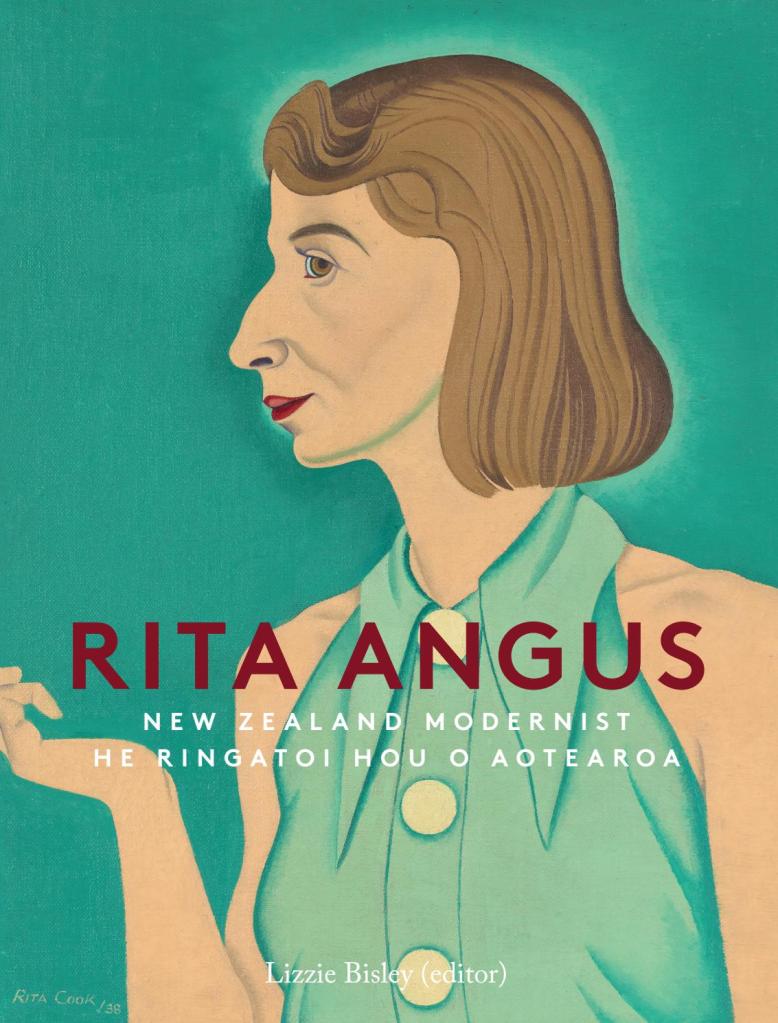
This year the Royal Academy in London was due to mount a major exhibition of works by Rita Angus but this was cancelled due to the Covid 19 pandemic. The Academy was heavily promoting the exhibition which was titled “Rita Angus: New Zealand Modernist.” She was described as an icon “inspiring generations of artists and admirers alike, her paintings broke away from the traditional art of the time, which was based on the European tradition and dominated by a nostalgic view of Britain. Instead, Angus developed a new visual style – with strong outlines and flat, unmodulated colour – that has come to symbolise the natural beauty and independent spirit of New Zealand.”
The show will now open next month at Te Papa (December 18 – April 25, 2022) with over one hundred portraits, landscapes and still life works.
Accompanying the show is an extensive catalogue edited by Lizzie Bisley, the Curator of Modern Art at Te Papa which is fully illustrated showing the range of her work and tracing the artists development in terms of subjects and techniques over a thirty-year period.
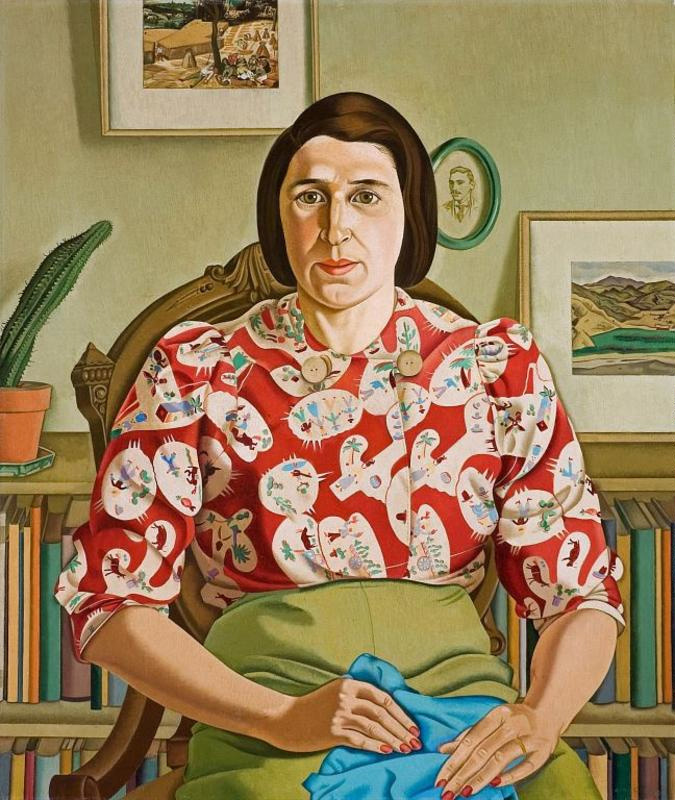
Rita Angus, Portrait of Betty Curnow
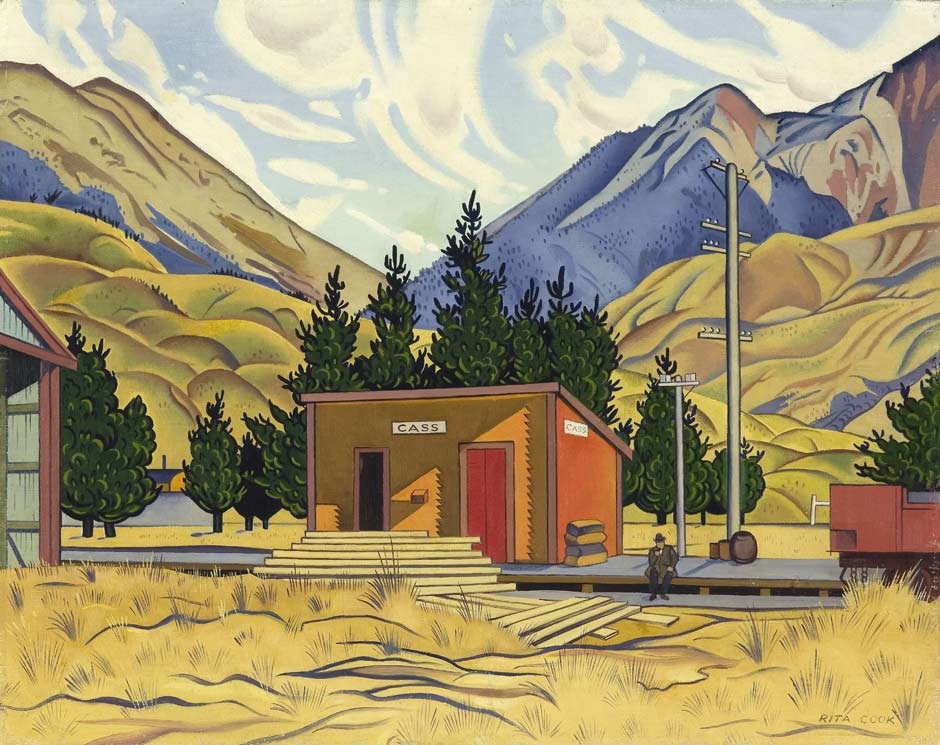
Many of the works in the show have become icons of New Zealand art – “Cass,” “Portrait of Betty Curnow” and” Fog Hawkes Bay.” Then there is her group of extraordinary portraits where she presents herself in various roles as goddess with such works as “Rutu.”
She was part of the Modernist cultural wave which developed in New Zealand in the 1940’s and 50’s. It was out of this period that some of the formative and seminal works of modern New Zealand art, literature and music emerged in Christchurch. As well as Angus there were artists such as Leo Bensemann and Colin McCahon along with poets, writers and musicians including Allen Curnow, Denis Glover, Ngaio Marsh and Douglas Lilburn.
These young artists assimilated the developments in style and technique that were occurring in Europe and America combining them with a local flavour, giving the country a new sense of nationalism.
There are several essays backgrounding the show with an introduction by Lizzie Bisley discussing Angus as a New Zealand modernist, a comprehensive outline of the artists life by Jill Trevelyan and a chapter placing the artist in an international context by Adrian Locke, the Chief Curator at the Royal Academy of Arts.
His chapter is of particular interest as he references a range of woman artists from the early and mid-twentieth century such as the Brazilian artist Anita Malfatti, the Indian artist Amrita Sher-Gil, Georgia O’Keeffe, Frida Kahlo and Emily Carr.
He makes a number of interesting points about Angus’s art from aesthetic, political and social perspectives.
Rita Angus, Cass
He notes that in Angus’s work “it is not the imagery of the indigenous communities that is central to the work but rather the tell-tale signs of a landscape inhabited and altered by European settlers. The key point here is that this new nationalist art, be it from Mexico, New Zealand, south Africa or the united States celebrated countries that no longer belonged to their indigenous inhabitants but rather to the descendants of colonisers.”
As well as the three major chapters there are several short personal reflections by a range of artists including Jennifer Ward-Lealand, Robin White, Fay Weldon and Gaylene Preston.
The catalogue and exhibition provide an understanding of those times as well as how Angus herself developed as a freethinking individual, pacifist, feminist and artist. The book explores her unique approach to art and the various threads of that work from the landscapes to the portraits.
Foenander Gallery, Mt Eden 14 November – 02 December
Reviewed by John Daly-Peoples
In 2018 Neal Palmer was the inaugural artist for the Karekare House residency provided by the Eden Arts Trust.
He has previously exhibited work from this period which he has continued to develop. His latest exhibition “On Track” at Foenander Gallery reflects on those original works which were intended as visual responses to walking and running the Hilary Trail on Auckland’s West Coast. Added to this his awareness of the issue of Kauri dieback has meant these new works have taken on a more urgent significance in response to the disease.
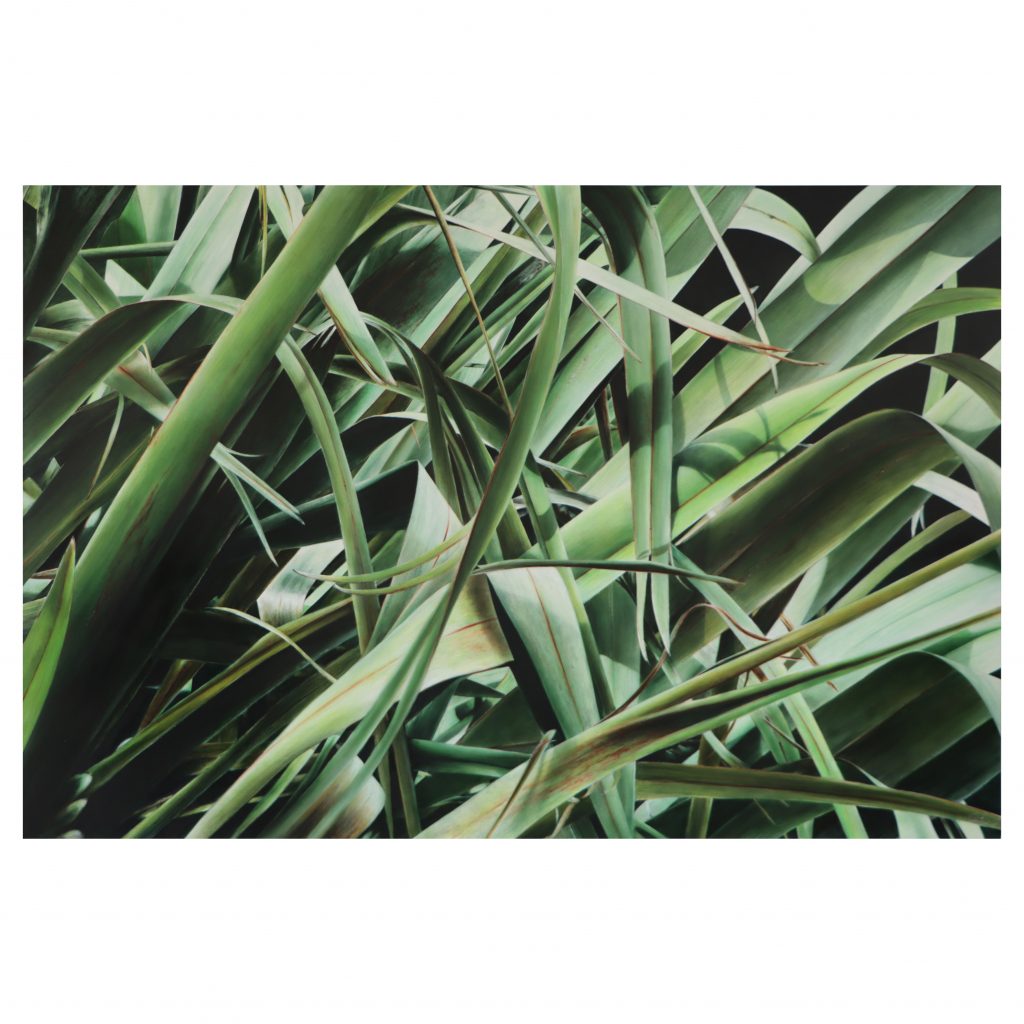
The resulting works include some of his signature paintings of flax such “Te Ahua” ($18,000) and “Northern Shadows” ($7800) with interwoven flax fronds creating images of the dense New Zealand bush. In these works there is an emphasis on the play of light on the fronds along with contrasting shapes.
Neal Palmer, Te Ahau
In others such as “Golden Returns” ($8500) there is a concern with the painterly process and the brushstrokes are more noticeable.
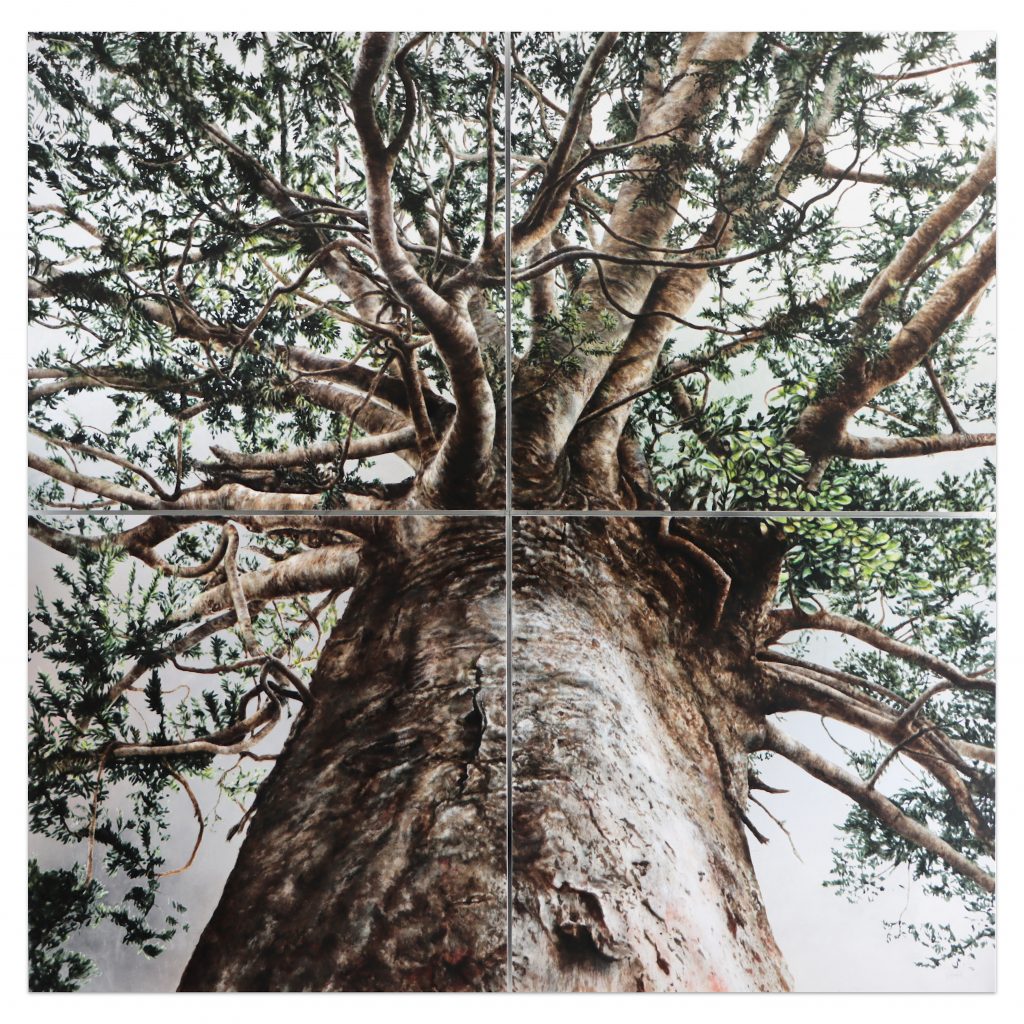
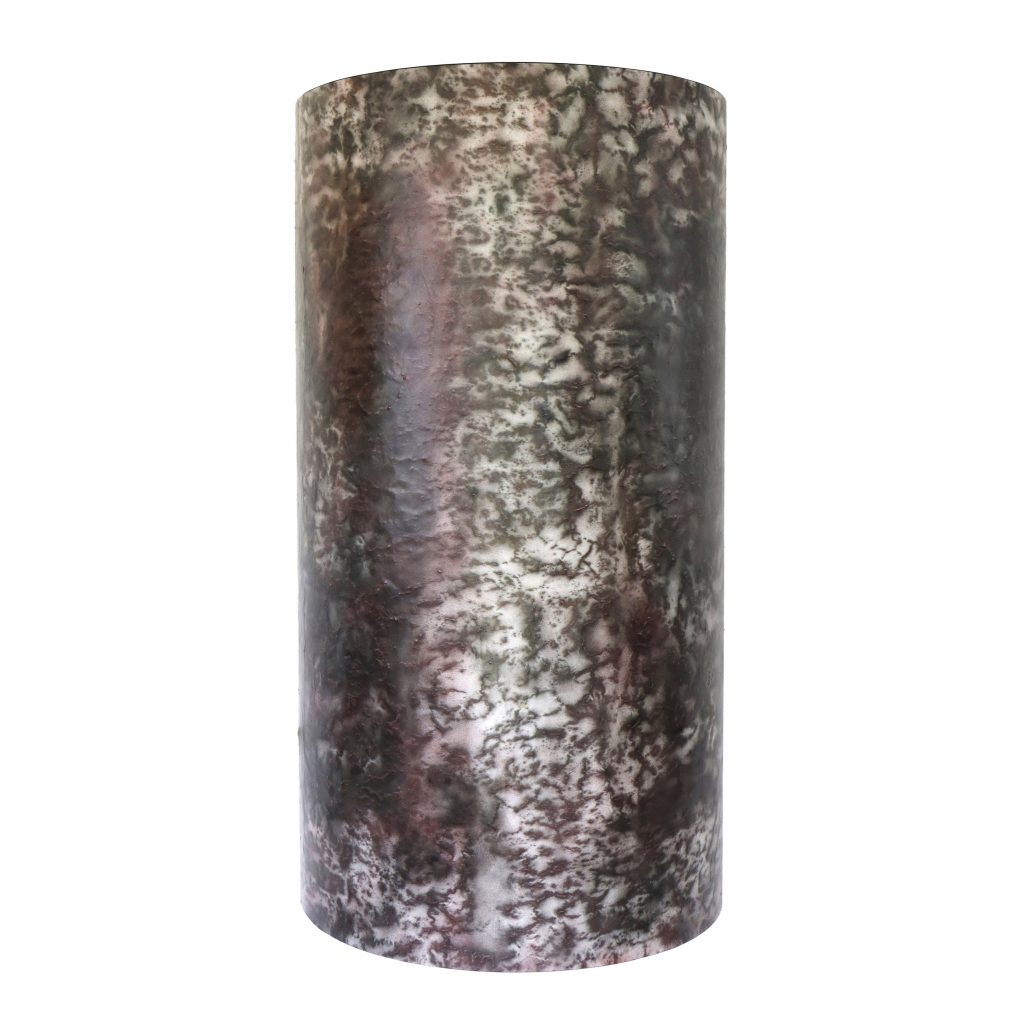
He includes a large, four panel painting of Tane Moana ($24,000), the largest kauri tree remaining on the East Coast, near Tutukaka. The worms-eye view of the trunk and crown providing a sense of the tree’s scale and grandeur. Another work based on a kauri is “On the Surface” ($6000) a frottage work where the artist has made a rubbing of a kauri, transferring the textures and shapes of the tree onto a curved panel.
Neal Palmer, On the Surface
There is a similar painted work with the tall “Worlds within Worlds” ($6000) where he has painted thetrunk and rings of a nikau. With this work and in “On the Surface” he has painted the trees as if they were at eye level presenting the view one would have when walking through the bush.
This notion of the walking though the bush is also seen in the almost abstract “Follow the Signs” ($1400) which depicts a triangular orange track marker fixed to a tree. This sign signifies more than merely indicating the trail becoming a metaphor for the new direction society needs to take in relation to preservation of the natural environment.
Neal Palmer, Follow the Signs
Two small works both titled ”Up Close and Personal” ($750) edge up to the abstract as well and are extreme close ups of foliage. One of them a slash of dark green against a greenish/white background while another possibly a section of coloured leaf against dark flax. They are both like sections taken from some of the artists larger works providing a sense of mystery.
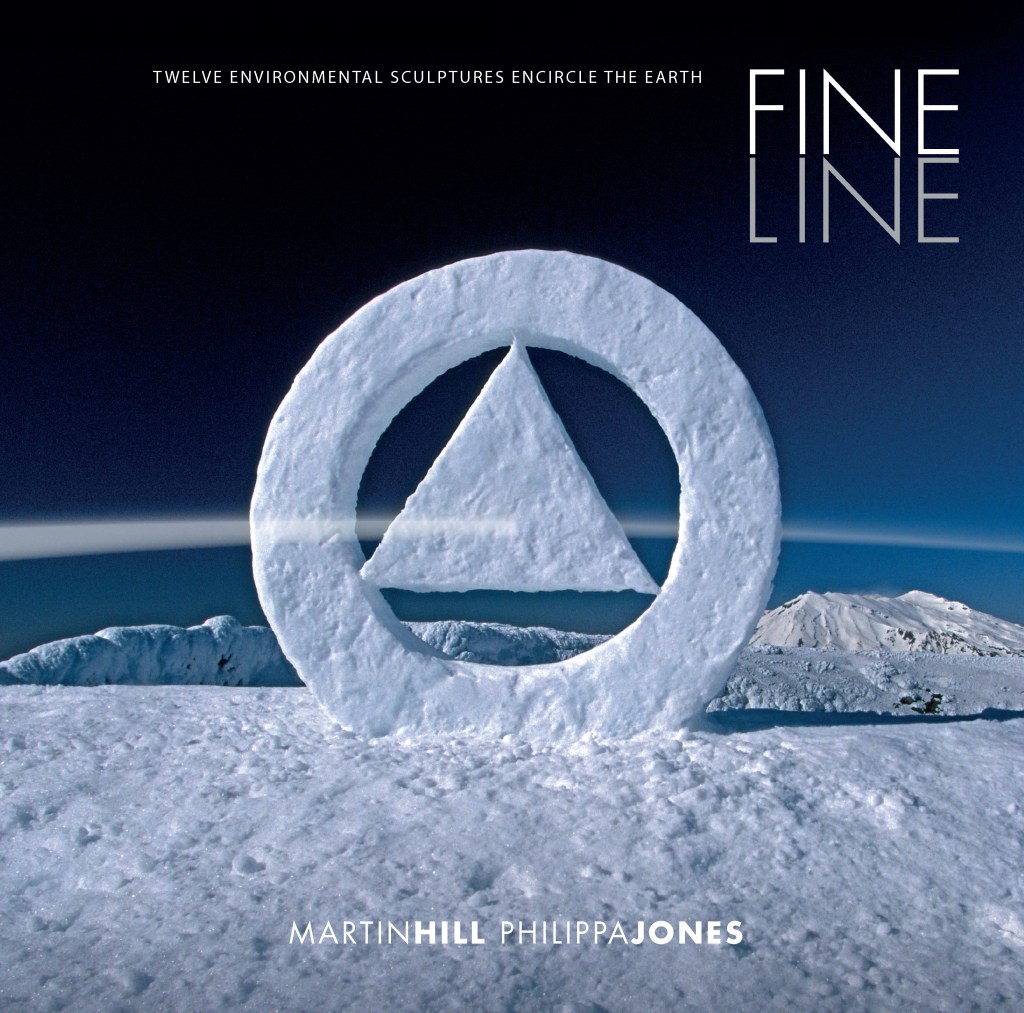
Fine Line: Twelve Environmental Sculptures Encircle the Earth
Martin Hill and Philippa Jones
Bateman Books
$69.99
Reviewed by John Daly-Peoples
Most New Zealanders at some time in their lives engage in the practice of Land Art or Earth Art. This normally involves making sandcastles or other constructions at the beach. These temporary sculptures sometimes simple, at other times elaborate will normally last for a few hours before being washed away. For that short time they become metaphors for man’s futile attempts to control Nature while making us aware of the daily cycle of the tides.
This practice of making art out of materials which are part of the landscape has been going on for millennia as the various standing stone sites around Europe attest to. The more recent practice has seen artists such as Robert Smithson with his “Spiral Jetty” where he constructed a koru-shaped jetty of rocks protruding into the Great Salt Lake in Utah. Andy Goldsmith has created a number of Land Art works both permanent as in his “Arches“ at the Gibbs farm as well as more ephemeral works.
New Zealand artists Martin Hill and Philippa Jones have been creating Land Art works for the past thirty years both in New Zealand and internationally with permanent records of their work available as photographs or in their many publications.
Their latest publication “Fine Line” extends their work with the documentation of their most ambitious and impressive project.
It stems from a concept or vision that Hill had twenty-five years ago where he envisaged “A symbolic line drawn around the Earth touching at a series of twelve high points.”
To achieve this goal the pair have visited twelve elevated sites around the world, made their ephemeral sculptures, photographed them and then left them to return into the environment.
The sculptures were made from natural materials found at each site, enduring only in the mind (and in photographs) as an artistic evocation of the temporary and interconnected nature of life.
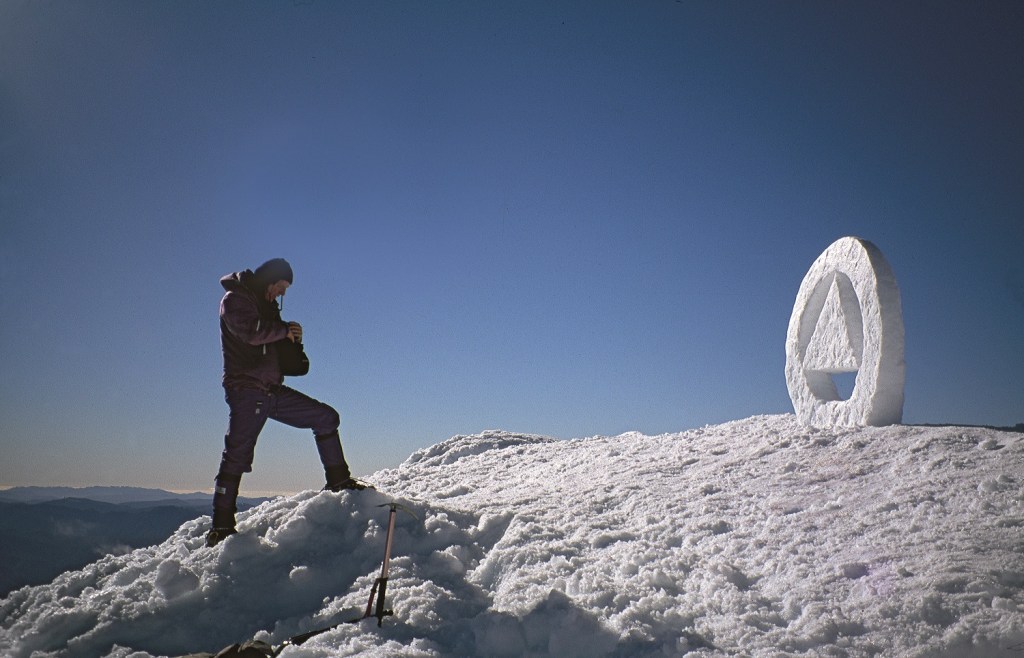
Martin Hill with Ngaurahou sculpture
The places they visited included New Zealand, The Antarctic, Madagascar, Kenya, Switzerland, Scotland, Vanuatu, Iceland, the USA and Canada.
The first of the visits was to Ngauruhoe in 1997 and the final one to Ruapehu in 2019 with the other ten sites visited between those years. The whole project was not consecutively photographed but were visited every one or two years.
While some of the locations were not much over sea level with Mt Yasur in Vanuatu at 361m others tested their climbing ability with Mt Kenya at 4580m.
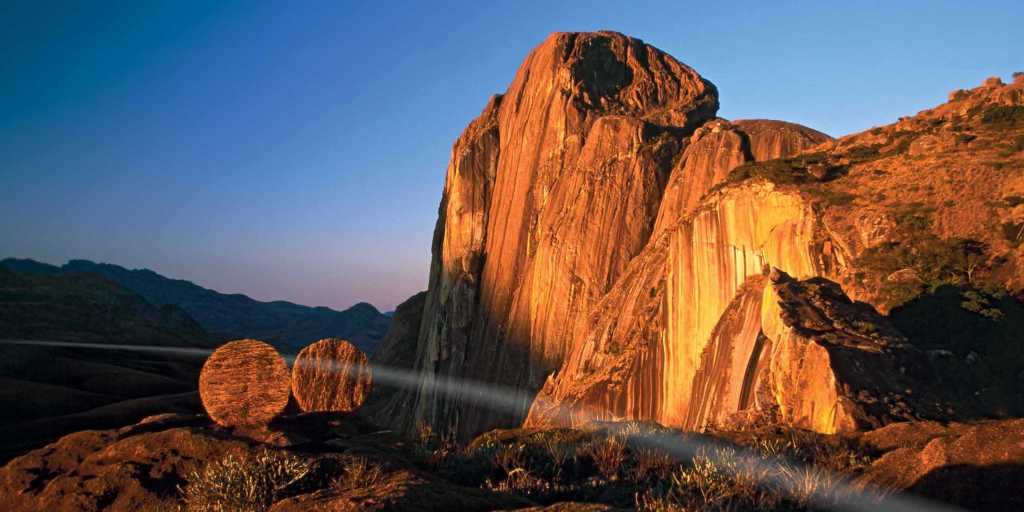
Karambony Climb, Madagascar
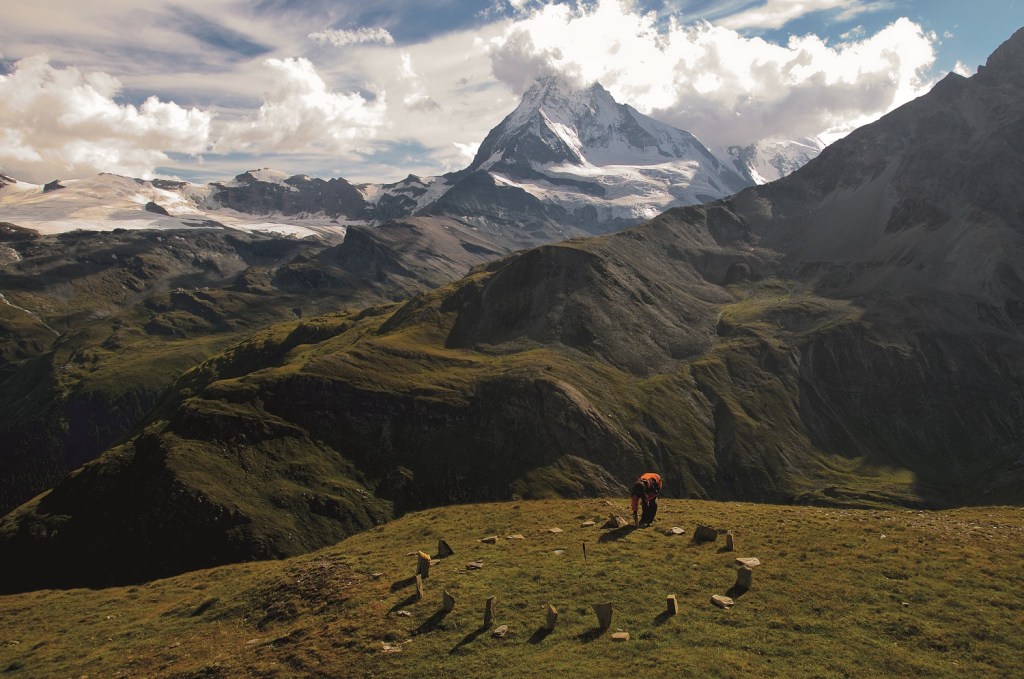
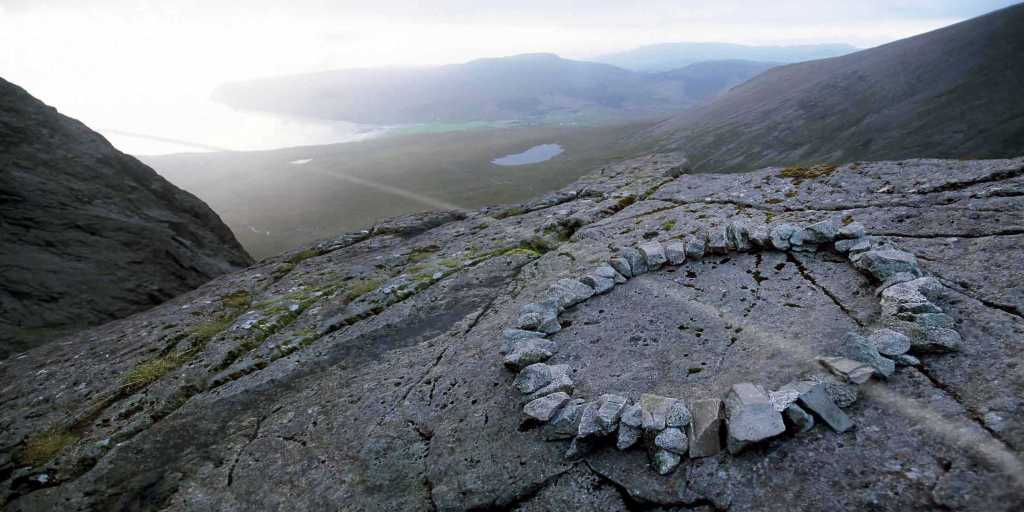
The works are circular either discs, inscribed circles or spheres. The shapes on Ngauruhoe, Ruapehu and Pigeon Spire in British Columbia were circular forms made of compacted snow, the works in Switzerland and Scotland made with rocks from the site while the works on Mt Yasur and Madagascar were constructed of foliage taken from the foothills and carried up the mountain.
Zermatt, Switzerland
The circular forms reflected the two artists concern about the cyclical nature of environmental activities and expresses the age-old notion of the circle of life. Linking these circular motifs together is the hypothetical line they have imagined which links the twelve works and in each of the “final” photographs this nebulous line is imprinted, passing through the centre of the sculptures.
The works have a familiarity with their own previous Earth Works and those of others such artists with the circle of rocks on Cioch Pinnacle in Scotland like an Andy Goldsmith work. Some other have connections to New Zealand art notably the koru form made on Half Dome in Yosemite. The Madagascar work has an affinity with the found circular constructions of Meryn Williams and the circular snow works with the art of Max Gimblett.
Isle of Skye, Scotland
The book documents the works the pair created as well as the amazing landscapes they worked in with over 200 remarkable photographs. Hills photographs capture the essence of the sculptures, the spectacular landscapes as well as the showing the difficulties of navigating to their spectacular locations. Among the dramatic photos are images of the active volcano My Yasur, the eerie landscape of Iceland and the precipitous Yosemite location.
The photographs are accompanied by the couples’ thoughts on their endeavours as well as essays by international specialists in systems theory, climate science, fine art photography and regenerative design which further elaborate on the artists’ ecological philosophy. The wide range of issues and activities the book touches on means it will appeal to artists, mountaineers, scientists and environmentalists.
Much has been made recently about what constitutes New Zealand culture, the intersection of Māori, Pacific and European experiences which has formed our contemporary multicultural society.
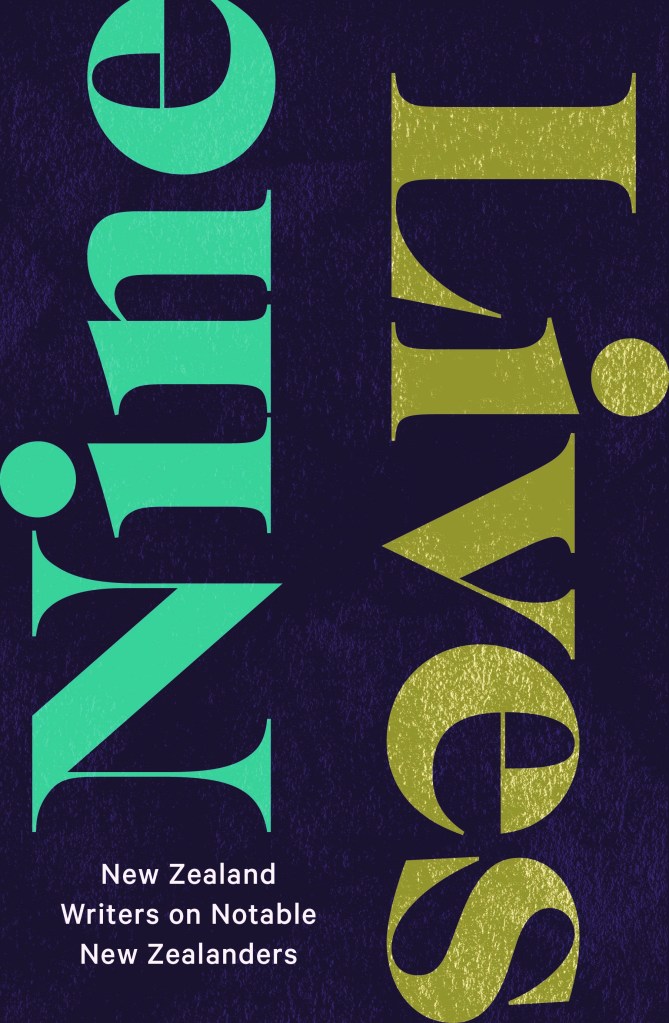
Part of the impetus behind these changes are people who make a difference and the new book “Nine Lives” examines the lives of nine people who have have helped reshape our culture.
The book provides something of an encapsulation of New Zealand cultures telling the reader as much about the ways that contemporary New Zealand has been formed as about the people who have made that happen.
These nine personalities range from the internationally famous to those who known only within their own areas of expertise or experience and the writers include some of our most distinguished novelists, poets and playwrights.
In the nine chapters the writers encounter, examine and reflect on the lives of nine others . Lloyd Jones on Paul Melser (potter), Paula Morris on Matiu Rata (politician), Catherine Robertson on Dame Margaret Sparrow (doctor and health advocate), Greg McGee on Ken Gray (All Black), Stephanie Johnson on Carole Beu (bookseller), Malcolm Mulholland on Ranginui Walker(academic), Selina Tusitala Marsh on Albert Wendt (writer), Elspeth Sandys on Rewi Alley (writer and activist), and Paul Thomas on John Wright (cricketer).
In his chapter on the potter Paul Melser Lloyd Jones quotes Goethe – “Try to do your duty and you will find out who you are … what matters is the manner in which one does the work.” It’s a quote which is relevant to all the characters in the book – people who attempt to make a difference.
In some cases the writers have close ties to their subject as with Elspeth Sandys who writes about her “uncle” Rewi Alley and the ambivalence she had concerning her communist relative, despised by many New Zealanders but revered by millions of Chinese for his work in improving the lives of the population. We learn about her family dynamics, her own life as well as the life of Alley himself.
One of the most personal and emotional accounts is that of Catherine Robertson on Dame Margaret Sparrow which opens with her first encounter with doctor – “After my twenty-first birthday and before the advent of seven-digit phone numbers, I was given a local anaesthetic and a foetus was aspirated out of my womb. The abortionist was Dr Margaret Sparrow.”
Her chapter on combines the life of Sparrow along with a short history of the development of abortion law reform in this country.
Greg McGee writing about the All Black Ken Gray recounts their parallel lives in playing the game. He dwells on the Gray’s personal life as well as the political dimensions of the game around tours to South Africa and the man being ostracized by the rugby establishment over his stand against apartheid.
Stephanie Johnson writing about Carole Beu of the Women’s Bookshop shows how chance and vision combined with the changes brought about by the women’s movement resulted in an iconic bookshop and a remarkable bookseller.
Selina Tusitala Marsh first encounters with Albert Wendt in her under-graduate years at Auckland University and she admits “I didn’t like him. In my New Zealand Literature course he was austere, distant, and seemed to me to be just plain ole grumpy.” But through personal and academic encounters with the writers she later notes ”I’ve never thought of Albert Wendt first or even foremost as a literary giant. For me he’s a political giant.” Her chapter explores the importance of Wendt as a great writer of Pacific literature but also as a person who has helped transform much about the Pacific politically and socially.
All the writers manage to skilfully weave their subjects lives and their own together along with events and encounters which have changed lives and histories in creating the fabric of New |Zealand culture.
NZ Sculpture OnShore which is the country’s largest outdoor sculpture exhibition opened this week with its organisers committed to raising $100,000 for Women’s Refuge.
Lockdown restrictions due to COVID-19 have meant that the exhibition, now in its 25th year will not be held at O Peretu / Fort Takapuna. Instead, they have created a new online platform to view and purchase the more than 200 works.
The online site also calls for Kiwis to support women and children fleeing domestic violence by donating to their Woman’s Refuge Givealittle campaign. This year, donations will go towards ‘Kids in the Middle’, an initiative to create safe, comforting and creative spaces for children staying in each of the Refuge’s 40 safe houses.
NZ Sculpture OnShore’s Board Chair Sally Dewar says, “The impact of this global pandemic has hit many of our local communities hard; more New Zealand women and children than ever before are fleeing from dangerous situations. There are few things more important than helping children feel safe and secure after experiencing trauma, and so we are determined to support Woman’s Refuge’s Kids in the Middle project.
“If you’re one of the tens of thousands of people who would usually buy a ticket to NZ Sculpture OnShore, please go online today and give generously to this important cause. If you’ve not been to the exhibition before, this is a great opportunity to do so,” says Ms Dewar.
Event curator Sally Lush says of this years event “The works are by emerging and established artists from around New Zealand, with a mix of crowd favourites who have exhibited at previous events, and others offering fresh and exciting new perspectives,”
“There are quirky and thought-provoking works, soaring monumental sculptures, sound and light art works and sight specific installations. Also, there will be many accessible works specifically for adding that special touch to home gardens.”
Jeff Thomson, “Mesh 4”
Included in this year’s exhibition are popular artists Jeff Thomson who has created several “model” houses made of steel mesh such as “Mesh 4” ($5000) which he says “ came about through my love of models which I create for both private and public sculpture proposals. My father Tiger spent 30 years building model boats, his commitment, patience and skill has always been a huge inspiration for me as a sculptor”.
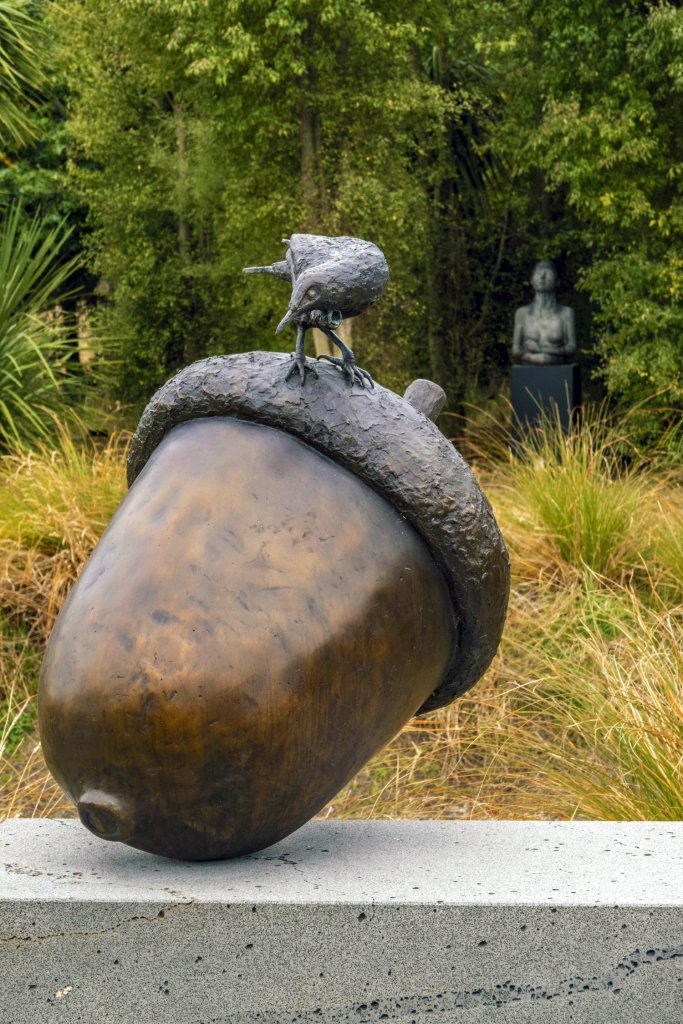
Fiona Garlick, “Off Balance”
There are realist sculptural works such as Fiona Garlick’s “Off Balance” ($29,000) featuring a tui perched on an oversized acorn. “The work is part of a body of work called Charming Invaders that has been occupying me as an artist for several years. She sees this as addressing the tension between introduced and native species of flora and fauna. “The work is intended as homage both to our native Tui and to the trees, plants and people who have come to New Zealand” from all over the world. But mostly it is a comment on the more serious issue of non-native species in our environment.”
John Dwyer, “Metallic Magenta”
There are also more abstract works such as Johl Dwyers “Metallic Magenta” ($3450) of which he notes “There is an interest in light-based colour and pigment-based colour, specifically when these two properties intersect – how we are increasingly experiencing colour in a light-based virtual space as opposed to a physical space, such as on a screen or device instead of in an artwork.”
Chauncey Flay, “Parliament House Structure I”
Taranaki artist Chauncey Flay’s “Parliament House Structure I” ($28,000) is literally made out of pieces of Takaka marble removed during earthquake strengthening of the Beehive, New Zealand’s Parliament building.
Julie Moselen’s “Unity” ($12,800) was inspired by and explores the duality of the Masculine and the Feminine, and through the unification of these two elements, harmony and balance are created. Steeped in symbolism relating to Mother Earth, and Sky Father, The Sun and the Moon, birth, death and rebirth, this curvilinear form (feminine) created from cold hard steel (masculine) takes on an elegance and grace where both softness and strength are present. The earthy rusted patina is evocative of the passing of time and represents the ever present need for equality between men and women in society.
Steve Molloy’s notes about “The Ripple Effect” ($13,000) that “The story of this piece is about the ripple effect of our words and actions, and how they can have a major influence over others and their future. We must be mindful of what it is we put out into society as we do not truly know the full consequences of where such a simple action will end.”
Also showing are Ramon Robertson and Susan Dinkelacker along with mother and son team Trish and Sean Clarke as well as father and son James and Jorge Wright.
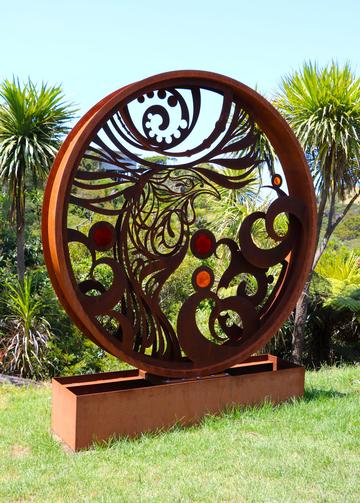
The event also reflects New Zealand’s indigenous and multi-cultural heritage. Shane Hansen (Tainui, Ngāti Mahanga, Ngāti Hine, Chinese, Danish and Scottish descent) is showing “Te Tūi Kaitiaki” ($45,000).
Shane Hansen,“Te Tūi Kaitiaki”
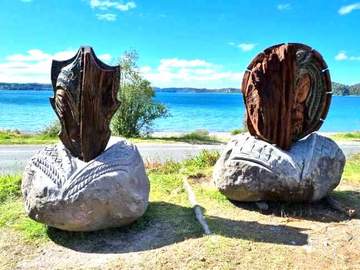
Master carver Joe Kemp (Ngai Tahu, Ngāpuhi and Te Arawa (Ngati Makino) is showing “Hinerau raua ko Tanerau” ($95,000) in swamp totara and Taranaki andesite.
Joe Kemp, “Hinerau raua ko Tanerau”
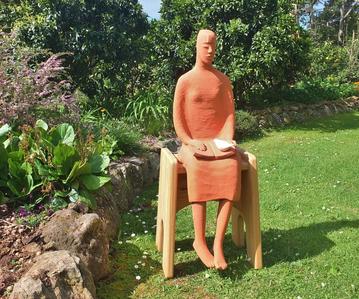
Jin Ling who taught art in China before migrating to New Zealand 20-years ago is showing “Reader” ($4200) which is one of her striking, life sized, ceramic works depicting women at peace.
Jin Ling “Reader”
Since inception, Sculpture on Shore has raised more than $2.1M for the victims of domestic violence, helping women and children access safe places to stay, counselling and wrap around services.
Thomas de Mallet Burgess with Joanna Foote and Bridget Costello at Wynyard Wharf
Opera on the Harbour “Carousel”
New Zealand Opera
Wynyard Wharf
February 11 – 14
John Daly-Peoples
Next year’s Valentine’s Weekend a concert version of Rodgers & Hammerstein’s classic musical “Carousel” will be performed on the water at Wynyard Wharf.
This will see New Zealand Opera joining companies around the world which have been experimenting with new ways to attract audiences, expanding their repertoires and staging works in novel environments.
One of the major developments which has occurred over the past few years has been the presentation of musicals such as “My Fair Lady”, “South Pacific” and “Phantom of the Opera” sharing the main stage with traditional opera.
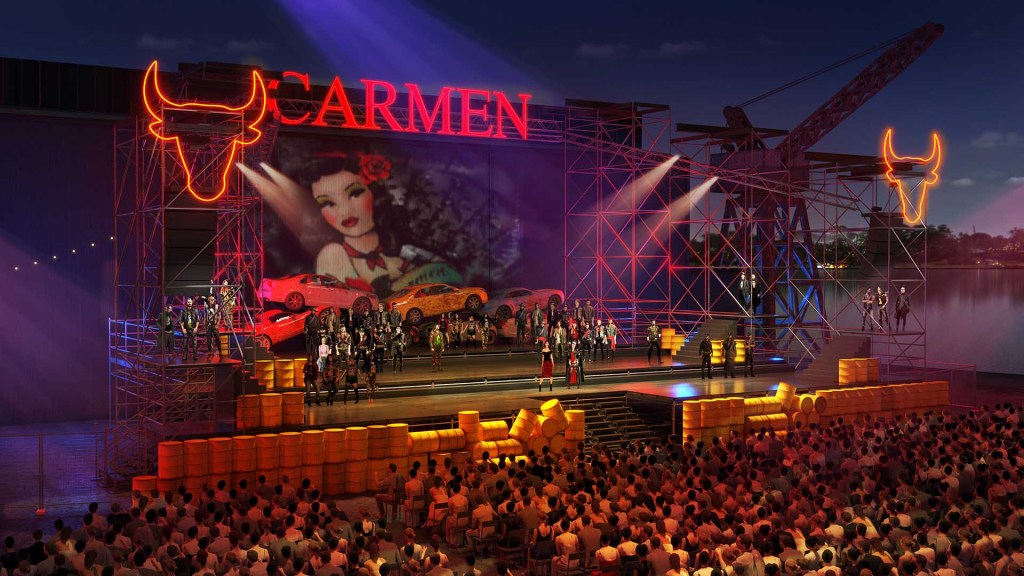
Carmen at the Bregenz Festival
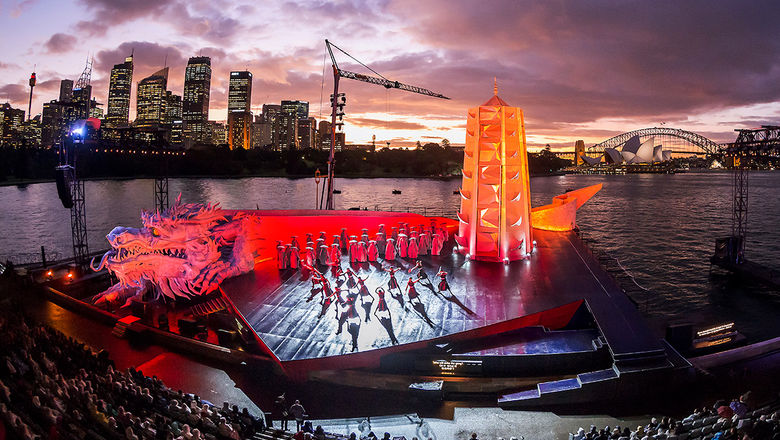
Another innovation has been the staging of productions on the water. The annual Bregenz Festival which has been going since 1946 features a floating stage on the shores of Lake Constance. It has a 7,000-seat open-air ampitheatre and features extravagantly original and innovative productions.
Opera Australia has also mounted successful programmes with the Handa Opera Seasons on Sydney Harbour which has been running for ten years. They have staged many of the classic opera such as Aida, Turandot and Carmen.
In 2019 they had their most successful season with “West Side Story” which attracted an audience of 65,000.
Handa Opera’s “West Side Story”
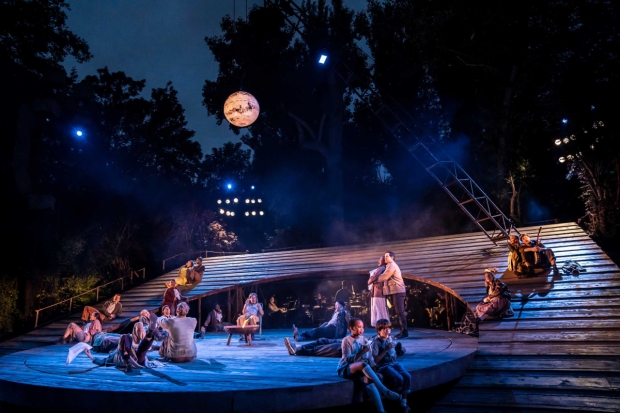
NZ Opera will be hoping their new venture will help kick start the company after a couple of bumpy years. The popular work has just finished a season at the Regent’s Park Open Air theatre in London where the production exposed thegender politics and misogyny of the work to emphasise the current stare of domestic violence in the UK.
“Carousel” at Regents Park
NZ Opera General Director Thomas de Mallet Burgess says, “This will be a spectacular experience for audiences – a first-of-its-kind opera event on Waitematā Harbour with a purpose-built stage and seating area. Broadway will meet opera in a world-class outdoor setting at the height of summer’s long, warm evenings, introducing what we expect will become a favourite annual show in the Auckland summer events calendar.”
“Carousel” was the second musical composed by Rodgers & Hammerstein and while the work seemingly has at its heart the traditional American fair it was actually an adaptation of Hungarian Ferenc Molnar’s 1909 play “Liliom” with its Budapest setting transferred to Maine.
The story tells of carnival barker Billy Bigelow and mill worker Julie Jordan who fall in love. After their marriage ends things go downhill driving Billy to commit crimes and he falls in with con-man Jigger Craigin. He gets caught in the midst of an armed robbery and takes his own life. Billy is allowed to return to earth for one day 15 years later where he encounters Louise, the lonely daughter he never knew.
The show which Richard Rodgers said was his favourite of all his musicals and which TIME magazine called “the best musical of the 20th century”, has some notable songs including “if i Loved You”, “June Is Bustin’ Out All Over”, This Was a Real Nice Clambake” and “You’ll Never Walk Alone”.
The cast will include Christian Thurston as Billy, Joanna Foote as Julia Jordan and Bridget Costello as Carrie Pipperidge.
The production will be directed by Jacqueline Coats and conducted by Paul Christ with costumes designed by Elizbeth Whiting.
Opera Australia has announced its 2022 season which will offer New Zealand audiences the opportunity to see some world class opera productions without having to get to Europe.
Hopefully fully vaccinated, Covid passport carrying New Zealanders will even be able to make it to one of the company’s first productions which will open on New Year’s Eve. Audiences will have a choice of two major production, one at the Sydney Opera House, the other on Cockatoo island in Sydney Harbour.
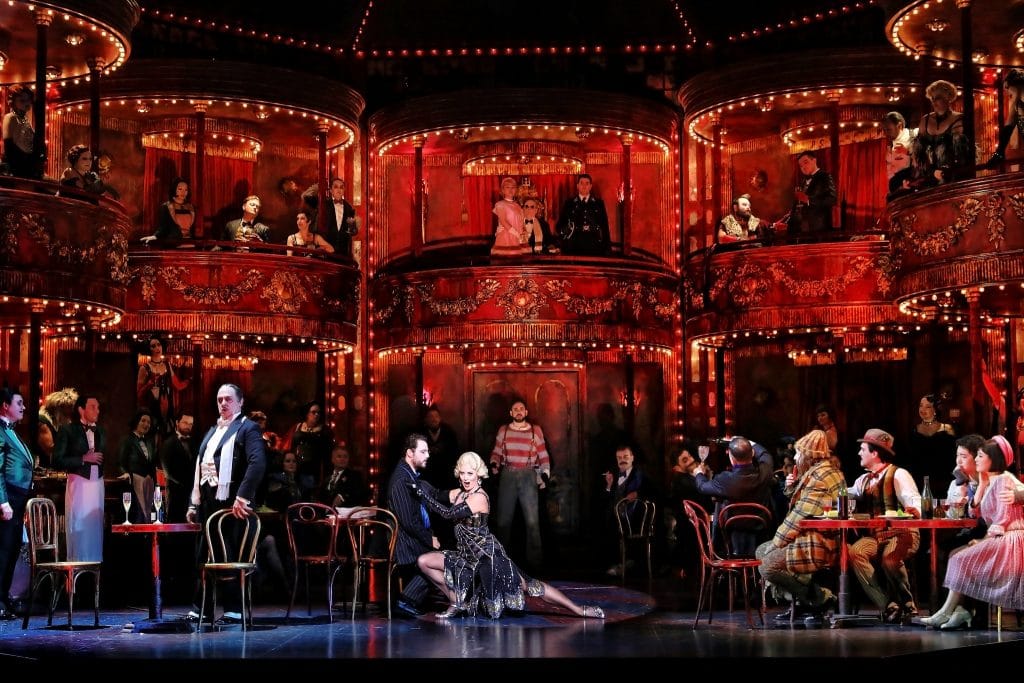
At Sydney Opera House’s Joan Sutherland Theatre will be a revival of Gale Edwards’s production of Puccini’s La Boheme set in 1930s Germany which first premiered in 2011. Tickets are from $250 as well as the pre-performance dinner at $399 or entry to the post performance Midnight Party ($349). There is also the Platinum Package at $1,422 which includes the performance, Pre-performance dinner and midnight party.
The really big show will be the Opera Gala on Cockatoo Island which will feature some of the country’s finest performers for a two-hour concert of opera classics with singers including Stacey Alleaume, Natalie Aroyan, Chanyang Choi, Diego Torre and Luke Gabbedy. Tickets include pre-booked ferry transfers and a ticket to the performance with the option of adding a 3-course pre-performance dinner ($499), interval drinks and the post-show midnight party ($419).
With both shows the interval will be timed to coincide with the 9pm fireworks display on Sydney Harbour Bridge.
The La Boheme production will feature Italian soprano Valeria Sepe playing Mimi with Australian-Chinese tenor Kang Wang as Rodolfo.
In January Graeme Murphy’s production of Puccini’s Turandot will feature American soprano Lise Lindstrom sharing the role with Australian rising star Anna-Louise Cole, alongside tenor Yonghoon Lee and soprano Karah Son, both from South Korea.
Sir David McVicar’s acclaimed production of Mozart’s The Marriage of Figaro opens at the end of January with Italian baritones Mario Cassi as the Count and Tommaso Barea as Figaro, alongside Russian soprano Ekaterina Morozova as the Countess and Australia’s Stacey Alleaume as Susanna.
February will see Harry Kupfer’s production of Verdi’s Otella which was originally going to be staged this year. It will feature Yonghoon Lee as Otello, Karah Son as Desdemona and Italian baritone Marco Vratogna as Iago,
In March, comes a co-produced with Opéra de Lyon of Fromental Halévy’s La Juive. The work premiered in 1835 and is the story of an impossible love between a Christian man (Diego Torre, )and a Jewish woman (Natalie Aroyan). This production which is set in the 1930’s has been seen as a plea for religious tolerance as well as having contemporary connections to The Holocaust.
Also in March there will be a concert version of Donizetti’s Maria Stuarda – its first ever, with Russian soprano Olga Peretyatko, Romanian soprano Carmen Topciu and Shanul Sharma.
Then In June there will with Graeme Murphy’s Madama Butterfly South Korean soprano Sae-Kyung Rim will play Cio-Cio San, with South Korean mezzo-soprano Chanyang Choi as Suzuki and Italian tenor Ivan Magrì as Pinkerton.
July sees a new digital production of Verdi’s Il Trovatore, directed by Davide Livermore, who has previously produced Aida and Anna Bolena using LED screens. Yonghoon Lee plays Manrico, with Leah Crocetto as Leonora, Elena Gabouri as Azucena and Belarussian baritone Maksim Aniskin making his debut as the Count di Luna.
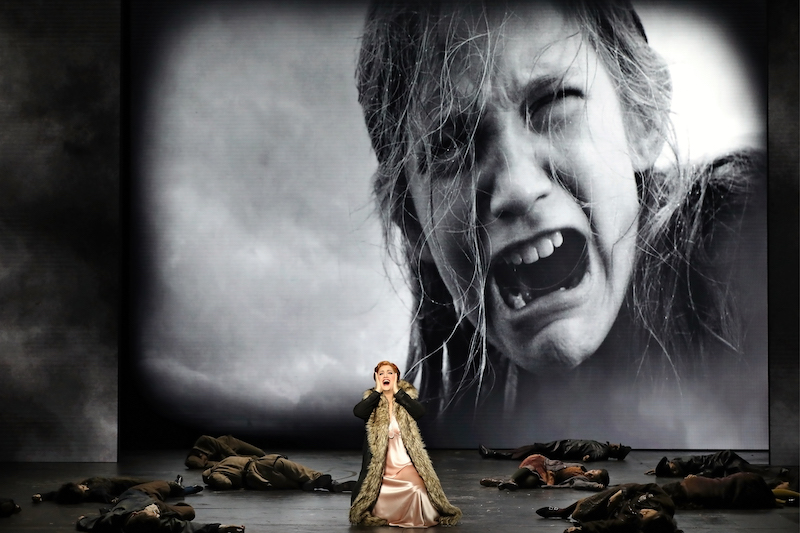
Attila
October brings Verdi’s Attila with Russian bass Ildar Abdrazakov. The company will be hoping for this being third time lucky. The production premiered in March 2020 but had to close after two performances. Rescheduled in 2021, another Covid lockdown saw it being postponed again.
For a month from March 25th the Handa Opera on Sydney Harbour will be a new production of Andrew Lloyd Webber’s blockbuster musical The Phantomof the Opera, directed by Simon Phillips.
There will also be Cameron Mackintosh’s new production of Phantom which will be on at the Sydney Opera House from August 19 and at the Arts Centre Melbourne from October 30.
The 2022 season also includes Rodgers & Hammerstein’s Cinderella which will be on at Sydney’s Lyric Theatre in October. There is also a new outdoor event called Opera on Cockatoo Island, for which Liesel Badorrek will create a new production of Carmen, custom-built for the site.
Carmen
The Melbourne Autumn Season opens in May with Elijah Moshinsky’s production of La Traviata and Olivier Py’s production of Wagner’s Lohengrin
The Melbourne Autumn Season also includes a concert version of Boito’s Mefistofele, conducted by Andrea Battistoni and directed by Matthew Barclay, with Italian bass Ferruccio Furlanetto as Mefistofele, Diego Torre as Faust and American soprano Leah Crocetto as Margherita.
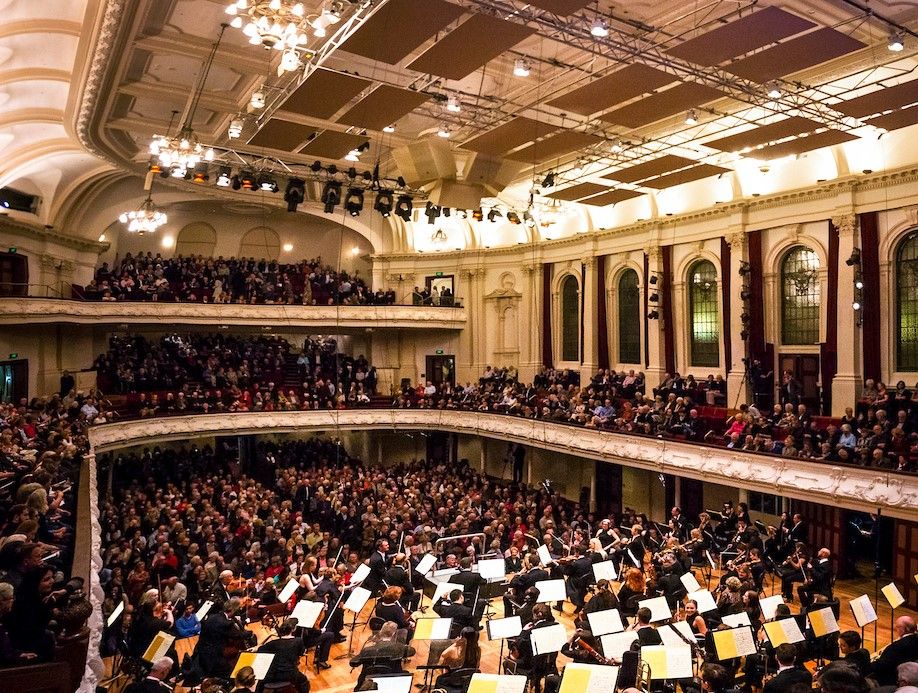
The Auckland Philharmonia Orchestra’s 2022 Subscription Season which has just been announced features forty-four performances across ten venues. It is an impressive schedule given that these performances are in addition to the extensive community, schools and outreach projects. The programmes offer a balance between exciting new works and major masterpieces with local and international talent.
Barbara Glaser the Chief Executive of the APO says “For next year’s programme we have done some risk assessment in how we plan the season. So, in the early part of the year we have Giordano Bellincampi who has a critical worker exemption status who will be returning to conduct as well as New Zealander Geneva Lewis. Also, at the start of the year we have some of our local soloists like Jonathan Cohen, our Principal Clarinettist.”
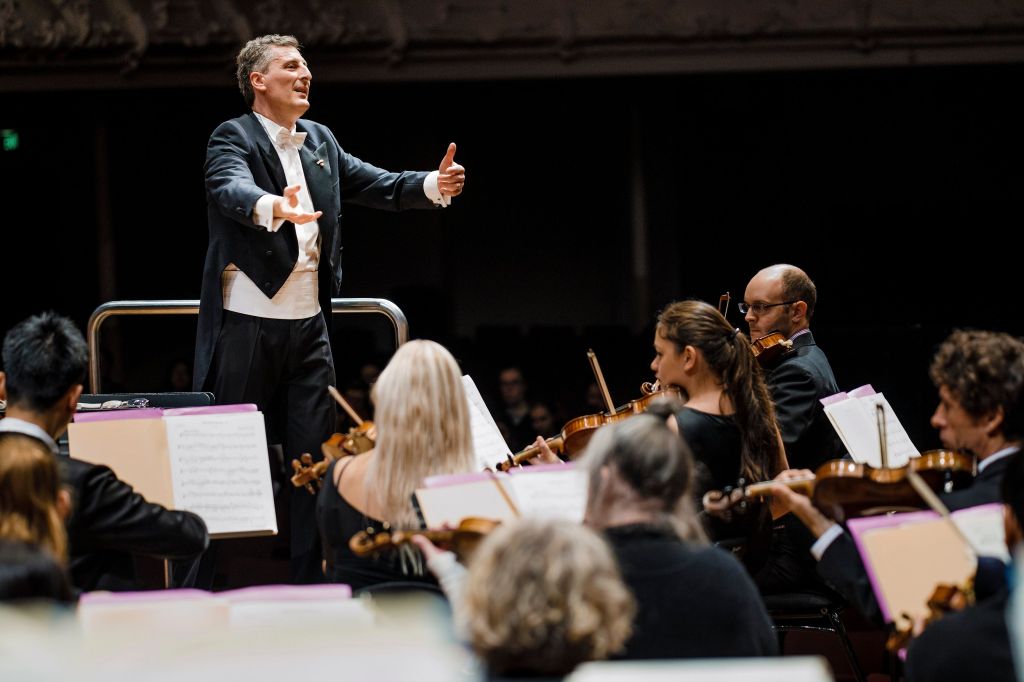
Giordano Bellincampi
“Then for later in the year we decided we would take the risk and assume open borders and have an international artist season.”
In this year’s programme there is a full range of nineteenth and twentieth century symphonic works. The major work will be Bruckner’s “Symphony No 4”, the composers most accessible and coherent work. Also drawing on the nineteenth century will be Tchaikovsky’s “Symphony No 4”, Brahms “Symphony No 4” and Schuman’s “Symphony No 4”.
Twentieth century works will include Rachmaninov’s “Symphony No 2”, Walton’s “Symphony No 1”, Martinu’s “Symphony No 6” and Strauss’s “Alpine Symphony”. The Strauss work which has previously featured a few times in Auckland concerts is an extraordinarily evocative and detailed work celebrating a day’s climbing in the Alps and was inspired by Strauss’ own walks in the mountains and his love of nature.
There is also New Zealander Douglas Lilburn’s “Symphony No 3” which was among the composers last purely acoustic compositions.
Glaser notes that “We have probably got a few more New Zealander artists across the season than we would have had pre- Covid. Those dozen kiwis show that we have a richness of local talent.”
“Orchestras in general operate in an international environment and our audiences have been exposed to a lot of local artists but in the long term we will move back to having a balance of international and kiwi musicians.”
Also providing a New Zealand dimension to the programme will be a major new work from award-winning composer Victoria Kelly. Her “Requiem” uses the poetry of Bill Manhire, Sam Hunt, Chloe Honum, Ian Wedde and James K Baxter, and is inspired by the visual language of photographer, Anne Noble. Kelly has composed for film and television with soundtracks for: “Under the Mountain” and “Out of the Blue”.
Then in June for Matariki, the APO and Rob Ruha will provide night of music, kapa haka performing works such as “I Te Pō”, “Ka Mānu” and “Kalega”.
There are a number of major violin and piano concertos on offer including performance of Mendelssohn’s “Violin Concerto”, Dvorak’s “Cello Concerto” and Shostakovich’s “Cello Concerto.”
Glaser is looking forward to a number of the works on offer for next year. “Any time Giordano is on the podium is a highlight for the orchestra and the audiences. He has developed a really lovely rapport with both the musicians and our audiences. I am particularly looking forward to hearing the symphonies of Bruckner, Brahms and Tchaikovsky. The Tchaikovsky in particular because it was that concert we had to close down at the last minute when there was a Covid outbreak in the Auckland CBD. That concert is going to be a really emotional event.”
Music Director Giordano Bellincampi will take the podium for the opening performance on Thursday 17 February and will be joined by Auckland born violinist Geneva Lewis in her official NZ debut playing Mendelssohn’s “Violin Concerto”.
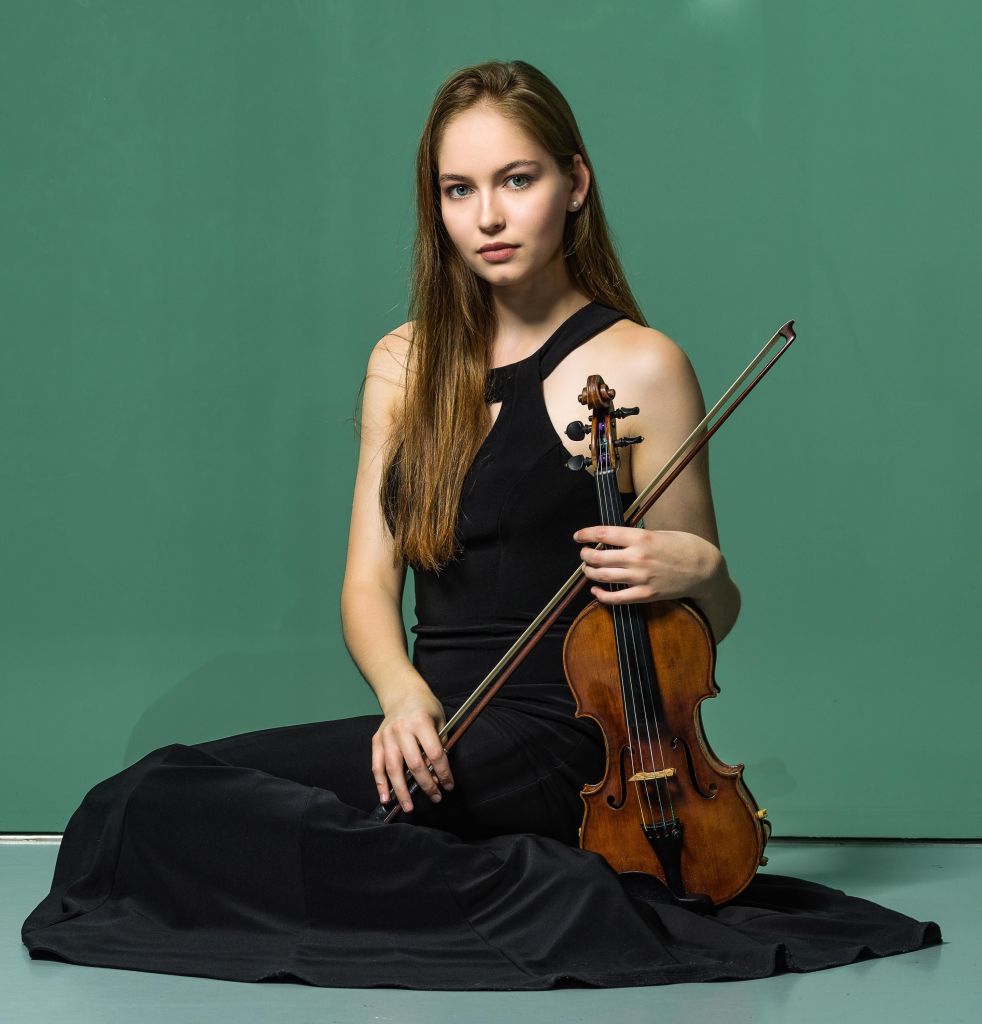
Geneva Lewis
As the daughter of legendary kiwi tennis champion Chris Lewis, US-based violinist is currently rated as one of the most exciting young players performing on the international circuit. She gained early chamber music fame as a member of the renowned Lewis Family Trio with her siblings and she made her solo debut with the Pasadena Symphony at the age of eleven. She has already played at the Concertgebouw in Amsterdam and next year will perform, at the Wigmore Hall in London.
In May the 13-year-old Australian violin prodigy Christian Li will be playing with the orchestra. He is the youngest ever winner of the Yehudi Menuhin Competition at the age of ten and in 2020 became Decca Classics youngest ever signing. His career successes to date have been guided by his teacher, the New Zealand violinist and renowned pedagogue Robin Wilson.
Li will be playing Saint-Saëns’ “Introduction and Rondo Capriccioso” along with Ravel’s “Tzigane”. The Saint-Saëns work was written as a showpiece for the virtuoso violinist of the time, Pablo de Sarasate. Li’s recent Melbourne performance of the works was described as ‘a mind-boggling MSO debut by the Aussie wunderkind violinist Christian Li.’
Other soloists include Principal Harpist Ingrid Bauer performing Debussy’s “Danses sacrée et profane” and Tailleferre’s” Concertino for Harp and Orchestra” and Principal Clarinettist Jonathan Cohen performing Nielsen’s “Clarinet Concerto”.
There are also performances of Mendelssohn “Violin Concerto”, Dvorak’s “Cello Concerto” and Shostakovich’s “Cello Concerto No 2”.
Later in the year there will be international pianists Ingrid Fliter (Chopin’s Piano Concerto No.2) and Jean-Efflam Bavouzet (Bartok’s Piano Conceto No 2) as well as 2021 Gramophone Artist of the Year violinist James Ehnes (Bernstein’s Serenade).
Other artists of note who will make their NZ debuts with the APO in 2020,include Norwegian trumpet sensation Tine Thing Helseth, conductor Shiyeon Sung and cellist Anastasia Kobekina.
A major contemporary work will be by the Polish composer Krzysztof Penderecki who died earlier this year His “Trumpet Concerto” was one of his last works and first performed in 2015. Audiences would have heard his work “Threnody to the Victims of Hiroshima” played in the Town Hall a few years ago. His radical work was adapted for films such as “The Exorcist”, “The Shining” and “Twin Peaks” and he influenced many composers including Led Zeppelin and Radiohead.
On the same programme as the Penderecki will be the Russian Aleksandra Pakhmutova’s “Concerto for Trumpet and Orchestra” It is a work she wrote in 1955 but was only introduced to the West in the late 1970s. Her music is an example of optimistic post-Stalin musical compositions which composers such as Rachmaninov and Shostakovich managed to avoid.
After sell-out performances of their Beethoven symphony cycle last year 2022 will see the orchestra turn their attention to Italian composer Giuseppe Verdi contributing to three of the composer’s great works: his Requiem, II Trovatore, (the APO Opera in Concert) and New Zealand Opera’s production of Macbeth. The APO and New Zealand Opera are offering a special three-event ticket package for audiences to experience these remarkable works.
The orchestra will also be offering some concerts designed for families and children with “APO for Kids” as well playing Mark Knopfler’s music to accompany a screening of “Princess Bride.”
The orchestra’s “Broom and Stick Man” concert features two films based on the books written by Julia Donaldson and illustrated by Axel Scheffler, which are brought to life with René Aubry’s magical score.
Glaser is also delighted that they are able to present the “Baroque and Beyond “ series which have been delayed on numerous occasions. “That concert came directly out of the Covid experience where the musicians performed without a conductor and they all wanted to repeat that experience”
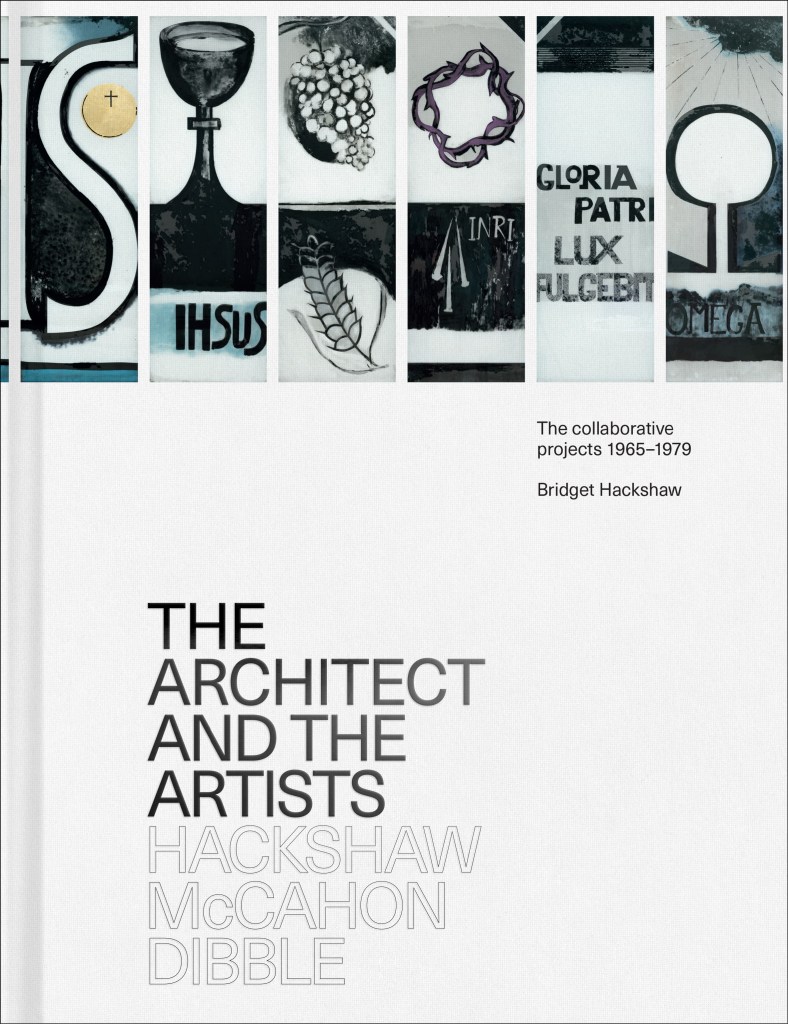
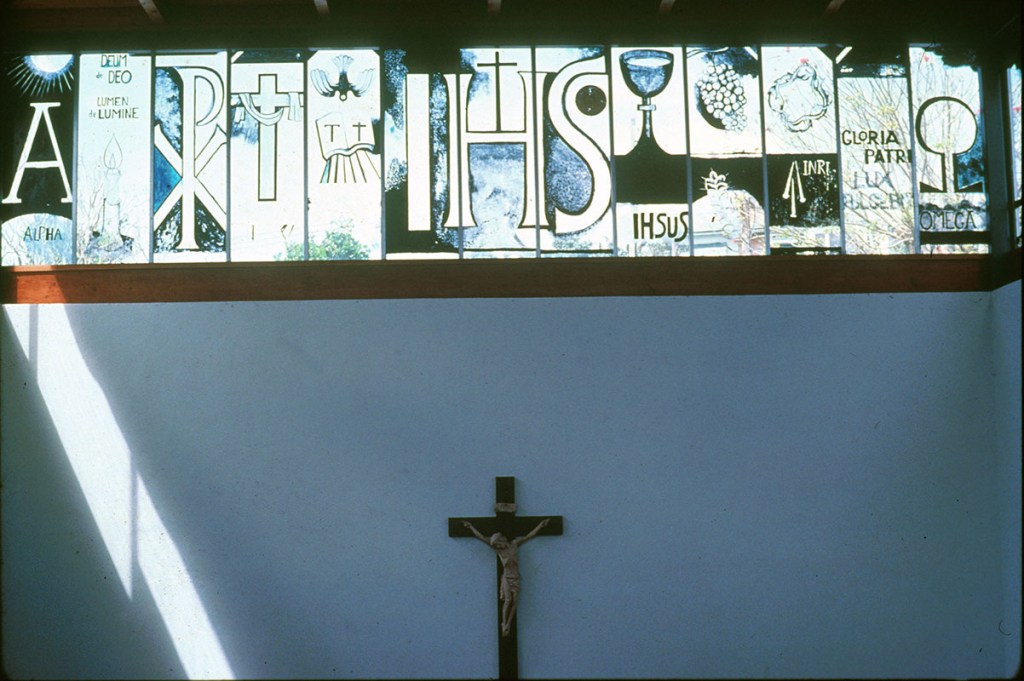
One of the highlights of the 2020 exhibition “A Place to Paint” at the Auckland Art Gallery was Colin McCahon’s restored windows which had originally been the commissioned for the Convent Chapel of Our Lady of the Missions in Remuera.
The chapel designed by James Hackshaw was a major work of church architecture which saw a collaboration between the modernist architect, painter Colin McCahon and sculptor Paul Dibble.
McCahon Window, Convent Chapel of Our Lady of the Missions . Image: Hackshaw Collection, Architecture Archive, Special Collections, University of Auckland Libraries and Learning Services.
In the 1960’s and 70’s they worked together on a number of architectural projects, often small chapels which until recently had very little public exposure. Now a new publication “The Architect and the Artists” conceived by the architect’s daughter, Bridget Hackshaw brings into the light the extent of the collaboration.
Along with extensive writing by Bridget Hackshaw there are chapters by Peter Simpson, Peter Shaw, Julia Gatley, Alexa Johnston, Sister Maria J Park and Christopher Dudman the book reveals how the collaborative process worked and as well as looking at the wider influences and motivations behind architectural / art projects. We are made aware of the interplays between contemporary architecture, historic church design, the demands of clients, the understanding of materials as well as personal visions.
The importance of James Hackshaw is explored, particularly his early involvement with the Group Architects and their pioneering domestic architectural work. The book also links his domestic architecture with his church buildings in areas such as his concern with developing an indigenous architecture, his interest in the use of exposed beams and timber along with importance of light and space. The book also notes his interest in architects such as Frank Lloyd Wright and Le Corbusier who can be seen as having a direct influence on his work.
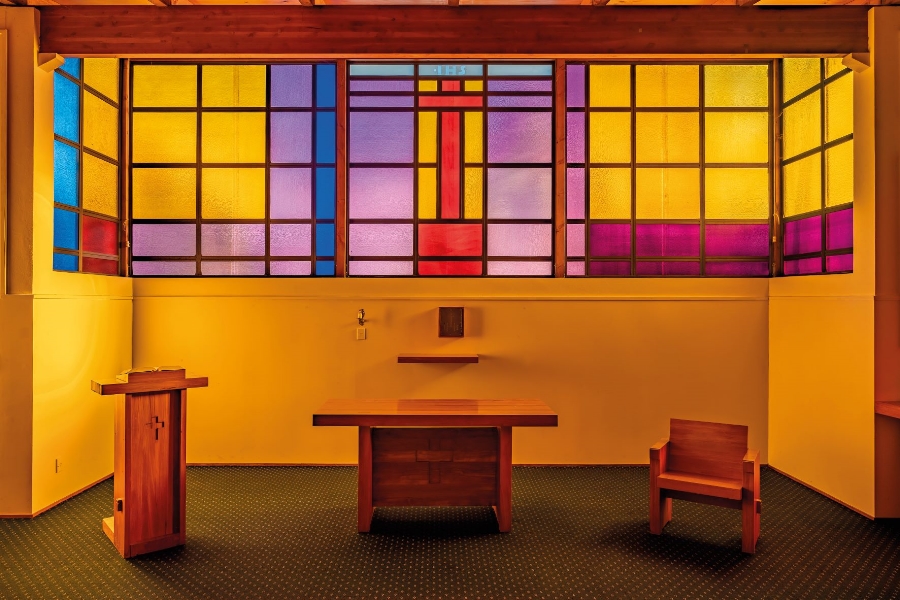
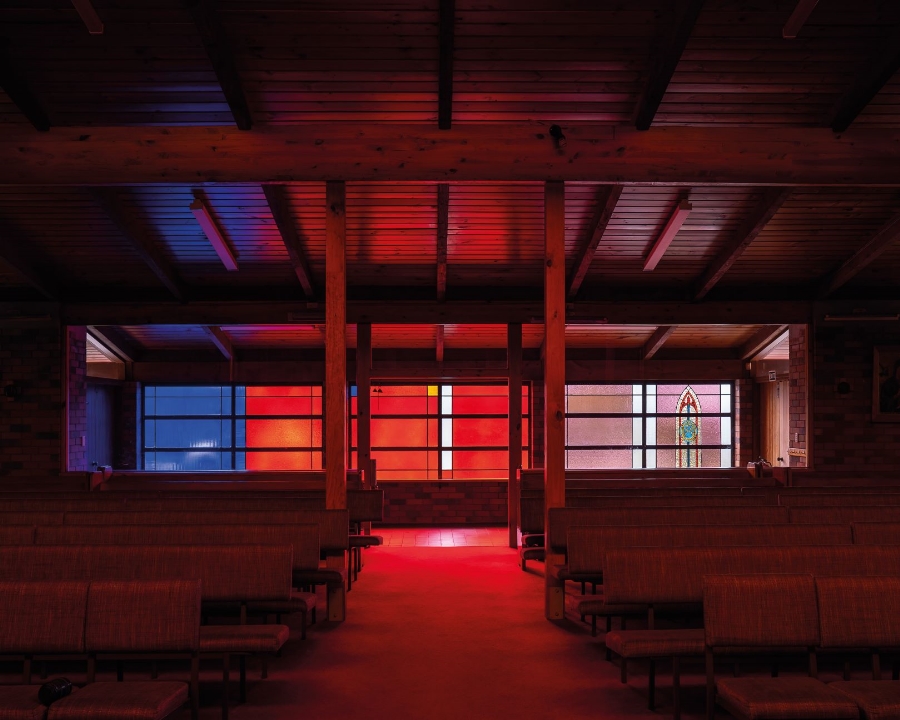
Liston College chapel. Image: Bridget Hackshaw
While McCahon had used Christian content early on in his career it was his work at the time of his involvement with Hackshaw which saw many of his works focussed on symbolism and numbers, seeing more meaning in the iconography then the stories of Christianity. His letters of the time also indicate his interest in the tactile qualities and the colours of glass
“Good glass holds your hands up high & a certain glory filters through your fingers. I love glass” and there are passages where he links his glass work with his other paintings writing about the enigmatic connections between the “5 wounds of Christ”, his “Rocks in the sky” series and the Stations of the Cross”
The period of the collaboration was important for Paul Dibble in that it provided the young artist, just out of art school with an early grounding for his future more monumental work. He became part of the team because McCahon had encountered him at Elam and offered him the position. It was as Dibble notes ”purely accidental and a bit of good fortune.”
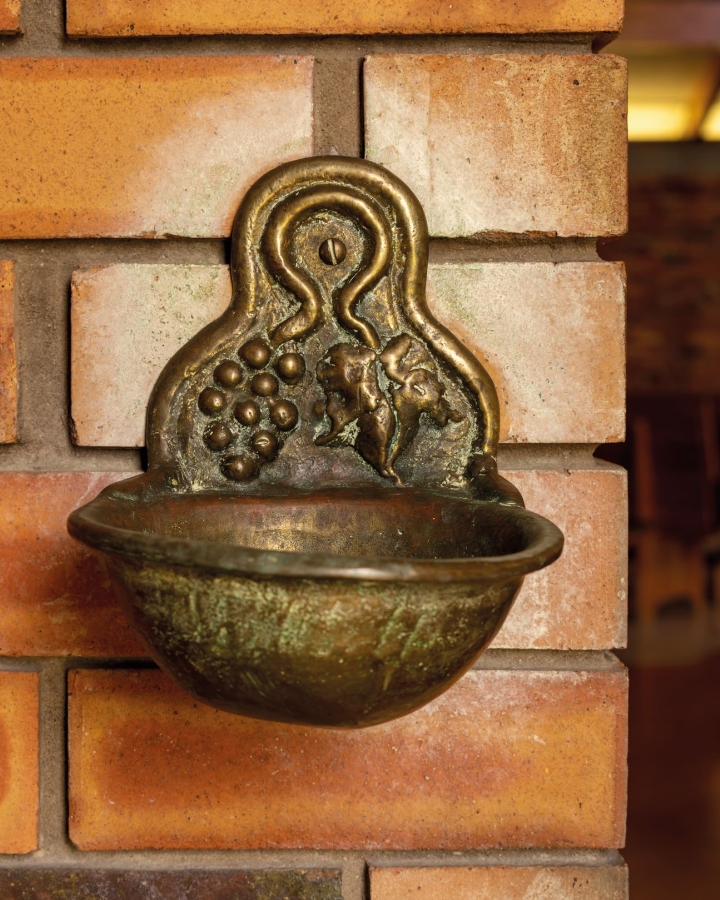
Paul Dibble, Holy water font. Image: Bridget Hackshaw
The works he produced – tabernacles, candlesticks and crucifixes are modernist but draw heavily on the traditions of church decoration and show that these sculptural works were in line with the changes which were occurring in churches as a result of the Second Vatican Council
The book is profusely illustrated with Hawkshaw’s plans and elevations , McCahon’s drawings, letters and notes, along with contemporary and historic images of the buildings, McCahon’s windows and Dibbles sculptures. Many of the photographs depict the impressive architectural spaces created by Hackshaw along with images which show how the rich colours cast by the windows transform the interior spaces.
St Ignatius Church St Heliers. Image: Bridget Hackshaw
“The Architects and the Artists” is a rewarding investigation into one of the great artistic collaborations of twentieth century New Zealand. It reveals the extraordinary connections between the various aspects of church architecture and design, religious tradition, new theological thinking, architectural innovation and personal concepts all underpinning the way in which creative individuals work within framework of architectural and artistic commissions.
The lobster has had something of a varied life in myth, history and literature.
In mid nineteenth century Paris the French Romantic poet Gerard Nerval had a pet lobster named Thibault rescued from the fishing nets at La Rochelle which he walked at the end of a blue silk ribbon in the gardens of the Palais-Royal.
Tupaia, Captain Cook’s translator on his 1769 expedition painted a watercolour of a cloaked Māori apparently bartering a lobster for a piece of cloth with the botanist Joseph Banks.
Cyril Connolly’s character Palinurus in his 1944 book “The Unquiet Grave” claims to have had previous incarnation as a lobster.
In 2012 Joseph Franzen (The Corrections) travelled to the island of Alejandro Selkirk where Alexander Selkirk was marooned for several years. His tale inspired Daniel Defoe’s “Robinson Crusoe”. The island is famous for its abundance of lobster and Selkirk presumably lived on the delicacy for his time there.
These various references to lobsters and other forays into literature, myth and science form the basis of Chris Price’s new book “The Lobster’s Tale”, a poetic exploration of the lobster’s place in history.
In addition to her essay there are two other poetic components to the book. There is a rolling one line poem which runs along the bottom of each page referencing the main text as well providing fragments of heroic journeys and surreal experiences along with images of water, fish and the looming climate crisis.
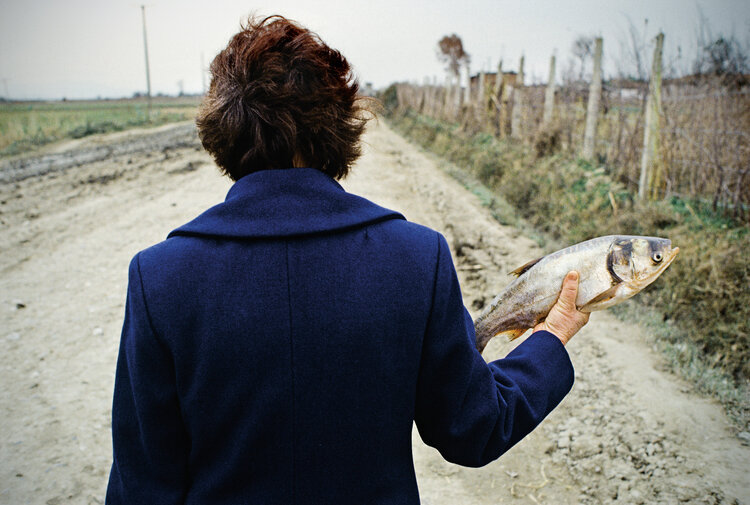
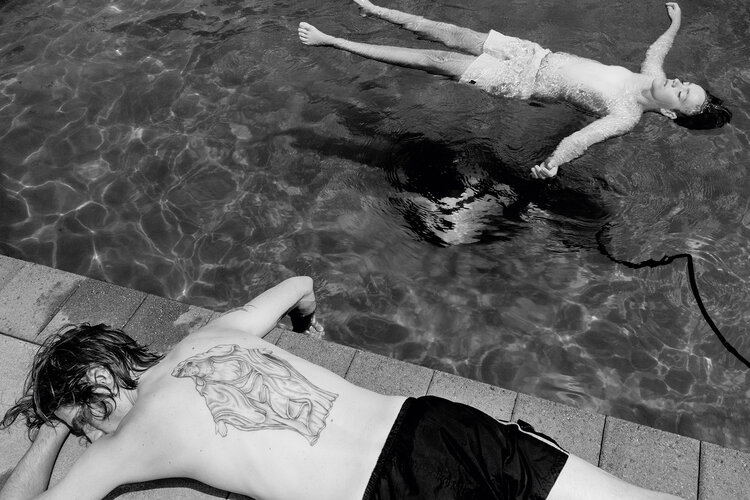
The other poetic element is provided by the photographs of Bruce Foster. These images at times illustrate the texts or serve as images which alert us to parallel ideas being touched on by Price. At other times they could be read as lobster-eye views of the environment.
Price describes the work as “either a braided essay or a collage essay – braided fits because of the essays multiple strands and the metaphor of the river; but “collage” suggests writing that develops by juxtaposition and speaks to the visual art element”.
This essayist’s journey also includes references to Albert Camus and his “The Myth of Sisyphus”. Here she empathises with the Frenchman’s writing about man’s desire for significance and meaning on the one hand and the silence and absurdity of the universe on the other.
The work is an extended metaphor for the search for immortality, meaning and creativity. Quoting from Camus, Price notes that “perhaps the great work of art has less importance in itself than in the ordeal it demands of a man and the opportunity it provides him of, overcoming his phantoms and approaching a little closer to his naked reality”.
In reading and viewing the book one can let the text and the images float over and around one, immersing oneself in the lyricism of the work or one can occasionally stop, rewind, explore and contemplate in order to fully appreciate the book’s nuanced ideas and dreams.
This is the third in the kōrero series of ‘picture books’ produced by Massey University Press which have been edited by Lloyd Jones. They are intended for grown-ups and designed to showcase leading New Zealand writers and artists working together in a collaborative and dynamic way









 New Zealand Arts Review