In one of his short stories entitled “Pierre Menard, Author of the Quixote” Jorge Luis Borges tells of the nineteenth century author who writes a version of Don Quixote which is word for word the same as the original. However, his intention is not to copy the words, but to write them as if Cervantes had not already done so. The resulting work is said to be more subtle and relevant than the original Cervantes work.
This notion of invention and relevance as opposed to copying or appropriation has a bearing on the work of Martin Ball and his references to pre-existing imagery. In his latest exhibition “Homage”, the artists own vision is separate or parallel with that of the original artists, providing a new interpretation and a new way of seeing.
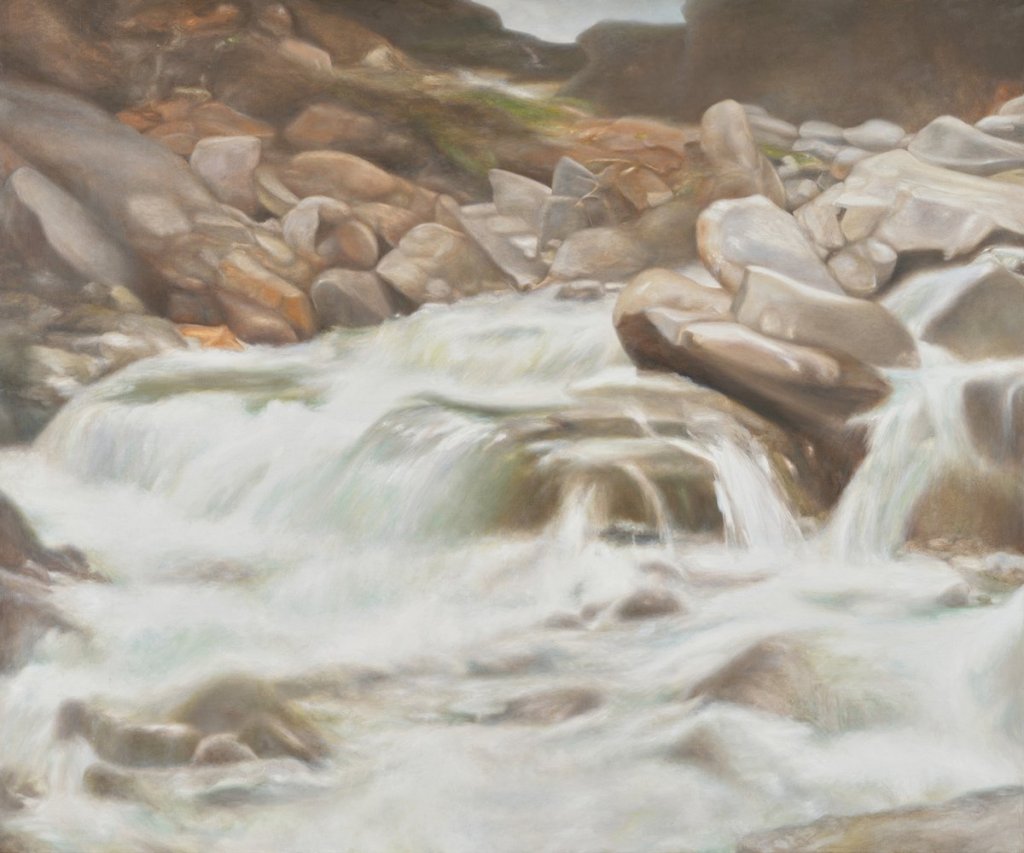
Where van de Velden’s Otira Gorge paintings encapsulate ideas about nineteenth century untamed Nature and the Sublime, Ball’s versions have been transformed through notions of Impressionism and abstraction into a new way of looking at the subject.
Ball’s van der Velden versions like “Otira Waterfall” has pared back the landscape, rocks and the dramatic torrents of water to the basic elements of colour, light and form.
Martin Ball, Pope Innocent X: After Velazques
With his paintings related to Velzsquez’s “Pope Innocent X” portrait he joins a number of artists who have used the original works to create radically different versions. Even Velasquez himself painted several other versions as it was regarded as the high point of portraiture at the time. Francis Bacon used the portrait as the basis of over forty of his works to make social, and personal comment. The interest in the Pope’s portrait also appears in Somerset Maugham’s “The Moon and Sixpence” as one of the protagonists in the book has a copy, painted in Rome, in his studio.
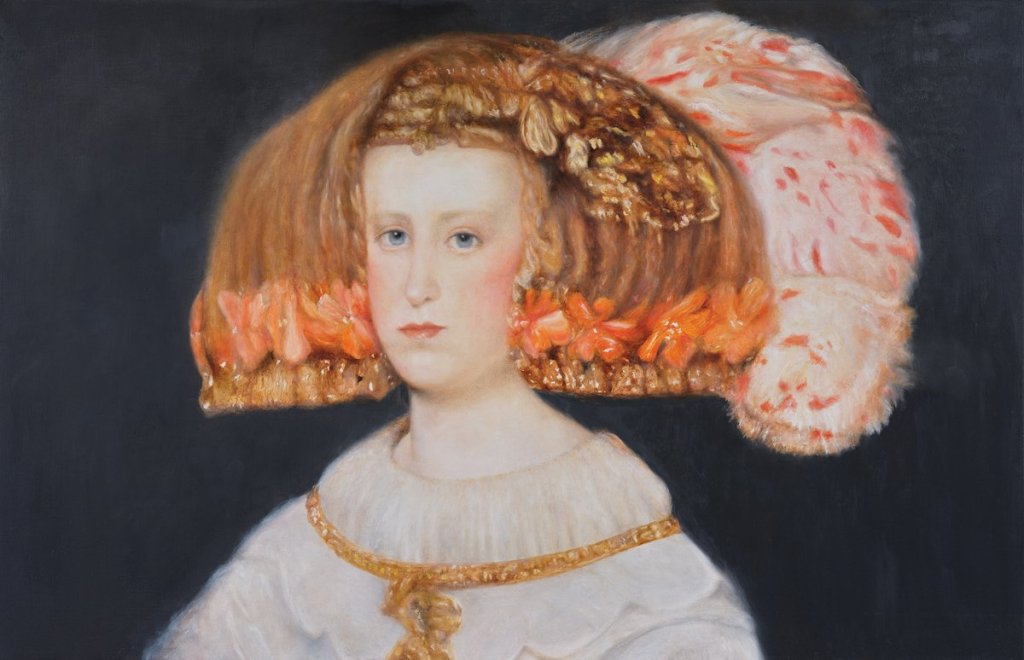
In his Queen Mariana he has removed most of the background dramatic curtains, furniture and elaborate dress of the original which emphasise the sitter’s status, instead concentrating on the complicated hair style which gives more focus to the individual’s face which takes on the mystery and intensity of da Vinci’s Mona Lisa.
Martin Ball, Queen Mariana
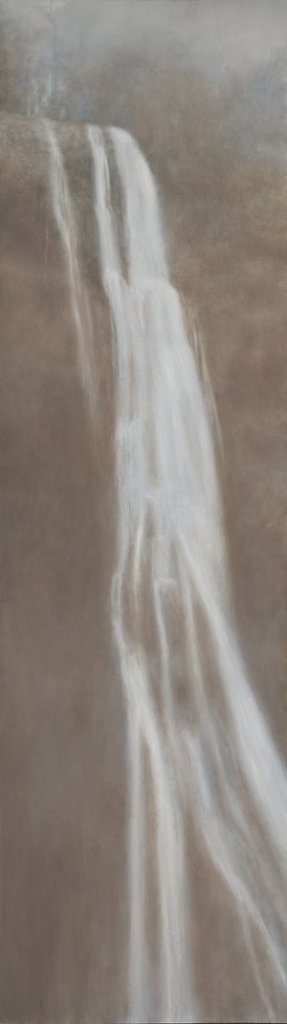
While the van de Velden and Velasquez works are related to paintings, Ball’s waterfall works are based on the photographs of George Valentine. In these paintings such “Waitakere Falls; After Valentine” he produces soft focus or blurry versions of the originals. This technique is the antithesis of his previous works, notably his large portraits in which the attention to detail appears to be more realistic than that of a photograph.
Martin Ball, Waitakere Falls; After Valentine
Removed from their original historical setting and context the artist’s works take on a new distinctive, independent life.
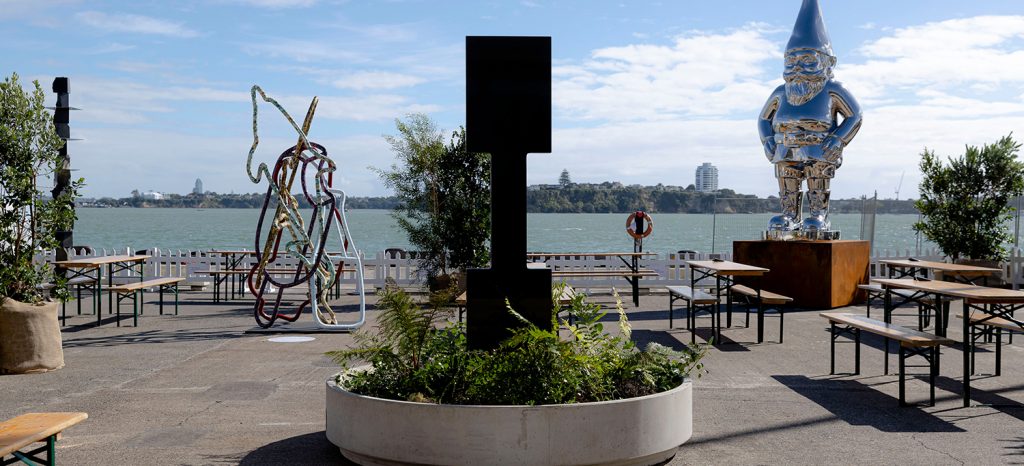
The sculpture display at the Aotearoa art fair is always worthy of a visit with many of our major sculptors exhibition along with never before seen works. There are works by Fred Graham, Simon Lewis Wards, Monique Lacey, Paul Dibble, Gregor Kregar, Semisi Fetokai Potauaine and Nathan Hull
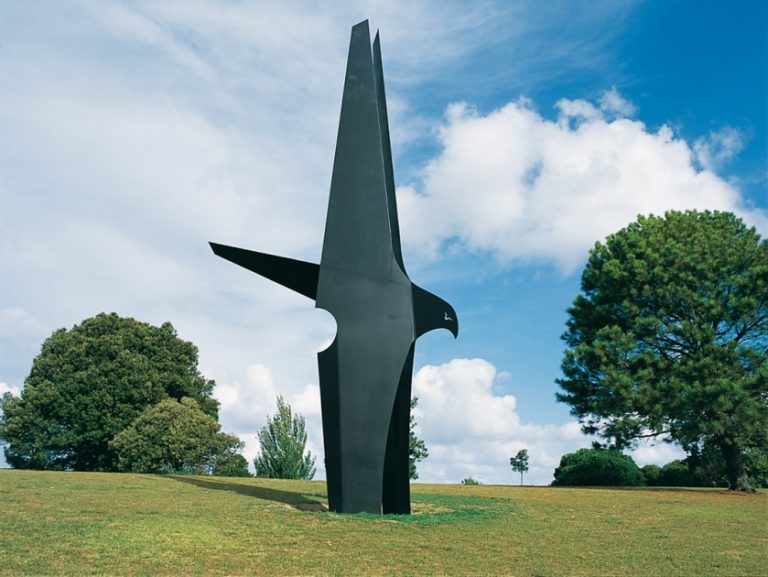
Fred Graham, Kaitiaki
This is a smaller version of the large public commission Kaitiaki, 2004 by the artist which is in the Auckland Domain adjacent to the Auckland War Memoral Museum The 12 metres high work and has become a landmark acting as a kaitiaki (guardian) of the lands of Ngāti Whātua.
His smaller-scale Kaitiaki, stands 5.5 metres high and is in an edition of three
With an artistic career spanning over 65 years, many public commissions and important works in national collections, and time spent travelling and working with artists internationally, Graham is an honoured Kaumatua and recognised artist statesman who has made a tremendous contribution to the arts in New Zealand.
Simon Lewis Wards, Giant Knucklebones
Cast concrete, 1500 x 1000 x 500mm each
With the Giant Knucklebones I wanted to explore how scale influences the viewing experience. Each knucklebone weighs in at around 300kg, I hoped the enormity of the pieces would shrink the viewer to childlike proportions, magnifying feelings of nostalgia which is a common theme in my work.
Aotearoa Art Fair Projects
This year the Aotearoa Art Fair has commissioned seven artists from across the country to reflect upon our inherited understandings of land, geography, and national identity.
Through the mediums of carving, print, photography, recording, moving image, and virtual reality, the artists draw upon the rich, complex, and nuanced histories, stories, and personalities to offer a forum to explore, critique, and, at times, better our paradoxical relationship to each other and the outside world
Projects is a curated exhibition designed to showcase the diversity of contemporary practitioners working across Aotearoa and the Pacific. These responses are installed throughout The Cloud, Yu Mei and the Britomart precinct from 16–20 November. This edition is curated by Michael Do.
Among the projects on offer are:
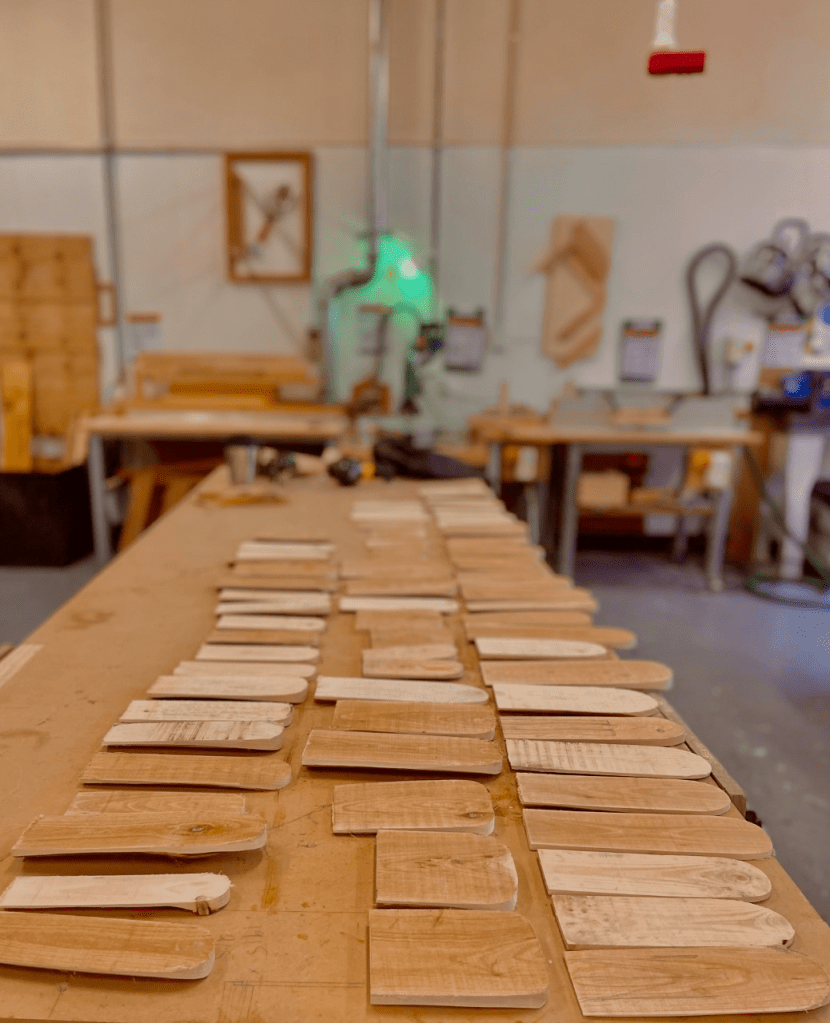
Miranda Bellamy and Amanda Fauteux,slew, slough, slueReclaimed kahikatea timber, butter.
Miranda Bellamy and Amanda Fauteux’s sculptural installation explores the interconnected relationship between Aotearoa’s native kahikatea trees and the history of New Zealand’s butter export industry. The work emerges from the artist’s research into the history of Queens Wharf, where the Fair takes place, and of the first shipments of New Zealand butter which were sent from wharfs across the motu in the 1880s in boxes made from kahikatea. By 1917 the British government was purchasing all of New Zealand’s exportable butter, cementing New Zealand’s status as world’s largest exporter of butter.
Using found Kahikatea planks the artists have created a ”booth”, similar to the commercial booths in the fair, to display a series of moulded butter sculptures that reference hawsers (ship ropes), wharf cleats, and bollards, objects with an association to shipping and wharfs.
“Our practice is in conversation with the overlooked meanings and stories held within material aspects of the everyday. slew, slough, slue brings forward the intersecting stories of kahikatea, butter, and the site of Queens Wharf. In listening to the stories of plants, we look to understand what it means to be in the world.
We are attuned to the stories held within the materials that we use. Through the reclaimed floorboards, we consider their decades and centuries in the wetlands of Te Waipounamu, their time as a villa floor in early colonial Ōtautahi, to be cracked and broken during the earthquakes, before being saved from the firewood pile and making their way to us.”
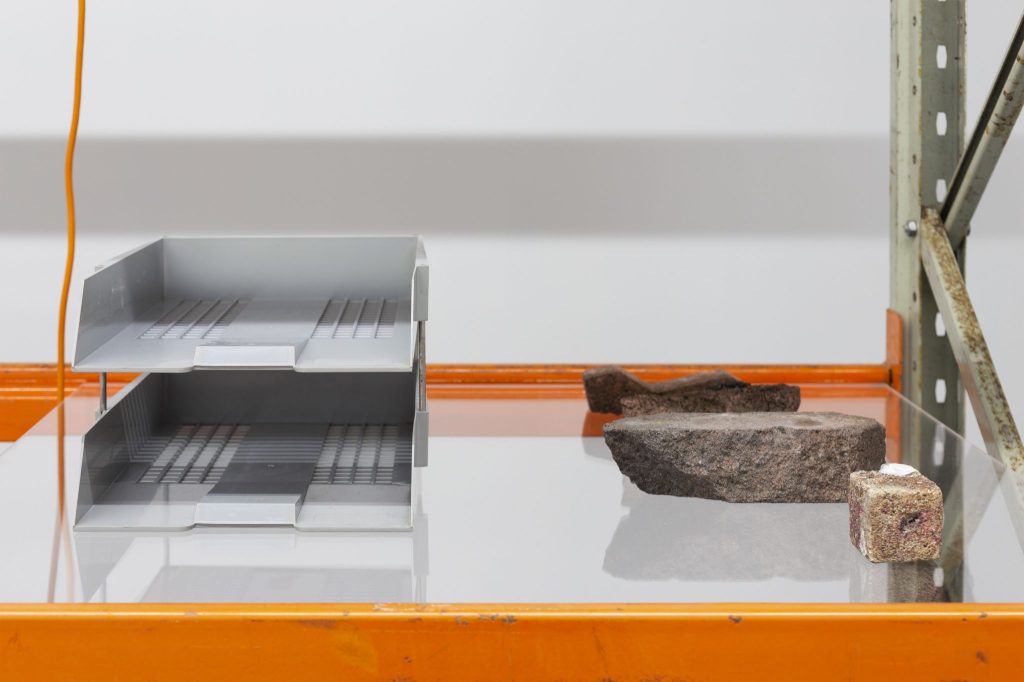
Ziggy Lever, Amalgamated Brick and Pipe Mixed media installation.
Amalgamated Brick and Pipe is conceived as an archive, combining sound, image, text and sculpture to create a system which explores the, now destroyed, Clark Brick and Pipe Works in Hobsonville-Point, west of Tāmaki Makaurau Auckland. Building upon his sculptural practice and interest in New Zealand history, Ziggy Lever‘s installation centres the detritus of the factory, tracking its legacy of contaminating the nearby shoreline with ceramic waste from the factory. Scattered across the bays, ceramic objects weather, grow barnacles and host the mangroves taking root around them. Making comment on history, industry and nature, Lever’s work invites careful critique and examination into national narratives of this New Zealand industry success.
“Upon a visit to the site in 2013, it struck me that these objects were going through a process of returning to clay. Removing some of the objects from the site, I wondered how this act might affect their relationship to time, and both preserve the state of the “amalgamated brick and pipe” and interrupt its material journey. Here there is a parallel to the problems of archaeological intervention, which seek to preserve certain aspects of an historical site yet affect other aspects of the site itself.”
Arapeta, Aloma in Velvet (exhibited in The Cloud and at Britomart).
Aloma in Velvet transposes the artist’s ongoing project of carving heru, Māori ornamental wood or bone combs, into a series of photographic interventions across the Cloud and Britomart. These large format images depict the artist’s combs placed against rich, blue velvet. Drawing upon their whakapapa and understanding of heru, a r a p e t a renders their ancestral knowledge into contemporary contexts, emphasising the importance of story, symbiosis and solidarity as tools to enlarge and expand the way Māori culture can take up space in the world.
The artist states, “Aloma in Velvet is a love letter to my Kuia (Grandmothers) who had held the space for the nurturing of new generations in my whānau (family). Heru became a prevalent reference point of this creative body of work as symbols and indicators of matriarchal lineage and succession of legacy practices.”
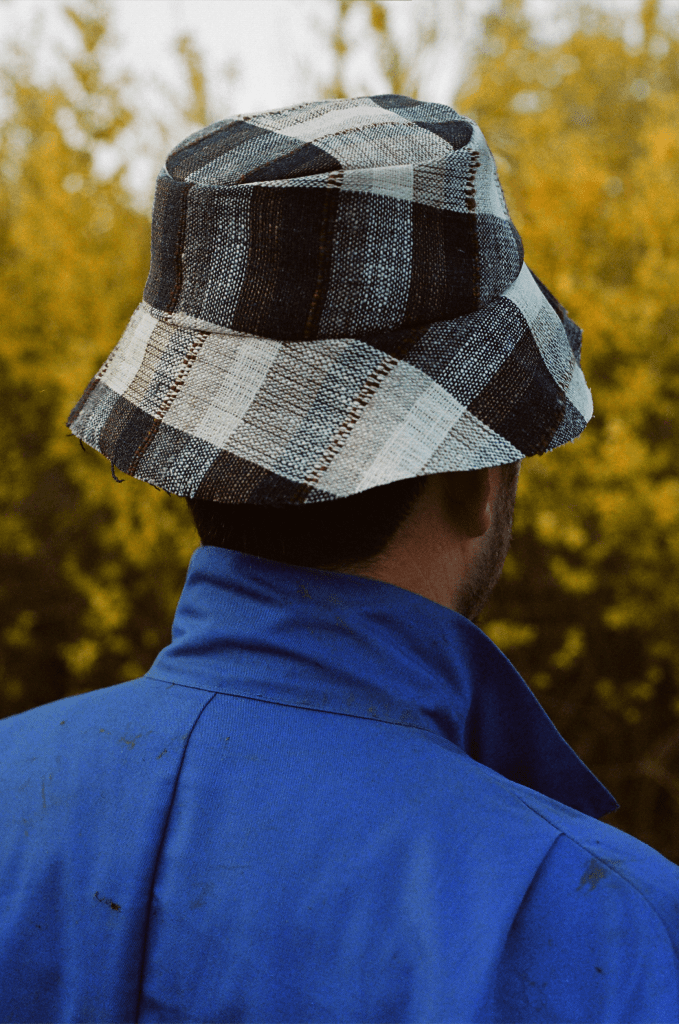
Daegan Wells, Local Makers Mixed media installation.
Local Makers pays homage to the stories of a small clothing factory in Riverton, in the South Island of New Zealand from the 1940s – 1980s. After learning of their heartening stories, including that workers would take scrap pieces of fabric to construct hats and clothes for their families, Daegan Wells has made a series of textile works which remember, recognise and comment on the changing face of New Zealand’s primary industry and the communities which serviced it. In mirroring their efforts of the handmade and local sourced materials, the artist has used muka, natural dyed linens and wool that he has cultivated from animal to yarn in his home in Southland, which forms a key part of his textile practice.
“I met a local woman who told me about a clothing factory that operated in Riverton. She had undertaken an apprenticeship at the factory in the 1970s, making school uniforms and utility clothing. The factory mostly hired women; however, a few local men had been employed as pattern cutters and fabric designers. This meeting was notable to me because of a recent conversation with my partner where it was suggested that I get a ‘real/full-time job’, moving away from the arts towards something more financially stable. This was frustrating at the time, primarily because of the lack of employment options within small-town Aotearoa. Historically, most small towns had many different types of industries that manufactured and produced various products. However, this decreased in the 1980s with a shift towards overseas manufacturing.”
Strauss’s Alpine Symphony is a monumental work, a musical equivalent of the stunning alpine landscape that the composer loved. Giordano Bellincampi guided the Auckland Philharmonia through this alpine wonderland with an exhilarating performance. The audience journeyed through twenty-two musical sections taking the the listener through the sights, sounds and events of a day hiking in the Alps.
The work opened with the enveloping darkness of pre-dawn night with snatches of Wagner followed by a glorious sunrise. We then enjoyed all the delights, vistas and anxieties of the day finishing with the deeply sad conclusion when as we returned again to the ominous night.
The work is filled with brilliant descriptions of birdsong, landscape and weather as well as rich emotional encounters. All this conveyed with the composers deft and acute musical language.
We had an extra horn-led chorus, offstage sounding as though calling from another mountain top, and then series of evolving melodies full of warm textures, muted vistas as well as several big climaxes
During the massive storm sequence where a wind machine and thunder sheet were employed one felt the full force of the orchestra’s sound pummelling the body but equally impressive were the refined musical passages with which the work abounds.
It was refreshing to have Bach’s Orchestral Suite No 1 on the programme. His works help give context to the canon of Western music. Hearing his ingenious technical skills in contrapuntal composition, his ornamentation, and inventive approach to harmony is something that should happen regularly.
This work was performed by members of the orchestra led by Andrew Beer with a nimble virtuosity
The violinists stood grouped around a harpsichord as would have been common during the composer’s time. This appeared to allow some of the players a much more vigorous and demonstrative manner of playing.
The work included several opportunities for solo instruments with some particularly lovely woodwind sequences.
Opening the programme was the avant-garde Hungarian composer György Ligeti’s “Lontano”. The title is an Italian word for distant and much of the music seems to be just that, as though played at a distance or heard from a distance.
The work opens with some are abstract sounds providing a tremulous soundscape which varies between sounding like electronic music and a faint singing voice,
There is much tension and an uneasiness, especially towards the end of the piece where a climax is tentatively reached. Familiar harmonies are presented in a range of different ways with overlapped tempos and rhythms creating an eerie atmospheric work.
Next APO Concert
Chopin and Schumann
Auckland Town Hall
November 24th
Conductor Giordano Bellincampi Piano Yeol Eum Son
Mendelssohn Calm Sea and Prosperous Voyage Chopin Piano Concerto No.2 Schumann Symphony No.4
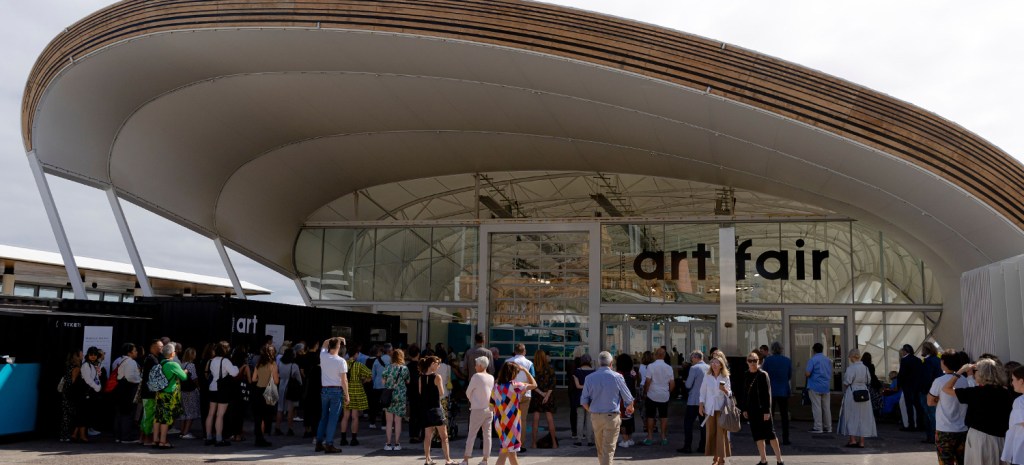
Next week the Aotearoa Art Fair will be hosting over forty art galleries from New Zealand and around the Pacific at The Cloud on Auckland’s waterfront. The event will feature the breadth and diversity of art from the region.
As well as exhibiting the latest and best in New Zealand contemporary art there are galleries showing major international works, historical works, aboriginal art as well as craft work by significant artists.
NZ Arts Review contacted five of the exhibiting galleries to provide a selection of their artists works.
Gow Langsford Gallery, Auckland
Exhibiting Judy Millar and Peter Halley
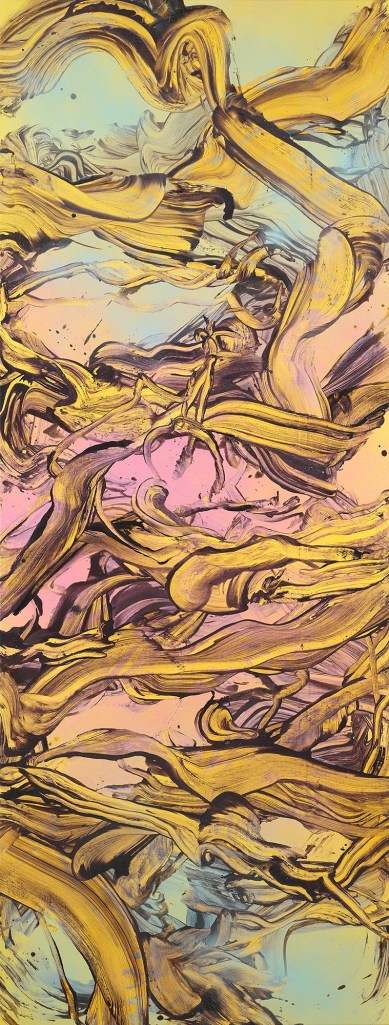
Judy Millar
“These works are the culmination of an intense two- and half-year period of painting which I have spent almost entirely alone in my isolated West Coast home and studio. Even though I have lived in this spot for almost 40 years, during the period between 2019 and early 2022 without travel or other distractions I have experienced the nuance of place in completely new ways. Wondering how a relationship with place; with the subtleties of shifting light, moods of weather, sounds of wind and birdcall, could be presented rather than represented, I have worked to develop this group of paintings which attempt to capture the beingness of this specific land. To show the spirit of a place that I can no longer separate from my own being. These works then, are an expression of place. Being there, being now, place based.”
Judy Millar, The Light Comes Quickly ($35,000)
Peter Halley:
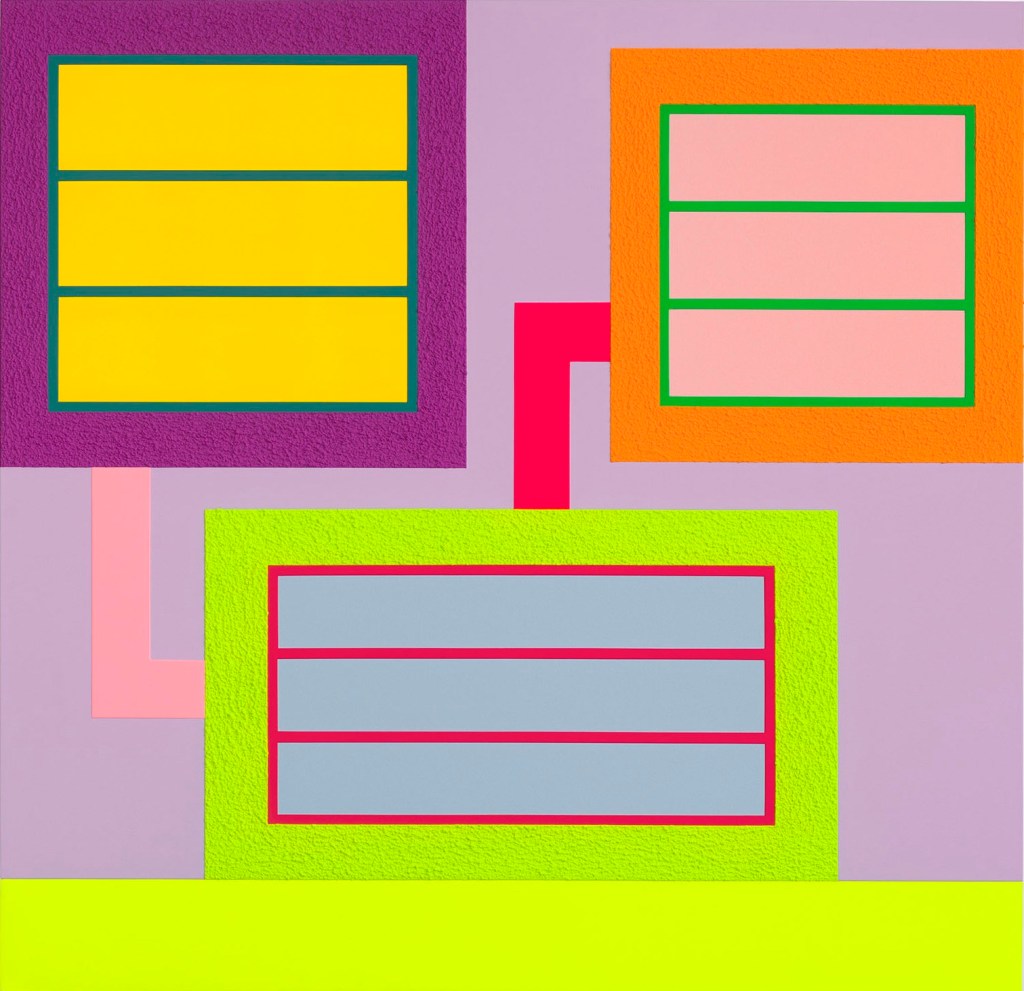
New York based painter Peter Halley is a contemporary American artist who is widely known for his geometric, neon Day-Glo paintings. He is considered a central figure of the Neo-Conceptualist movement of the 1980s, which originated from a group of artists exhibiting in New York’s East Village. Halley’s paintings merge geometric abstraction with digital and urban landscapes, as he ponders social space from both a psychological and physical perspective. His hard-edged compositions of horizontal and vertical divisions focus on motifs of prison cells, barred windows, and the grid structure of city environments; they offer a sociological exploration of the isolation experienced in contemporary life, with its increasingly complex networks and systems. Halley has exhibited internationally throughout his career, including large-scale public installations across Europe and the United States. He is also a published writer and was the founder and publisher of Index Magazine in the 1990s.
Peter Halley, The Social Dilemma (POA)
Page Gallery, Wellington
Exhibiting Max Gimblett, Turumeke Harrington and Reuben Paterson
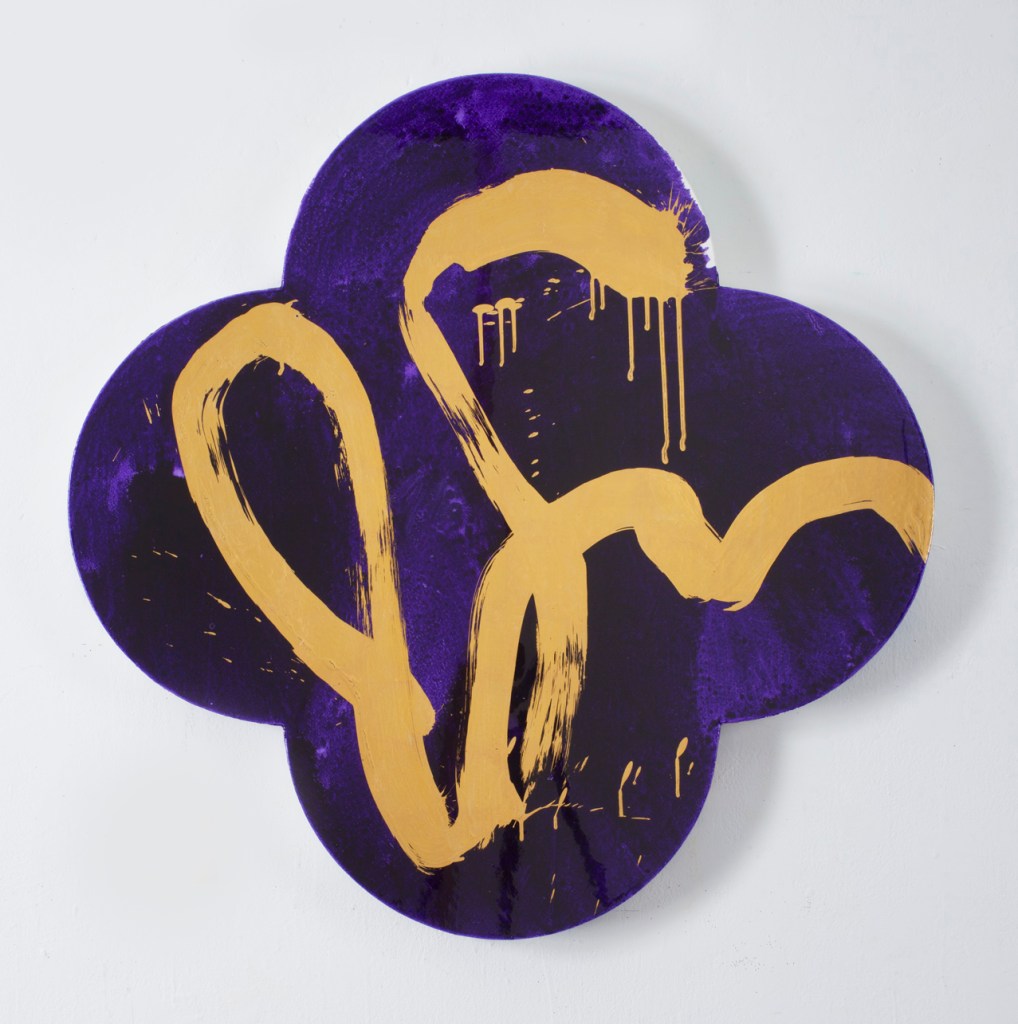
New York based Max Gimblett’s practice encompasses influences as varied as Abstract Expressionism, Modernism, Eastern and Western spiritual beliefs, Jungian psychology, and ancient cultures. His work explores the multiplicity of meaning attached to revered objects and symbols. The quatrefoil shape dates back to pre-Christian times and is found in both Western and Eastern religions symbolising such objects as a rose window, cross, and lotus. Gimblett steps further into the realm of the spiritual with his use of precious metals; materials such as gold and silver are religiously associated with honour, wisdom, enlightenment and spiritual energies.
Max Gimblett , Quest of Gold, 2014, gesso, acrylic and vinyl polymers, rosanoble gold leaf / canvas,. $58,000.
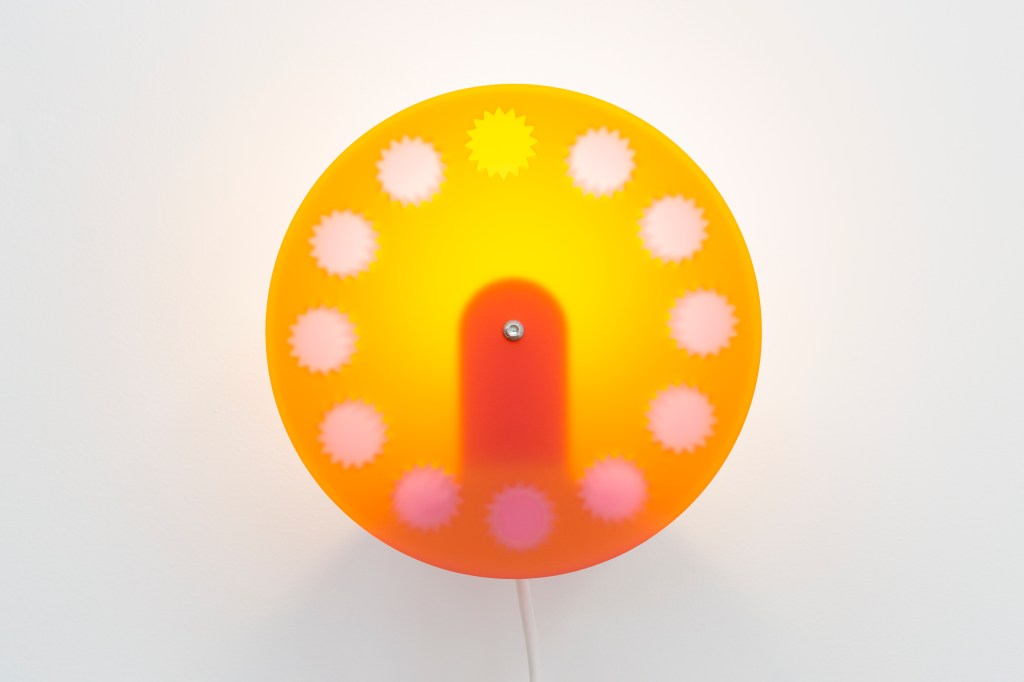
Turumeke Harrington (Otāutahi Christchurch, Ngāi Tahu) has a background in industrial design and fine arts. An interest in whakapapa, space, colour and material sees her regularly creating large sculptural installations at the intersection of art and design. The artist’s clarity of form and function is supplemented by a poetic pragmaticism and a commitment to making that is at once playful and provocative. Her sympathetic approach to materials combines with a bold colour palette to create engaging works that speak to the artist’s own personal relationships, cultural anxieties, and everyday musings.
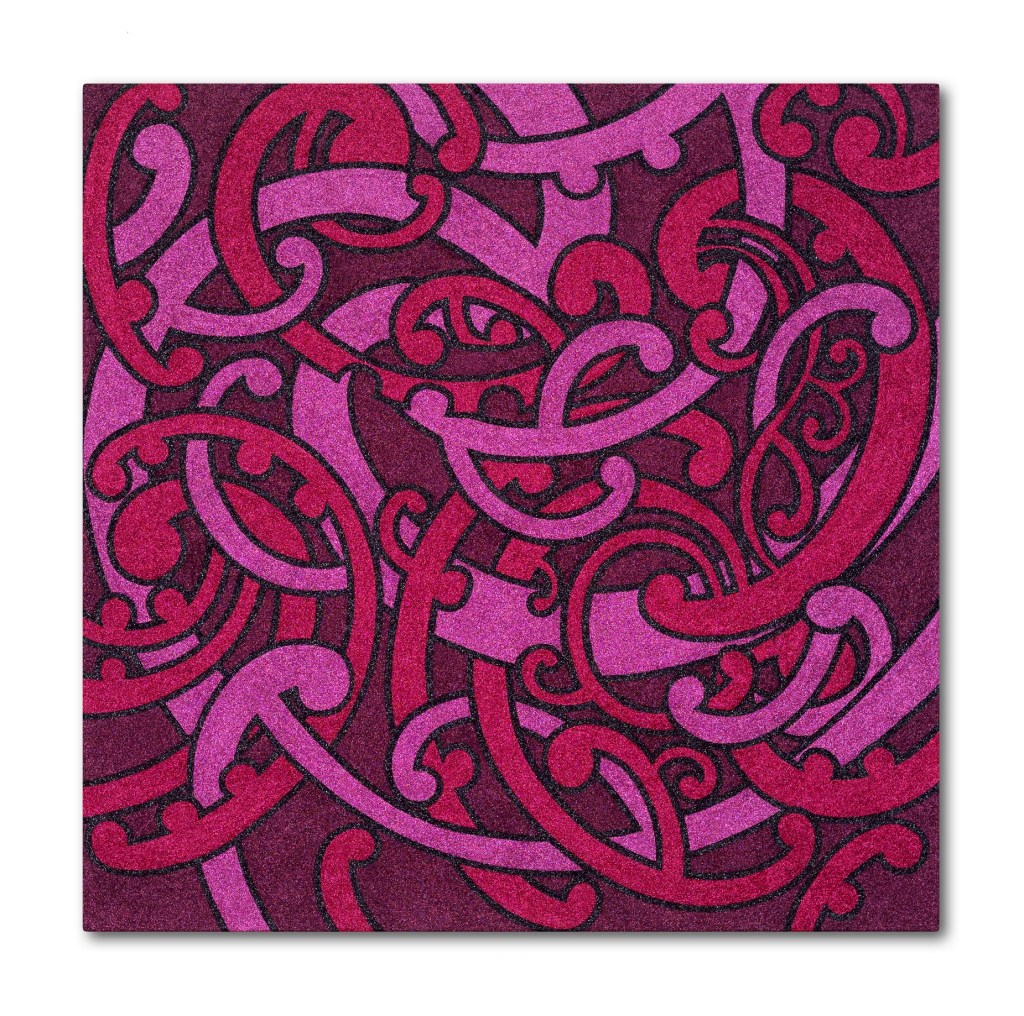
Reuben Paterson (Auckland Tāmaki Makaurau, Ngati Rangitihi, Ngāi Tūhoe, Tūhourangi) harnesses the mesmerizing properties of light through his practice. Paterson is renowned for his inimitable, iridescent paintings, made through a distinctive application of glitter on canvas. These paintings encompass all manner of subject matter – from cloudscapes to wild cats, botanical blooms, kōwhaiwhai, and fireworks – each providing a source of exploration, contemplation, and self-reflection for the artist.
Suite Gallery Auckland / Wellington
Exhibiting Georgia Spain, Richard Lewer and Tia Ansell
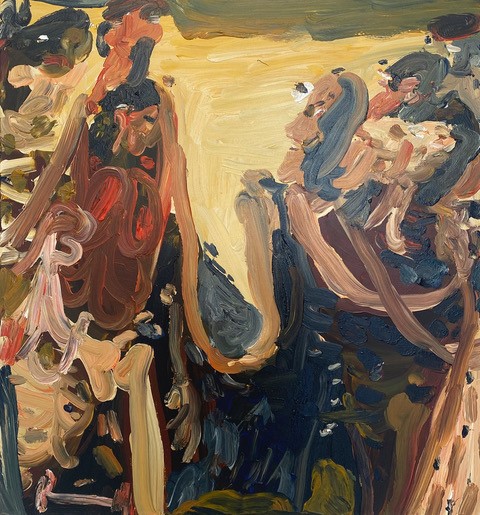
In Naarm/ Melbourne based Georgia Spain’s paintings people are repeatedly together in. In their collectivity, they’re always in the middle of something — often the most cataclysmic and euphoric moments of existence. With limbs akimbo, flesh melting into flesh, Spain has a sea of figures awash in a tsunami, or wielded together as flood waters sweep in. Other canvases contain a sheer jumble of bodies, signalling the messiness that however much power we might ascribe to solipsism or individuality, we are inescapably tied up with another.
Georgia Spain, When all your friends are leaving $4,500
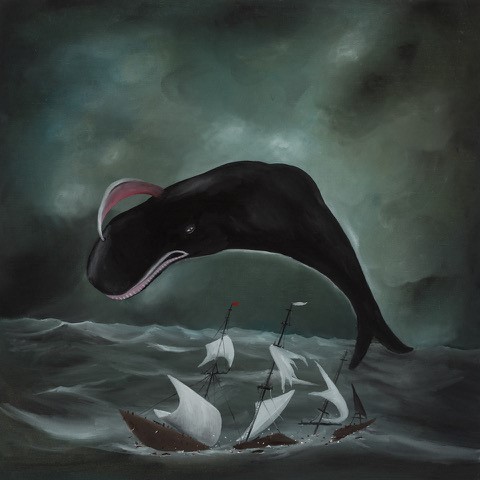
Richard Lewer is showing a series of four works based on Herman Melville’s 1851 novel Moby-Dick is an epic story revolving around Captain Ahab and his obsession with a huge and elusive white whale. The whale caused the loss of Ahab’s leg and the disciplinarian is so preoccupied by his desire to kill the whale, that he is prepared to sacrifice everything, including his ship, the lives of his crew, and his own life, in order to exercise revenge.
The ocean features often in Richard Lewer’s work, for him the sea is an overwhelmingly powerful force, but also a place to find one’s self. In this instance the ocean is a place to investigate human delusion, power and control. The white whale brings to the surface emotion from the depths, and reminds us of the peril and futility of human’s desire to contain and control nature.
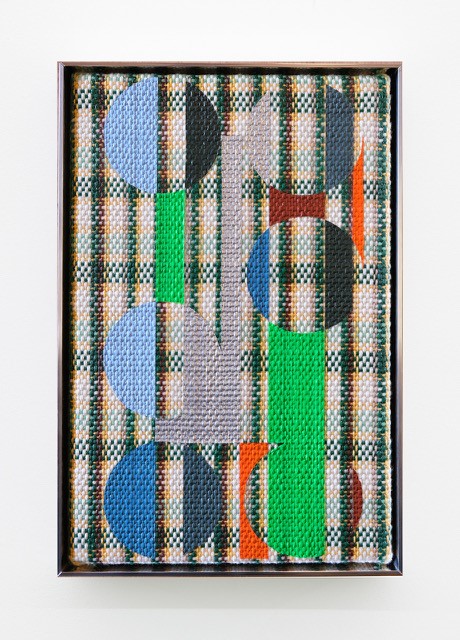
Richard Lewer, The Act of Impalement $11,500 Deconstructing fundamental elements of a painting, Tia Ansell practice calls attention to the origin of the woven substrate and its context within contemporary art. Tia Ansell utilises the loom to explore intricate weaving patterns generated using her idiosyncratic coding system based on urban landscapes. Her weaving-paintings form a structure of intertwining colours with bold compositions of geometries and hardlines, a language of architecture which frames the weaving medium. Tia threads these ideas within the context of Melbourne architecture extrapolating facade compositions into the construction of the woven plane, with painted architectural patterns and design symbols interrupting the image.
Tia Ansell, Daphne, $2,500
Futures Gallery
Exhibiting Tim Bučković
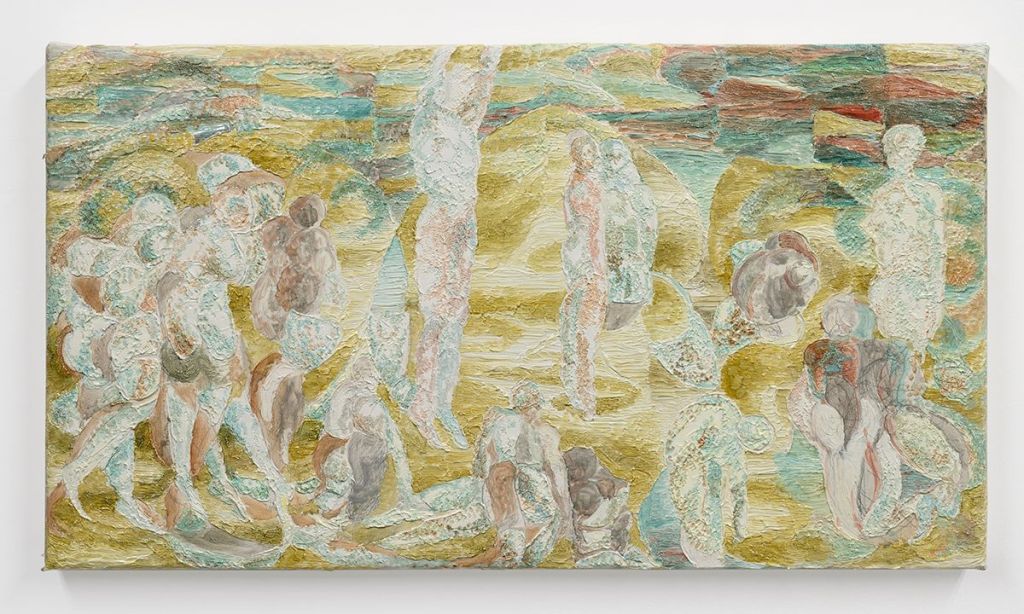
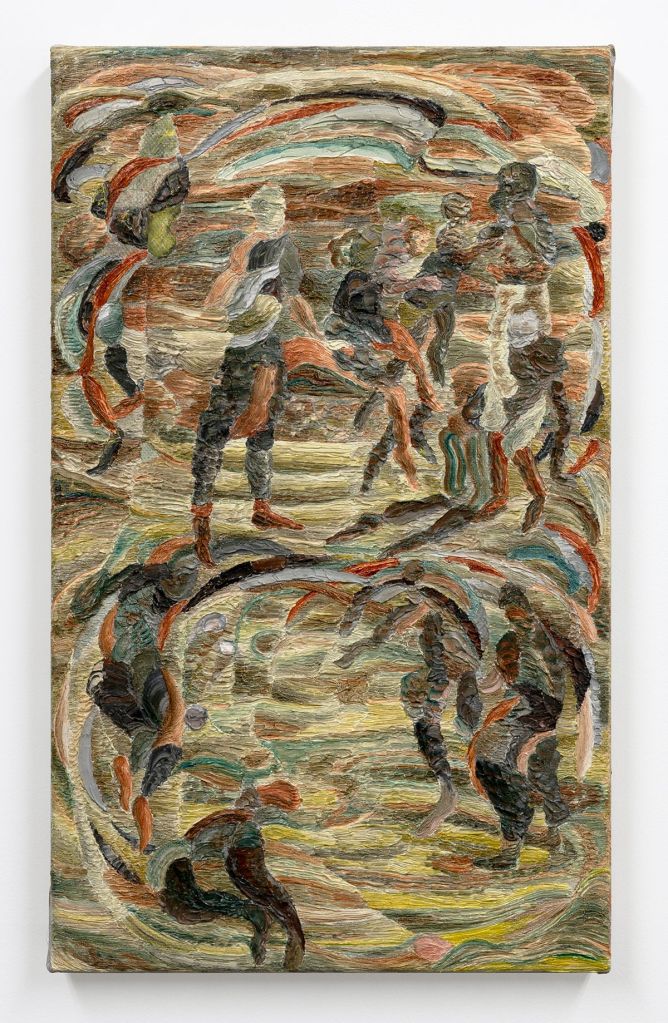
Tim Bučković’s small and multi panel paintings selectively hold and release contextual information, such as dissolving figures engaging in bizarre rituals, fictional or diagrammatic settings of vacillating flatness, depth, perspective and optical noise. His practice pushes historical painting values through a sieve, reconstituting disparate parts into a pixel-like language that is unmistakably his own. His dynamic compositions are informed by historic, modernist and avant-garde practices and brim with the semiotic qualities of Eastern European visual culture and technology. These works are laced with a tension between time and space that is simultaneously neo-utopian, ominous, sci-fi, and mystical; qualities often found in alternative histories.
Tim Bučković, Light Performance AU$4200
Tim Bučković Untitled AU$4200
Scott Lawrie Gallery, Auckland
Exhibiting Roy Good, Ara Dolatian and James Collins
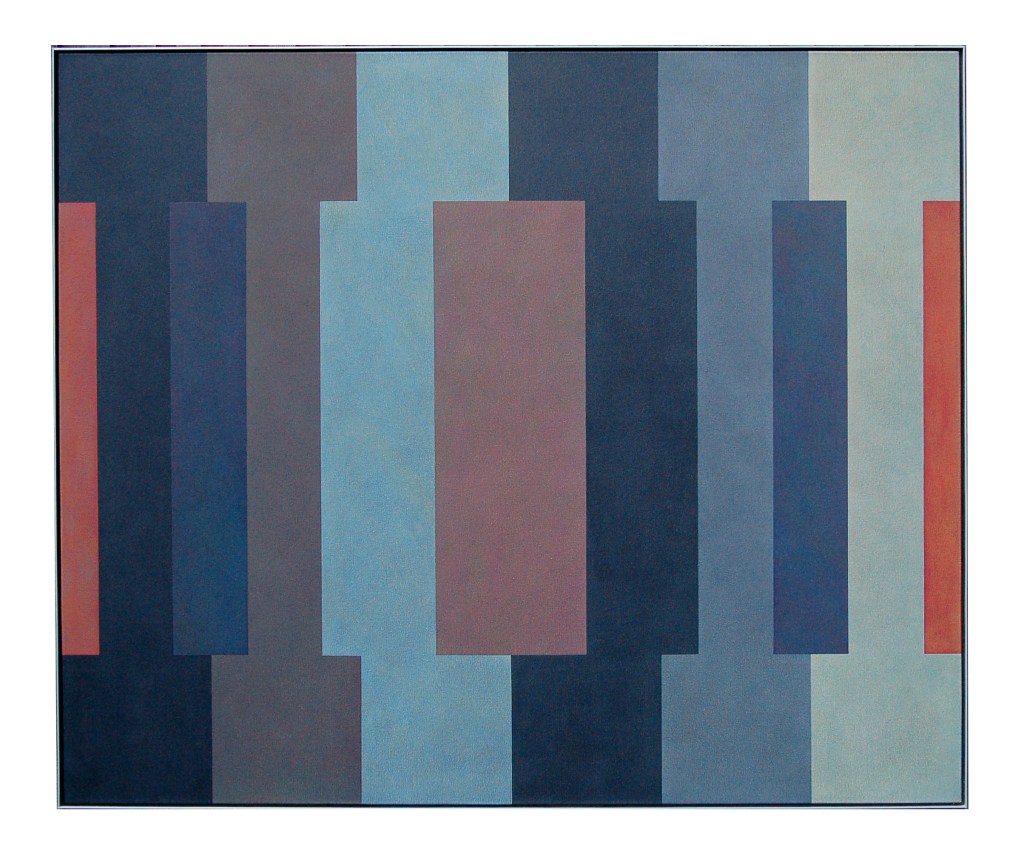
Roy Goods dedication to modernist abstract painting has now reached beyond 50 years. After the success of his recent solo show at Scott Lawrie Gallery, Scott brings to the art fair a hand-picked selection of work from 1973 to 2019. Spanning these decades are some outstanding and rare works from Roy’s private collection (which Scott had to plead with him to let go of!) which are being presented as a major solo show at this year’s Aotearoa Art Fair. An important figure in New Zealand art, Roy’s continual exploration of form, order and harmony has now come full circle to reach a new generation of collectors.
Roy Good, Lintel for Joseph, 2009,Acrylic on canvas, $25,500
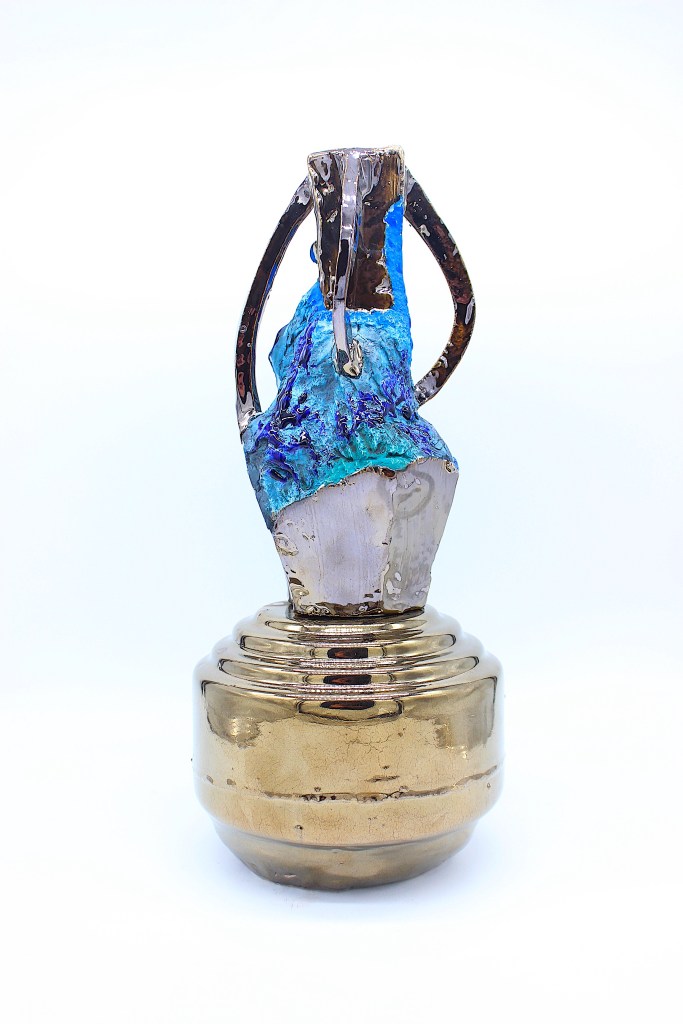
It’s unusual to bring an emerging artist into the realms of an Art Fair, but that’s exactly what Scott Lawrie Gallery is doing with Ara Dolatian’s sensational recent ceramic works. As Ara explains, ‘After the US forces occupied Iraq – modern-day Mesopotamia – instability caused a booming trade in stolen artefacts, in addition to their outright destruction. In my recent work, I seek to reinstate some of this lost history, while at the same time highlighting the fragmented nature of its archives. The work also pays homage to the foundational materials used and skillfully developed in ancient Mesopotamia. My use of bright blue glazes mirrors the use of lapis lazuli in Mesopotamian civilisations.’
Ara Dolatian, Myths, 2022., Glazed ceramics $3200 (Image to come)
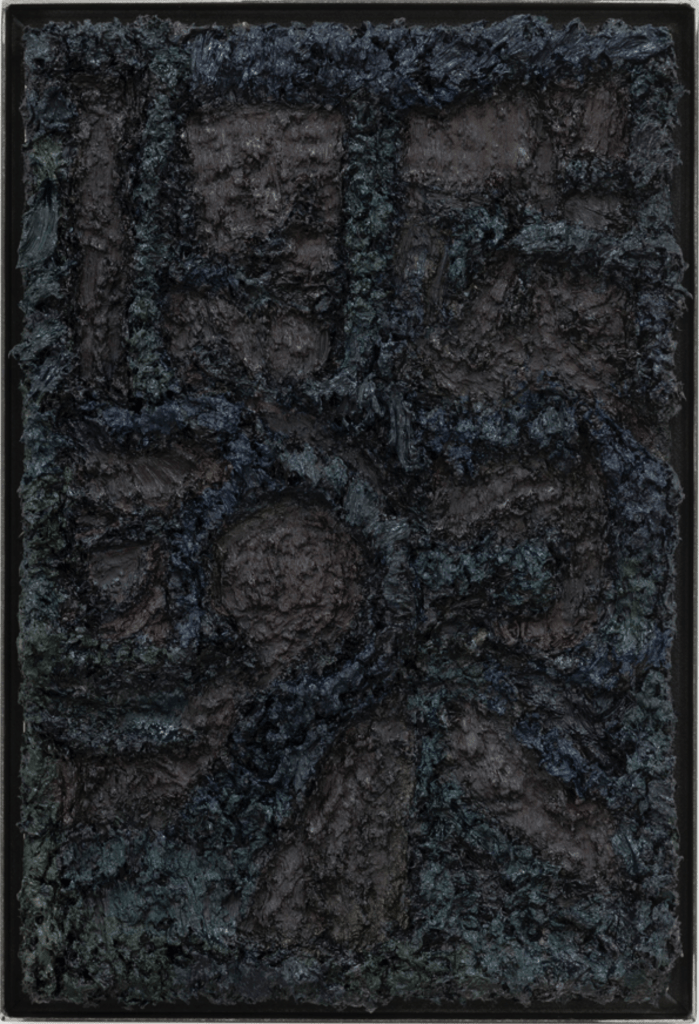
James Collins made a mark for himself while still a young painter studying at Wimbledon College of Art, and consequently the Royal College of Art in London. His career has progressed ever since, with impressive group and solo shows around the world, including Claas Reiss in London, and James Fuentes in New York. Scott Lawrie Gallery is delighted to welcome James to the Aotearoa Art Fair for the first time, where two magnificent smaller paintings of his will be included for the VIP opening event, and continue for the duration of the fair. Known for his lush, boldly sculptural, dense impasto paintings (often 20-30mm deep),James was a recent highlight of the Brussels Art Fair, with his presentation for Claas Reiss Gallery.
James Collins, Liquid Engineers 21, 2018, Oil on wooden panel $6000
For many New Zealanders their first artwork will have been an artist’s print. This relatively low-cost artwork will often have been the beginning of life-long buying of art and many major collectors will note that their first limited edition print will have been the start of their collections.
The Barry Lett Multiples, a set of 12 prints which were produced in 1968 by the art dealer Barry Lett became a central feature of many early collections and were on display in many institutions such as secondary schools. The set of prints included major artists such as Colin McCahon, Pat Hanly and Don Binney.
The artist’s print was generally a silk screen print, an etching or wood cut but in the last few years there has been an increase in the enrage of techniques with the emergence of digital media, hybrid prints with new production methods, materials and inks.
The printed image has long historical, political and social associations where it has been used to address political, social, aesthetic and personal issues. The invention of photography and screen-printing had an enormous impact on the art world, especially in the 1960s, and many significant artists have worked with commercial printing to both lift standards and to feature strongly in their studio production. New technologies continue to be explored by artists, and this is increasingly so for printmakers.
Robin White, Kereru, (2011)
Printmaking in New Zealand has a long history and has been taught in the various art schools and other institutions such as the Auckland Society of Arts. and the Whanganui Regional Community Polytechnic (WRCP). There was also ben the NZ Print Council established by Kees Hos and Dr Walter Auburn which operated between 1964 and 1977,
It was out of the WRCP that a new group of printmakers developed in the 1990’s. This organisation became Print Council Aotearoa New Zealand in 2000, promoting printmaking and printmakers
To celebrate more than twenty years of its history a new book “Proof” has been published featuring some of the best examples of contemporary fine art printmaking in the country today. With 180 works by 127 artists, “Proof” covers the breadth of printmaking processes and display the diversity of this artform, from the more traditional woodcuts and etchings to those pushing the boundaries of print.
With a foreword by Susanna Shadbolt, Director of Aratoi, Masterton, an essay on the history of printmaking in New Zealand by Carole Shepheard and one on the history of PCANZ the book provides a useful overview of the current state of printmaking in the country.
Stanley Palmer, From Maungawahau (2003)
Along with a list of significant exhibitions, and a glossary of printmaking terms and techniques this book is something of a catalogue of New Zealand’s major print artists with full colour plates and biographies of the artist. It is a valuable resource for art lovers students and teachers.
Among the more than one hundred artists included in the book Prooa few are given greater status as Honorary Member – Barry Cleavin, Dee Copland, Rodney Fumpston, Mark Graver Stanley Palmer, Carole Shepheard, Gary Tricker and Robin White.
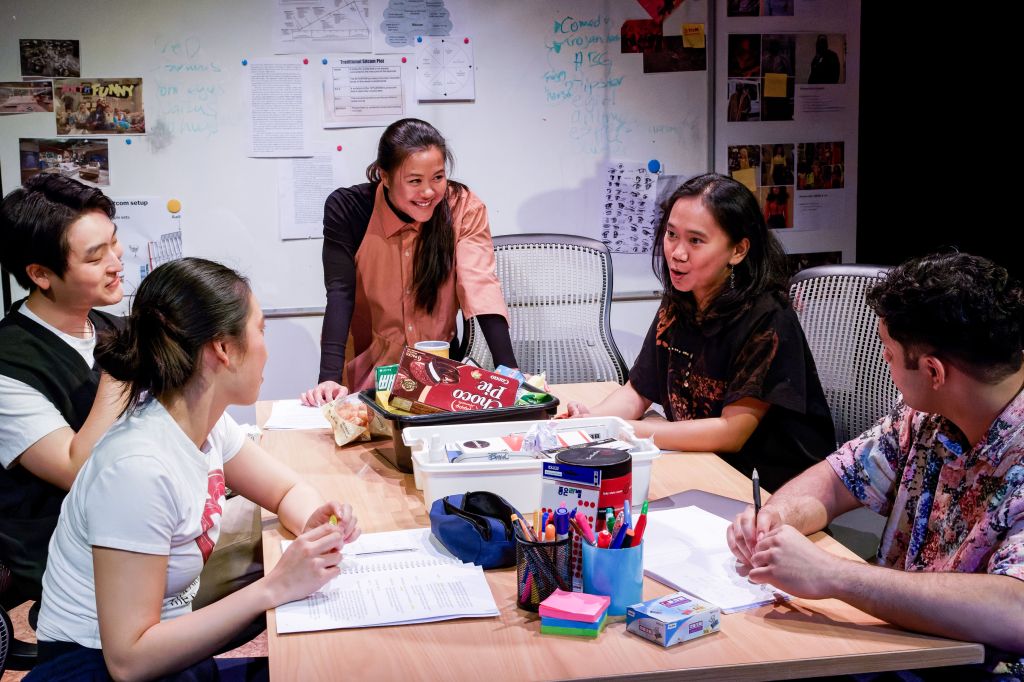
Jess Hong, Uhyoung Choi, Dawn Cheong, Ariadne Baltazar, Jehangir Homavazir. Photo: Michael Smith
The First Prime Time Asian Sitcom
By Nahyeon Lee
In Good Company
Co-produced by Q Theatre and Silo Theatre
Q Theatre Loft
Until 27 November
By Malcolm Calder
5 November 2002
The second scene (or is it an Act?) of The First Prime Time Asian Sitcom sums it up. An earnest academic welcomes four panellists to discuss a new show recently screened on mainstream television and introduces them to her audience. The TV show is a frenetically paced sit-com that, according to a popular convention adhered to by many, might loosely be stereotyped as ‘Korean’ satire of Friends. But is it? And what is ‘Korean satire’ anyway? Who says so? How do stereotypes arise? What relevance does this have to mainstream New Zealand? Or to mainstream television?
Her panel guests (each a satire themselves) comprise a social networking influencer, a blogger, a highly opinionated academic, a theatre worker and the Showrunner who created the show. But the moderator quickly loses control as her panel leap immediately to a consideration of ‘Korean-ness’ and thence quickly to ‘Asian-ness’. How do national stereotypes accommodate multiplicity? Who exactly is an Asian? Are those from eastern Asia the determinant? What about Indians? How important is comedy? Are the children of Asian immigrants lost between cultures? And what about food? Her panel goes at it hammer and tongs, each expressing their viewpoints, no one listens to anyone else, egos are paramount and ‘winning’ discussion points becomes the goal of each. The point of course is that outcomes become submerged in mere noise – a further layer of satire.
Meanwhile, sitting right down the far end of the panel, is the actual writer of the TV show that gave this play finds its name. She is quiet, could quite possibly be a seriously good thinker and is clearly unsettled by all the non-productive noise. But we never find out because, although clearly having thoughts to contribute and using body language alone, she is out gunned by those around her and is literally left with her mouth flapping and nary a word is heard. Yet another satirical statement.
The First Prime Time Asian Sitcom lays satire upon satire upon satire. Its context is about any minorities that are visually, aurally and culturally different. How they fit in and how they discover their place in the habitable world. And, more importantly, about how they become heard, accepted by and a part of that world.
It is a truism of course that the habitable world eventually does so and that comedy has played a not insignificant role in the process. Worldwide over many generations, for example, acceptance of the Irish diaspora as something more than drunken singers, or that rock and roll is a valid musical form or that granting teenagers a voice all do so too.
The First Prime Time Asian Sitcom is bitingly comedic in places, uncomfortably so in some, while wrapping itself in its own satirical constancy.
Is it good theatre? While cleverly introduced and a designers delight, the first scene that establishes the TV show could possibly cope with some trimming while the strength of the second is noted above. However the third scene seems far too long, particularly the ending, and it might even benefit from a different treatment entirely.
Ahi Karunaharn’s direction implicitly acknowledges the self-consciousness and implicit anger underlying this work while maintaining its frenetic pace at all times, and his well-credentialled cast of Ariadne Baltazar, Dawn Cheong, Uhyoung Choi, Jehangir Homavazir and Jess Hong provide glowing evidence of a rising generation of new actors.
On balance, The First Prime Time Asian Sitcom is both important and welcome. It is likely to appeal primarily to its own cohort – educated, articulate, second-generation New Zealanders who have something to say and who are doing something about it. But it deserves a broader audience too. Not only because it plays with an idea that has rarely if ever received much airtime in New Zealand, but because it shows the work of an important young playwright in Nahyeon Lee and, as such, is a welcome addition to our national play-book.
Q Theatre and Loft Theatre are to be congratulated on co-producing this work.
Before the main work on the programme of the NZSO “Heavenly” concert, Gustav Mahler’s Symphony No 4, the orchestra played the young American composer Gabriella Smith’s “Tumbleweed Contrails”. Just as Mahler’s works often reference the natural world, Smiths work was also inspired by Nature and natural forces and it sounded as though the composer had been inspired by the sounds she would have detected with her ear to the ground, pressed up against a growing tree, or immersed in a flowing stream.
The work is mixture of the sounds of Nature – animal, birds and insects along with the sounds of wind in the trees and the burbling of water. She seems to have taken these sounds and then slowed them down or sped them up so they are only just recognisable. Throughout the work there is a constant whispering as through the spirits of all these elements was being fed into the composition and then in the final moments of the work we realise what we can hear is probably the breath of the composer herself.
The rhythms of Nature have been transposed into music and seem be following mathematical shapes and sine waves. It is this mathematical rigour which conductor Miguel Harth-Bedoya then applied to his conducting with precision and exactitude giving the work a sense of profound insight and sensitivity
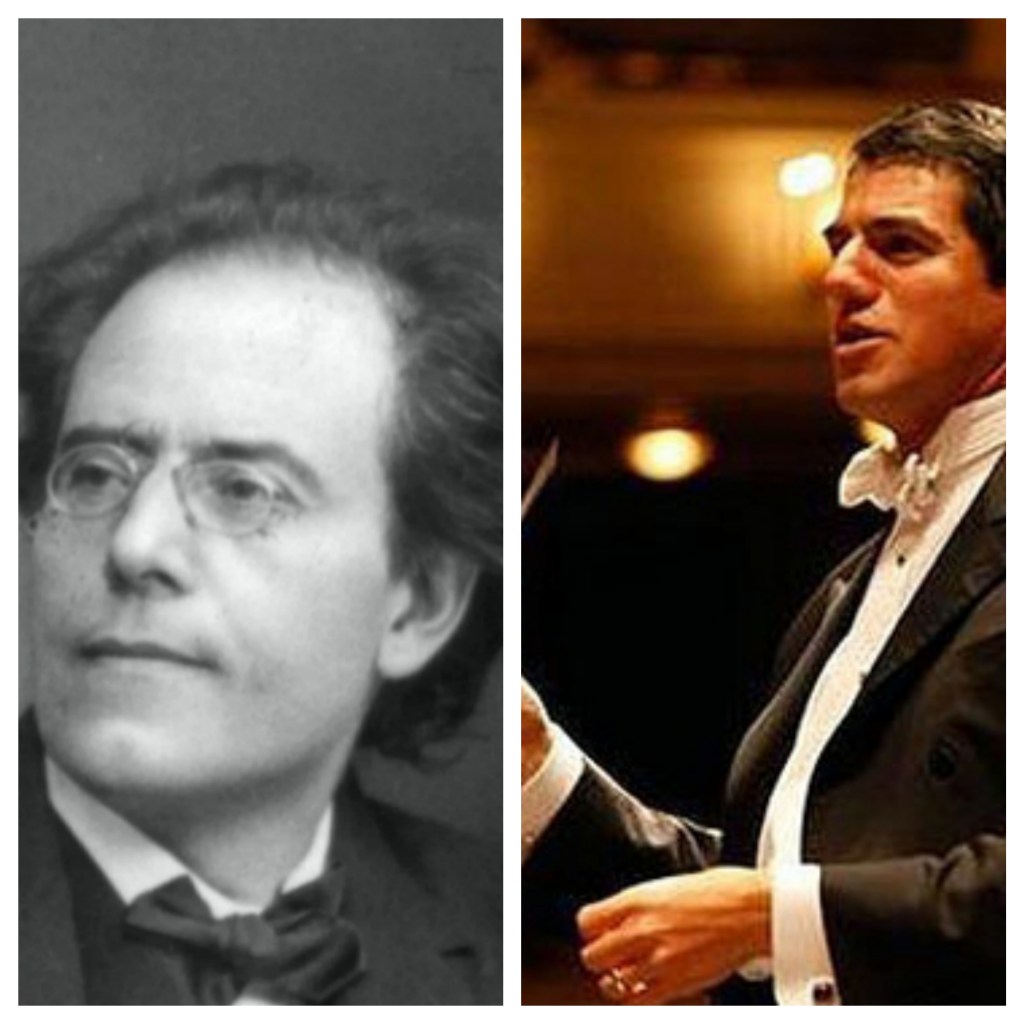
One of the impressive things about Mahler’s music is that the man looms out of the music. He is present at these performances, with the conductor becoming his alter ego and we are presented with the man and his struggle to express himself through his music in a way few other composers manage to do.
Mahler had a relationship with Sigmund Freud both as a client as well as friend and in much of his Symphony No 4 the music appears to be attempts to understand his inner psychological states. As an autobiographical work it alludes to the composer’s personality as well as his own family’s encounters with death and despair.
Central to the symphony is the song “The Heavenly Life” which is sung in the final movement. The song is a child’s version of heaven, but as with his other works this childlike, innocent vision is tempered with notions of death.
Mahler’s task was to complement the naive, childlike tone of the poem, and also the convey the ethereal lightness of heaven. The orchestration is light and the instrumentation distinctive, with bells, flutes and pianissimo strings. The soprano solo adds the final heavenly quality.
Mahler’s symphonies have so much drama, invention and contrasts that it would probably easy for them to be conducted without too much control but conductor Miguel Harth-Bedoya, was quite clearly in controlling the orchestra so that subtle nuances were made evident and individual instruments were allowed to shine.
The contrasts and contradiction in the music need to be realised and Harth-Bedoya and the orchestra achieved that, providing sounds that ranged from the from the childlike to the mature and from the bold strokes to the simple gesture.
The first movement with its sounds of sleigh bells evoking the child’s delight in Christmas are soon followed by darker undertones. Then there was an exquisite passage of angelic voices delivered by the four flutes and later the sound of the bells themselves seem to cast an ominous sound.
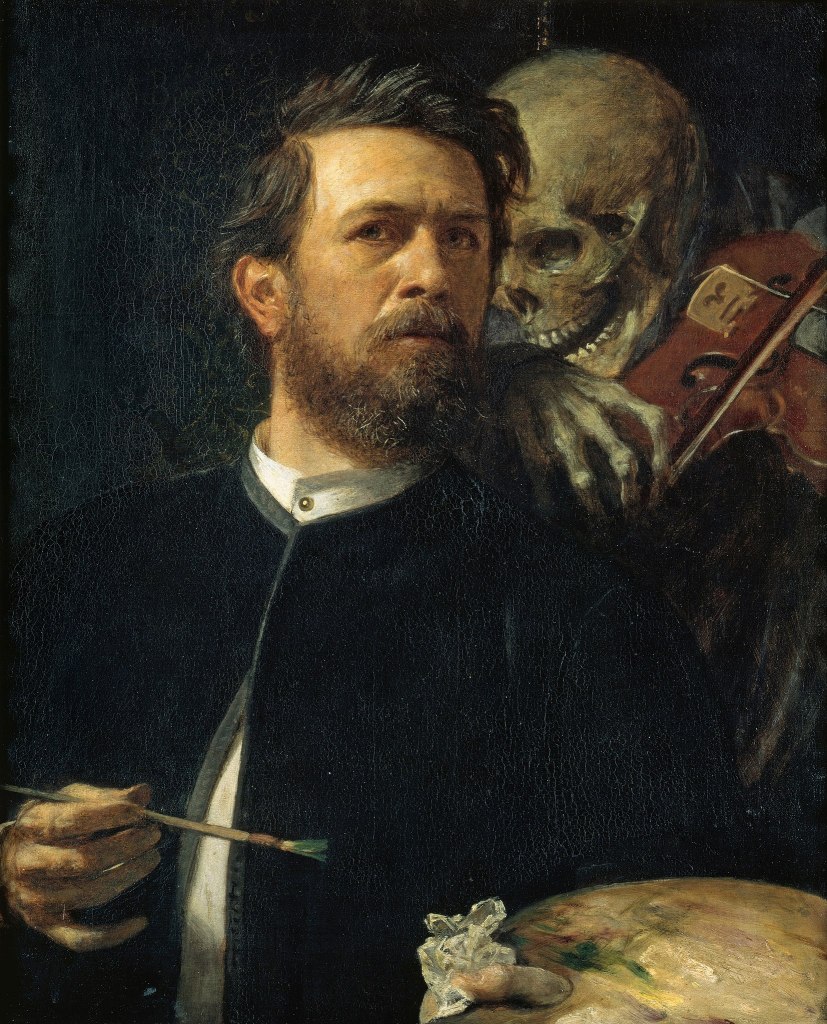
“Self-Portrait with Death Playing the Fiddle” by Arnold Böcklin
The second movement picks up on themes we heard in Gabriella Smiths work with numerous references to Nature, birds, Spring and an awakening again there is a darker element which refers to the painting “Self-Portrait with Death Playing the Fiddle” by Arnold Böcklin which obsessed Mahler. This image was given form by Concert master Vesa-Matti Leppanen playing on a slightly discordant gypsy violin
Harth-Bedoya created some enchanting ethereal moods in the third movement “Ruhevoll” (Restful) where the music conveys the transition from earthly state to heavenly life
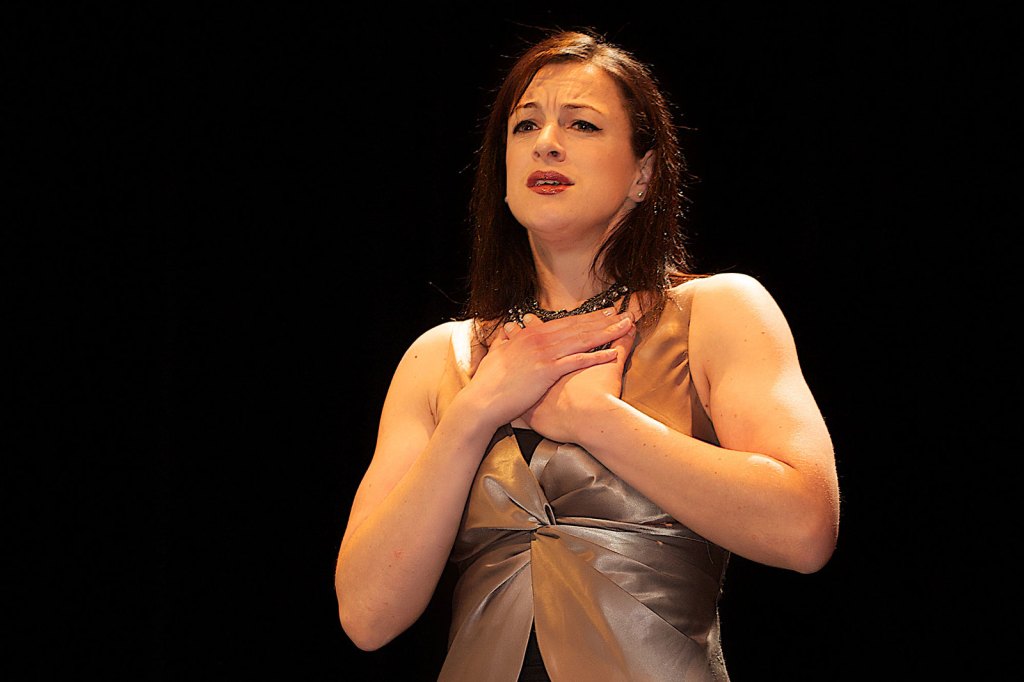
Madelaine Peirard gave an impressive performance in the final movement singing “Das himmlische Leben” (The Heavenly Life). From the outset, this movement had been the destination and source of the entire work with many of the previous musical themes repeated in the song, its motifs creating a sense of arrival and completion.
Madelaine Peirard
While the poem is a depiction of heaven as seen through the eyes of a child there is also a disconcerting element and one of the verses has the lines
‘We lead a patient
Innocent, patient
A dear little lamb to its death”
Rather than singing in the childlike voice which Mahler seems to have preferred she took on the voice of an angel carrying the work with an astute understanding
She inhabited the stage with a real presence giving the song and expressive, vibrancy which was at time ecstatic and at others tender and joyful.
THE ARTIST Created by Thom Monckton & Sanna SilvennoinenQ Theatre
A Mulled Whine Production
Q Theatre
November 8 – 12
Previewed by John Daly-Peoples
“The Artist” was on at the Auckland Arts Festival a couple of years ago and at the time I wrote the following review.
“The Artist” should come with a warning – make that two warnings. Don’t sit in the front row. You could get to go on stage as The Artist’s stooge. Also, if you can remember where it is, bring along a table tennis paddle.
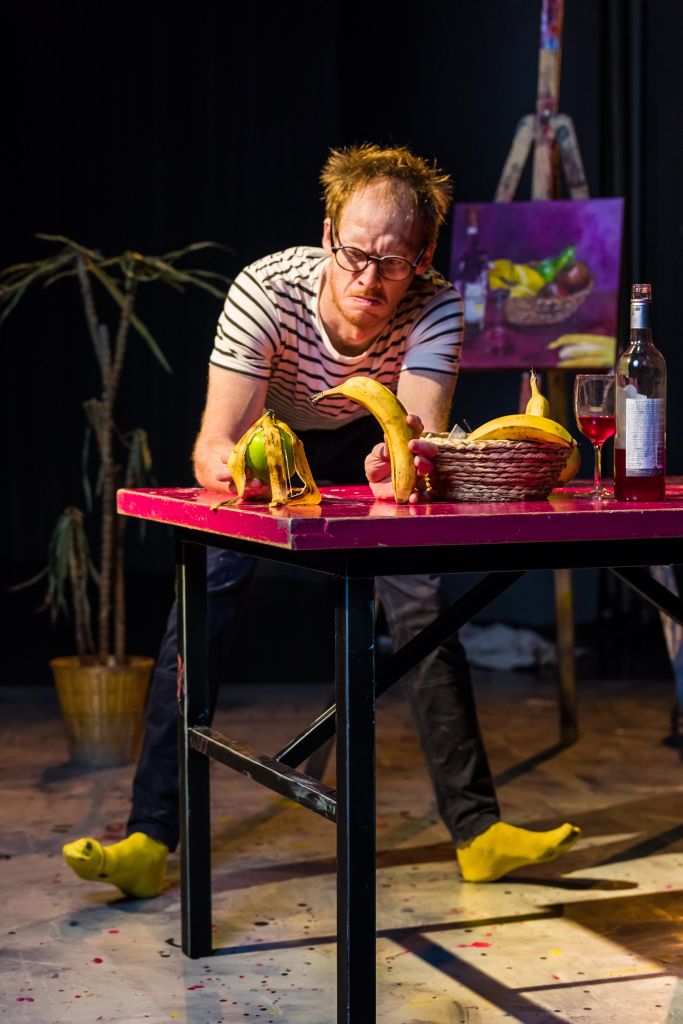
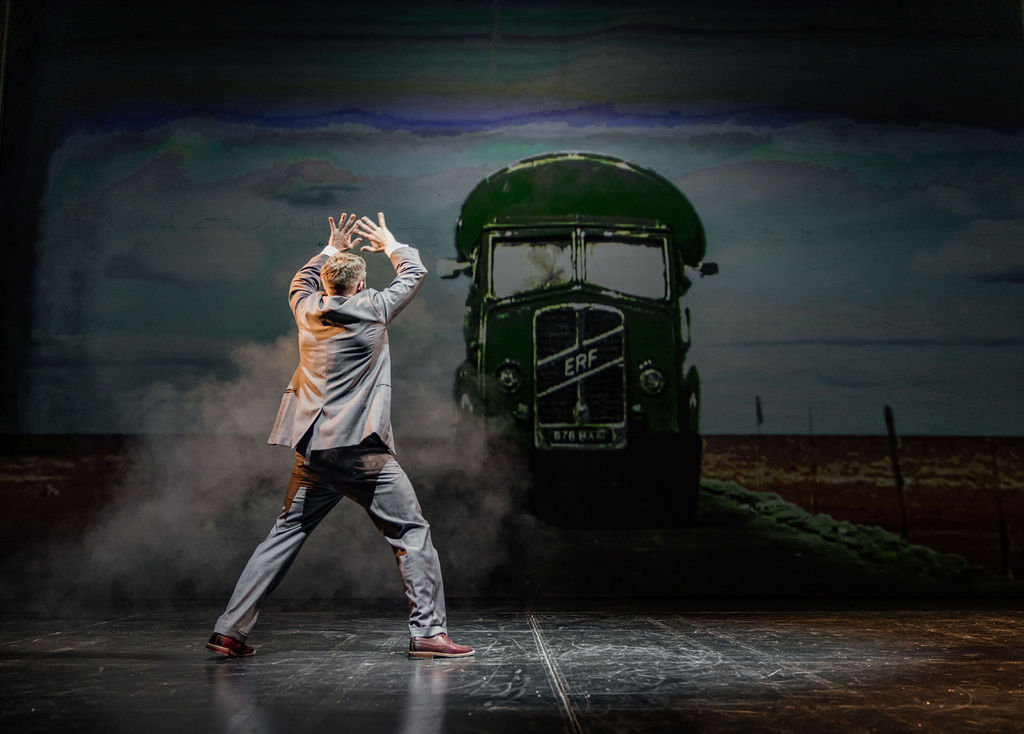
We are in an artist’s studio where we encounter The Artist (Thom Monckton) who over the course of an hour produces / assembles / finds several artworks which in the end are brought together for an art exhibition. Monckton explores a number of the tropes about art and artists which he plays with or gets lost in.
He must be a French artist because he wears a blue and white striped top but no beret – so he is bit like Picasso, but his activities have him more like Marcel Marceau the great mime artist. But then again he is also disconcertingly like the very un-French Mr Bean.
Monckton is a conjurer, acrobat, mime and contortionist who creates endless visual jokes, making use of the artists equipment and the everyday items of the studio. His attempts to get hold of a brush have him entangled in a table, a set of shelves and a rogue ladder while his attempts to secure some fabric to a stretcher with a staple gun are complicated, hilarious and dangerous.
There is an elaborate set-up around a still life where the fruit are given a life of their own and the traditional image of a bowl of fruit, bottle of wine and glass gets reworked in a clever visual joke where the artist paints one of the real green apples red so it matches the apples in the painting .
There was a bit of audience involvement. One young woman was cajoled onto the stage to sit for a portrait and then got given the job of painting artist’s portrait. There is also a rapid game of ping pong (remember the paddle) as he fires balls into the audience. The audience provided feedback with waves of laughter, but Monckton was particularly concerned with the chuckles of a young child pointing at his watch, letting the parents know it was past the young ones bedtime.
Monckton displays brilliant timing and pace in a mixture of physical theatre, mime and visual humour which makes this act classy and entertaining.
While he is silent apart from a few guttural phrases the background sound and music are brilliantly integrated into the performance.
THE ARTIST performance schedule Tauranga 12 October, 6:30pm Addison Theatre – Baycourt As part of ESCAPE Festival
Auckland 8 – 12 November 7:30pm Tuesday – Thursday l 6:30pm Friday – Saturday Rangatira, Q Theatre Book at qtheatre.co.nz
New Plymouth 15 November, 6pm plus schools performances on 16 November Theatre Royal – TSB Showplace As part of the SpiegelFest
Making Space: A history of New Zealand Women in architecture
Edited by Elizabeth Cox
Massey University Press
RRP $65
Reviewed by John Daly-Peoples
The names of major female architects don’t feature greatly in the history of architecture. Recently there has been Zaha Hadid who was the first woman to win the Pritzker Architecture Prize but there have been few successful women architects with important architectural and design careers such as the American Julia Morgan who designed several hundred buildings including the famous Hearst Castle.
There was also Eileen Gray who may have inspired some of Le Corbusier’s thinking and the designer Charlotte Perriand who created some of the furniture credited to Le Corbusier.
However few could name a successful New Zealand female architect.
Now a new book, “Making Space” looks at the history of New Zealand female architects and designers
The book has been edited and substantially written by Elizabeth Cox along with 30 leading women architects, architectural historians and academics. They have contributed original research as well as personal accounts of involvement in the profession and include information about many whose careers have until now been lost to the historical record. It also looks at those using architecture to benefit communities, the careers of women in associated industries, and the changes that have resulted in improvements to working in the profession.
We are introduced to some women who designed building at the beginning of settlement in New Zealand. There was Marianne Reay who designed St Johns Anglican Church in Wakefield just out of Nelson in 1846 and there were Ellen and Mary Taylor who designed and built the original James Smith’s store on Wellington Cuba St in the late 1840’s.
These women and others were not trained as architects but applied practical skills to their designs.
Later women gained more formal training with woman such as Kate Beath who was contracted to an architectural firm in Christchurch in 1908 where she began her studies.
Later there was Lucy Greenish who is considered to be the first woman to establish her own practice as an architect in Lower Hutt in 1927. In 1913 she was the first woman to have been elected as an associate of the New Zealand Institute of Architects having worked in architectural practices since 1908.
There is an account of the life of the entrepreneurial Esther James who not only worked as an architect but was also a developer and builder, where she made her own concrete blocks. Her main claim to fame was walking the length of the country in the 1930’s to promote New Zealand made goods and then repeating the activity in Australia walking from Melbourne to Brisbane.
The book is filled with histories of the many women who have been associated with the profession but often on the edges along with accounts of the pioneering women of the mid twentieth century such as Lillian Chrystall through to Julie Stout becoming the first woman to win the NZIA Gold Medal this year.
As the book moves into the latter part of the twentieth century and into the twenty-first century there has been a notable shift as women graduates have increased. In the 1960’s and 70’s there were only ever one or two women in each year at the Auckland University School of architecture, now there is parity.
Generally, there has been a low participation rate of women in the field for a number of reasons including lower salaries, lack of equity and worker well-being in the workplace, lack of role models and mentors and the undervaluing of women’s qualifications and competence.
The book focusses on the way in which societal and workplace factors have led to a more collaborative approach which has seen women adding other skills and perspectives to the profession.
This aspect was realised early on, and Thomas Wilford, one hundred years ago during a parliamentary debate on the NZIA stated “I believe that women architects in this country would bring about the building of a better class of house than we have today”
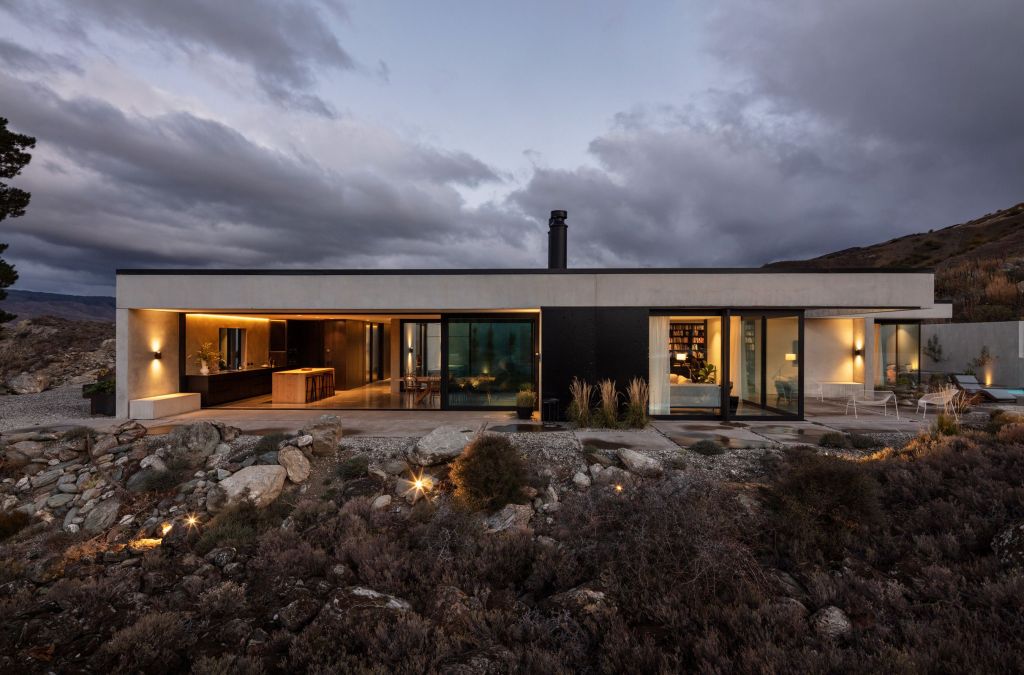
Women architects now feature at all levels within the profession and they are a designing an impressive range of building. One notable architect is Bergendy Cooke whose Black Quail House was Home of the Year in 2021. She has also worked international including work on Zaha Hadid’s MAXX museum in Rome.
Bergendy Cooke, Black Quail House
While the book looks at the rise of women architecture it also touches on the changes which have occurred generally in the education, development of the profession and changes in ideas about architecture. It also highlights the growing number and impact of Māori woman in the profession.
The book is a significant resource with over 400 photographs and mention of over 500 women which will add greatly to our understanding of the development of architecture in New Zealand and the impact of individual architects.
Antonia Prebble (Eve Kendall) and Ryan O’Kane (Roger O. Thornhill) Image Andi Crown
North by Northwest
Written by Carolyn Burns
Screenplay Ernest Lehman
Directed by Simon Phillips
Auckland Theatre Company
Auckland Waterfront Theatre
Until November 19
Reviewed by John Daly-Peoples
“Roger. This is silly”
So says Eve Kendall to Roger Thornhill after being rescued off the face of Mt Rushmore at the end of “North By Northwest”. the latest production at Auckland Theatre Company.
She is right. The whole play seems to be a bit silly, continually turning the dramatic events which occur throughout the play which have been lifted from the film into comic moments.
The play follows the movie scene by scene and also word for word. Just in case you haven’t seen the movie the plot concerns Roger Thornhill (Ryan O’Kane) a twice-divorced New York advertising executive who is mistaken for a man named George Kaplan and abducted by criminal masterminds. He escapes their clutches and a thrilling chase ensues taking him from New York to Chicago and all the way to South Dakota.
Over this time he is variously force-fed bourbon, arrested, beaten up, seduced, shot, pursued and nearly blown up by a plane and then chased across the stone heads of the presidents at Mount Rushmore.
What was a spine-tingling drama has been turned by director Simon Phillips into a witty romp which takes all the tropes of the chase / espionage movie and gives them a comic twist.
In many ways the approach emulates Hitchcock’s own style of working with humour not far from the dramatic action and although Roger Thornhill is an ordinary man caught up in events out of his control, he also demonstrates a few James Bond qualities.
Phillips and designer Nick Schlieper’s set uses simple props on wheels, supported by a square metallic grid of walls that becomes doors, balconies and the edges of buildings. On either side of the set are production suites where miniatures are filmed and projected onto the rear of the stage to enhance the on-stage action. Car chases are filmed using a rotating model hillside, a model plane replaces the biplane from the film and four of the actors faces replace the presidents on Mount Rushmore.
Image: Andi Crown
Cary Grant who played the original Thornhill with a mixture of bafflement and nonchalance but in the play Ryan O’Kane goes for more of the utterly panicked as he races from disater to disater with a pace and animation which is riveting.
Antonia Prebble in the role of the femme fatale Eve Kendall, the professional spy and part-time seductress is totally convincing and an ideal foil to O’Kane.,
The other ten members of the cast paly a myriad of roles from cops, train steward, FBI agent, clerks, auction-goers with Roy Snow as the arch villain Philip Vandamm,
In the effort to mimic all the scenes from the film the play suffers occasionally from some unnecessary and overly hectic scenes. At least the actors haven’t spoilt the fun by trying out bad American accents.








 New Zealand Arts Review