John Daly-Peoples
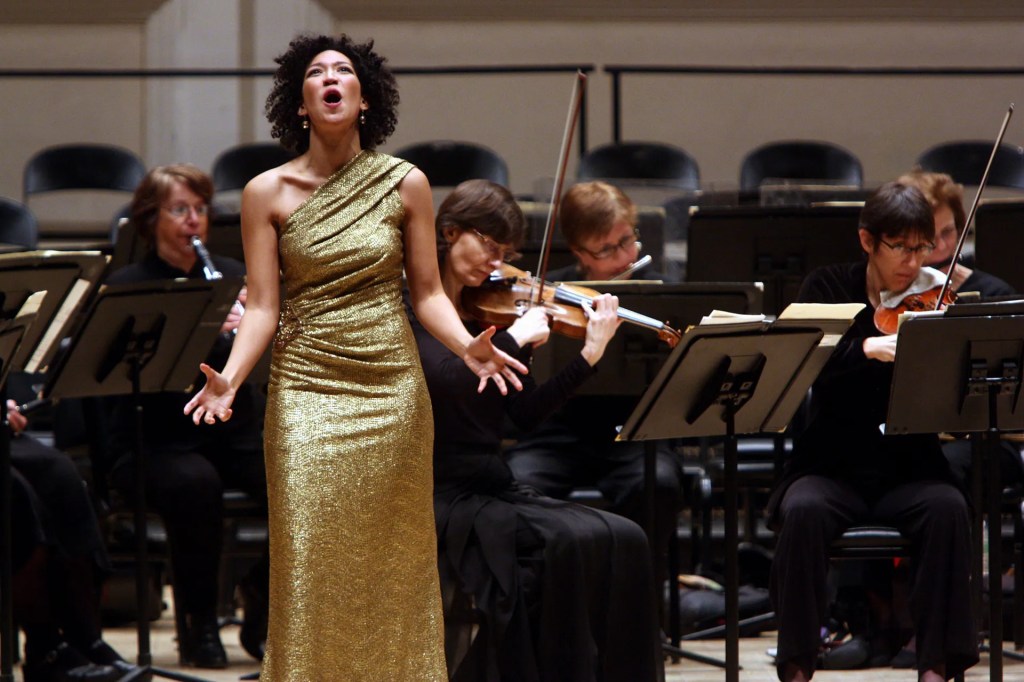
Julia Bullock, Bluebeards Castle, Sincere Apologies
The New York Classic review last year featured a review of Julia Bullock by Rick Perdian
“It would have once been almost impossible to imagine a vocal recital by a major artist with songs by Alban Berg, Bob Dylan, and Rodgers & Hammerstein on the program. These are different times, however, and what once would have been dubious box-office is now perfectly attuned to the times.
Bullock opened the recital with songs by Samuel Barber, whose embrace of Romanticism put him at odds with the more progressive elements of the musical establishment in mid-twentieth-century America. The three songs which she sang—“My Lizard (Wish for a Young Love),” “Nuvoletta,” and “The Daisies”—outlined the wistful nostalgia, zaniness, and embrace of the bizarre that would course through the recital.
As with the Barber songs, Bullock performed songs by Kurt Weill which spanned the composer’s career from his collaboration with Bertolt Brecht in Germany to his Broadway hit, Lady in the Dark.
The outlier was the first, “Complainte de la Seine,” which Weill composed in Paris after fleeing Nazi Germany. This setting, like earlier songs dating from Weill’s collaboration with Brecht, “Ballade vom ertrunkenden Mädchen” and “Song of the Hard Nut,” show the composer at his most hard-edged and bleak. With crystalline tone, perfect pitch, and a delivery void of sentiment, Bullock sang of cadavers resting at the bottom of the Seine, the Marxist revolutionary Rosa Luxemburg’s decaying corpse in a Berlin canal, and the calculated transactions that fuel capitalism. With “The “Princess of Pure Delight,” Bullock switched gears, projecting a cool sophistication that evoked the era.
Bullock’s most sublime singing came with Berg’s Altenberg Lieder. Viennese audience’s greeted the songs with such derision in 1913 that Berg never permitted them to be performed during his lifetime. The five songs are settings of enigmatic verses by the poet Peter Altenberg which he sent to friends on postcards.
A substantial portion of the second half of the recital was devoted to songs by Richard Rodger and Oscar Hammerstein. Bullock told the audience that their music had been a part of her life from her earliest years growing up in St. Louis. “Dites-Mois” from South Pacific was the first song that she ever sang in public at the age of ten before an audience of thousands.
The audience was enthralled as Bullock sang some of the greatest hits from The Sound of Music and South Pacific. For the most part, these were straightforward renditions of beloved songs, but Bullock and Brown could be provocative, such as in “You’ve Got to Be Carefully Taught” from South Pacific. Bullock delivered the song’s message with a matter-of-fact directness which was intensified by Brown’s punctuation from the piano.
There were also songs linked to Odetta Holmes,who was known as the voice of the American civil rights movement in the Sixties. Bullock sang Bob Dylan’s “Masters of War” with a penetrating, unflinching directness. Odetta’s arrangement of “Going Home” and Elizabeth’s Cotten’s “Freight Train” followed.
Bullock ended the recital with Converse’s poignant ballad “How Sad, How Lovely,” a meditation on the loveliness and sadness of life.”
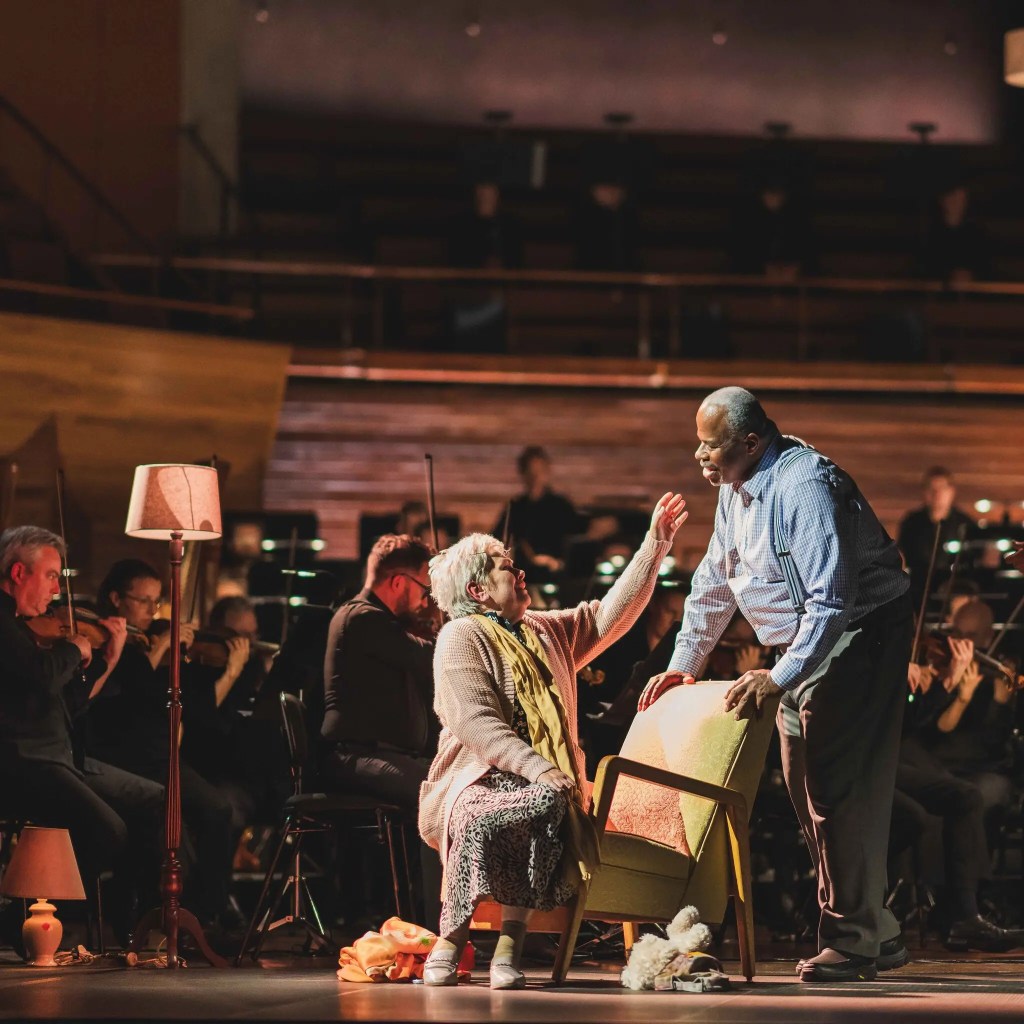
This version of Bluebeards Castel was previously performed in Wellington and Christchurch in 2023. Elizabeth Kerr reviewed the work in Five Lines.
“The dramatic trajectory of this contemporary production of Bluebeard’s Castle is vivid and deeply moving from its opening bars till the passionate conclusion. ..For me, its greatest wonder is the faithful use of the original text and music to tell a tragic story of today, a superb creative reimagining of Bartók ‘s only opera.
Bartók wrote Bluebeard’s Castle in 1911. He was 30 years old. The Gothic work, with a libretto by the composer’s friend, poet Béla Balázs, was based on the French folk tale published in the 17th century by Charles Perrault.
The opera has a singing cast of two with a full orchestra. The role of Bluebeard is sung in this New Zealand performance by US baritone Lester Lynch, and his wife Judith by UK soprano Susan Bullock. As the semi-staged production opens, the strings of the NZSO set a rather creepy mood. The couple arrive onstage, Judith appearing confused and troubled. “If you left me, I’d be lost and all alone here,” she sings.
In the original, Judith was Bluebeard’s very young wife, brought to his cold, dark castle and confronted by seven locked doors, which open in turn throughout the opera, revealing their disturbing contents. The locked doors are replaced by a suitcase, and from it are drawn contents representing memories of Judith’s life and their relationship.
Bluebeard’s Castle is often described as a Symbolist opera and symbolism remains strong in this production. ..This is the writing of a young Bartók, strongly influenced by Romantic composers and Debussy, and his score, including the challenging and chromatic vocal lines, is beautiful, colourful and lush. It is also highly dramatic and alongside the theatrical symbolism are meaningful musical motives, most noticeable the “blood” motive of a minor second, a semitone, appearing whenever Judith, remembering past losses and fears, refers to blood.
A final “door” brings the impassioned denouement. “When this door is opened, Judith, you will find my wife there waiting”, sings Bluebeard, handing her a mirror from the suitcase. The poetry in the libretto really blooms here, as Bluebeard sings of his former wives, the young lover, wife of the dawn, the young wife of his “noontime”, the mother, wife of his evening.
The younger wives return, also holding mirrors, and as Bluebeard sings of each, Judith offers a repetitive and sad little refrain from her chair. “Ah, compared to her, I am nothing.” But she is, he tells her, his wife of the night. Musically, Bartók brings the opera to its big romantic climax. “Eternal beauty!” sings Bluebeard. “Now, all turns to darkness.”
The mood in music and staging fades quietly. Tenderly, Bluebeard brings Judith a cup of tea. The lights also fade to blackness.”

“Sincere Apologies” is an Australian production with relevance to New Zealand with a recent review of the production in “My Melbourne Arts” praising the low key, audience based play.
“Sincere Apologies” begins unassumingly: an envelope is handed to an audience member and it is passed from hand to hand. No words are exchanged, no introduction is made, no actors are present. It’s just a low-key game of “pass the parcel” that opens the door to a chorus of voices and a world of regret.
Fifty real apologies are sealed inside fifty envelopes that are distributed to the audience. These span from 1990 all the way into the future, each one factual and collected from documented expressions of remorse by public figures, private correspondence, and personal moments by the shows three creators, Dan Koop, Jamie Lewis and David Williams. One by one, in numerical order, audience members step up to a microphone and read them aloud.
Some are weighty and political – a Prime Minister’s apology to the Stolen Generation or BP’s statement following an oil spill. Others tap into pop culture’s hall of infamy – like Kanye West and Taylor Swift. Then, there are the apologies from the creators themselves, adding a deeper intimate layer to the mix.
There are no actors in Sincere Apologies. No one introduces the show or welcomes the audience. Even at the end, when we clap, it’s not for performers on stage, but for each other, and the three tech staff quietly stationed in the corner. The audience is the cast, and in that shared vulnerability something almost communal forms. Strangers stumble over words, laugh nervously, or surprisingly choke up. You start to listen differently, not as a spectator, but as part of a temporary community bound by confession.
As the reading unfolds, you find yourself unexpectedly drawn in, paying attention not only to the words themselves, but to the way they are spoken. Stripped of power, fame, and PR polish, these words take on new meanings. When random people speak them, they can come across as absurd, hollow, or even heartbreaking and genuine. The performance asks: what happens when we remove status from an apology? Can tone, delivery, and intent make any acknowledgment register as authentic – or insincere?
A carefully crafted score heightens the work, as subtle sound effects and rhythmic pulses heighten particular instances, building a hypnotic rhythm that pulls the audience into this collective act of reckoning.
By the end, this experience is strangely moving. There’s humour and absurdity, yes, but there is a weight to hearing the people in the room attempt to make things right. It’s exhausting and cathartic, and a reminder that “sorry” is both universal and endlessly complicated.”

 New Zealand Arts Review