John Daly-Peoples
Visitors
A Theatre Times review by Bronwyn Carlson.
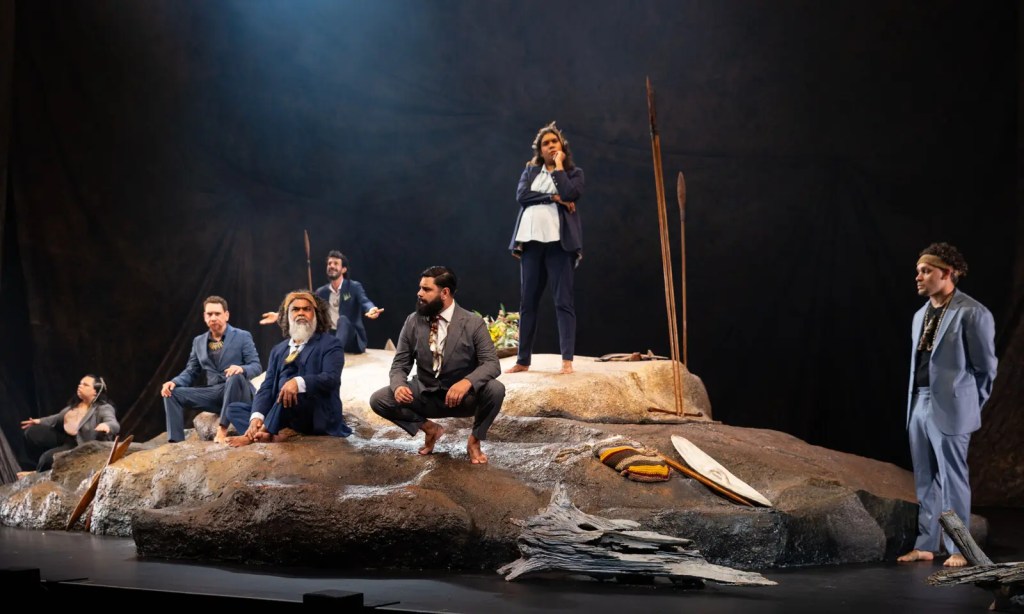
“It is 1788, and six senior lawmen (with one young man sent as a representative) witness the arrival of the First Fleet. The play features a talented cast: John Blair, Damion Hunter, Colin Kinchela, Nathan Leslie, Leroy Parsons, Glenn Shea, Kerri Simpson. As we approach the 250th anniversary of Cook’s arrival, this play is timely and fresh given the paucity of publicly available sources that document first encounters from an Indigenous perspective. Visitors had come and gone for many years and the play includes reference to Cook’s visit 18 Summers prior. But previous visitors always left.
Humour provides relief to this intensely imagined moment in history. The Visitors is written by Jane Harrison. Dir. Frederick Copperwaite. Carriageworks Theatre, 2020. Photo: Jamie James.
The script involves much discussion about whether to engage in war or allow the visitors to come ashore. After lengthy debates, the men notice that the visitors are landing. They make the fatal decision to welcome them. The Visitors’ dialogue is witty and satirical. The men at its center describe the visitors in derogatory ways that mirror the way colonizers described us – “wretched people” with nothing to offer.
The Design
The set is beautifully designed with large trees framing the meeting place. Fog drifts in, allowing the audience to imagine a time long ago by the ocean. The sound of the sea and birds amplifies the experience.
The men are dressed in suits symbolizing their status in contemporary terms. They are given clan names that relate to Countries such as Eel clan or Bay people. This avoids any contest around traditional boundaries and clan names.
Personalities, But Where Are The Women?
Aboriginal protocols are clear – the men pay respect to the Country as they each arrive. Formal proceedings begin with being welcomed onto the Country, just like what the audience experienced before the performance.
Formalities aside, there is also a lot of humour in this play. Fun is made of one of the men who has complained he can’t connect with his new wife. Grandfather Elder examines him and concludes that his new wife probably just doesn’t like him. Personalities are clear – something that is often missed in the colonial writing of Indigenous peoples. We are human, we laugh, we disagree and we engage in combat, revenge, grudges, and all manner of human frailty.
The experience could have only been improved by the inclusion of Aboriginal women in the cast. The women, we are told, are away on Women’s business and although they are often referred to, are missing from the decision making process. In one scene one of the men refers to women as “spoils” of battle and in another, after hearing the younger man simulate the mooing of a cow, a comment is made that it sounds like his wife. Perhaps this is just banter between men, however, historically a range of tropes have been used to typecast Aboriginal women into roles imagined by the colonizers.
The women’s absence suggests there was — or is — a lack of senior Aboriginal women knowledge holders. The truth is far from this assumption. There is ample evidence Aboriginal women were involved in early interactions, amicable and otherwise, with early settlers. For example, it is believed local fisherwoman Barrangaroo — noted for her presence and authority — was present at the first meeting between settlers and her Cammeraygal people at Manly in 1788, and also participated in warfare with settlers at North Harbour in November 1788. She is remembered in early colonial documents as having a commanding presence, inciting respect and fear in those around her. Likewise across the country, there are stories of Aboriginal women emerging including their heroic efforts to defend Country.
A review of A Place in the Sultan’s Kitchen (or How to Make the Perfect One-Pot Chicken Curry) by Nance Haxton in Brisbane’s Indaily
“There aren’t many shows where you emerge and say the play was as good as the food, but A Place in the Sultan’s Kitchen (or How to Make the Perfect One-Pot Chicken Curry) certainly passed the taste test.
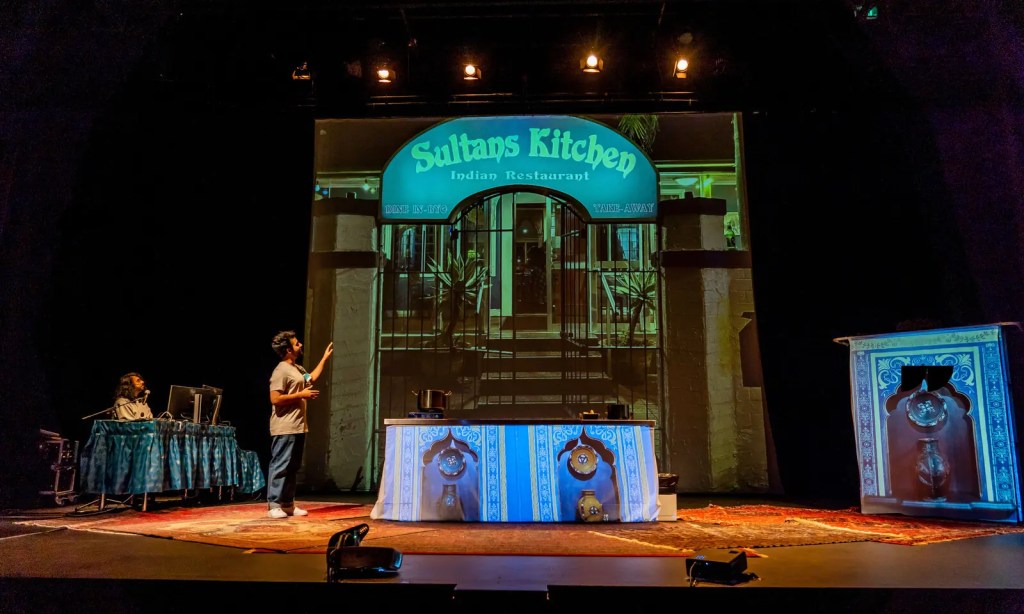
Telling the multi-layered story of his family’s past while cooking his grandmother Mehmeh’s chicken curry, Joshua Hinton recalls his heritage, sprinkled with a message so needed right now – that we are all not as far apart culturally as we think. And that food unites us all.
The Australian singer-songwriter unpicks his origins going back generations by skilfully weaving into his conversation audio interviews with his grandmother while the aromas of turmeric, garam masala, cinnamon, chilli, tomato and chicken float over the audience like a spell.
The spice bottles from his onstage kitchen become integral parts of the story, with photos of his family emerging from the spice rack to become characters in his grandmother’s recollections. Kitchen utensils magically becoming war planes in war stories.
Joshua’s brother Dominic is also on stage throughout, on guitar and supporting his brother by controlling multi-media shots from a range of angles around the kitchen to highlight crucial elements in the evolution of the curry. This all reveals aspects of Joshua’s identity, living between cultures.
For Brisbane lovers and appreciators of Sultans Kitchen, a staple of the Paddington foodie scene for more than 40 years, this is somewhat compulsory viewing to see the incredible challenges that the founders of this Brisbane institution overcame to build this restaurant.
Hinton is a skilled storyteller as well as musician, wrapping up his culinary journey around the world with an original song sung with his brother, satisfying all the senses before the audience steps outside to partake of the chicken curry that formed the backbone of the tale. It was a beguilingly simple device executed perfectly, and a night to remember.”
A review of Duck Pond in The Guardian by Lindsey Winship
“Australian company Circa are masters of modern circus, often eschewing obvious exhibitionism, and instead weaving acrobatic skills with a dance and theatre sensibility to make mood pieces. Previous works have considered the plight of refugees (The Return), tragic tales of Orpheus and Eurydice or Dido and Aeneas, and have taken on music from Stravinsky’s Rite of Spring to Beethoven’s Ninth – all serious business.
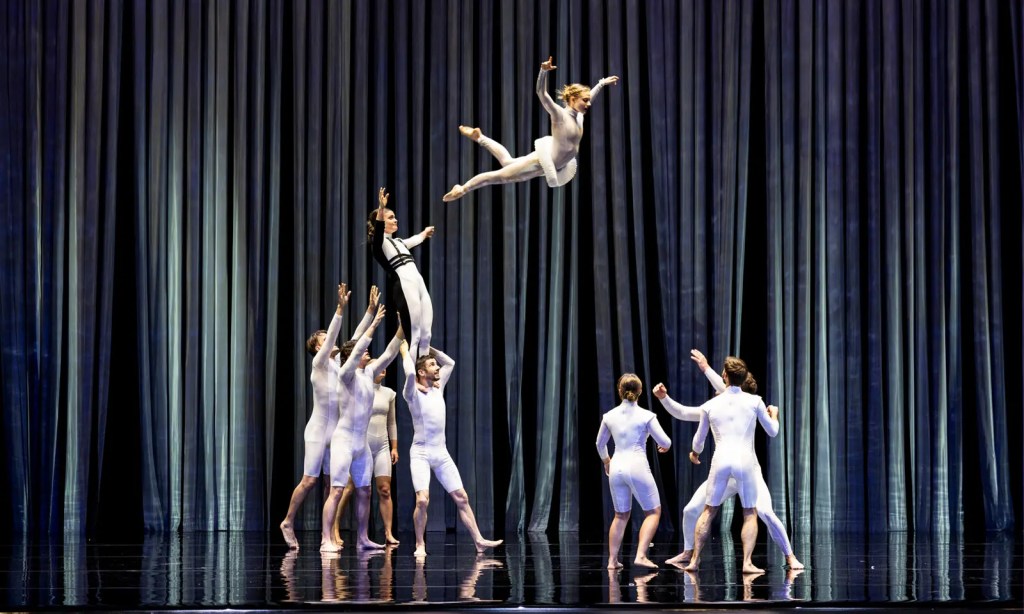
Duck Pond is, on the surface, a less serious proposition. The name is a parody of Swan Lake and it borrows from the famous ballet – shards of Tchaikovsky’s score feed into Jethro Woodward’s soundtrack – and also from another fairytale, the Ugly Duckling. So we get a love triangle of sorts between a prince, an ugly duck and a vivacious black swan. The conceit might seem to promise a more conventional narrative, but it delivers something a little different. The mood is understated, classy, colours of black and gold, a clan of performers in shimmering velvet catsuits. The music is a constant underscore rather than a game of set-ups and climaxes.
There is a lot of beautiful skill on show. Acrobats climb up human towers; flyers somersault between bases. Their formations of three are especially inventive: ornate arrangements of bodies in fine-tuned equilibrium, toes anchored on hips, lower backs, shoulders, anywhere they can get a foothold. There are some lovely moments of flow between couples who lift and fling, curl and unfurl, balance and counterbalance. Bodies tie themselves in knots on the trapeze; others soar on the silks. The ugly duck is revealed to be a swooping swan; the black swan has a dominatrix moment walking over a man’s bare back in red stilettos. But there are lulls too, such as a pillow fight that turns into an anticlimax.
Story-wise, director Yaron Lifschitz puts a couple of nice twists on the Swan Lake narrative but it lacks a big emotional payoff. Low-key lyricism, rather than transactional tricks for applause is Circa’s way and Duck Pond is a lovely show, with warmth, skill and some wow moments, but you can’t help feel it could do with a dash more pizzazz.”

 New Zealand Arts Review