Reviewed by John Daly-Peoples

Dick Frizzell
The Weight of the World
Gow Langsford, Onehunga
Until October 25
Reviewed by John Daly-Peoples
Dick Frizzell’s latest show “Weight of the World,” at Gow Langsford could well be a reference to Ringo Starr’s 1998 comeback single of the same name which uses the phrase to describe the struggle of letting go of the past and embracing the future.
The exhibition is ambivalent in terms of the artist’s own life and work, linking the past with his history of breaking new ground. At times his work has seemed to be conservative, borrowing art of the past and outdated advertising images. But this reworking or appropriating images of the past can also be a way of charting new directions for his art.
The exhibition also alludes to his recently published autobiography “Hastings” with its references to growing up in small town New Zealand and the rural landscapes of Central North Island in which the young Frizzell’s encounters with the world of Hastings provide an almost heroic account of his life.
As the artist says “My landscapes occupy a special place in my affections because they define, more than any other of my endeavours, the most solid manifestation of my philosophy. Both the subjects and their manner of representation are chosen to emphasise my eternally optimistic faith in the physical universe that I believe we are ultimately destined to define. I hope… through my piles of hills, stumps, trees and land… to literally convey ‘the gravity of the situation’.”
While his paintings can be seen as simple descriptive works there is a complexity to their construction as well as their context and history. creating dense works about observation, contemplation and significance.

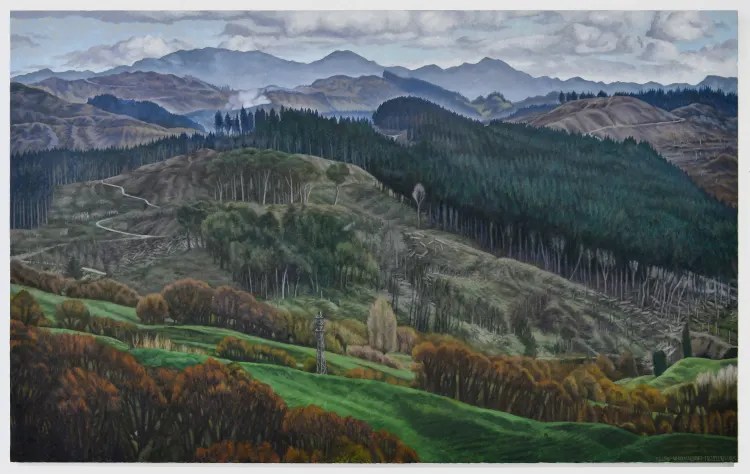
Several of the landscape images from the exhibition could have been illustrations to his autobiography such as “Dirt Road” ($27,500) and “Backtrack” ($45,000), images that are quintessential New Zealand scenes which link past and present with images which are both descriptive and metaphoric.
There is one work with the same title of the exhibition, “The Weight of the World” ($163,000). It depicts a large tree stump, a reference both to his own tree stump works of the 1980’s as well as those by artists such as Mervyn Taylor and Eric Lee-Johnson. These dead trees were both a symbol of modernism and change as well as an emblematic of the past and loss of identity.
Much of the artist’s work is imbued with this sense of nostalgia and Frizzell has regularly depicted aspects of New Zealand – a series of local businesses, the huts at Scott base and the controversial series of hei tiki works which all helped define the nature of New Zealand culture.
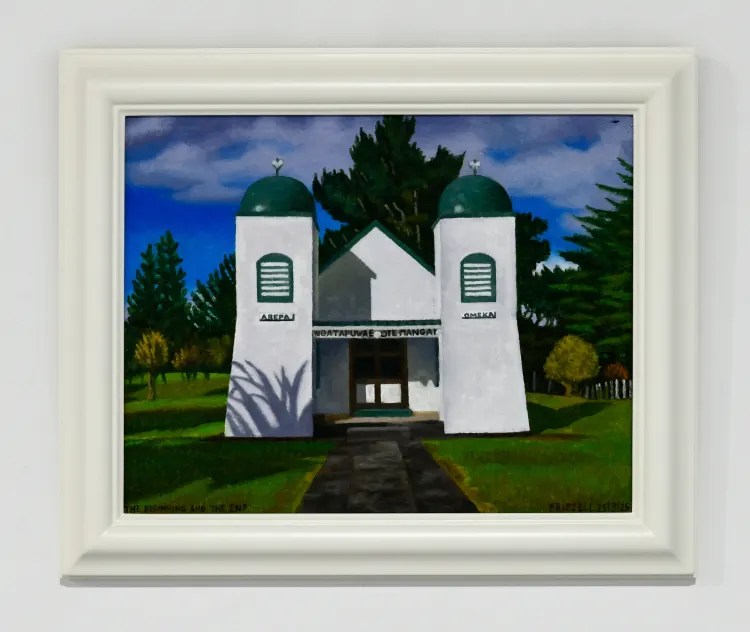
There are a few signs of habitation or figures in his works mainly small insignificant buildings, “Whitebaiter’s Huts” ($27,500) and “Leaning Toilet” ($27,500) but there is also a painting of a Ratana Chapel “The Beginning and the End” $27,500) displaying the words ārepa (alpha) ōmeka (omega), and the large panoramic “Autumn Morning Alexandra” $185,000).
The only paintings of a settlement in the exhibition are “Autumn Morning Alexandra, 2023 “($185,000) and “Alexandra Morning 2019” ($65,000) where the emphasis is on the natural aspects of the view, the distant hills, the colours of the sky and Autumn leaves as well as the surrounding vegetation. The largest work in the exhibition is “Milling Whakaangiangi” ($225,000), a celebration and recognition of the ever-changing face of the land.
As well as taking inspiration from the New Zealand artists of the early twentieth century there are acknowledgment of other artists – such as his Monet-like “Winter, Earnscleugh Road” ($55,000) and a nod to Winslow Homer’s lighthouse with his “Castlepoint”.

As with much of the artist’s work there is a wry humour in many of the paintings both in terms of the subject and the titles. A small painting of a pie is titled 
The exhibition reveals an artist addressing conflicted personal and national histories around land, seeing the land as both a record of our history and a metaphor for our changing identity, seeing the future looming out of the past.

 New Zealand Arts Review