Reviewed by John Daly-Peoples
Ascension
NZSO
Auckland Town Hall
August 9
Reviewed by John Daly-Peoples
The three works on the NZSO’s “Ascension” programme featured the responses of the composers to Nature with responses that ranged from encounters with the small incident to contemplation of its vastness and complexity.
Ralph Vaughan Williams’ observation and reflection on the simple action of a bird taking flight is turned into a metaphor for Spring and the awakening of consciousness in his “The Lark Ascending”.
The work opens with both bird and orchestra being roused from their slumber, the sounds of the orchestra capturing the notion of bird flight while the woodwinds and brass build a picture of the forest and bush
Inspired by the poem of the same name by George Meredith, the poem’s imagery of water and nature conveys a sense of fluidity and renewal, while the bird’s song inspires a profound sense of harmony and contentment.
Lines sauch as
For singing till his heaven fills,
’T is love of earth that he instils,
Show that Merdith and Williams saw their works as metaphors for both the simplicity and drama of Nature.
The orchestra’s brooding tones depicting a landscape blended well with the solo violin of Vesa-Matti Leppänen, the concert master of the NZSO. He managed to evoke a spirit of celebration tinged with a sense of the melancholic.
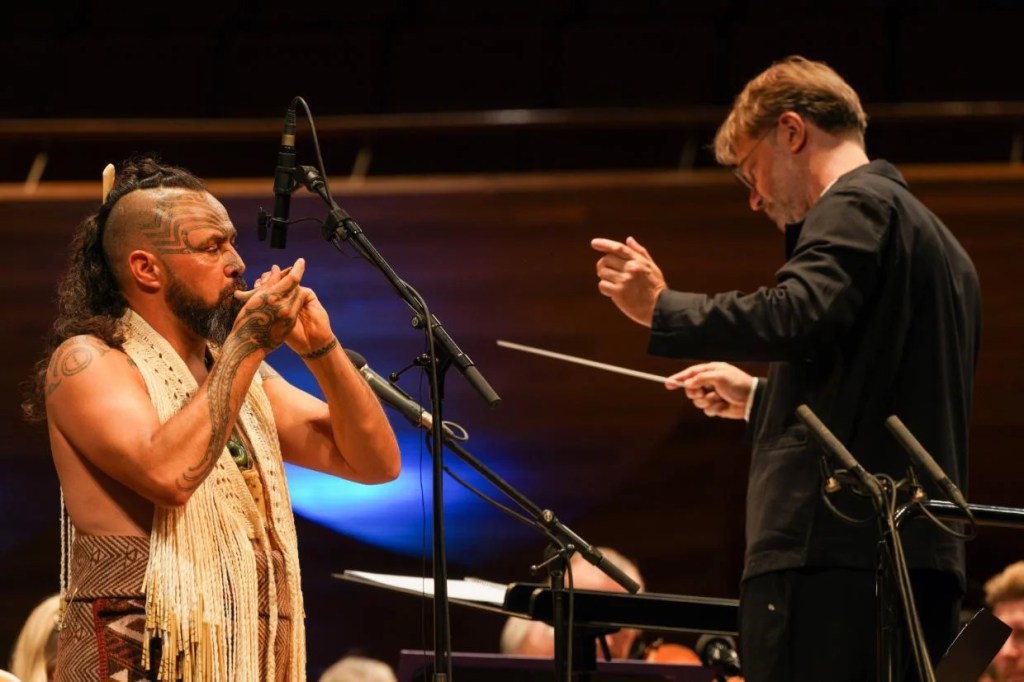
The central work on the programme was “Papatūānuku”, a joint collaboration by composer Salina Fisher and taonga pūoro specialist Jerome Kavanagh Poutama. It was a work honouring the Earth Mother, Papatūānuku and featured a number of instruments played by Jerome which produced music which replicated sounds of the natural world.
The musical landscape featured an intertwining of the orchestra’s instruments with the taonga pūoro which including pūtātara and pōrutu pounamu. Throughout the work the two groups of instruments called to each other with both sets of instruments replicating bird sounds. The percussion instruments of the orchestra, including the piano responded to the taonga pūoro, often mimicking their sounds. As well as bird calls Jerome’s instruments also captured the sounds of sea shore and bush. The work becomes a dreamscape of drifting sounds.
As the work progressed, we seemed to drift further and further into the bush, some of the instruments sounding like voices enhanced by the breathing of Jerome himself.
Jerome had laid out his instruments on a table covered with a Palestinian keffiyeh so his performance took on a reflective mood referencing Gaza where no birds sing.
The major work on the programme was Schumann’s “Symphony No 1 (Spring)”. It opened with a dramatic introduction ,something of a welcome to Persephone, the Goddess of spring, acknowledging her return from the underworld each spring, a symbol of renewal and immortality.
After the sprightly first movement there was the softness to the second movement which morphed into an heroic sequence featuring a vibrant dance. Here conductor André de Ridder took a few tentative dance steps to the music which flicked between the languorous and the dramatic. This-was followed by the Scherzo with its rapid tempo creating a sense of liveliness. before the final movement’s farewell to Spring.
Throughout the work the composer celebrated aspect of spring – the blossom erupting, the sounds of birds and animals and the cries of children at play.
André De Ridder has been announced as the NZSO’s next Music Director, and will take up the position in 2027.

 New Zealand Arts Review