Reviewed by John Daly-Peoples

Alexander Gavrylyuk Image Adrian Malloch
Tchaikovsky 5
Auckland Philharmonia
Auckland Town Hall
April 15
Reviewed by John Daly-Peoples
First up on the Auckland Philharmonia’s “Tchaikovsky 5” programme was Kenneth Young’s “Douce Tristesse”, a work composed in 2012 in response to the composer’s final visit to the long-time family holiday spot near Tauranga.
Strings and woodwind opened the work with a description of landscape, with swathes of colour conveying the changing light and textures of the land, sea and sky.
These vignettes were studded with musical highlights deftly conveyed by the small group of percussion instruments – cymbals, glockenspiel, crotales and harp suggesting the sparkles of light on water, the movement of clouds and the chirping of birdlife.
The work manages to suggest panoramic images from dawn to dusk suggesting the romanticism of the idyllic as well as a nostalgia for lost times and memories.
The composer says that the title ‘Douce Tristesse’ means ‘ sweer sadness and that the piece is about looking at a familiar scene for the last time, a view never to be seen again.
Prokofiev’s third Piano Concerto was written in 1921 during a period of self-imposed exile from Russia and a period when he did not feel oppressed by war or demands on his time and seems to have more leisurely ambience . The work was first performed in Chicago with the composer playing. The audience and press raved over the music with The Chicago Daily Herald calling it the “the most beautiful modern concerto for piano,”
It opens with the sounds of a clarinet and strings playing a floating melody emblematic of his own more relaxed life. This led quickly to pianist Alexander Gavrylyuk racing into the first movement of the work with fiery sounds from both orchestra and pianist who played as though the piano were a percussion instrument
Hunched over the piano his playing was by turns delicate and ferocious as he grappled with the various sequences. There were times when his sounds were languid and romantic and other times when he took a delicate almost spiderly approach to his playing.
In the second movement he turned the slow dance-like opening into a cacophony of jarring sounds and the intense finale of the third movement saw him in studious concentration.
He displayed a mastery of stylish playing, able to ignite the orchestra with his passion and drive.
His playing technique – changing tempos, charging through themes and varying the tonal qualities added to the excitement of the playing and appeared to enliven conductor Shiyeon Sung well as the orchestra.
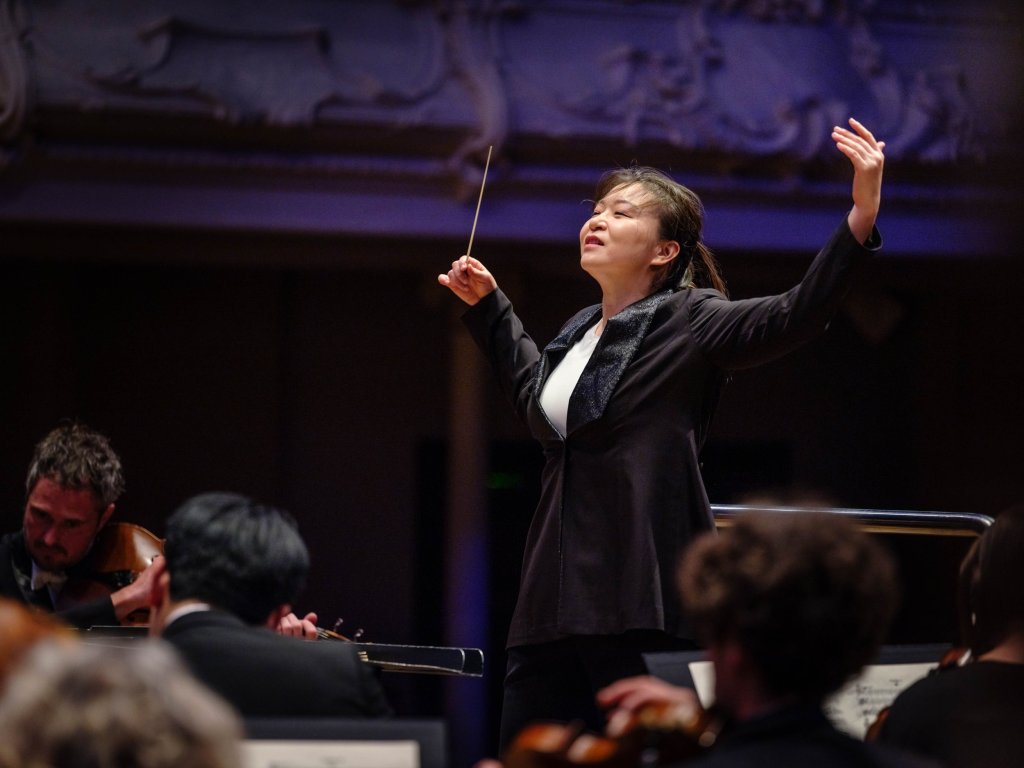
Shiyeon Sung Image Adrian Malloch
The major work on the programme was Tchaikovsky’s “Symphony No 5” which saw Shiyeon Sung and the APO deliver one of their outstanding performances. The work is full of sensuous melodies, intense emotions and dramatic climaxes which make it one of the composers more invigorating works.
Some of the sequences are monumental with music similar to his 1812 Overture while there were traces of his ballet music in others.
Sung deftly, guided the orchestra, building musical images, of landscapes, seasons and events creating a world of sensation and emotions.
There were joyous moments throughout the work but these were set against contemplative sections with the composer finding redemption in the grandeur of the work.
From the anguish of the first movement through the graceful mid-section and onto the final tumultuous fourth movement the orchestra provided a rich and satisfying performance.
While the orchestra was expertly conducted and the players superbly coordinated there were some stand-out performances by the bassoons, flutes, clarinets and French horns.

 New Zealand Arts Review