Reviewed by John Daly-Peoples

Groundwork: The Art and Writing of Emily Cumming Harris
By Michele Leggott and Catherine Field-Dodgson
Te Papa Press
RRP $60
Reviewed by John Daly-Peoples
Botanical painters have been an integral part of the botanical and artistic history of New Zealand since Joseph Banks accompanied Cook on his voyage to New Zealand and his publication of detailed illustrations of the exotic plant species he found here.
Since the time of Banks there have been many other artists who have devoted themselves to depicting the flora of New Zealand .A new book “Groundwork” by Michele Leggott and Catherine Field-Dodgson reveals one of the first women botanical artists in New Zealand. Emily Cumming Harris who was born in England in 1837 spent most of her life in New Zealand, mainly in the Taranaki and Nelson areas.
During this time, she painted numerous examples of plant life as well as landscapes, a number of which were exhibited locally and internationally.
Her works were exhibited at the Sydney International Exhibition in 1879, the 1880–81 Melbourne International Exhibition and the Colonial and Indian Exhibition in London in 1886. At the New Zealand Industrial Exhibition held in Wellington in 1885 she won first prize and a silver medal for a painted screen.

Throughout her life she also had solo exhibitions, selling a number of works, the sales of which provided useful financial assistance to her and her family.
The book documents her career as an artist and even though this was never to be a full-time career she amassed a large collection of images many of which are in public collections. Leggott and Catherine Field-Dodgson’s research, along with other individuals reveal a woman whose work lies between the scientific, botanical illustration and artistic.
The book has been the result of a lot of detective work, research in various museums and some family history. Michelle Leggott ‘s interest came about when she was researching about Emily’s father, Edwin who had painted several views of New Plymouth at the time of the Land Wars in Taranaki. His paintings are also included in the book.

The authors also discovered a number of paintings Emily had done of astronomical subjects – The Total Eclipse of the Sun in1885 and a double tailed comet in 1901.
The book includes a number of her poems which range in quality but the occasional one shows some literary skills and keen observation.
Her “The mountain looks down on the river” contains some lines which indicate an awareness of the situation of Māori.
But the forest which grew by the river,
And the flowers on the mountain that bloomed
Will they gladden our hearts for ever
Or pass like a race that is doomed?
In 1890, she published three books, New Zealand flowers, New Zealand ferns, and New Zealand berries. Each contained twelve lithographs with descriptive text, and some copies were hand-coloured by Harris herself.
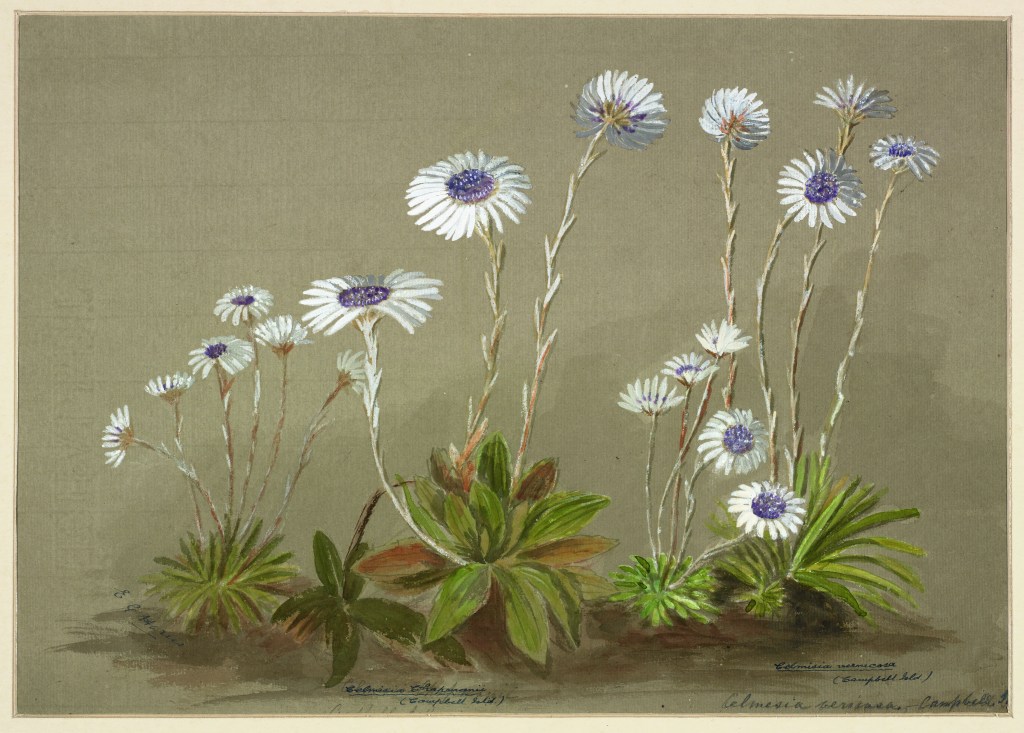
All her paintings as well as her writings and poems provide a portrait of a woman of great talent and enterprise but social convention prevented her developing an independent career and she was viewed merely as a gifted illustrator.”
This has meant she has not been well served by history but this book will do much to correct that.

 New Zealand Arts Review