Reviewed by John Daly-Peoples

The Planets
New Zealand Symphony Orchestra
Auckland Town Hall
November 23
Reviewed by John Daly-Peoples
One of the disappointing aspects of the NZSO’s recent “The Planets” concert was the short duration of the first work on the programme.
The Finnish composer Kaije Saariaho’s “Asteroid 4179: Toutatis” was performed for four minutes, but many in the audience would have been delighted if it had run for twice or three times that length.
“Asteroid 4179: Toutatis”, is named for an actual asteroid, a two-kilometre rock fragment which moves between Mars and Jupiter. The work is a confluence of science and art with the music sounding like music many composers have used for the soundtracks of science fiction movies or to create otherworldly sounds Her ethereal sounds which represent the movement of the asteroid were mysterious and saw her turning scientific notations into music.
The composer was trying to describe the pattern of Toutati’s movements, its chaotic orbit, its unfixed north pole and its complex pattern of rotation so we had music which described the various ellipses, parabolas and cosmic curves tracing out celestial journeys.
The work contained multiple combinations, of strings and huge sounds from the full orchestra . Many of the sounds were unusual with shimmering strings, eerie sounds from the wind instruments and even fleeting sounds from the harp.
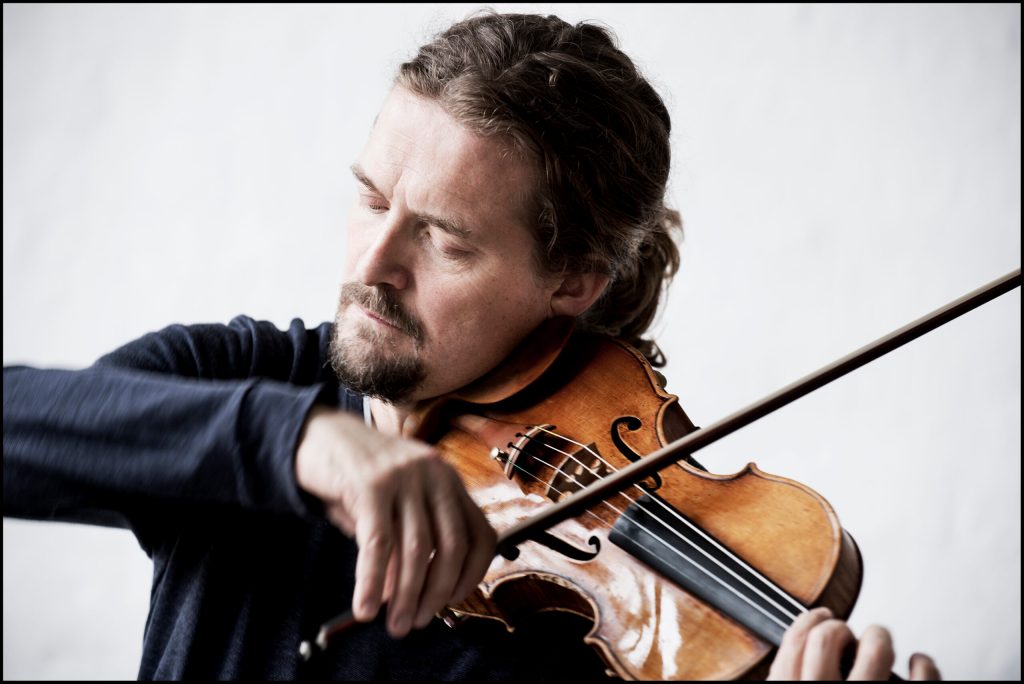
Christian Tetzlaff gave an electrifying performance with his playing of Elgar’s Violin Concerto and he seemed to become one with the violin, It was not just his bowing arm but his whole body which appeared to be affected by the music.
He opened with some ferocious bowing but this soon morphed into playing which was not much more than a whisper with Tetzlaff gently rocking as though playing a lullaby, taking him into a state of reverie.
There were times when the bow met the strings with a piercing sound, while there were other passages when the bow barely touched the strings.
Several times his feverish playing was matched by Gemma New’s demonstrative conducting where she conducted with her body and not just baton and hands. Then there were times when violinist and conductor appeared to be linked in a dance, their bodies swaying in harmony.
There were many passages in the work which were extremely taxing for the violinist but Tetzlaff handled these with style and self-assurance. At times he was sharply focused with some aggressive playing, as though he was trying to outrun the orchestra before changing to a more serene mode, melding with the orchestra.
With the slower second movement he was like a different violinist, the torments of the first movement replaced by an engaging romanticism Before the spirited finale he effortlessly dashed off a spirited theme with some grand gestures.
That Gustav Holst composed his The Planets suite early on in the twentieth century saved a lot of problems later on. Pluto was not discovered until 1930 so was not one of the planets which the composer included in his work. So, with Pluto now being dropped as one of the planets his work doesn’t have to be seen as an oddity just one of the great British musical works of the early twentieth century.
Under the brilliant direction of Gemma New the orchestra managed to give each of the sequences a thrilling interpretation, exploring their emotional and narrative themes. At times New seemed carried away by the music performing little dances and jigs, her hands and arms tracing out the music as though replicating planetary arcs.
From the relentless marching sounds of Mars, The Bringer of War through to the almost spiritual Neptune there was an urgency and drama from the orchestra.
Jupiter featured an onslaught from the full strings along with an array of percussion including bells and triangle which added to the intense atmosphere.
Emotional and expressive playing by the violins, cellos, and double basses introduced Venus along with percussion instruments – gongs, triangles, bells, timpani, celesta and drums, which provided a serene and imposing atmosphere.
Saturn gave us the sombre sounds of the double basses and plucked cellos and this then changed with a nice contrast to harps and double bass.
The opening harps and organ of Neptune, created an enigmatic sound with the orchestra joined by Voice New Zealand Chamber Choir which was beautifully expressive, becoming another instrument to finish the work in style,

 New Zealand Arts Review