Reviewed by John Daly-Peoples
Jupiter: Mozart & Copland
New Zealand Symphony Orchestra
Auckland Town Hall
September 21
Reviewed by John Daly-Peoples
Aaron Copland’s Appalachian Spring which opened the NZSO’s latest concert featured music the composer originally wrote for Martha Graham’s ballet of the same name. The work has a simple narrative following aBride and Husband as they get married and celebrate with the community. The work contains various themes – faith, love and the joys of a new life.
The work is a celebration of the American West as well as an acknowledgement of the country’s past times of violence, referencing both the Civil War and World War II (the work was written in the midst of the war).
Copland used American folk music for melodies, harmonies and textures, that he had used in previous works such as Billy the Kid and Rodeo and he also included a theme and variations on the Shaker tune “Simple Gifts”.
Like those other two ballets the composer has responded to the notion of fluidity, representing the dancer’s movements.
The piece starts off with one of the great descriptions of the dawning day but with it is also the couple’s wedding day. This is described with soft chords from the strings, followed by soaring woodwinds with the flute and clarinet sketching out the storyline.
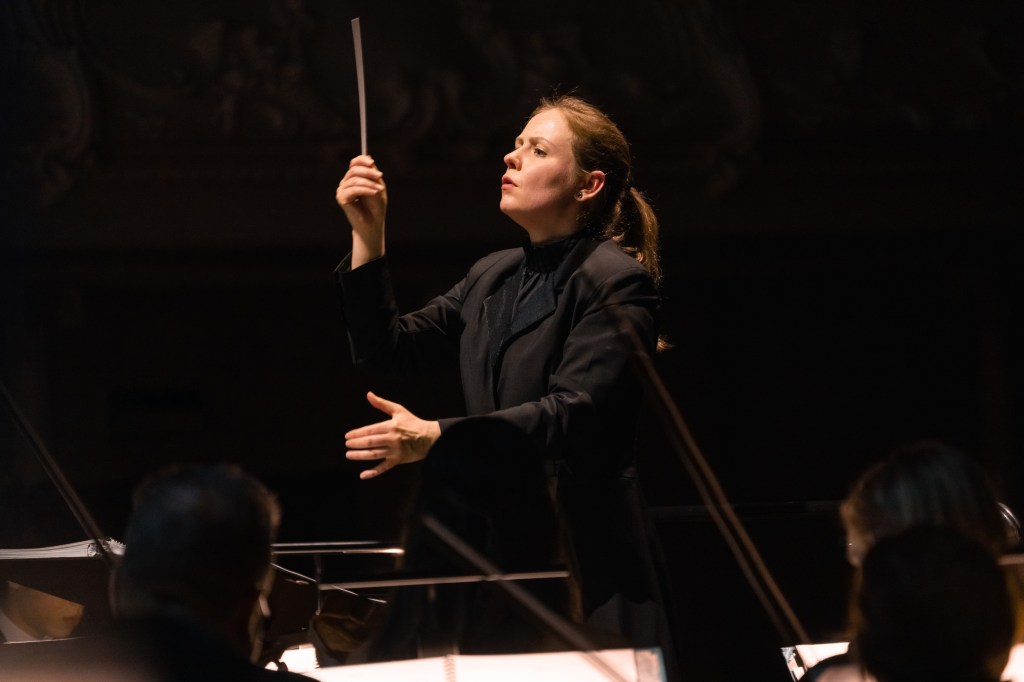
Quiet and wistful vistas and activity merge into cheery dance-like passages echoing the early American folk tunes and Conductor Gemma New responded with a little dance, caught up in these lively rhythms
The work was punctuated by dramatic use of the percussion and horns which contrasted with the lively, dancing strings.
The finale with its grand statement along with Copland’s others works added a new dimension to the idea of rural America and the West elevating them to a sophisticated and iconic level.
The second work on the programme was Lyell Cresswell’s Piano Concerto No 3 which was given its world premiere, played by Stephen De Pledge, a long-term admirer and advocate of the composer’s work.
The concerto is full of contrasts, between the instruments themselves as well as the musical colours and textures which are all bound together with innovative instrumentation.
It opened much like the Copland with a dawning with suggestions of Nature, the stillness of landscape and the sounds of the forest. This was soon followed by the aggressive orchestra which merged with De Pledge’s piano where shimmering clouds hovered over the raucous strings.
Throughout the work there were musical suggestions of observations of his environment linked to a strange, abstract realm of sound with De Pledge and the orchestra contributing a range of textures – delicate, frenzied, lush and meticulous.
The brutal sounds of the orchestra were often matched by the equally brutal sounds of the piano, orchestra and piano creating interweaving and inventive sounds. These included the pianist using the instrument as a percussion instrument, knocking on the piano keys or playing long passages of a repeated single note.
Much of the piano work was sparse but there were occasional energetic bursts of sound accompanied by the orchestra with the whispering strings at time sounding like the gentle wind in the trees or a breath slowly exhaled.
The final work in the programme was Mozart’s Symphony No 42 , The Jupiter one of his last symphonic works and one in which the composer is producing work which is at the centre of the transition of music form the classical to the Romantic…
With this work Gemma New seemed to be interested discovering nuance and depth in the composer’s work.
Even in the opening sequence which is full of drama she created contrasts so that the great melodies took on a more impressive sound with New seeing possibilities in the music that even Mozart may not have been aware of.
Her approach was obvious in the intensity of many passages, reducing some to more of a sigh while the dramatic moments featured immense surges of sounds.
The mysterious quality of the second movement featured some beautiful balance between the woodwinds and orchestra while the energetic final movement with multiple themes and intricate playing demonstrated the orchestra’s superior musicality.
To subscribe or follow New Zealand Arts Review site – www.nzartsreview.org.
The “Follow button” at the bottom right will appear and clicking on that button will allow you to follow that blog and all future posts will arrive on your email.
Or go to https://nzartsreview.org/blog/, Scroll down and click “Subscribe”

 New Zealand Arts Review