Review by John Daly-Peoples

Gordon Walters by Francis Pound
With a Foreword and Afterword by Dr Leonard Bell
Auckland University Press
RRP $89.99
Reviewed by John Daly-Peoples
A new book by Francis Pound on the abstract artist Gordon Walters (1919–1995) provides insights into the career of this remarkable artists as well as giving the reader an understanding of the development of abstract art in New Zealand
The book traces the development of the artist’s work from his early experimental works up to his 1966 exhibition at New Vision Gallery which is considered to be a significant point both in the artist’s career as well as the public’s awareness of his work.
Not only do we get to understand the ways in which Walters developed his vision and his art, we also get to understand something of the development of abstract art both within New Zealand and internationally.
Pound quotes Walters commenting on his own career, “Essentials of my work have not changed much. It has been largely a matter of developing insights into painting and a struggle to free myself form nature; that is working form nature. Essential character of my work has just become clearer as I have continued, but not without such struggle, false starts and wring directions”.
Walters more than any other artist in New Zealand was aware of and responded to intentional art movements including post war American art. Colin McCahon who also encountered American abstract art did not use it in the way Walters did. Walters incorporated the ideas and stylistic features in a way which indicates a deep understanding of these overseas movements.
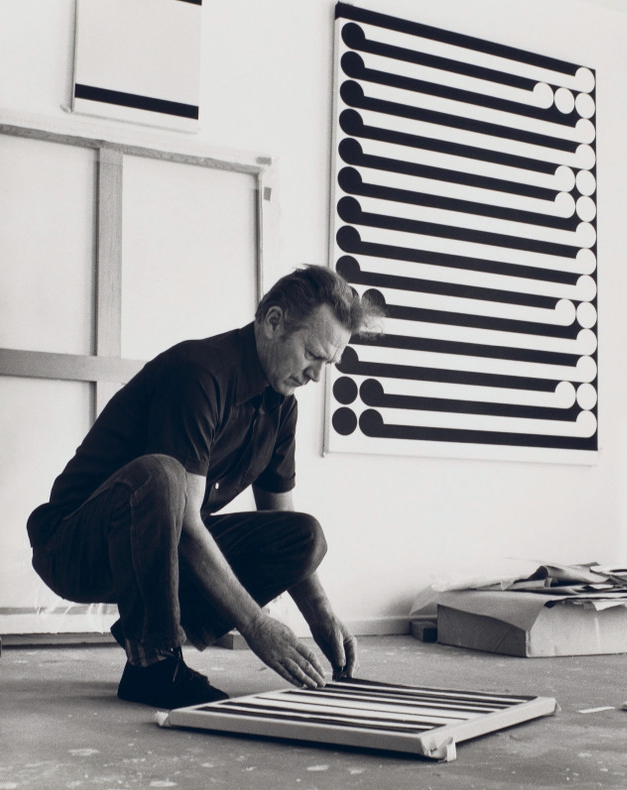
Pound meticulously follows the life and career of Walters with detail and understanding so that we understand both the creative genius of the artist but also the way he absorbed and adapted the work of others. The influences on the artist were wide-ranging from Picasso, Klee and Mondrian to Māori cave art and the unusual art of the Rolfe Hattaway He was also aware of the work of Sophia Taeuber-Arp, Auguste Herbin, Giuseppe Capogrossi, and Americans such as Frank Stella.
Pound examines many areas of abstraction with an emphasis on the the Koru paintings but as well as this major series he also deals with what he terms the Vertical or Horizontal Men, the Spirals, the Bars and Balls, the Wandering Rectangles and the Diagonals. With all these series of works the author takes an almost forensic approach in discovering and outlining the artist’s inspirations, visions and stylistic approaches.
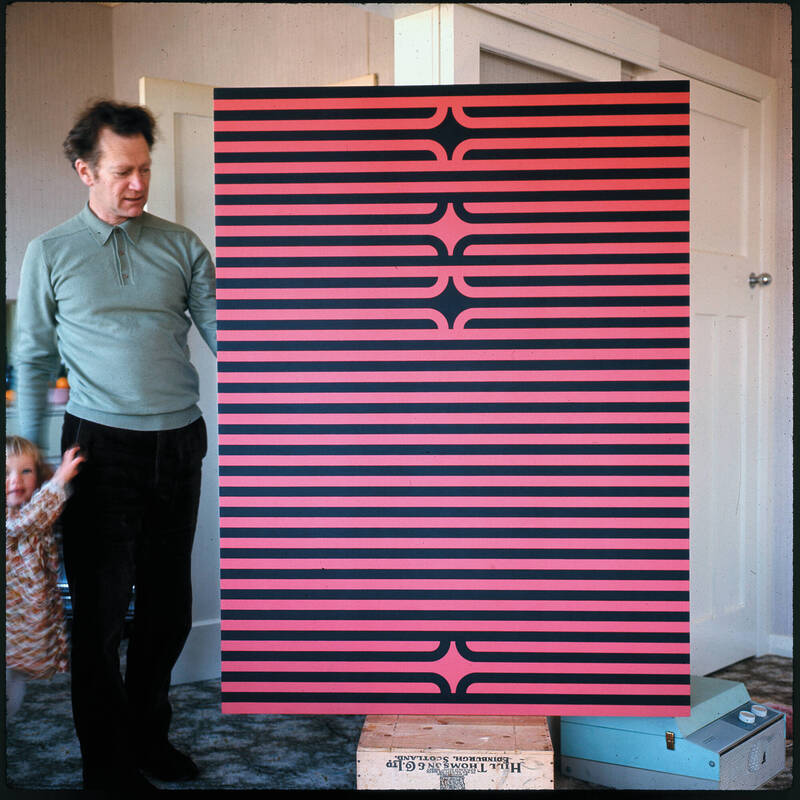
Walters Estate, Auckland
The Rauponga series he produced were inspired by his interest kōwhaiwhai patterns as well as Māori rock drawings which he documented along with Theo Schoon.
The book is a one of great scholarship with detailed information on the artist, a wealth of notes and references along with copious photographs of the artist’s work. It is also a book which reads like a biography and we get to understand the artist in much the same way that Pound, who devoted many years studying the artist’s work grew to understand the artist.
This book and others such as the recently published two volume work on Colin McCahon by Peter Simpson show there is a great interest in the development of contemporary New Zealand art.
Over the last forty years Pound has had a major impact on thinking about New Zealand art history having produced books which have helped change our perspectives on both historical and contemporary art. These have included Frames on the Land: Early Landscape Painting in New Zealand (1983), The Space Between: Pakeha Use of Māori Motifs in Modernist New Zealand Art (1994) and The Invention of New Zealand: Art & National Identity, 1930–1970 (2009).
Dr Francis Pound (1948–2017) was a New Zealand art historian, curator and writer. He taught for some years in the art history department of the University of Auckland before becoming an independent art curator and writer. His books include Frames on the Land: Early Landscape Painting in New Zealand (Collins, 1983), The Space Between: Pakeha Use of Maori Motifs in Modernist New Zealand Art (Workshop Press, 1994), Stories We Tell Ourselves: The Paintings of Richard Killeen (Auckland Art Gallery and David Bateman, 1999), Walters: En Abyme (Gus Fisher Gallery, 2004) and The Invention of New Zealand: Art & National Identity, 1930–1970 (Auckland University Press, 2009).
Leonard Bell is an independent art and cultural historian based in Auckland. Among other works, he is author of Colonial Constructs: European Images of Maori 1840–1914 (1992), Marti Friedlander (2009), Strangers Arrive: Emigrés and the Arts in New Zealand, 1930–1980 (2017) and Marti Friedlander: Portraits of the Artists (2020), all published by Auckland University Press.
To subscribe or follow New Zealand Arts Review site – www.nzartsreview.org.
The “Follow button” at the bottom right will appear and clicking on that button will allow you to follow that blog and all future posts will arrive on your email.
Or go to https://nzartsreview.org/blog/, Scroll down and click “Subscribe”

 New Zealand Arts Review
One reply on “New insights into the art of Gordon Walters”
VG review….I intend to buy the book in due course (it’s not in at Paradox in Devonport).
See you tomorrow…?
LikeLike