Reviewed by John Daly-Peoples
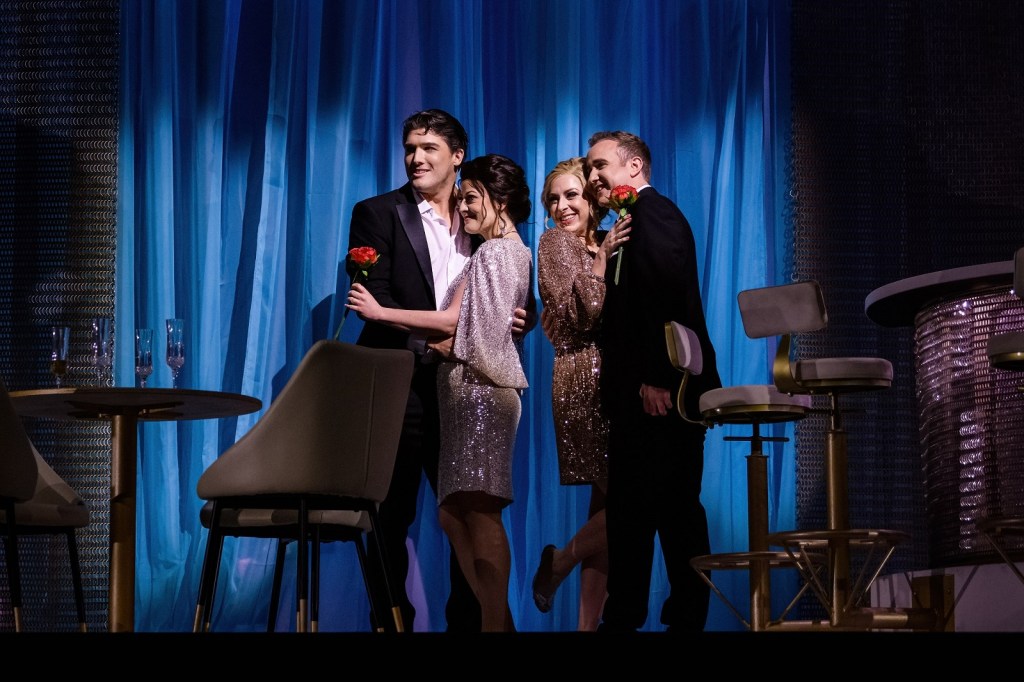
Cosi Fan Tutte
By Wolfgang Amadeus Mozart
NZ Opera
Aotea Centre
May 31 – June 4
Then Wellington (June 14 – 18) and Christchurch (June 28 – July 2)
Reviewed by John Daly-Peoples
Cosi Fan Tutte is not the most perfect of Mozart’s operas but with NZ Opera’s latest offering the creative triumvirate of director Lindy Hume, designer Tracey Grant Lord and conductor Natalie Murray Beale have expertly guided six outstanding voices in a lively farce.
The opera tells of two friends who take a bet with the cynical “old philosopher” Don Alfonso that they would be able to cheat on their girlfriends with ease. They disguise themselves, woo each other’s fiancée and ultimately marry them.
The work reveals historic and contemporary attitudes to love, fidelity and relationships while the mix of comic and serious music makes for a multi-layered depiction of chaotic interpersonal relationships. It juxtaposes notions of true love and fidelity, betrayal and manipulation, farce and genuine human emotion in a mosaic woven together by the composer’s magnificent music.
There are however elements of political incorrectness which can be seen as troubling, starting with the title “All Women are like that” and even librettist Da Ponte’s alternative title “The School for Lovers” could be seen as problematic.
The aspects of misogyny are not reserved to Cosi and can be found in most of Mozart’s operas and in many of the theatrical and literary works of the eighteenth-century including novels such as Fielding’s “Tom Jones” and the thread can be traced back to earlier authors such as Boccaccio.
Early on in the work the “old philosopher” Don Alfonso makes an observation about women,
Woman’s constancy
Is like the Arabian Phoenix;
Everyone swears it exists,
But no one knows where.
Then, later on, the more enlightened and cynical bar manager, Despina provides a more pragmatic observation when she sings.
To hope for faithfulness
in men, in soldiers?
Don’t let people hear you, for heaven’s sake!
All men are made of the same stuff;
Lying tears, false looks,
deceitful voices, lying charms –
these are their outstanding qualities.
There is an ambiguity throughout the work with not only the actions and the text but also the music which ranges from the comic to the serious and all the characters adopt disguises of some sort.
Director Lindy Hume has attempted to give the work something of a feminist take but ultimately as she says “the work is about four flawed individuals who detach from their dependencies, lose their innocence, give in to sexual desire and have their fragile certainty smashed, but who paradoxically gain far more along the way. Self-knowledge is not the lesson that the cynic Don Alfonso is teaching. Rather it’s a hard-won, bittersweet wisdom to which we as humans aspire.”
Tracey Grant Lord’s modernist set of bar, terrace and lounge functions well but the notion of the set as a metaphor for the crumbling relationship mirrored in the collapsing set is never fully resolved.
The singing of the entire cast was excellent. Emma Pearson was a glorious Fiordiligi, her voice quivering with outrage when first confronted by (the disguised) Ferrando. Later as she reacts to his advances her voice and manner became tense, expressing a mixture of sadness and wonder before a transformation into passionate longing.
Hannah Hipp’s Dorabella displayed a more physical and urgent demeanor and her robust and mercurial voice contrasted well with Pearson’s nuanced performance.
Both Jonathan Abernethy (Ferrando) and Julien Van Mellaerts (Guglielmo) gave fine comic performances, particularly once they had taken on their disguises.
Abernethy was also able to give an intense display of wretchedness on realizing that Dorabella had been unfaithful while Van Mellaerts rich baritone served him well in his arias with Hipp.
Andrew Foster-Williams gave his Don Alfonso a standout performance with an animated voice. He was the arch manipulator inhabiting roles within the narrative as well directing the characters and events. At times it seemed that he was the conductor of the orchestra, and he was particularly ingenious in the way he summoned up the cast of departing soldiers who marched down the aisle at his command.
Despina (Georgia Jamieson Emms) in this production is changed from being a maid to the two sisters into the manager at the local bar which makes her privy to all the secrets the various characters share. Her sharp voice added expertly to several of the trios and sextets. She showed her acting skills in a nice little vignette singing to the sisters while whipping up a couple of cocktails. However, in her roles as notary and doctor she appeared to take the notions of farce a bit too far.
The APO under the direction of conductor Natalie Murray Beale gave a splendid performance making Mozart’s music one of the great delights of the evening.
It is unfortunate that the opening scene takes place in a bar with a lot of drinking and for some this might be too close to reality with the impact of the recent Mama Hooch trials.
To subscribe or follow New Zealand Arts Review site – www.nzartsreview.org.
The “Follow button” at the bottom right will appearand clicking on that button will allow you to follow that blog and all future posts will arrive on your email.
Or go to https://nzartsreview.org/blog/, Scroll down and click “Subscribe”


2 replies on “Cosi Fan Tutte: A triumvirate of creative talent guiding six outstanding voices ”
Ā good review. But please change the heading G to reflect what the text says. It is 6 outstanding voices not 4.
I also beg to differ about this sublime work not being perfect. It is Mozarts most
perfect opera and perhaps the most perfect opera I know. Everything about it is right and withhis most glorious music. I suggest anyone who doesn’t agree read Prof John Drummond lecture on the work. A masterly exposition on Cosi
LikeLike
[…] – NZ Arts Review […]
LikeLike