Categories
Reviews, News and Commentary

Manifesto full of relentless energy and amazing invention

Reviewed by John Daly-Peoples
Auckland Arts Festival

Manifesto

Aotea Centre

Until March 10

Reviewed by John Daly-Peoples

Thankfully Manifesto didn’t have a manifesto, any sort of declaration of the intent or views on issues, but they did make manifest their intention to entertain, amaze and transport the audience.

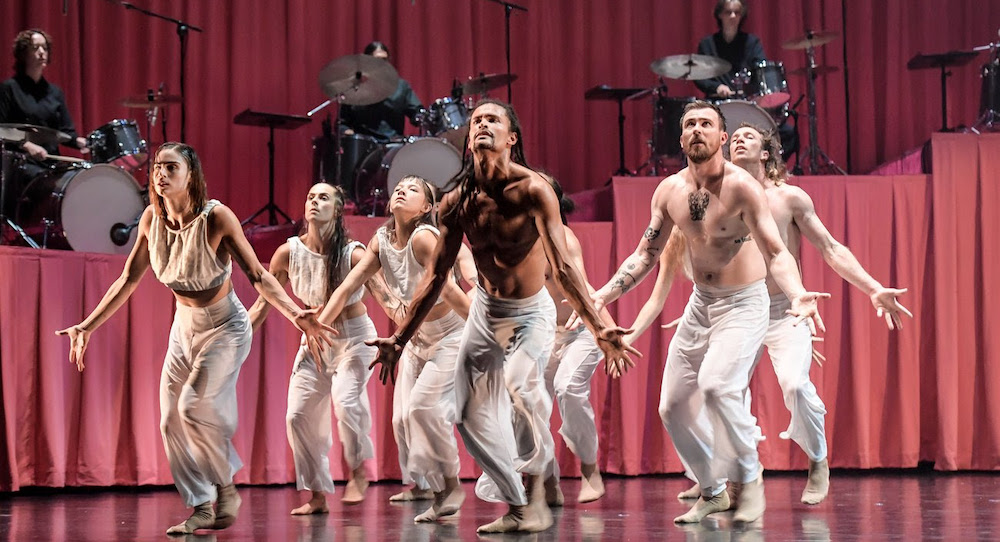
Nine musicians with a selection of drums, cymbals and bells ranged above a group of white clad dancers who sat,  calmly  facing the audience. But then the first burst of cymbals sent a shock wave through the dancers, followed ten seconds later by another explosive sound with a corresponding eruption of the dancers – and so it begins – torrents of sound which galvanized the dancers into hectic sequences of dance.as they responded to the changing tempo of the drumming. They seemed to be responding as though to electric shocks or the physical impact of the sound waves with their somersaults, kicks, lifts, throws and breakdance moves.

In one sequence one of the dancers took on the role of choreographer / director, controlling the chaotic assemblage with wild gestures.

As with all dance the there is a connection between music and movement but with Manifesto, they are for the most part inextricably linked, each beat corresponding to a jump, twist, leap or limb  gesture.

The performances are a mix of modern dance, aerobics, gym workout, athletic workout (one practicing their archery skills) and individual self-absorbed responses.

Some of the sequences are reminiscent of the stylish Cirque de Soliel routines, others are more poetic in their grace and line. There was even sequence which could have alluded to The Rite of Spring with tightly grouped bodies. Other times their movements were epileptic, militaristic or like that of clockwork figures.

One sequence saw the dancers performance a series of fast paced pas de due as they raced around the stage showing off various dynamic, dexterous, challenging , dangerous  and expressive moves. These actions and reactions had much in common with contemporary dance

There were a couple respites and in one of periods a Bob Marley look a like engaged briefly with each of the drummers as well as the audience before being assaulted by a thunderous attack from the combined drummers.

The show, choreographed by Melbourne-based Stephanie Lake was full of relentless energy and amazing invention and there is only two more shows on.

Categories
Reviews, News and Commentary

“The Effect”: A sizzling chemistry lesson coming to Auckland Theatre Company

John Daly-Peoples

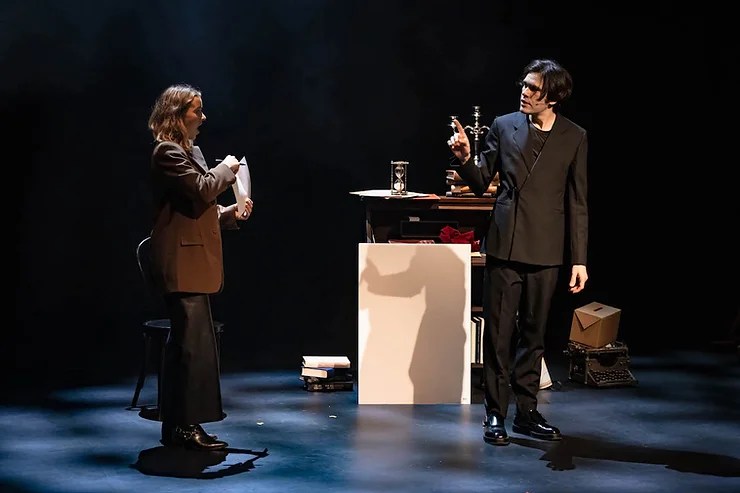
Zoe Robbins (Connie) and Jayden Daniels (Tristan)

The Effect by Lucy Prebble

Auckland Theatre Company

ASB Waterfront Theatre

 April 16 –  May 11

John Daly-Peoples

Straight off a highly acclaimed season at London’s National Theatre, Auckland Theatre Company is presenting The Effect, written by BAFTA, Golden Globe and Emmy award-winning co-executive producer and writer Lucy Prebble of the HBO international hit series, Succession (2018-2023) in their 2024 line up.

“The Effect” will be directed by Benjamin Kilby-Henson (King Lear) and feature major stage and screen stars including; Jayden Daniels (Head High, Celebrity Treasure Island), Zoë Robins (Amazon’s The Wheel of Time), Jarod Rawiri (Long Day’s Journey into Night) and New Zealand screen legend Sara Wiseman (Under the Vines, Creamerie).

British playwright and producer Lucy Prebble shows all the razor-sharp flair that made her a star writer on Succession in this deft dissection of medical ethics and the nature of human attraction.

The review of the work in the New York Times gave it a strong recommendation.

“Are you in love, or are you merely experiencing a giddy dopamine rush? Are those two states even meaningfully different? Is there a true, innermost “you” that is distinguishable from your neurochemistry?

These are some of the tricky questions explored by Lucy Prebble’s thought-provoking play, “The Effect”

The play revolves around two young people, Tristan and Connie, who take part in a trial for a dopamine-based psychiatric drug with powerful antidepressant properties. Initially, they seem to have little in common — he’s a working class lad from East London; she’s a bougie psychology student from Canada — but as the trial progresses, a tender rapport develops.

Throughout the study, the participants are monitored by two psychiatric doctors, Lorna and Toby, who debate their findings: Is the drug pulling their subjects together, or are their feelings organic? And if one of the trial participants was actually receiving a placebo the whole time, what then? Prebble keeps us guessing.

Throughout, the pair’s gradual transition from wary awkwardness to intense mutual magnetism is convincingly rendered, in large part thanks to the actors’ terrific onstage chemistry.

Things get messy in the latter stages of the experiment, as both the doses and the emotional stakes increase, leading to a fraught and affecting denouement.

The stiltedly ambivalent friendship between the two middle-aged doctors provides an intriguing subplot. We learn that Lorna and Toby once romantically involved, many years ago. Lorna is prone to bouts of depression, but refuses to take medication; Toby, on the other hand, is a true pharmaceutical believer.

“The Effect” is healthily skeptical about scientifically deterministic approaches to emotional well-being, channeling a dissenting tradition that dates back to the anti-psychiatry movement of the 1960s; its moral sensibility recalls Ken Kesey’s  1962 novel, “One Flew Over the Cuckoo’s Nest.” The play’s revival is particularly timely as a new generation of wellness gurus have, in recent years, latched onto the idea that much of human behavior can be explained away as neurotransmitters or hormones simply doing their thing.

Prebble invites us to ponder the implications of such thinking. Connie is initially uncomfortable with the notion that two people can fall in love just like that (“It takes work,” she insists), and wary of her attraction to Tristan. He, in response, makes the case for mystery, and thus articulates the play’s key message: That a world in which all feeling is viewed as a matter of chemistry would be a bleak one indeed.”


Categories
Reviews, News and Commentary

Romeo and Juliet. An entertaining theatrical production of a theatrical production

Reviewed by Malcolm Calder

Natasha Daniel as Juliet

Romeo and Juliet

By William Shakespeare

Pop Up Globe Company

Director David Lawrence

SkyCity Theatre, Auckland

Until 25 February

Review by Malcolm Calder

After a brief, and apparently successful, season of Twelfth Night at Q Theatre last year, Pop Up Globe Shakespeare Company has popped back up again in 2024.  This time with one of Shakespeare’s safest classics Romeo and Juliet running in a brief back-to-back season with a remounted Twelfth Night, at the larger SkyCity Theatre.

This venue is a far cry from the company’s heyday in the scaffolded pseudo-replica behind the Q Theatre, followed by 3 years in the leafy environs of Ellerslie.  Romeo and Juliet makes the transition well and the house-full sign was out for Opening Night.

This is rumbustious theatre with the primary aim of entertaining people.  And if it manages to change a few minds that’s a bonus.  The Opening Night Romeo and Juliet audience was an interesting and highly-varied bunch with a huge age spread and attending for many different reasons.  Not unlike the audiences at Ellerslie. Nor, come to think of it, many of Shakespeare’s own audiences.

This one ranged from boomers to their grandchildren and all points in between. There were probably some serious Shakespearean afficionados, but many seemed to be longstanding Globe-converts along with some who were just looking for a good entertaining night out, rather than a draining one with significant mental effort required to ‘understand’ often subjective new work.

David Lawrence’s Romeo and Juliet certainly had something for everyone.  No longer in the scaffold-replica Globe, he has developed a close-knit ensemble that works and moved them around both the stage and the theatre itself so that they came to own the joint. This resulted in part of the audience being on stage, and the actors spending a fair bit of time in the auditorium.

More importantly and perhaps significantly, he achieved this with a cast that largely exuded strength. Today, holding a large-ish room for a long-ish time is an effort for many actors  –  even more so when the language and its Shakespearean rhythms are pretty important and this cast manages to do so almost uniformly. Juliet’s balcony speech(Natasha Daniel) is a great example, accentuated by her very location in the theatre.  Her clarity and power was something shared throughout the ensemble.  No spoiler alert about where she was though.

In fact, all the more serious characters hold their ground well, and set things up for others to generate a load of belly-laughs.  Let’s face it, pretty much everyone knows that R&J is rife with deaths, so why not play the lead-up to them comedically.  Keeps the masses entertained y’know.  And while we’re about it, let’s make the deaths a bit gory and gruesome as well!  So it’s perhaps no accident that the ticketing categorisation for this Romeo and Juliet avoids the conventional header ‘Theatre, tragedy’ and uses ‘Theatre, comedy’ instead.  It is.  And it works.  As both a comedy, but one undershot with tragedy.

Many of Lawrence’s cast have appeared with Globe in one form or another over several years.  For example, I found Salesi Le’ota (Nurse), who I first saw in Globe’s Hamlet  5 or 6 years back, has grown immensely, developing his strength, energy and immaculate timing considerably  He is at the heart of the comedy, ably supported by Frith Horan, whose energetic, clownish Mercutio really becomes the ‘saucy merchant’ Nurse brands him to be and almost overshadows Tybalt (Adrian Hooke) and even Friar Laurence (Kevin Keys).

That said, this production remains a tragedy at its core.  And Natasha Daniel and Alistair Sewell (Romeo) give us two very young lovers drawn together by adolescent passion but tragically fated to wind up nowhere.  They carry it well.

However, this remains essentially a theatrical entertainment.  The cast is aware of this and the audience is too.  And that leaves plenty of space for the delivery of Shakespeare’s words, time to play with the emotions he has drawn and just plain have fun. 

In summary ?  Well,  Romeo and Juliet seems almost like a theatrical production about a theatrical production.  That is just great and it’s refreshingly good to see the Pop Up Globe Company at work again. – Enjoy

Categories
Reviews, News and Commentary

An immersive Tales of an Urban Indian experience

Reviewed by Malcolm Calder

Nolan Moberly (Simon) in Tales of an Urban Indian

Tales of an Urban Indian

An immersive TIFT experience

By Darrell Dennis

Director Herbie Barnes

With Nolan Moberly (Simon) and Dean Deffett (Stage Manager)

Jan 11 to 14 2024

The Bus Stop, Corbans Estate Art Centre

Review by Malcolm Calder

11 January 2024

I went for a 90 minute ride today.  With others.  On an AT bus.  In and around some of Auckland’s western suburbs.  And an actor called Nolan Moberley told us a story. 

I’m glad I did.  Because it left me drained.  Exhausted.  And not a lot of theatre does that to me.

Moberley gave us bus passengers a character named Simon Douglas, an indigenous Canadian born on an Indian reservation in British Columbia perhaps 50 years ago.  He is a product of the Canadian Indian Residential School system. Tales of an Urban Indian focusses on his struggles with self, on family and heritage and on the world in which he lives during childhood, adolescence and early adulthood, moving into an ever-increasingly urban lifestyle. 

His issues are shared by a cohort that is international.  But the context of each is unique.

This story is moving and painful at times.  It tells of segregation, alienation and rejection.  It tells of aspiration and maybe even – hope.  As Simon says, “it’s a story I need to tell, not because it’s extraordinary, but because it’s common. Too common, and it’s not told enough. It’s a story about my people …”.

In this country we have some awareness of our own socio-historical context and, to some extent, we like to think we comprehend something of the Australian terrain too.  Or perhaps we only think we do. 

For some reason however, Canada is not imprinted on our national consciousness in the same way.  Hardly at all in fact.  And that is what made this performance so strikingly different for me.  The issues may not be dissimilar.  But the context certainly is.

Nolan Moberley gives a bravura performance, somehow keeping his footing as our big blue bus as it lurched over traffic humps and narrow turnarounds.  I’m not sure if the itinerary was random or carefully programmed but there was something deliciously ironic as we passed smashed up deserted and graffitied houses that somehow echoed the words of the script.  Or how Simon’s vain attempts to get work in films, fancying himself to be James Bond, came just as we passed some of the giant sound stages that encircle this part of Auckland.

Accolades to our driver who found his way into and through some impossibly teensy streets and to stage manager Dean Deffett who revealed stage management skills delivered by sign-language.

After 90 minutes I was starting to wonder how director Herbie Barnes would round it all off – or get Simon off the bus, to coin a phrase.  He did.  But no spoiler alerts from me.  You will just have to take your own ride to discover how.  It is fitting, apt.

First Nations theatre has developed an ever-increasing international voice over the last few decades and Talk Is Free Theatre (TIFT) is to be congratulated for sharing thus Canadian story with other parts of the world, for finding commonality there and for such a breathtakingly exhaustive bus ride.

Categories
Reviews, News and Commentary

An Arts Festival show which has the reviewers wondering

John Daly-Peoples

Auckland Arts Festival

Scott Silven “Wonders”  

March 19 – 24

One of the more intriguing acts on at the Auckland Arts Festival this year will be Scott Silven’s Wonders.  The clairvoyant, mentalist, and performance artist has dedicated his career to unique form of theatrical  illusionism which fascinates audiences.

He studied hypnosis in Milan at 15, gained recognition from the American illusionist David Blaine at 19, and headlined one of the United Kingdom’s most prestigious theatres at 21.

In Wonders, Silven invites the audience on a journey through his childhood memories in the lowlands of Scotland, connecting his participants with the myth and mystery of the landscapes that shaped him. This show is said to go beyond the traditional theatre experience, offering an interactive, audience led, performance that explores the power of connection through illusions.

What is extraordinary about his show is the response of reviewers who grapple with trying to explain what they have witnessed in seeing one of his shows

A Melbourne Time Out reviewer said of Silven, who talks to the audience about his early exploration of the family attic –  “he also explored the corners of his own mind, and he claims that he began to discover his ability to make mental connections to the world around him in weird and wonderful ways. Interspersed in this narrative are demonstrations of Silven’s extraordinary skill as a mentalist, which involves audience members at every turn. His ability to convince that he’s reading minds – and that random audience members are able to perform similar feats under his instruction – is absolutely dazzling. The complexity of his work is spectacular, and he draws together the threads of just about every “ta-dah” moment in the final moments of the show. Even non-believers, like myself, will be blown away by the artistry.”

A Sydney reviewer was also baffled  “Silven does not perform your typical brand of magic, using visual illusions and tricks to stun the audiences. Instead, he uses the power of language and of the imagination to draw the audience in, fostering magic out of the power of human connection. One by one, he brought members of the audience up and seemed to be reading their minds. In reality, a lot of the time he was actually guiding them as to what to think. That prepared monologue at the start that felt out of place was actually an ingenious way of planting motifs and ideas in the audience’s mind that they would bring back to him later. Every little bit of speech had a purpose.

Some moments felt scarcely believable. When an audience member said their prize possession as a child was a “Snoopy” dog, Silven reached under his chair and pulled out a billboard he had written earlier predicting that the prize possession of the audience member he called upon would be a “Snoopy” dog. Is this too much of a coincidence? Did he have plants in the audience? Did he have an assistant furiously typing up a billboard backstage and slipping it under the stage curtain to his chair when we weren’t watching?”

And The Guardian reviewer said of another of his shows  “Silven’s use of storytelling and setting creates something genuinely magical, and it’s a joy to willingly suspend disbelief and slide into a sense of wonder not experienced since childhood.

And with that comes connection. Not the psychic kind Silven suggests, but the kind forged by a shared sense of discovery. Across the table, eyes are shining, guards are down, and there’s the odd report of goosebumps. The childhood game of Chinese whispers, further confounded by whisky, brings things to a delightfully silly finish.

I emerge still a sceptic, but certainly not a cynic.”