Reviewed by John Daly-Peoples
Opera Australia
Hamlet,
Brett Dean , Music
Matthew Jocelyn, Libretto
Until August 9
Reviewed by John Daly-Peoples
“or not to be “, are the first lines we hear from Hamlet in Opera Australia’s latest offering by composer Brett Dean and librettist Matthew Jocelyn. They are of course a clip from one of the plays most well know soliloquies – “To be or not to be, that is the question”.
That question is
“Whether ’tis nobler in the mind to suffer
The slings and arrows of outrageous fortune,
Or to take arms against a sea of troubles”
In other words act now or prevaricate.
Hamlet never answers his own question and delays taking action to revenge the death of his father. In a typical revenge tragedy of the time that revenge would be quickly and simply exacted but his equivocation is a sign of his own mental illness or his inconsistent political decision-making which ultimately leads to the death of multiple individuals.
Hamlet doesn’t even speak the words of the soliloquy that is left to a player from the theatre troupe, later in the play.
The opera explores questions of Hamlet’s mental state, how it impacts on his relationship with other members of court, his friends and his betrothed, Ophelia.
Librettist Mathew Jocelyn has done this by cleverly concentrating on some key lines and phrases while Brett Dean has produced a musical landscape which creates moods, emotional portraits and dramatic moments. The score is largely percussion with raw and unusual sounds along with traditional instruments pushed to their limits, providing an edginess and inventiveness to the work.
Director Neil Armfield has realised the visions of Dean and Jocelyn with an impressive production employing a stellar class including Allan Clayton who has performed the leading role at Glyndebourne and the Met. This is an opera which seems as relevant today as it was 400 years ago.
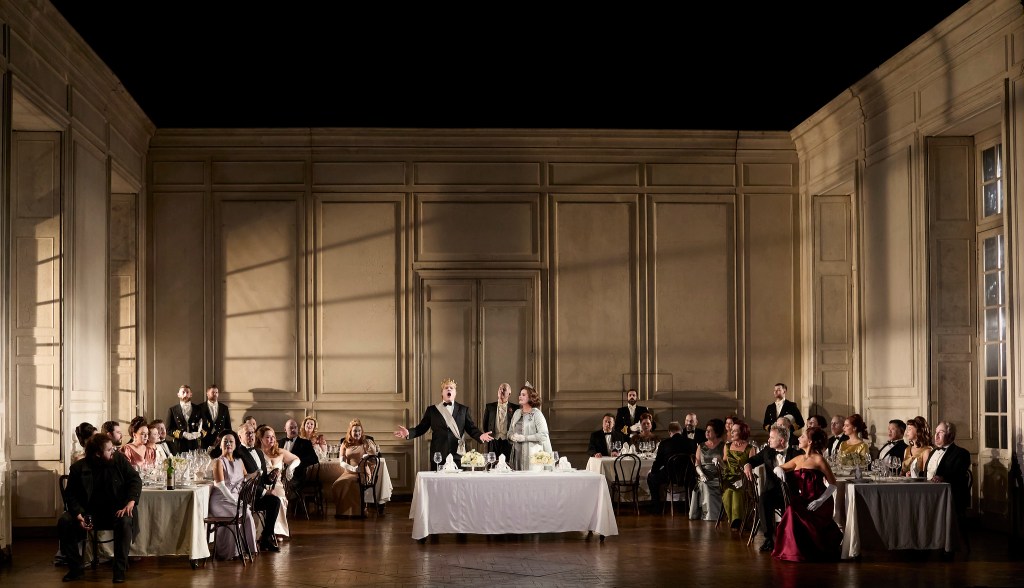
The opening scene, which is replicated in the final duel scene is the main hall in Elsinore where the new King Claudius and Gertrude enter for a banquet. Hamlet, looking remarkably like Peter Jackson prowls the room in his ‘inky cloak’, gets his own bottle of wine and makes sharp comments about his mother and new father. Along with his brusque complaints there is also a playfulness when he greets his friends Horatio and Marcellus
One becomes aware of the conflict within the work. Is Hamlet actually mad or is it a ploy which he uses. There are a number of scenes where the theme of pretence, subterfuge and acting are cleverly developed by Jocelyn. This notion of reality and artifice is seen at its most powerful in the Players scene where Hamlet adds some lines to the fictional “Murder of Gonzaga” play.
.One of the clever approaches that Jocelyn uses is to repeat particular words and phrases, giving emphasis to them so they become striking mantras
Allan Clayton’s Hamlet is very different from most theatrical versions, there is little that is princely or all that perceptive about him – he is a man burdened with a task, angry with most of those about him and lacking in empathy. He is in a dark world of his own making and that is conveyed through Brett Deans oppressive and stressful music.
It conveys something of the internal melancholy of Hamlet and Clayton’s rough tenor makes one aware of his struggles as he flails physically and vocally with his feelings and (in) actions. His approach to revenge is insipid compared to the pesky Laertes (Nicholas Jones) who leaps at the opportunity of dispatching Hamlet.
Much of Hamlet, as with many of Shakespeare’s plays is focussed on the nature and the future of the royal family and by implication, the future of the state, with reference to the legitimacy of Claudius and Gertrude and the rottenness of the state of Denmark.

Many of the scenes are brilliantly staged. When the ghost of his father (Jud Arthur) appears to Hamlet it is in a surreal setting worthy of Salvador Dali. The Frankenstein-like figure moves slowly across the stage, a beam of light cuts across the stage from a door giving onto a misty swirling nether world. The ghost tells Hamlet of the need for revenge as the quivering woodwinds and tentative percussion aid his growling voice. The relationship between the two becomes particularly physical as the two embrace.
Lorina Gore’s Ophelia gives a splendid performance as she expressed love, confusion and ultimately madness. Her performance was particularly touching in her mad scene where, having strewn herbs around the stage, she proceeded to beat her breast and used her strangled voice along with the sharp strings of the orchestra to convey her fragile mental state. Her cries were accompanied by a small female chorus situated high in the boxes who initially shouted their concerns but then became a choir of angels.

Rod Gilfry as the guilty Claudius stepping into his new role as king was able to convey his own ambivalent position with a voice which ranged from the rough to the benign while Catherine Carby’s Gertrude duets with her son and Ophelia were taut with genuine feeling.
Kanen Breen’s supercilious bureaucrat, Polonius was excellent with his finger clicking insistence, and Samuel Dundas as Horatio, the only likable character in the opera, gave an intelligent and perceptive performance.
Most of the characters were white faced, as though already embalmed but it was Jud Arthurs monstrous, white figure and his penetrating bass which made the most impression. Arthur was also magnificent as the cocky, philosophical Gravedigger.
The two foppish counter tenors, Rosencrantz (Russell Harcourt) and Guildenstern (Christopher Lowrey) looking like the artwork, Gilbert and George added an element of comedy as well another dimension to the notion of artifice.
The set designed by Ralph Myers with its changing structures was something of a metaphor for the changing veneers, masks and stratagems of the characters while the lighting by Peter Harrison provided many moments of visual drama.
 New Zealand Arts Review