Categories
Reviews, News and Commentary

Scenes from a Yellow Peril; poetry, polemic, comedy. and cabaret.

Reviewed by John Daly-Peoples
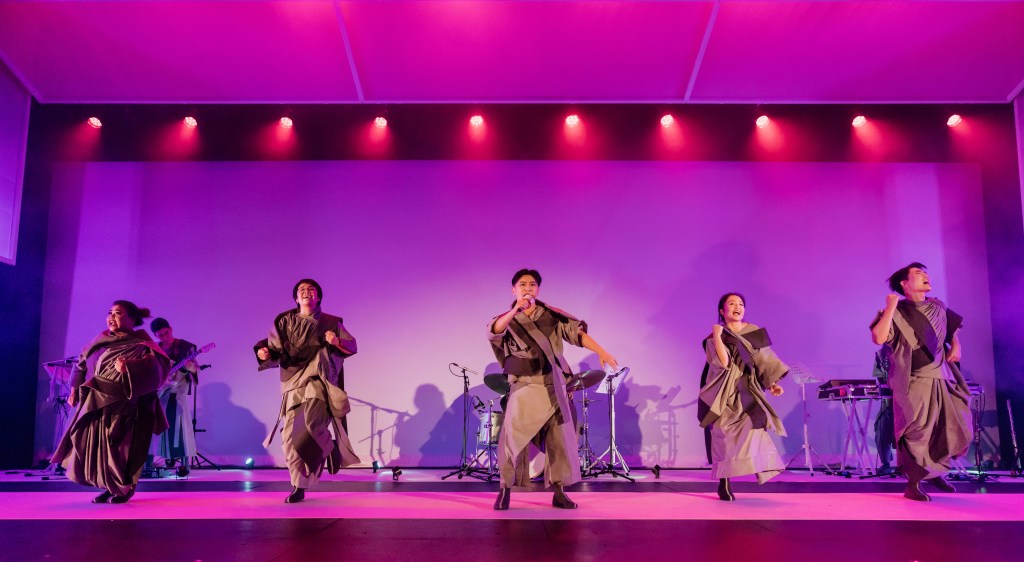
Scenes from a Yellow Peril Image Andi Crown

Scenes from a Yellow Peril

By Nathan Joe

Auckland Theatre Company

Auckland Waterfront Theatre

Until July 3

Reviewed by John Daly-Peoples

Nathan Joe’s “Scenes from a Yellow Peril” is the latest in a very short list of plays about the experiences of contemporary Chinese in New Zealand. The playwright, Nathan Joe notes that for some time he had avoided writing about being Asian but there had been an underlying need for him to write something and so the play is, as he says, “the result of all those feelings of internalised racism slowly being corrected.”

The result is a thoughtful snapshot of clashing cultures – alternately comic, poignant, anguished and angry in a condensed contemporary history of assimilation, along with the complexities of communication.

The sub-title of the play is “Scenarios for the Assimilated Asian” and the work consists of fourteen scenes in which five actors address issues around ethnicity, racism, colonisation and cultural displacement.

They explore the personal, social and cultural dimensions of these issues under various  titles such as  “ A Short History of Humiliation”, “Love in a Time of Colonisation’, “How to End Racism” and “They Shoot Chinese Don’t They”.  

The  actors speak of the European perspective of Asians and the  comic aspects of being Asian in New Zealand today. They also speak of the bewilderment and hurt of everyday events and the pressure to adapt and conform. But, at the heart of the play is the anger against the system and the oppression. Here, pure rage is distilled, displaying the anger of reacting to the stereotypes.

The play opens gently enough with the Director of the  play Jane Yonge interviewing each of the cast in a game show format where we learn about the range of their East Asian ethnicities – Chinese, Korean Singaporean, Japanese Fijian/Indian, along with their various careers. After that the cast embark on a dissection of the issues.

The dozen scenes are delivered in a  range of styles – panel discussion, poetry, polemic, stand-up comedy, cabaret and  game show. This all creates something of a Chinese banquet – a mix of sweet and sour, some spicey morsels as well as  some  bland bits

Each of these scenes explores a different dimension so that in “You Often Masturbate”, the characters muse on looking for Asian porn and the fraught feelings and reactions of engaging with it, the confusing sense of liberation and guilt at  finding Asian porn and the reflecting on whether this is “exotic”.

One of the standout performances is Louise Jiang in the ”Decolonise The Body. We are All Meatsacks” segment where she  gives a scorching delivery with her long poetic monologue of almost operatic dimensions, culminating in a ferocious dance routine.

Nathan Joe gives some eloquent deliveries notably his ”sorry for being sorry” speech about making the audience feel guilty as the huge red curtain slowly descends on him in the final  moments of the play. Amanda Grace Leo does a fine comic turn in “I Cannot invite my Parents to My Play.”

Uhyoung Choi, and Angela Zhang all give spirited performances and the three-piece band of  Rhohil Kishore, J Y Lee and Daniel Mitsure McKenzie provide  a well-judged accompaniment composed by Sound Designer and Composer Kenji Iwamitsu-Holdaway.

The cast are dressed in  strangely enveloping costumes which are  a combination of traditional Asian monks, and straightjackets and they seem to be constrained by what they are wearing so they seem to be metaphorically limited by both historical and contemporary cultures.

Production Highlight from Scenes from a Yellow Peril at

(Video Credits: Videographers Julie Zhu & Isaiah Tour, Editing/Postproduction Calvin Sang, Eyes and Ears)

Categories
Reviews, News and Commentary

Artfull is a new online site for buying New Zealand art

Reviewed by John Daly-Peoples

Paul Hartigan, Seraphine ($28,000)

Artfull

Reviewed by John Daly-Peoples

When galleries, art fairs and auction salesrooms went dark when the Covid 19 struck art institutions previously slow to innovate digitally found themselves with no choice but to use online platforms to reach buyers.

An art market report published by UBS and Art Basel in 2021 showed galleries reported that more than a third of sales had taken place on dealers’ websites or through art fairs’ online viewing rooms climbing 7% to about $13.3 billion.

Figures for the New Zealand market are not disclosed but many galleries have experienced increased online sales and the auction houses have experienced more interest in the digital  platform. Because of Covid 19 restrictions many galleries restricted viewing to online viewers only and in one example Suite Gallery sold the majority of a Richard Lewer exhibition to online collectors.

Most galleries make it simple to buy online and sites like nzartbroker.com offer sales via a fixed price listing. All works listed are offered exclusively to members for a 7-day period prior to full release.

Many of these galleries and sales sites have limited number of artists and range of works by individual artists so the big problem for buyers / collectors is having  access to a single site where a range of work can be viewed and purchased,

The newly launched www.artfull may be able to provide such an enhanced service.

The website currently has work by two dozen artists including notable practitioners such as Paul Hartigan, several mid-career artists such as Elliot Collins and Kathryn Stevens as well as number of recent graduates and emerging artists many of whom have won awards.

Kathryn Stevens, Cell 1 ($3500)

The site makes it easy to select and purchase works and buyers are also able to make use of MyArt which offers collectors interest-free loans to buy art from galleries in New Zealand and Australia.


The site once it is up and running should provide something of a snapshot of current practicing artist in much the same way as an art fair.


Hopefully if they expand to Australian and international artists it will make the purchase of artists from around the world easier.


The two innovators behind the site are Jessica Agoston Cleary and John Barnett. Cleary has background in corporate branding and advertising. She also has a post-graduate degree in Art History and has worked with leading gallerists and contemporary artists as well as on a number of public art project


John Barnett is well known for his work through South  Pacific Pictures and as the producer of some of New Zealand’s most important films such as Whale Rider and Sione’s Wedding .


He has been recognised for his contribution to the screen industry with a CNZM.


He has been an active collector of New Zealand and international art for over fifty years.

Elliot Collins, Every Sea ($2500)
Categories
Reviews, News and Commentary

The APO’s evocative Ebb and Flow concert

Reviewed by John Daly-Peoples

Andrew Beer and James Feddeck Photo Adrian Malloch

Auckland Philharmonia Orchestra

‘Ebb & Flow’

James Feddeck (Conductor) Andrew Beer (Violin)

Dame Gillian Whitehead, Tai timu, tai pari (world premiere)

Rachmaninov Symphony No. 2.

Auckland Town Hall, June 10

Reviewed by John Daly-Peoples

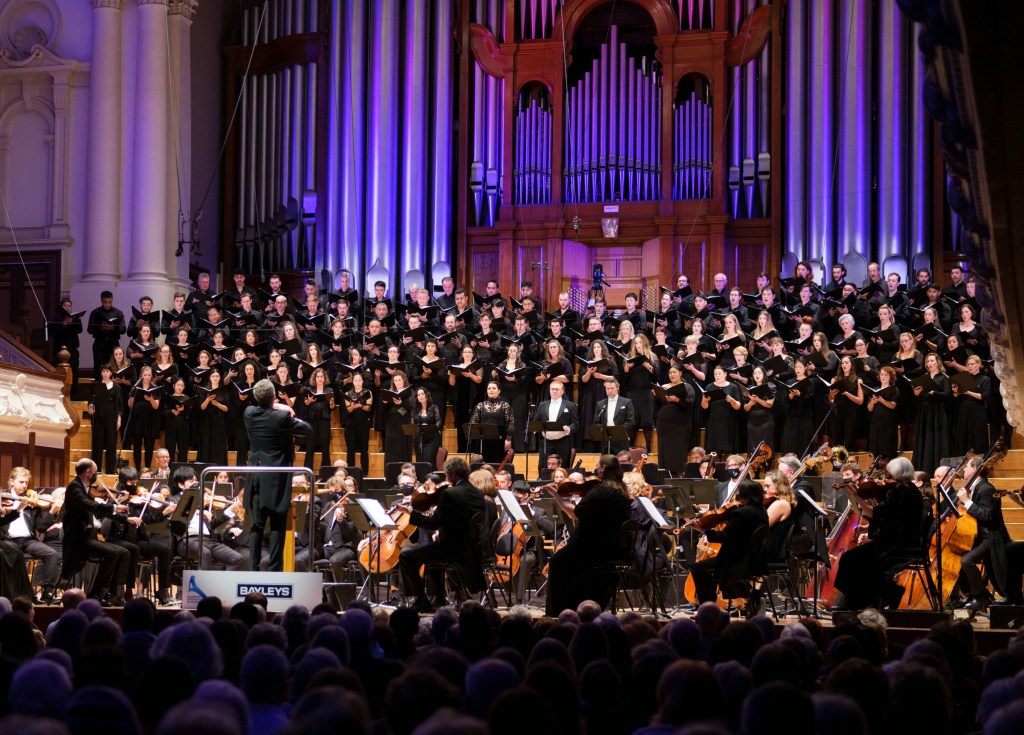
The APO’s latest “Ebb and Flow” concert opened with a new commissioned work from Gillian Whitehead “Tai timu, tai pari”

The title translates as “low tide, high tide” and Whitehead notes that this reflects her observation from her studio window overlooking the Otago Peninsula, an area host to many seabird species including the yellow eyed penguin, red billed gull, white fronted tern, and sooty shearwater  

“The tide ebbs and flows, light plays on the water, birds forage for food, rest on the water, whirl in flocks. But it’s not a soundscape – more than most of my pieces, it harks back to exploring an idea within the traditions and proportions of the classical era.”

Central to the work was soloist Andrew Beer, Concertmaster with the APO who along with his  violin acted a commentator and observer throughout the work.

The music conveys much about the landscape, the changing light, the ebb and flow of the waters  as well as the bird life. But, with the work having been  written over the past two years of Covid there is also an underlying tension.

The opening moments of the work with its soft strings and gentle percussion along with soloist Andrew Beer created a radiant dawn with light shimmering on the waters and a host of twittering birdsong.

Beer’s urgent bowing and sharp plucking heralded birdsong but there were also times when his ferocious and often abrupt playing seems to take on the part of a human presence and an underlying darker tone.

All the instruments contributed to the impressionist depiction of the landscape the fauna and flora, the murmur of the sea, the scudding clouds and the sense of light. – the percussion instruments, the harp, brass and the woodwinds all creating descriptive sounds, revealing both the ingenuity of the instruments as well as the inventiveness of the composer.

While these sounds revealed much about the physical environment, they also provided a sense of the spiritual  and emotional reactions we have to the environment.

With much of the work the orchestra created an enigmatic background into which Beer  inserted himself. His relentless solo work was stunning, varying from the delicate to the to the dynamic, conveying  ideas of hope, wonderment and despair.

“Tai timu, tai pari” with its brilliant evocation of personal and emotional responses  to the landscape and nature is a welcome addition to contemporary New Zealand compositions and deserves to be played often.

The American conductor James Feddeck himself gave a splendid performance. At times he seemed to use his baton to  sculpt the music out of the air and at other times it was a delicate drawing instrument employed with careful movements. He conveyed tempo and energy as he moved about the podium in precise dance-like steps and at times with his actions; crouching, turning and lunging he seemed like a man possessed.

The main work on the programme was Rachmaninov’s Symphony No. 2, a melodious triumph in which the composer confidently comes to grips with the symphonic form after his less than successful symphony No 1. Rachmaninov once said of the work that he composed it to give expression to his feelings; his melodies proclaim his feelings to have been not only dark and brooding, but also with a romantic warmth.

Just as there was an ebb and flow to Whiteheads work here too is an ebb and flow that is integral to the music such that it feels carefully planned, flowing in an organic fashion.

James Feddeck guided the orchestra expertly. From the film score drama of the second movement to the  dynamic  shifting moods of the third movement he was in perfect control. The strings had a burnished fullness, well matched by flamboyant woodwinds and brass.

He manged to express the psychological and emotional depths of the music, without the angst of Tchaikovsky or Mahler, featuring a lot more sweetness and joy.

Andrew Beer and Gillian Whitehead Photo Adrian Malloch
Categories
Reviews, News and Commentary

How fashionable women dressed in nineteenth century New Zealand

Reviewed by John Daly-Peoples

Dressed: Fashionable Dress in Aotearoa New Zealand 1840 to 1910

By Claire Regnault

Te Papa Press

$70.00

Reviewed by John Daly-Peoples

The Winner of this year’s  Ockham New Zealand Book Awards – Booksellers Aotearoa New Zealand Award for Illustrated Non-Fiction was “Dressed: Fashionable Dress in Aotearoa New Zealand 1840 to 1910” by Claire Regnault. It’s a work of scholarship and research but also one which breathes life into the many illustrated dresses and examines the ways in which women conducted themselves in the nineteenth century.

As the title suggest this is not a history of clothing but of  fashionable dress. These are the clothes of the well to do made of quality material by both  amateur and expert dressmakers.

While it is a history of clothing the book also provides a generous overview of New Zealand’ s social history of the Victorian period, one dominated by the mindset of Victorian England along with colonial adaptations.

Through the numerous illustrations and descriptions, the reader can trace the changing designs and silhouettes of the prevailing fashion. the degree of exposed neck shoulders and arms and the degree of ornamentation and decoration.

The book is filled with interesting mini histories and anecdotes. We learn of the enterprising individuals who worked as dressmakers as well as those who opened stores, imported materials and were aware of international trends.

The major stores such as Kirkcaldie and Stains Milne and Choyce  were important as they imported the new dresses from the England as well as producing their own clothes. By the turn of the nineteenth century Milne and Choyce was employing more than one hundred people in its dressmaking, millinery and mantle workrooms.

Dress with fitted bustle pad manufactured by James Spence & Co of London (Te Papa)

Then there are those who created fashion out of New Zealand indigenous furs and feathers for local and international consumption.

Hector and Elizabeth Liardet not only made and sold a variety of items made from of local exotic skins and furs. They also exhibited their goods at international exhibitions in Australia, London and Paris.

This muff, which belonged to James and Georgiana Hector, is made from the skin of a little spotted kiwi. (Te Papa)

There is even small historical note which could let Walter Buller of the hook. While he has recently been presented as the man who single-handedly destroyed the native bird population in the late nineteenth century, the fault may lie elsewhere. Regnault notes that as a twelve-year-old boy his mother skinned and stuffed four kokako to make into cabinet specimens which he received as birthday present – a gift which may have had an adverse lifetime effect on the young man.

There is a revealing episode which occurred in 1863 when a group of Māori (ten men and four women were taken to London by an enterprising William Jenkins. They caused much news and sensation and were even presented to Queen Victoria. For much of the time when they were in public they dressed in a mixture of European and traditional clothes, indicating that they were civilized. The European  clothes were a symbol of that civilization, but some of the men in the party objected to having to wear their traditional mats as they no longer wore them in New Zealand and regarded them as “heathen.”

Many of the dresses and accessors are works of art showing not just the technical skills of the dressmaker but also a genuine creative flair  with works such as a magnificent white swan feather evening cape and a vibrant red “newspaper” costume made by Miss Munro for the  Strange and Co Department Store in Christchurch.

Miss Munro of Strange & Co made this prize-winning newspaper costume for the Canterbury Times in 1908. (Canterbury Museum)

The book is also peoples by the fashionable people who wore the dresses. So, there is a photograph of Katherine Mansfield’s mother, Annie Burnell Beauchamp, Lady Ranfurly, Dick Seddon’s wife Louise and his daughter May in her militaristic uniform of the Lady Douglas  Contingent at the time of the Boer War. There are also fashionable Māori such as  Huria  Matenga, famous for saving many lives from the wreck of the  Delaware.

Huria Matenga – Nelson Provincial Museum

Also included is a section in full colour of example of fabrics from Te Papa’s collection showing the intricate nature, design and quality of some of the fabrics including damask, silk, cotton and velvet.

The book itself is a beautiful creation with a soft pink cover and a pink material bookmark. There are numerous full colour illustrations of dresses along with many historical photographs.

It is an important addition to books which show how New Zealand developed a local culture in art, architecture decoration and design in the nineteenth. It was a culture which was  heavily dependent on overseas models but with an increasing degree of local enterprise and creativity.

The bodice of the Tudor-themed costume worn by Lavinia Coates to Lord and Lady Ranfurly’s ball at Government House in 1898. (Tāmaki Paenga Hira Auckland War Memorial Museum)
Categories
Reviews, News and Commentary

Salvador Dali: great thinker, visionary or delirious madman.


Dali’s “The Persistence of Memory”. One of many famous works on view at Inside Dali

Inside Dali

Spark Arena, Auckland

Until June 30

Then

Air Force Museum, Christchurch

July 14 – August 26

Reviewed by

With the new exhibition “Inside Dali” at Auckland‘s Spark Arena the remarkable life and the full range of work by the artist is on view.

Following hot on the heels of two previous multi-media exhibitions –  “Van Gogh Alive” (also at Spark Arena) last year and “Michelangelo – A Different View” at the Aotea Centre earlier this year comes “Inside Dali”, a multi-sensory insight into some of Salvador Dali’s famous art works.

Dali was the supreme artist of the 20th century not just because of his instantly recognisable  melting clocks, surrealist figures and objects but in his ability to create his persona  as the celebrity artist.

Where most artists are valued for their individual artworks, Dali brings to mind the man himself with his remarkable flaring moustache, his glaring face and outlandish poses. He is also one of the most enigmatic artists of the  20th century – was his art the expression of a great thinker, that of a visionary or was it the outpouring of a delirious madman.

He combined an extraordinary artistic talent along with showmanship, intellect and wit, gaining publicity not so much for the art as his own behaviour and comments on art and life.

He was not only a surrealist painter as he experimented with other art forms as well. He worked with Luis Bunuel on the films “Un Chien Andalou”, and “L’Age d’Or” which were banned in France for their sexual imagery.

He also worked with Alfred Hitchcock on “Spellbound” and later collaborated with Walt Disney on the animated film  “Destino”, a film they started in 1945 but which was not released until 2003.

There are several rooms in the exhibition providing information about the artist’s life, his relationships with other artist as well as Gala, his wife of nearly fifty years.

Gala features in many of the artists paintings

The exhibition provides a journey through the artists life in photographs, text and  reproductions of his works as well as immersive visual rooms. Throughout there are several themes which preoccupied the artist – notions of time, sexuality and death.

In addition to Freudian imagery—staircases, keys, dripping candles—he also used a host of his own symbols, which had special, usually sexual, significance to him alone: the grasshoppers that once tormented him, ants, and crutches, and he saw  William Tell as his father figure.

One room is showing his rarely seen controversial set of prints illustrating  Dante’s “The Divine Comedy”, a surrealist tour of Heaven, Hell, and Purgatory combining the sinister with the sensual.

There is  the Mirror Room where viewers will be exposed to Dali’s surrealist work in a 360-degree setting. Here we encounter major works such as ”Dream Caused by the Flight of a Bee Around a Pomegranate a Second Before Awakening” where two tigers leap over the naked body of Gala”, a work filled with Freudian sexual imagery.

“Dali” speaks to the viewers

Central to the show is a large room where the artist’s works are projected floor-to-ceiling in high-resolution moving imagery. It is an immersive experience which provides a sense of Dali’s hallucinogenic dreamscape filled with sexual, political and religious imagery with several the artist’s works which the audience  will recognise. As part of this display an illusionistic ” Dali” appears and talks to the audience about his life and ideas.

Dali’s Mae West room

Near the beginning of the exhibition is the ideal social media setup which features a three-dimensional version of the artist’s Mae West where you can sit on the famous Mae west sofa creating your own Salvador Dali image.

Categories
Reviews, News and Commentary

NZ Trio provides another sophisticated concert

Reviewed by John Daly-Peoples

NZ Trio, Legacy 1

Auckland Concert Chamber

May 29

Reviewed by John Daly-Peoples

This year the NZ Trio celebrates twenty years of bringing music to New Zealanders. While two  of the original members, pianist Sarah Watkins and violinist Justine Cormack have moved on the current members,  Somi Kim (piano), Amalia Hall (violin) and Ashley Brown (cello) continue to provide a remarkable range of both classical and contemporary music. Over the last twenty years they have commissioned and played over 75 works by New Zealand composers. With each of their concerts they provide inspired programming, insights into the history music, an understanding of the technical issues related to the works

With their latest concert they presented a range of work spanning two hundred years from a Beethoven work of 1911 to a contemporary New Zealand work composed this year.

This was the  most intriguing work on the programme – a new commission from Michael Norris. His “Horizon Field Hamburg” was a response to a large art installation by sculptor Antony Gormley, famous for his “The Angel of the North.”

The installation is a vast, suspended floor with a mirror-like surfaces, seven and a half metres from the ground. The suspended floor responds to human movement and small groups are able to swing the whole floor slowly. In moving the work groups need to communicate with others evolving a collective behaviour so that Individual and group experience is mediated through vibration, sound and reflection.

It is these qualities which Norris realised in his work

Much of the time the musicians play their instruments as though they were percussion instruments, Somi Kim plucking and hitting the piano strings, and the other two using their bows to strike the stings as well as creating shimmering sounds by feathering the stings and there were times when their ferocious bowing was like an unsettling siren

They captured the idea of both physical movement and the play of light on a vibrating structure creating a sense of tension.

There was sense that they were describing a complex organisation or mechanical device which moved from being in a state of flux to an  out of control. unstable  state, exposing its fragility. In the final moments of the work the flurry of sounds saw  stability restored.

First up on the programme were two short works by Robert Schumann from his  Six Pieces in Canonic Form. The first of these which owed much to Bach was filled with an endless set of variations, developed by the players. Where the first work was almost mathematical in construction the second piece was more fluid and intimate, where the various themes were interwoven and the players seemed to be in their personal reveries.

Also in the first half was a 1998 trio by the Ukrainian composer and jazz musician Nikolai Kapustin.

The trio transformed themselves into a small jazz combo with each of them taking on the appropriate demeanour, notably Ashley Brown who became the quintessential jazz musician. Each of the players took turns in presenting themes which were explored as they fused the traditions of classical piano repertoire and improvised European-style jazz, combining jazz idioms and classical music structures.

The final work was Beethoven’s ‘Archduke,’ which because of its symphonic dimension, dwarfed the other works. It is one of composers last and most difficult pieces of chamber music, expressing exhilaration, melancholy, mystery and a search for love

Throughout, their playing they seemed conscious of each  detail of the music along with a sense that whole work was held in fine, intelligent balance. From the leisurely opening they carefully and gradually, explored the qualities of the work including the dance-like scherzo with its contrasting darker mood then giving a logical sense of flow to the Andante cantabile with some elegant playing.

With the final sublime movement, the trio created dynamic flowing ,melodies filled with sweep insistence and drama. Their playing took on an almost mystical feel and they seemed to be tracing out the dimensions of an undefined subject which was always withheld, providing a disconcerting sense of  mystery and anticipation leading up to the enthusiastic finale, where the players completed their sophisticated playing  suffused in a musical aura.

Categories
Reviews, News and Commentary

Four landscape exhibitions

Reviewed by John Daly-Peoples

Peter James Smith, Acheron’s Measure / Milford Sound

The Limitless Horizon. Orex, Until June 4

Paul Woodruffe, Pop Tones, Föenander, Until May 31

Daniel Unverricht, Suite, Until June 4

Clare Brodie, Elusive Forms, Scott Lawrie, Until May 28

Reviewed by John Daly-Peoples

Four recent Auckland exhibitions show artists looking at the natural and built environment in a variety of ways with “The Limitless Horizon” at Orexart featuring  six artists looking at the landscape from various perspectives.


Peter James Smith has several works such as “Acheron’s Measure / Milford Sound” ($9500) where mathematics, history and romanticism connect.

Martin Ball, Otira Gorge (after Van der Welden)

Martin Ball’s “Otira Gorge (after Van der Welden)” ($8500) with water shrouded boulders could have been an oil sketch by the nineteenth century artist himself. Ball is also showing some of his drawings of strips of paper as in “Remnants 3” ($4800) where the creases in the paper can be read in the context of the show, as folds in the landscape or the shifting sands of  dunes.

Richard McWhannell has some idyllic landscapes including “The Princesses and their Little Brother ($7500) which is peopled with a group from a Velasquez painting. Tony Lanes paintings link the landscapes of New Zealand with those of Trecento Italian artists in “A Way Through (the Mountains)” ($6500) as well as linking notions of medieval mysticism and   The Cloud of Unknowing with the Land of the Long White Cloud

There is also Johnny Turner’s “Red Sail (Wainui Beach/ Gisborne)” ($18,500) where the solidity, colour,  texture and detail  of the red and black granite hint at the  age and variety of the landscape. John Madden’s paintings similarly hint at the energy contained in the landscape with his bold expressionist work Tokatea ($8500).

Paul Woodruffe, After All

In Paul Woodruffe’s show “Pop Tones” at Föenander many of his images exist between the real  and the fantastic. Some of the images are of recognisable locations bringing together elements of his life and environment. Within each of the works there are structures, stories and events which intersect and overlap. As a landscape designer he is probably both conscious of preserving and  landscape, understanding the landscape  as well as adapting and enhancing it.

Realist observational painting intersect with abstract designs as though there is an underlying simplicity to the landscape but also refers to the way in which we impose a geometry and design on the natural landscape.  This is all linked in “The Drawing” ($2400) where an artist is shown producing an art works surrounded by both the images of bush and houses along with a swathe of abstract designs.

In “Forest Bathing” there are three levels to the work. A realsit background in muted tones, a semi-abstract depiction of plants and then abstract shafts which reach to a canopy of abstract shapes.

“Mother”($6000) hints at the notion of Mother Earth or Gaia with a female figure tracing out arcs on an elliptical shape

Several of the paintings feature individuals in the natural environment such as “Hunters” ($3500) while in “After All” ($4500) he has  cleverly linked contemporary notions of the outdoors with Manet’s “Luncheon on the Grass ($4500).

Some of  the paintings such as “Sleeping/Dreaming” ($3500) present a landscape image split in two, one in full light the other in darkness while “Moonlight Suburbs” ($1950) is a bird’s eye view of a night-time neighbourhood.

Nocturnal views of suburban New Zealand dominate in Daniel Unverricht’s exhibition ‘Sleeping Village’ at Suite Gallery where  empty streets and the dilapidated buildings of small-town New Zealand have a film noir edge to them. There is a melancholic beauty as well as a menace in the shadowy scenes such as “Linger” ($3800) and  “Chimera” ($6800).

Daniel Unverricht, Chimera

There are also daytime images but these present an equally depressing vision with boarded up  buildings such as  Center III ($20,000) and “Insulate” ($4500) both of which look like abstract sculptural  artworks.

Several of the images are of the decaying exteriors of the rundown building with traces of weeds and fading graffiti in  “Company” ($1800)

In many of the works the artist plays with the rendering of light and colour  with a hazy impressionist approach. So, with “Cul” ($1800) the various light sources of streetlight, moonlight and house lights as well as the blurred colours and shapes make for an unsettling image.

Clare Brodie, Elusive Forms 4

The Australian  artist Clare Brodie showing at Scott Lawrie Gallery sees the world as composed of colour, shape and pattern with works which shimmer and jostle as though flooded with light.

Her views  of nature are reduced to flat planes with soft pastel colours, abstracting and  simplifying so the paintings look like elaborate jigsaw puzzles. The soft greens and blues  are interspersed with patches of vibrant purples, pinks and darker blues,  hinting at indistinct  man-made forms.

All the works are titled “Elusive Forms” and with many  of them one can detect the shape of a tree trunk, the canopy of  a tree, the dappled light on leaves and the forms of hedges. With some such as” Elusive Forms 4” ($12,500) the various elements are almost recognisable but then with “Elusive Forms 13” ($7950) the shapes seem random and ambiguous.

Categories
Reviews, News and Commentary

NZSO’s passionate concert filled with events, ideas and emotions.

John Daly-Peoples

Amalia Hall

New Zealand Symphony Orchestra

Passione

Auckland Town Hall

March 14

Reviewed by John Daly-Peoples

“Passione” was the first NZSO concert to be held in Auckland this year celebrating its 75th anniversary. James Judd led the orchestra, fifteen years after he conducted them for its sixtieth-year anniversary in 2007.

The three works on the programme were all linked to other creative works which explored stories about passion where the music conveyed events, ideas and emotions.

The first work on the programme was Strauss’s tone poem “Don Juan” which captures  the philandering exploits of the hero. The  frenzied swelling of the opening represented the lustful  Don Juan’s while the passionate voices of the harp, sprightly flutes and woodwinds painted expressive portraits  of his female lovers.

The second work on the programme was John Corigliano’s “Chaconne for Violin and Orchestra” written for  the score of the film The Red Violin which  traces a rare violin from Cremona, Italy, where a violin maker adds a secret ingredient to the varnish – his wife’s blood.

The work was filled with haunting themes that echo the moodiness of the tale with soloist Amalia Hall taking on the role of the violin itself. The work opened with Hall playing a tingling melody representing the birth of the instrument with tentative chords and then later playing some achingly beautiful passages which  revealed an intense fragility with a sense of the violin itself being filled with despair. Throughout the work with the soaring voice of the violin contrasted with the orchestra’s sounds full of drama and shocks.

Her voice prevailed over the onslaughts of the orchestra at times with a pure romanticism while at other times her playing was indignant and insistent as she seemed to battle with the orchestra, a battle which came to a close as she outplayed the orchestra in the final moments the of the work.

The main work on the programme was a selection of pieces from Prokofiev’s “Romeo and Juliet”. Prokofiev’s ability to create drama, romance and grief makes the music to the ballet one of the most powerful orchestral works.

The opening work “The Montagues and Capulets” captured the mood of power and drama with an underlying attention to dance movement this was followed by a transition to the Aubade with the romanticism of the piece  conveyed by flutes and then to the light dance of Juliet herself where the sprightly orchestration creates a entrancing image of a young girl.

They also played “The Death of Tybalt” one of the most impressive and moving pieces. From the opening sinister sounds through the almost playful and hectic fight scenes  and onto the dramatic and tragic death, the work pulses with emotion.

James Judd ensured the orchestra provided a performance with an almost symphonic scope while ensuring we appreciated the balletic  nature of the work, conveying the scores colour grace and excitement.

Future NZSO Concerts

FOUR SEASONS

Vesa-Matti Leppänen Director
Anna van der Zee Violin
Malavika Gopal Violin
Simeon Broom Violin
Alan Molina Violin

Vivaldi The Four Seasons
Piazzolla orch. Desyatnikov Las Cuatro Estaciones Porteñas (The Four Seasons of Buenos Aires)

Hamilton May 20 & 21

Nelson May 26

Categories
Reviews, News and Commentary

APO’s Tall Tales concert featured two remarkable story telling solioists

Reviewed by John Daly-Peoples

Jeno Lisztes

Auckland Philharmonia Orchestra

Tall Tales

Auckland Town Hall

May 5

Reviewed by John Daly-Peoples

The APO’s “Tall Tales” concerts opened with Zoltan Kodaly’s “Háry Janos Suite, an impressionist tale of the quixotic, Hungarian folk hero.

The Empress Marie Louise, wife of Napoleon, falls in love with Háry and takes him to Vienna. France  declares a war on Austria in which Háry single-handedly defeats the armies of Napoleon but he realizes  he can find happiness only with his village sweetheart, Orzse, so he dismisses the Empress.

The work is a dream about the personal search for glory but also a search for nationalist pride. It is these qualities which Kodaly tries to express in the work. At the centre of this musical search is the cimbalom, a Hungarian musical instrument played by soloist Jeno Lisztes

There are sequences of  drifting landscape and militaristic display with lots of animated Hungarian melodies and atmospheric passages.

There were sequences of sorrowful strings, blasting trombones and lots of clashing cymbals as well as some jazz like interventions. Along with brass and timpani was the cimbalom which sounds like a mixture of the harp and the xylophone with conductor Gilbert Varga seemingly carried away by some of the dance sequences.

Jeno Lisztes then performed one of his own solo improvised works with a dazzling display of music and some remarkable technical skill. The cimbalom is played with two sticks but Lisztes’ speed and agility meant that it sounded as through there were at least two players  creating an avalanche of intertwined sounds and themes. Several of his variations were based on Hungarian themes but one could also detect a  clever riff on pokarekare ana.

Clara-Jumi Kang

The major work on the programme was John Adams’ Scheherazade 2

A lot of John Adams major compositions have strong political and social purpose such as “Nixon in China” and “The Death of Klinghoffer”. His “Scheherazade 2” is no different. The work is about the violence  that women suffer, even at the hands of the people who should care for them.

In the mythical  stories of the Arabian nights Scheherazade tells her murderous husband a new tantalizing tale each night for 1001 nights, thus sparing her life a day at a time. Adams saw that this account of brutality had resonances with the present day.

The four movements work has no  explicit  narrative but each part has a description with enigmatic titles. Some of these – “Tale of the Wise Young Woman – Pursuit by the True Believers” and  “Scheherazade and the Men with Beards” gives a sense of the oppressive nature of the sultans’ court while “A Long Desire” and  “Escape, Flight, Sanctuary” speak more of her personal reactions.

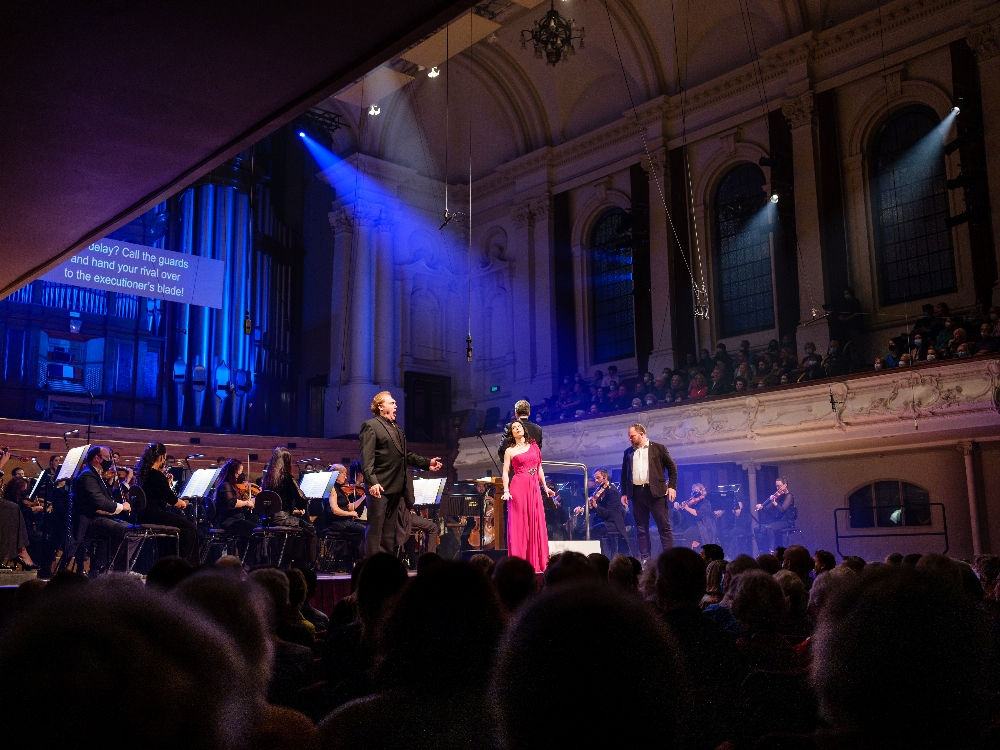
With the orchestra providing a lush sensual backdrop to the stories  violinist Clara-Jumi Kang  or rather her violin became the embodiment of Scheherazade in an electrifying performance. Her violin along with Lisztes cimbalom displayed a strident voice which conveyed the emotional aspects of the storytelling as well as a feeling of adventure.

In many ways this was mini opera with Kang’s  voices expressing the qualities of the heroine, moving from the harsh to the lyrical. She conveyed  through her  playing various dreamstates, sadness, coquettishness, and sensuality, morphing from  quiet introspection to rage.

In the final movement “Escape, Flight, Sanctuary,” Kang enveloped by brass and wind instruments expressed a  fierceness and vulnerability  with some frenzied bowing,

Next Town Hall concert

May 19

Conductor Gilbert Varga
Harp Ingrid Bauer

Saint-Saëns Le rouet d’Omphale
Debussy Danses sacrée et profane
Tailleferre Concertino for Harp and OrchestraMilhaud Le boeuf sur le toit
Satie (orch. Debussy) Two Gymnopédies
Ravel La valse

Categories
Reviews, News and Commentary

Robin White: A life through art revealed in new book

Reviewed by John Peoples

Robin White: Something is happening Here 

Edited by Sarah Farrar, Jill Trevelyan and Nina Tonga

Te Papa Press & Auckland Art Gallery
RRP ($70.00)

Reviewed by John Daly-Peoples

In “Soon the tide will turn” one of her large collaborative barkcloth works Robin White included a small image based on a painting of hers from fifty years before. It is of the building which dominates “Mangaweka” but without the old Bedford truck sitting outside. The two works illustrate her commitment to recognising place and her links to the land across time. For many artists their work is an expression of and a contemplation of their physical, emotional and spiritual connections. With White the images she has created constitute a visual diary of the places she has lived, the environments she has inhabited and the people she has encountered.

As she has previously said of her work “A consistent thread in my work it that it’s made in response to place and what’s happening around me – physical and social environments provide raw material, the inspiration and the starting point”

The new book “Robin White – Something is happening Here” brings together many of her images in a survey of her life’s work greatly expanding the readers appreciation of the artist’s work.

The book follows her career from the early successes, selling work to the University of Auckland and The Dowse through to her relocation to Kiribati. It traces out  the development of a personal style and shows the various influences on her work including her friendship with the poet Sam Hunt, high school teacher May Smith and Colin McCahon at the Elam School of Fine Arts. Threaded  though all these aesthetic influences were the teaching of Bahai which affected her social and political ideas.

Her work up till 1982 when she moved to Kiribati is quite distinctive from the latter work she would produce. Her work of the 1970’s includes images of building and landscapes of the places she encountered – Bottle Creek, Porirua,  Mt Eden, Dunedin and Harbour Cone. Some of these paintings recall McCahons line about landscapes with too few lovers but they also hint at Rita Angus’s Cass.

Robin White, Mana

The large portraits of that time set in landscapes seem to link to the portraits and religious depictions of the Renaissance where the backgrounds perform a symbolic function as well as providing a sense of place.

The work after 1982 when she began living in Kiribati, touring the Pacific and the world have a different style and different outlook. As she says about arriving in her new homeland “You look one way and there is the ocean, and the other way and there is more ocean. It’s just the sense of vastness and the nothingness of space.”

A lot of these works focussed on the domestic and everyday life on the island. A series of woodblock prints from the 1990’s was inspired by a young woman with “Nei Tiein goes for  a walk” and  another of The Fisherman loses his way.” The Nei Tiein works are linked to the poems of Yeats and Blake and the Fisherman series look like Pacific reworking of biblical images and narratives.

Robin White and Ebonie Fifita, Soon the tide will turn

Many of the  significant works she produced were collaborations. The first of these was with her artist friend Claudia Pond Eyley and their set of woodcuts “Twenty-eight day in Kiribati.” Later collaborations were with female artists of the island as well as artists from Tonga Fiji and New Zealand. Some of these large-scale works were on barkcloth , the images made from earth pigments and natural dyes  featuring a range of stencilled motifs of Western and Pacific art. In “Soon the tide will turn” which featured her own work she also includes Henri Matisse’s shoes and hat, a reference to the time the Frenchman spent in the Pacific.

The book provides an insight into a wide ranging and multi-layered  life where everyday life and experiences meld with symbols and metaphors creating work where the deceptive simplicity conceals a depth of enquiry and comprehension seeing order and meaning in the world.

The book itself is a beautiful production  with more than 150 full colour reproduction, numerous photographs. While the main text of the book is  by Sarah Farrar, Jill Trevelyan and Nina Tonga there are also  a number of shorter essays on particular works and aspects of the artist life by other commentators including Peter Brunt  Helen Ennis, Gregory O’Brien, Justin Paton , Linda Tyler and Haare Williams.

Robin White, Clouds, Hill and Claudia

A major retrospective exhibition featuring more than 70 works from across White’s 50-year career – Robin White: Te Whanaketanga | Something is Happening Here – will open at Te Papa on 4 June, followed by Auckland Art Gallery in late-October 2022.