Categories
Reviews, News and Commentary

Little Doomsdays; an innovative text by  Nic Low with enigmatic images by Phil Dadson

Reviewed by John Daly-Peoples

Little Doomsdays by  Nic Low & Phil Dadson

Massey University Press

RRP $45.00

Reviewed by John Daly-Peoples

“Little Doomsdays” by  Nic Low and Phil Dadson is the fifth in the series of  collaborations between an artist and a writer conceived and edited by Lloyd Jones. With this work experimental musician and artist Phil Dadson has illustrated the innovative text that is based on sacred texts from antiquity, modern writings and  te ao Māori by Ngāi Tahu writer Nic Low.

The book is an extraordinary combination of fairy tale, parable and scientific enquiry. In it Nic Low in referencing the mythical Ark of Noah, looks at the ways in which humans have attempted to preserve flora, fauna and knowledge over the centuries. He takes the reader to the great Svalbard Global Seed Vault  in Norway which is in the process of preserving examples of all seeds and the Qaitbay Fortress in Egypt where the Rosetta Stone was discovered in 1799, allowing translation of Hieroglyphs.   He also hints at the possible discovery of the flavour  of the Moa, detected in the remains of a long buried umu on the East Coast

Low links the efforts of scientists worldwide with those of past ages who have endeavoured to preserve their culture along with similar attempts by Maori.

With this notion of an attempt to catalogue the history of civilizations the work has certain parallels with the fictions of Jorge Luis Borges  and the remarkable library of Hernando Colón.

Borges’s short stories such “On Exactitude in Science” which imagines an empire where the science of cartography. becomes so exact that only a map on the same scale as the empire itself will suffice or his essay entitled “The Total Library” describing his fantasy of an all-encompassing archive. Low’s themes as with those of Borges, include infinity, reality, elaborate reasoning and labyrinthic concepts.

The idea of the universal library was actually created by Hernando Colón in the sixteenth century. The son of Christopher Columbus he travelled the world to build the biggest library the world had ever seen with the aim of creating a universal library containing all books, in all languages and on all subjects. The resulting collection of between 15,000 and 20,000 books of mainly, contemporary printed material.

Little Doomsdays opens with a typical Borgesian approach from Low, creating an almost allegorical tale – “It’s said — that in the late twentieth century an unstable grouping of scholars, writers and fanatics from several Ngāi Tahu hapū in Murihiku created what has come to be known as the Ark of Arks.”

“It’s said that this project aimed to catalogue all known arks from the last five millennia. It was a failed attempt to capture previous civilisations’ failed attempts to preserve whatever was valuable to them: waka huia, time capsules, caches, burial ships, seed banks.”

Phil Dadson’s illustrations provide a colourful, graphic accompaniment to Low’s texts and have a sense of the enigmatic and the mystifying. Over many years Dadson has visited many sites where the record of humans is marginal but the traces of the simple forms of life are evident. He has documented items from desolate places such as  the Antarctic and the Chilean desert where he photographed the simple life forms he has encountered.

Unfortunately, the book doesn’t give references to these strange locations and images which would have added to the general enigmatic quality of the book.

To subscribe or follow New Zealand Arts Review site – www.nzartsreview.org.

The “Follow button” at the bottom right will appear and clicking on that button  will allow you to follow that blog and all future posts will arrive on your email.

Or go to https://nzartsreview.org/blog/, Scroll down and click “Subscribe”

Categories
Reviews, News and Commentary

(m)Orpheus: Fast Forward to the Past

Reviewed by Malcolm Calder

(m)Orpheus by Christoph Gluck

An Opera in 3 Acts

NZ Opera/Black Grace co-production

Director/Choreographer: Neil Ieremia

Conductor: Mark Taddei

Design: Tracy Grant Lord

Lighting: JAX Messenger

Assistant Director: Jacqueline Coats

Re-orchestration: Gareth Farr

With: Samson Setu, Deborah Wai Kapohe, Madison Nonona

NZO Chorus: Alfred, Emeline, Faamanu, Jordan, Lemauseafa, Stella, Taylor, To Ohorere

Black Grace Dancers: Demi-Jo, Rodney, Fuaao, Sione, Vincent, Ben, Paula

Auckland Philharmonia Orchestra

ASB Waterfront Theatre, Auckland, 6, 7, 9, 10 September

Opera House, Wellington, 20, 22,23 September

Reviewed by Malcolm Calder

Once again NZ Opera reveals strength, innovation and rising stars while Neil Ieremia continues to astound and amaze.

I would not have been surprised to learn that Gluck and Ieremia shared childhoods – they certainly share mindsets. Both have that rare ability to work from clear cultural underpinnings and to innovate. Both build on tradition and to then fill a story with clear characters and real emotion and then generate a revolution in style and content.

Gluck turned the traditional opera world a little on its head in the 18th century when he – shock, horror – veered away from the prevailing highly-mannered teutonic reliance on pretty loose plots that served to primarily to show off singers. He stood by them of course, but added a new twist to a traditional Greek fable by creating a new plot for Orpheus and Eurydice that animated his characters. Courtly audiences soon found this entertaining and other composers were to follow.

Ieremia’s cultural roots are firmly planted too. But his are Pasifika ones and his outlook is decidedly visionary. He says he found Gluck’s ideas on enduring love and loss inspiring, and then goes on to toss in a couple of contemporary issues as well and the result is this high-impact contemporary re-imagination (m)Orpheus.

So, if Gluck led a movement that took opera to a whole new place, then Ieremia starts from a slightly different one and takes it to yet another place.

His key character is Orpheus. Samson Setu gives us a young man who is definitely a man’s man. He probably works in a highly physical environment, lives an industrial life and could easily make it as a rampaging forward for the Warriors. But with the death of his wife, the lovely, delicate Eurydice (Deborah Wai Kapohe), sensitivity to his feminine side is revealed as rather absent and things don’t go so well.

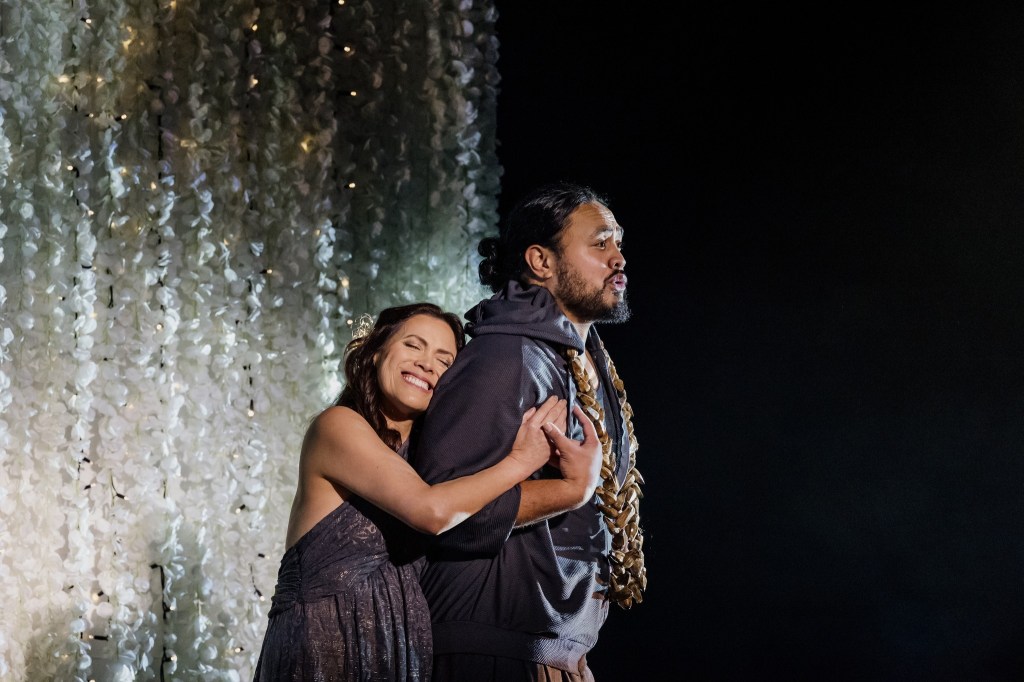
Deborah Wai Kapohe (Eurydice) and Samson Setu (Orpheus) Image Andi Crown

(m)Orpheus is a story of Eurydice’s death and then Orpheus’ search for her under the auspices, guidance and suggestions of a perkily bouyant Amor (Madison Nonoa). But it is also a story about one man’s search for himself through the netherworld of his own mind until he eventually come to terms with life itself.

The power and strength of the principals stand out as they should, highlighting the many fine young voices now rising to the surface of a what can be a cut throat industry. Setu is consistently strong and then wrought, Kapohe personifies eye-rivetting beauty and a strong sense of self, while Nonoa provides a delightful dash of both costumed and vocal pink.

But it is Ieremia’s blend of dancers and chorus into something that moves in fluid singularity that stands out. Somehow singers become dancers, and dancers become singers – at least they did in my mind. He blends Samoan tradition with lyrical movement the fluidity of the whole becomes a thing of beauty itself. It is a joy to see a cast enjoying itself. And this cast does exactly that.

Tracy Grant Lord’s design rests largely on a black and white motif with splashes vibrant colour to high-lighting particular points, all dramatically lit by JAX Messenger. It moves from an industrial setting to a suburban one, then to the netherworld and back again. Yes, there is a rather battered old car. Two in fact.

Gareth Farr’s re-orchestration for small chamber orchestra is entirely appropriate, fitting both Ieremia’s interpretation and this venue well, while the APO is as accomplished as ever under Marc Taddei. (m)Orpheus is sung in English with some Samoan chorus work, full surtitles, and could easily transfer quite easily to anywhere in the world.

As I have written previously, Neil Ieremia is by far one of Aotearoa’s most astonishing and prolific home-based creatives.    His ever-growing body of work has easily and unselfconsciously graced stages in many parts of the world and he is rapidly becoming a one-man export machine.  In part this is because of his perfectionism that never forgets the past, stands firmly rooted in the present and yet finds time to seriously address the future – sometimes simultaneously. In sum, he is particularly perceptive about the way cultural forms are adapted, reimagined and made relevant.

So congratulations to NZ Opera for this production and especially for both introducing younger performers and for innovative programming. And thank you Neil Ieremia for making it happen.

To subscribe or follow New Zealand Arts Review site – www.nzartsreview.org.

The “Follow button” at the bottom right will appear and clicking on that button  will allow you to follow that blog and all future posts will arrive on your email.

Or go to https://nzartsreview.org/blog/, Scroll down and click “Subscribe”
Categories
Reviews, News and Commentary

Wagner’s Ring set to open in Brisbane later this year

John Daly-Peoples

Opera Australia

Der Ring des Nibelungen, The Ring Cycle

Opera Queensland, Queensland Symphony Orchestra and Dancenorth,

Queensland Performing Arts Centre,

December 1 – 21

Preview John Daly-Peoples

Opera Australia’s  highly anticipated world-first, fully digital Ring Cycle opens in Brisbane in three months. Originally scheduled for 2020, but postponed twice due to the COVID pandemic, Wagner’s epic opera will finally open at the Queensland Performing Arts Centre on Friday 1 December 2023.

Recognised as one of the greatest of operas, Der Ring des Nibelungen, generally known as the Ring Cycle, comprises 15 hours of extraordinary music performed over four evenings, and this brand new, cutting edge reimagining of Wagner’s masterpiece will see opera lovers from around the world descend on Brisbane to experience the history making production which will make use of  of towering LED screens with the latest technologies to create a visually stunning new Ring.,

Presented in partnership with the Queensland Government and Brisbane City Council, and in collaboration with Queensland Performing Arts Centre, Queensland Symphony Orchestra, Opera Queensland and Dancenorth, the Ring Cycle will showcase the outstanding talent Australia has to offer..

The scale and scope of the story is epic. It follows the struggles of gods, heroes and several mythical creatures over a magic ring forged by the Nibelung dwarf Alberich from gold he stole from the Rhine maidens. It is a ring.that grants domination over the entire world. The drama and intrigue continue through three generations of protagonists, until the final cataclysm at the end of Götterdämmerung.

Opera Australia CEO Fiona Allan expressed her gratitude to these partners who have remained committed to this production and looks forward to rehearsals beginning again in coming months. “Opera Australia wouldn’t be able to present this world first Ring Cycle without the help and support of our many partners in the Queensland Government, Brisbane City Council and Queensland’s broader arts and cultural community. “We are extremely grateful for their longstanding commitment to this production and are thrilled to finally be only six months away from seeing everyone’s hard work shine together onstage,” said Ms Allan.

Chen Shi-Zheng with a model of one of the sets of The Ring (Image Rhiannon Hopley)

Drawing on the best of the best talent from Australia and around the globe, acclaimed director Chen Shi-Zheng will lead a world-class creative team, cast and orchestra to bring a futuristic version of the Norse mythology to life. As the first Chinese director to direct a major Ring Cycle, Chen Shi-Zheng will also be the first to weave Chinese mythology into the production. Several New Zealanders are involved in the production including  Katherine Wiles who will be performing in Götterdämmerung

Expected to draw huge local and international audiences across the three complete Cycles, this groundbreaking production of the Ring Cycle will bring many visitors to the area and. Queensland’s Tourism Minister Stirling Hinchliffe said the Ring Cycle was set to bring a $16 million boost to Queensland’s visitor economy. “The world-renowned reputation of this opera has fans from all around the globe winging their way to Brisbane to see it,” Mr Hinchliffe said. “Even after two postponements of the season due to the pandemic, most ticket holders retained their seats, a ringing endorsement of just how special this production is.

The Full Cast

Wotan/Wanderer Daniel Sumegi, Brünnhilde Lise Lindstrom (Cycles 1&2), Brünnhilde Anna-Louise Cole (Cycle 3), Siegfried Stefan Vinke, Alberich Warwick Fyfe, Mime Andreas Conrad, Siegmund Rosario La Spina, Sieglinde Anna-Louise Cole (Cycle 1&2), Sieglinde Olivia Cranwell (Cycle 3), Fasolt David Parkin, Hagen/Hunding/Fafner/ Andrea Silvestrelli, Gunther Luke Gabbedy, Gutrune Maija Kovalevska, Loge Hubert Francis, Fricka/Waltraute Deborah Humble, Donner Alexander Sefton, Froh Dean Bassett, Freia/Helmwige Mariana Hong, Erda Liane Keegan, Woglinde Lorina Gore, Wellgunde/Gerhilde Jane Ede, Flosshilde/Schwertleite Dominica Matthews, Rossweisse Ruth Strutt, Ortlinde Jennifer Black, First Norn Celeste Haworth, Grimgerde / Second Norn Angela Hogan, Siegrune Agnes Sarkis, Woodbird Celeste Lazarenko, Third Norn Olivia Cranwell

Categories
Reviews, News and Commentary

Political parties and their arts policies

As this year’s election approaches it is timely to remind all political parties that there is an  important sector which deserves a lot more than the usual platitudes about the importance of art and the need for coherent and visionary approaches. Hopefully everyone involved in the sector can remind their local candidate of the need for arts policy!

Background

It is hard to find any experienced artist who does not view the situation for the arts in our country as gruelling and frequently discouraging. The latest report on the income of those working in the sector (sponsored by Creative New Zealand and NZ On Air) provides evidence for that gloomy view, by reporting that the median income for creative professionals is only $19,500 per year. More than half of our creative professionals have a second job, but even then, their median income is only $37,000 compared with $61,800 which is the average figure for salary and wage earners in New Zealand. Among the groups in trouble are the 47% of music and sound artists whose income is even lower now than it was in February 2020.

But income is only one aspect of the problem. There is huge public interest and involvement in the arts, yet somehow that does not get translated into media coverage or political support. The absence of arts policies by the major parties is once again conspicuous by its absence. This year, many members of the arts community have gazed enviously at the situation in Australia where the government has done extensive planning and policy-making and provided new funding to develop the arts. When the Hon. Carmel Sepuloni, Labour’s Arts Minister, was asked (by a Stuff interviewer onAugust 20) for her view of what the Australians had done, she replied that she did not think it was time for New Zealand to attempt “any visionary roadmap” of that kind. But will that time ever come?

Progress on Policies

It appears that the only three parties have seriously bothered to promote art policies for the election — the Green Party, NZ First, and Te Pāti Māori. The Greens propose some striking initiatives, such as a guaranteed level of income for every New Zealander. They also promise “adequately resourcing work in the arts,” though they have not yet provided details.

The idea of a universal basic income has been debated in the Nordic countries since the 1970s. The Irish government recently announced a basic annual income of around $30,000 for 2,000 of its artists. It is interesting to recall that our Labour government once ran a similar scheme. In 2001 Judith Tizard, then the Associate Minister of the Arts, instituted the ‘Pathways to Arts and Cultural Employment’ (PACE) scheme to assist artists on the benefit. In her words, PACE meant: ‘Now, when you go to Work and Income, you won’t be told to go and work as a dishwasher.’ By 2003 Steve Maharey could report that 1200 beneficiaries had found work using the scheme, and 2127 jobseekers were signed up for PACE. The change of government in 2008 led to the running-down of the scheme, and in 2011 it was officially discontinued. It is fondly remembered as having lent important assistance to many careers, including bands such as Black Seeds and the Phoenix Foundation, along with creative people from other arts such as fiction writer Anna Taylor and film-maker Taika Waititi. There is no longer any sign of such an initiative in Labour policy, but the Greens are obviously thinking along similar lines.

The Greens also call for a general review of arts funding policy, and for the government to provide direct support for the arts instead of relying on income from gambling. They also speak of the need for an arts education strategy. The context for that is the widespread concern in the cultural sector that arts education at every stage, from primary school to tertiary level, is currently in a situation of crisis. (https://www.greens.org.nz/arts_culture_and_heritage_policy)

New Zealand First promises strong support for the arts and cultural heritage, but its policies are expressed in a more general form (https://www.nzfirst.nz/broadcasting_arts_culture_and_heritage). There are, however, some fresh initiatives such as “funding specialist curriculum leaders to support schools to deliver on the Arts Curriculum,” and requiring international pay television streaming services to include New Zealand content. (Australia already has a requirement of that kind.)

Te Pāti Māori speaks eloquently about the value of toi (the arts). It says: “Toi Māori is our total wellbeing strategy; our mental health strategy, our physical health strategy, our Reo Māori strategy, our Educational strategy, our whakapapa strategy, our tourism strategy, our community development strategy and our cultural defence strategy and must be recognised as such.” (https://www.maoriparty.org.nz/toi_maori)

All the policies of Te Pāti Māori focus primarily on Māori creative activity rather than on the arts in general. One of the party’s policies was implemented in May this year by the Labour government – a boost of $34 million in funding over the next two years to the kapa haka festival Te Matatini, making it the country’s highest-funded arts service provider. The party’s other proposals include the establishment of a Māori funding body parallel to Creative NZ with a budget of $57 million.

ACT has nothing about the arts currently on its policy website, but it has told PressReader that it “was open to reforming bureaucratic arts funding applications, and funding for large public sector payrolls for culture agencies.” (https://www.act.org.nz/policies)

Labour has focused mainly on the video games industry, announcing that it would give it a $40 million tax rebate each year. For other areas of the cultural sector, it may feel that it can rest on its laurels, following its support for Te Matatini in May, and its $22 million “funding injection” to “the arts, culture and heritage sector” in February. That was a final instalment of the government’s Covid Recovery Programme. $10 million of that amount will be devoted to “festivals,” while the other $12 million will go to Creative NZ in the wake of the bad publicity it received last year when applications hugely exceeded available funding.

The government deserves credit for having made these increases in funding, but in policy terms they seem piecemeal, nowhere near as comprehensive or unified as the Australian government’s support for the arts. Within our cultural sector, there continues to be a widespread desire for an overall review of funding priorities. There have been a number of public controversies over funding decisions by Creative NZ and by the Ministry for Culture and Heritage. And individual freelance artists, who have very insecure careers, question the fact that such a large proportion of overall funding is swallowed up by institutions (such as ballet, opera, orchestra, Te Papa, etc.). Again, while everyone agrees that diversity and access are important goals, there are different ways of defining those terms. For example, a debate about the meaning of ”diversity” should address the changing needs of a society that is both “bicultural” and “multicultural,” both urban and rural, both contemporary and traditional. It is also argued that there is too much emphasis on emerging talent when so many proven, established artists are left to struggle with the “mid-career problem.” These are just a few of many issues that suggest the need for a review.

The arts have received little attention as part of Labour’s election campaign, and that is also the case with National. The leader of neither party is showing any interest in the subject in their speeches. Within the National team, media spokesperson Melissa Lee has expressed concerns about the future of Radio NZ and TVNZ, but Simon O’Connor who is the spokesperson for Arts, Culture and Heritage keeps devoting his newsletters to his other interests – “Internal Affairs and Defence,” “cost of living, health, crime,” etc.

Of course it is still possible that Labour and National will surprise everyone with last minute announcements. But as matters stand, we expect the cultural community will once again be struck by how restricted appears to be the support or understanding of the arts among our mainstream politicians and media. In that situation, it is not surprising that so many areas of our cultural infrastructure remain fragile, able to continue functioning only through the slog and dedication of the arts community.

Our arts lobby group consists of:

Judith Darragh

Sir Roger Hall

Eve de Castro-Robinson

John Daly-Peoples

Professor Peter O’Connor

Roger Horrocks  

Categories
Reviews, News and Commentary

Mike and Virginia: A flash of magic

Reviewed by Malcolm Calder

Laura Hall (Virginia) and Andrew Grainger (Mike)

Mike and Virginia by Kathryn Burnett and Nick Ward

Tadpole Theatre Company

Pumphouse Theatre, Takapuna

Directed by Simon Praast

Lighting/Sound – Gareth/Geoff Evans

Costumes – Robyn Fleming

With : Andrew Grainger and Laura Hill, and Muna Arbon, Stephen Papps and Jodie Rimmer.

Thursday 31 August 2023 (until Sept 10)

Reviewed by Malcolm Calder

Last year Takapuna’s Tadpole Theatre tackled Kathryn Burnett’s new work The Campervan.  I thought it perfectly suited to Tadpole’s demographic, had some great localised comedy and was pretty well-balanced.  Their Relatively Speaking earlier this year was also a pretty competent handling of the Alan Ayckbourn classic.

But I found Mike and Virginia an odd choice for Tadpole.

Using the simple and well-hyphened rom-com plot line of boy-meets-girl-meets-boy-meets-girl-again, its demands on an audience are low.  Both playwrights are perhaps better known as screenwriters and this is reflected in a stage production that some might see as better suited to celluloid.

Amiable academic Mike (Andrew Grainger), fresh from a collapsed relationship, falls for Virginia (Laura Hill) a fiercely independent-minded academic.  Power duly swings back and forth, interspersed with one-liners that generated appropriate laughter from the opening night audience.  Some of the lines bite.  Some don’t.  And some are genuinely funny.

The two discover they both specialise in film analysis – albeit of different genres – and that sets up a nice push-pull between them that then occurs over maybe 40 or more different and very rapid scenes – rather like a film.  Some are very brief indeed.  Just as I was beginning to grasp a point, I was disconcerted when it jumped quickly to the next scene before I could digest the last. There is no set – only a couple of strategically-used chairs – and many scene-changes are simply another lighting cue.  The entire piece is played against blacks.  Yes, I wondered about the possible irony of this.

I also felt a little sorry for director Simon Praast and his cast as the material came up so quickly any opportunity to connect with each other was fleeting.  They are all competent and capable actors although, oddly enough, each has a strong film background.  Hmmmmm, now there’s a thought.   

Grainger gives his usual highly capable performance, developing Mike to reveal some sensitivity though I wondered if he may have been perhaps little too amiable especially earlier on.  Hill’s Virginia was far more (and appropriately) glacial.  Her icy Virginia fairly spasmed with a fiery, glacial intensity.  There were a couple of instances where a flash of magic occurred between them.  I wanted more but the scenes were a bit brief.

However, it was the supporting cast of Mike and Virginia that had some of the best opportunities even though these existing mainly as foils or counterfoils for many of the one-liners.  Jodie Rimmer created a genuine frenetic wannabe Sally – I’m sure I have seen her as a be-costumed fairy in a shopping centre recently.   While Stephen Papps came to own the dry observation as the droll Harry – I could swear he was fixing my neighbour’s plumbing the other day, fag and all.

But Mike and Virginia is not a film.  It is theatre. Many will enjoy this rollicking rom-com, but be mindful that the two genres are distinctively and deliberately different.

Categories
Reviews, News and Commentary

A painters view of Tongariro National Park

Reviewed by John Daly-Peoples

Tongariro National Park

An artist’s field guide

By Desmond Bovey

Potton & Burton

Publication Date: November 2023

RRP $39.99

Reviewed by John Daly-Peoples

To many people driving  across the Volcanic Plateau, the landscape can seem bland apart from the views of the mountains which are always impressive. However, when there is volcanic activity, the views can be spectacular making one aware that the area has hidden depths and dimensions, that Nature isn’t always silent and lacking in interest.

For the hiker, the hunter and the skier who get closer to the land the area reveals its many  hidden treasures – the plant life, the animals the birds, the fish and the geology.

A new book Tongariro National Park : An artist’s field guide by Desmond Bovey explores the various aspects of the area. While this  is an artist’s exploration of the park’s plants, animals and landscapes Bovey is also very knowledgeable about the flora and fauna.  He writes in a detailed, informative style describing how the various elements of the ecosystem have developed an interconnected system where plants and animals depend upon each other for survival on the often harsh and inhospitable Volcanic Plateau. He also refers to the introduced species which have made their home in the area often to the detriment of the local species.

While the writing often takes a broad-brush approach to the subject we are also given detailed information of some aspects of the animals who live there. For instance, he notes the difference between the pellet droppings of red deer and the local hare.

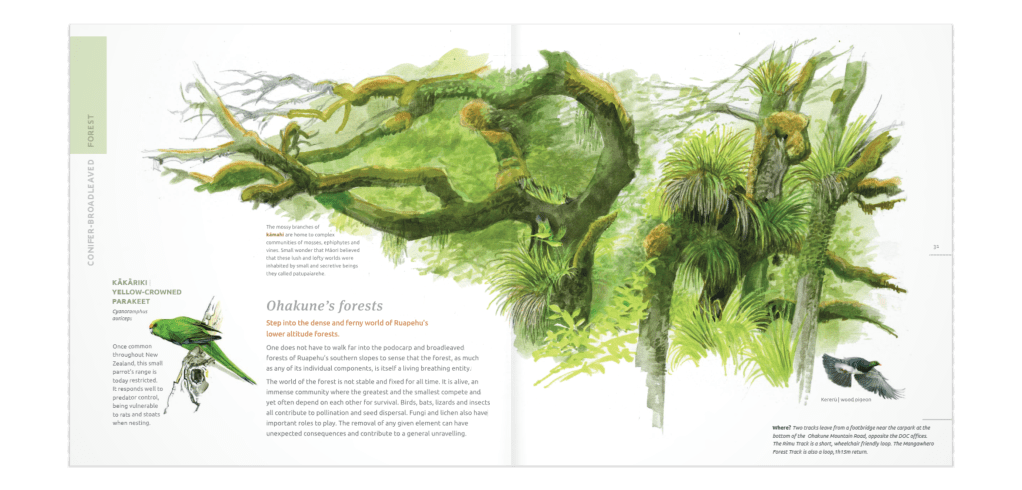
The text is accompanied by a  four hundred illustration which vary from postage stamp size to double page spreads.

Bovey has a keen eye for the animals and plants he depicts. The artists ability to render the details of nature requires careful attention to the shape and line of the specimens but also the colour which with many of the plants can be quite subtle.

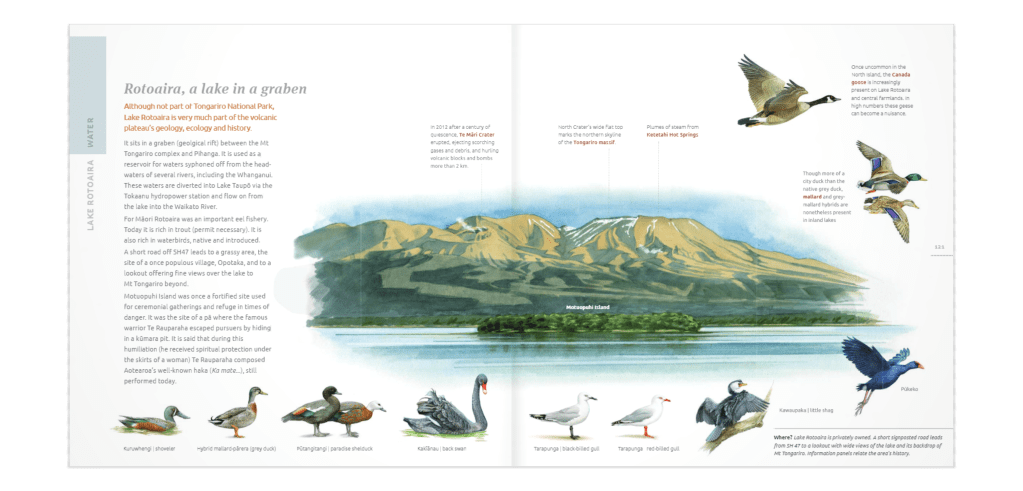
The book shows just how extensive the flora and faua of the area is and he meticulously paints all the plants and animals including all the larger introduced  animals – red deer, fallow deer, the sika or Asian deer feral pigs and goats, along with the possums, rabbits, hares  stoats, feral cats and ship rats.

He pays much attention to the birds of the area including  kareara, fantail,  kaka, matata, skylarks and dotterels He also examines the bees, moths, grasses and trees, depicting them in their habitats with a varsity of illustration which are much more informative than a photograph.

The author also provides something of a travel guide not only showing and describing the  habitats but also explaining why the area looks as it is,  taking account of the influence of climate, history and evolution. He also  provides a few pointers as to finding interesting trails and locations. He mentions in particular Lake Rotopounamu which is located high on the flank of Pihanga, one of the smaller volcanoes. The lake’s name refers to its  blue green colour  and Pihanga in Māori tradition was a beautiful mountain fought over by the larger ones.

The lake is protected so bird life is abundant including papango, weweia, kotare and black shags  and thanks to Project Tongariro bush Robins are making their re-appearance.

While the author makes a few references to the impact of man on the environment he gives an account of John Cullen the  honorary warden of the Tongariro National Park who in the early part of the 20th century tried to create his vision of a grouse hunting landscape by seeding the slopes of Tongariro with heather and then introducing  red grouse. The grouse didn’t survive but the heather has been a pest ever since although an introduced beetle has made some impact in reducing its growth.


Bovey  who has dual nationality has worked as an art director and illustrator in Besançon, France, for 30 years. For many years he travelled to Africa pursuing his interest in photography of traditional arts and ceremonies. In 2011 he returned to live in his hometown, Whanganui.

On his  return he felt a need to reconnect with the landscapes of his youth. He chose Tongariro National Park, inspired by a chance encounter with a kārearea, the New Zealand falcon. He returned again and again, sketchbook in hand, applying his delicate brush as he reacquainted himself with the dramatic landforms and ecology of the volcanic plateau.

Categories
Reviews, News and Commentary

Moe Miti: The dream world where gods and humans meet

Reviewed by John daly-Peoples

Moe Miti

Red Leap Theatre

Q Theatre

August 22 – 27

Reviewed by John Daly-Peoples

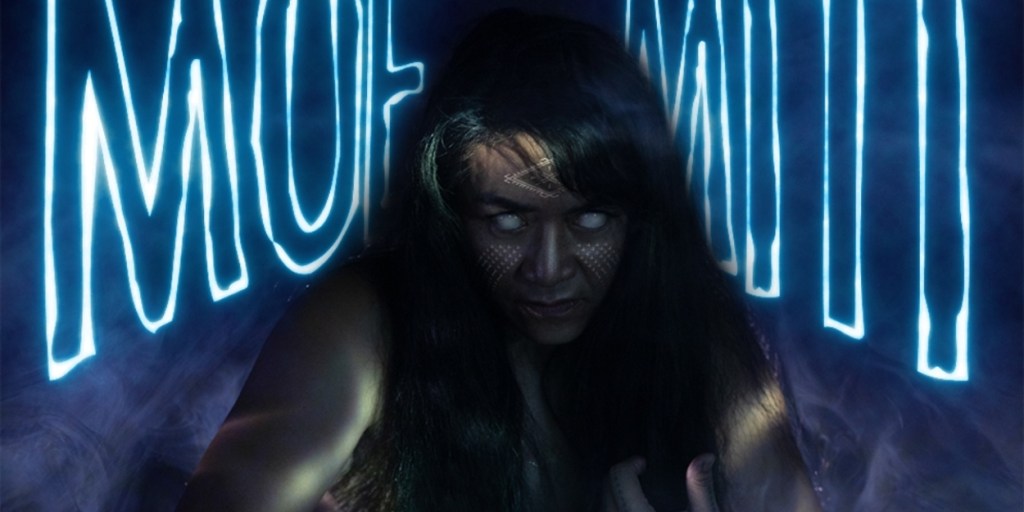
In Red Leap’s “Moe Miti” three generations of Pasifika women examine their identities in order to imagine their future by contending with the past.

The work is located in the shifting space between waking and sleep, between ancient myths and contemporary angst. The characters seem to alternate between being demi-gods and flawed humans.

Pepe, a young woman born in New Zealand, is estranged from her mother Valu but she has to  has to engage with her as well as her culture, represented by Aiga, their mythic ancestor from which she is also alienated. In searching for her identity, she has to understand, transition and transform.

Throughout the work figures glide in and out of deep shadows and shining surfaces along with changing times, places and  histories. This surreal environment is enhanced by a mesmeric soundtrack and dramatic lighting.

While there are occasions when the house lights are on full most of the time the stage is a in half light, figures are indistinct and the action set in an amorphous environment.

Central to the staging is a large translucent rectangular shape which acts as a transition point between the past, present and future with connections to the monolith in 2001 A Space Odyssey and a Tardis. The background also features rays of light signifying notions of the spiritual

The clash between mother and daughter, between the ancient and the new is expressed in the metaphor of the daughter running uphill, laughing and the mother going downhill, crying.

The cast of three Katerina Fatupaito, Ma’aola Faasavala and Malama Tila manage to convey characters which are deeply rooted in the mythology of Samoa as well as presenting contemporary individual striving to negotiate their place in the world.

Being part god part human, they present the mythic Samoan creation story in parallel with drama and aguish of the mother / daughter relationship.

Categories
Reviews, News and Commentary

Ngātokimatawhaorua  The biography of a waka

Reviewed by John Daly-Peoples

Ngātokimatawhaorua 

The biography of a waka

By Jeff Evans

Massey University Press

RRP $50

Reviewed by John Daly-Peoples

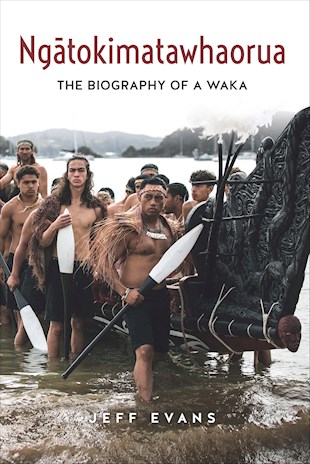
Anyone who has attended the ceremonies around the annual Waitangi Day commemorations will have seen the massive  wāka Ngātokimatawhaorua  which is launched each year as part of the celebrations. The craft which is housed on the Treaty grounds is also seen by thousands of people each year.

The vessel is 37.5 metres long, requires at least 76 paddlers, and can seat up to 120 people. It is lashed with more than 1km of rope, and weighs six tonnes when dry, 12 tonnes once it is wet and in the water.

It was built to mark the 100th anniversary of the Treaty of Waitangi in 1940. The job of carving the wāka from three kauri trunks had begun in 1934 and involved many men and a team of 24 bullocks over many weeks to haul the hull’s sections out of the forest.

A new book Ngātokimatawhaorua  written by Jeff Evans explores the history of the craft which is considered to be one of the largest of its type in the world.

Evans says he was drawn to the  wāka’s story because “Ngātokimatawhaorua is an iconic waka taua, and not just for its size. It is intrinsically connected to the commemoration of the signing of the Treaty of Waitangi, so holds a special place in the history of Aotearoa New Zealand. Interacting with the waka in any way — whether it be as a crew person, a support person, a visitor to the Treaty Grounds, or as a spectator when it is out on the water — leaves an indelible memory, and that was certainly the case for me. The sight of a full crew paddling the waka on Waitangi Day should be witnessed by every New Zealander”.

The author takes the reader on three major journeys in telling about the craft. There is the history of its name, the history of its construction as well as the authors own journey to retrace the history of the boat.

In tradition, when Kupe discovered New Zealand, his waka was named Matawhaorua. But on his return to Hawaiki, it was re-adzed and named Ngātokimatawhaorua (‘ngā toki’ means ‘the adzes’). It was captained by Nukutawhiti, the grandson of Kupe  on its return to New Zealand.

The inspiration for its construction came from Te Puea Hērangi, the influential leader in the King movement, and the project was directed by Pita Heperi (of Te Tai Tokerau) and Piri Poutapu (Waikato). The book traces the efforts over many years of Te Puea, whom initially did not have the full support of the Northland tribes.

The book follows the search for the best trees in the Puketi State Forest, their cutting down, transport and construction. The project presented  many difficulties because of the size of the logs and their location. Evans also retraces the routes taken by Pita Heperi and the other loggers who  brought the cut trees.  

In the 1930’s this whole process was documented by the New Zealand filmmaker Jim Manley who took thousands of feet of 30mm and 16mm film as well as many black and white photographs. This footage would later be turned into a significant film edited by Mereta Mita which was screened in the late 1980’s.

In describing the 1940 commemoration and the launch of Ngātokimatawhaorua  Evans uses eyewitness accounts as well as newspaper reports. He also describes the 1974 refurbishment of the wāka and commemoration that year when the when Queen Elizabeth II attended the Waitangi Daty celebrations.

Evans has written an in-depth account  of this important and little known part of New Zealand history  filled with detail and anecdote which gives new life and understanding to the vessel. As the subtitle of the book suggests this is a biography of the wāka, seeing the canoe as an entity with many dimensions, entwined with the history of Māori and the country as whole.

To subscribe or follow New Zealand Arts Review site – www.nzartsreview.org.

The “Follow button” at the bottom right will appear and clicking on that button  will allow you to follow that blog and all future posts will arrive on your email.

Or go to https://nzartsreview.org/blog/, Scroll down and click “Subscribe”
Categories
Reviews, News and Commentary

I Want To Be Happy: Delightfully Delicious

Reviewed by Malcolm Calder

I Want To Be Happy

By Carl Bland

A Nightsong Production

Directed by Ben Crowder & Carl Bland

Lighting – Sean Lynch
Set – Andrew Foster
Composer – John Gibson
Costumes – Elizabeth Whiting

With: Jennifer Ludlum, Joel Tobeck, Milo Cawthorne

Herald Theatre, Auckland, Until Sat 31 August

Then Circa, Wellington, 6-30 September

Reviewed by Malcolm Calder

Delightfully Delicious

This production is arguably one of the most delightfully delicious pieces of theatre I have seen this year. 

I Want to be Happy is clever and becomes ever-more so as it unpacks.  It is simple and yet it’s not.  It is hugely comedic but it’s about other things.  It is timely and requires sensitivity to a multitude of social issues.  Above all, it is remarkably intelligent and requires an intelligent audience. 

In short, and tucked away in the Herald Theatre, this piece of absurdism is likely to be something of a sleeper.  A not to be missed one.

The cast is in a word – outstanding. 

Binka is a guinea pig in a laboratory cage complete with attached sleeping kennel.  But she is isolated and lives in a rodent world where only occasional smells, moments and memories have any meaning.  She is completely isolated in the cage, has no contact with others and instinctively wants to escape. 

Jennifer Ludlum’s first eyebrow twitch as guinea pig Binka captivates the audience and, for me, is one of the moments of Auckland’s theatrical year.  Who would have thought it – a simple eyebrow twitch!  Audience rapport grows from very quickly there as she takes Binka through various antics and anarchic adventures that become an emotional roller-coaster for the audience.  Some pretty physical work at times too.

Monitoring, rewarding and feeding Binka via a feeding tube that dispenses food pellets and water, is Paul, a downbeat, chain-smoking lab assistant.  He is lonely and isolated too and desperately wants to regain the love and the dearest friendship of his apparently wayward wife.  But his efforts are failing miserably and Joel Tobeck endows him with the reality of this, imbuing the repetitive routines of his daily life with a shoulder-slumping tiredness that hints at depression. 

Binka is the antithesis of Paul and the combination of Jennifer Ludlum and Joel Tobeck serves only to endow the production with a yummy depth.  Their characters may have something in common but they cannot communicate.  They occasionally talk at one but never actually exchange lines.  Of course they can’t … one is a human and the other is – well, just a guinea pig. So the two characters mirror each other, albeit in different ways and in different contexts.  Yet they share so much.

I Want To Be Happy explores this via the introduction of couple of other guinea pigs – a nice one and a not-so-nice-one of course, both played by a well-encased Milo Cawthorne, plus a few stray rats and even a particularly malicious cat.  There are accidents, incidents and escapes all generating considerable mirth, yet touching a broad range of emotions.

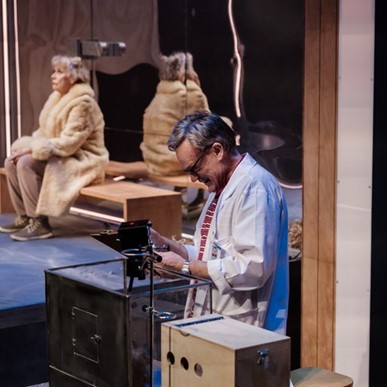
Jennifer Ludlum (Binka) and Joel Torbeck (Paul) – Photo : Ralph Brown

I was particularly taken with Andrew Foster’s set which is divided into two parts.  One is a mirror of the other, albeit on a different scale.

I Want To Be Happy is hardly conventional theatre.  It achieves this with two outstanding actors playing two very different roles – outstandingly – and asks a lot of bigger questions and demands the audience ask them too.

Under no circumstances miss this production.  Congratulations Nightsong, you have made my winter.

To subscribe or follow New Zealand Arts Review site – www.nzartsreview.org.

The “Follow button” at the bottom right will appear and clicking on that button  will allow you to follow that blog and all future posts will arrive on your email.

Or go to https://nzartsreview.org/blog/, Scroll down and click “Subscribe”

Categories
Reviews, News and Commentary

APO’s Shostakovich 5

Reviewed by John Daly-Peoples

Shiyeon Sung

Shostakovich 5

Auckland Philharmonia Orchestra

Auckland Town Hall

August 17

Reviewed by John Daly-Peoples

The  APO’s Shostakovich 5 concert opened with “The Enchanted Lake”, a short work by the Russian composer Anatol Liadov. The work is a musical descriptive of a landscape most likely a lake view by the Russian painter Arseny Meshchersky.

Here the shimmering strings, the tinkling piano along with the brass and woodwinds all contributed to the whispering, atmospheric sounds which created a lush vision as the orchestra took the audience on a journey through a romantic landscape.

Arseny Meshchersky

Next up was Ravel’s Piano Concerto in G where the composer linked his Spanish / Basque heritage to his interest in post war jazz.

From the opening sharp whip crack this was a work which was full of surprise and  contrasts While the orchestra took on the role of the Big Jazz Band,  pianist  Steven Osborne was like a barroom piano player cleverly combining the Spanish themes and  the lively, experimental music of the 1920’s. He skilfully played the various themes as they  pursued each other with changing pace and intensity. At the same time conductor Shiyeon Sung worked hard to control the almost out of control orchestra.

Then  second movement saw Osborne playing a serene  romantic piece which slowly increased in intensity but maintaining a fluidity which contrasted with the first and last movements. Osborne showed a sensitivity in the way that he brought out the  nuances of colour and texture. The dramatic third movement where jazz elements  again enter along with all the instruments. Here Osborne was conscious of the conductor and the various instruments which seemed to energize him. At times his playing was delicate and meditative while at  other time there was a more ferocious quality

The big work on the programme was Dmitri Shostakovich’s Symphony No 5  

In the 1930s the purges of Joseph Stalin meant that contemporary music and many composers were declared decadent and  Dmitri Shostakovich saw the need to adapt to the current political climate. In a cynical nod to political correctness, he  subtitled his Symphony  No 5 “A Soviet Artist’s Response to Just Criticism.” While there are many  lyrical and heroic aspects to the work which were favoured by the cultural critics, and saved him from criticism there is a sense of brooding despair beneath the almost romantic melodies.

The symphony feels as though it is  contemplation of the battlefield, the drama and horror of battle and its eerie aftermath. But this is not some reimagining of Tchaikovsky’s triumphant 1812 and it  sems very relevant to the present day as Ukraine had been focus of Russian territorial ambition in WWI and the site of much fighting and destruction.

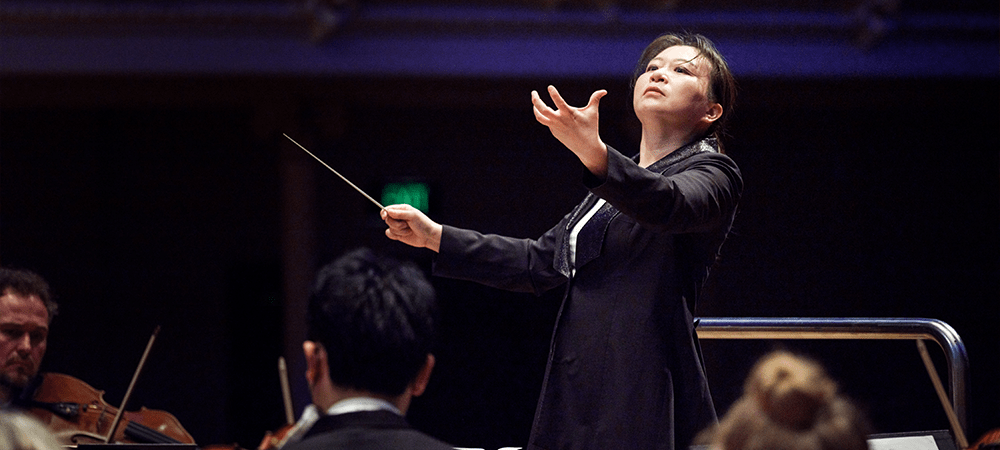
The work opens with the great percussive roar of war and destruction followed by the  various colours and moods of the battlefield landscape mixed with desperate pleas of the souls and spirits of the dead. Then there are themes which could be derived from folk melodies which seem to speak of a coming Spring and a renewal, but it is a bleak Spring interrupted by pounding militaristic brass which had conductor Shiyeon Sung  conducting with feverish gestures

The second movement which has some links to dance, but this is not folk dance or the waltz but rather a dance of death. Then there was some bright and colourful tunes along with a delightful pizzicato sequence from the strings which expressed contrasting feelings of tension and fragility in the music before eventually returning  to the militaristic  the dramatic and the chaotic.

The slow third movement was almost a requiem with Sung conducting with surging gestures and at times she seemed to struggler with herself  as she coped with the tortured, mournful sounds provided by flute and harp and the work eventually moves to a transcendental mood  conveyed by the flute with music derived from Orthodox prayers.

In the fourth movement Sung extracted  nuance and subtly, giving the work a lightness and  innocence before erupting into a reworking of the opening theme with a lightness streaming through the bleak sounds of the battlefield

At times throughout the work Sung’s elaborate conducting style saw her more as a magician than conductor and her baton more of a wand.  She seemed to be encouraging the orchestra, beseeching and inspiring them with, drive, aggression and reflection.

The concert had opened with a farewell to Barbara Glaser who has been the CEO of the orchestra  for the past seventeen years. Her leaving was acknowledged by chairman Geraint Martin who spoke of her many accomplishments ending with announcing that she would now become  a patron the orchestra.