Categories
Reviews, News and Commentary

Auckland Theatre Company’s eight innovative plays for next year

John Daly-Peoples

Scenes from the Climate Change Era
Auckland Theatre Company have announced eight plays in their 2024 Season, presenting a line-up of shows that feature star-studded creatives and high flying collaborations, alongside striking international works.

After welcoming over 50,000 people through their doors this year, the 2024 programme, will be presenting  five works by New Zealand playwrights (four of which are world premieres), alongside West End hits, a climate change epic and a big-scale retelling of one of the most popular children’s stories of all time.
 
The works on offer also reflects the Company’s continued commitment to collaborating with organisations across the motu, including Te Pou Theatre, Nightsong, Silo Theatre, I Ken So Productions, Auckland Arts Festival and Agaram Productions.
 
Artistic Director & CEO Jonathan Bielski says, “After a great year for our 30th anniversary in 2023, we are excited to offer Aucklanders a 2024 season of outstanding theatre filled with stars, local heroes and extraordinary storytellers.”  
Auckland Theatre Company’s accessibility programme continues as a commitment to inclusive access. Each production in 2024 will have a dedicated New Zealand Sign Language-interpretated and audio-described performance and touch tour. A Sensory Relaxed Performance will be introduced for the first time in the Company’s history to welcome people who would benefit from a more laid-back theatre atmosphere including people who are neurodivergent, and folks with sensory and communication needs.      

The Plays

Hyperspace by Albert Belz
7 – 24 Feb
In Albert Belz’ award-winning play Supernova, the audience is taken back to 1990, the heyday of Pump Up The Jam, Miami Wine Cooler, Timotei shampoo and Gloss. Entries are open for the NZ Aerobics Competition and small-town Natalie ends up having to team up with haka queen Tāwhai for the mixed doubles. This world premiere season is for all the lovers of dance movies and ‘90’s time capsule nostalgia. Co-produced with Te Pou Theatre, directed by Tainui Tukiwaho (Astroman) and choreographed by New Zealand dance icon (and former aerobics champion) Jack Gray. This season of Supernova is proudly presented with the support of MiNDFOOD.


O le Pepelo, le Gaoi, ma le Pala’ai | The Liar, the Thief, and the Coward by Natano Keni and Sarita So
5 – 23 Mar
The second show of the year is a family drama in the vein of August: Osage County, set in Sāmoa’s not-so-distant past, in collaboration with Auckland Arts Festival and I Ken So Productions. Proud chief Pili Sā Tauilevā has devoted his life to his village, but when he falls ill and refuses to name a successor, his daughter and son become rivals to the title. Power, politics and tradition collide in this darkly comic piece by Natano Keni and Sarita So, starring Semu Filipo (Things That Matter, Young Rock).
 
The Effect by Lucy Prebble
16 Apr – 11 May
Straight off a critically acclaimed season at London’s National Theatre, The Effect, directed by Benjamin Kilby-Henson (King Lear), brings four stars to the ASB Waterfront Theatre. In this chemistry-laden medical drama from Succession writer Lucy Prebble, two participants of a clinical trial struggle to figure out whether their attraction to each other is real or just the medication. Jayden Daniels (Head High, Celebrity Treasure Island) and Zoë Robins (Amazon’s The Wheel of Time) make their Auckland Theatre Company debuts, Jarod Rawiri (Long Day’s Journey into Night) returns and New Zealand screen legend Sara Wiseman (Under the Vines, Creamerie) makes her return to the company after 20 years.
 
Red, White and Brass adapted by Leki Jackson-Bourke
18 Jun – 6 Jul
Adapted by award-winning playwright Leki Jackson-Bourke (Inky Pinky Ponky), the beloved hit movie Red, White and Brass makes its theatrical world premiere. Reprising his star-making film role, John-Paul Foliaki is a Tongan superfan who will do whatever he can to score tickets to see his team play in the Rugby World Cup. Directors Anapela Polata’ivao (Things That Matter) and Kila Kokonut Krew royalty, Vela Manusaute will create a family-friendly feel-good entertainment where everyone gets to experience just how cool it is to be Tongan.
 
Scenes from the Climate Era by David Finnigan
2 – 24 Aug
Scenes from the Climate Era confronts the current and future effects of climate change. This scorching work from Australian playwright David Finnigan is a genre-bending, wide-ranging look at the climate crisis, the biggest story in human history. This show, directed by Keagan Carr Fransch (seven methods of killing kylie jenner) is the first collaboration between Auckland Theatre Company and Silo Theatre, fitting for a collective call to action of the greatest urgency.
 
Girls & Boys by Dennis Kelly
10 – 28 Sep
Girls & Boys brings the West End and Broadway sensation to the ASB Waterfront Theatre stage. A play made famous by Hollywood star Carey Mulligan, this shattering solo drama by Tony-Award winning Dennis Kelly stars Beatriz Romilly (the West End’s 2:22 A Ghost Story, King Lear) as a funny, gutsy, messy woman who falls head over heels for a charismatic man who imports European antiques. This show, directed by Eleanor Bishop, explores the dark shadow on the far side of love – and asks how far we’ll go for it.
 
Peter Pan by Carl Bland
8 – 28 Oct
The boy who never grows up comes flying through the stage in Peter Pan, a collaboration with the magical team at Nightsong (Te Pō, The Worm) and written by Carl Bland adapted from the novel by J. M. Barrie. This fresh twist on the classic story will have all your favourites – Captain Hook, Tinker Bell, and the Lost Children – with the visually spellbinding storytelling that directors Ben Crowder and Carl Bland have captivated the country with.
 
a mixtape for maladies by Ahi Karunaharan
19 Nov – 7 Dec
a mixtape for maladies is a new collaboration of Agaram Productions, Arts Laureate Ahi Karunaharan (Tea, The Mourning After) and director of Basmati Bitch) that sweeps from 1950s Sri Lanka to modern-day Aotearoa. Directed by Jane Yonge (Scenes from a Yellow Peril) this is both a love letter to Sri Lanka and a lament, the story plays out over 17 songs – ranging from Dusty Springfield to La Bamba to the hit single from a Tamil rom-com.


To subscribe or follow New Zealand Arts Review site – www.nzartsreview.org.

The “Follow button” at the bottom right will appear and clicking on that button  will allow you to follow that blog and all future posts will arrive on your email.

Or go to https://nzartsreview.org/blog/, Scroll down and click “Subscribe”
Categories
Reviews, News and Commentary

Auckland Choral’s St Mathew Passion an outstanding performance

Reviewed by John Daly-Peoples

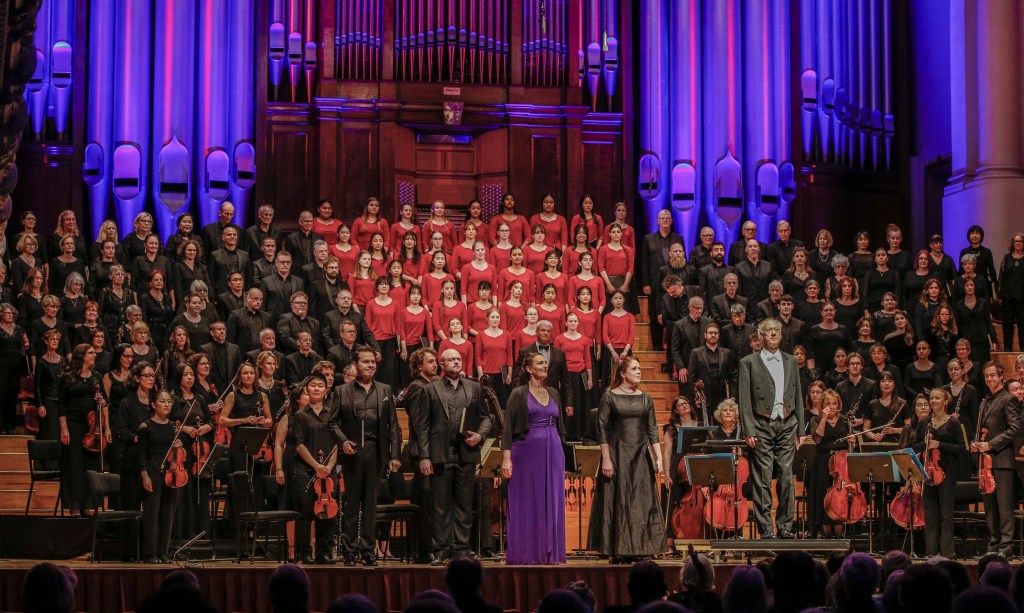
Auckland Choral’s St Mathew Passion Image Hazel Thomas

St Mathew Passion

Auckland Choral

Auckland Town Hall

October 15

Reviewed by John Daly-Peoples.

The St Mathew Passion  tells the story of the of the last days of Jesus – his betrayal, trial, crucifixion and burial. . The major roles are that of the evangelist Mathew and Jesus. The other individuals and  groups also have parts to play with singers given the various roles of Judas, Peter, a slave girl, hight priests and soldiers.

The work is monumental both in conception as well as in performance with two choirs, six major soloists as well as several minor soloists both singers and players. For the work to be successful it needs a great orchestra, experienced choirs, exceptional soloists and a conductor with an understanding of the work.

With the latest Auckland Choral production all of these elements were present resulting in an outstanding performance.

Central to the production is the role of the evangelist Mathew sung by Iain Tetley who was positioned in the centre of the stage between the chorus and the orchestra. His voice was initially uneven as he struggled to change register. However for the most part his voice which ranged from the soft and fluid to the forceful was able to convey the narrative of the story, giving emphasis to important moments.

Conductor Uve Grodd maintained a from control over Pipers Sinfonia and choirs, deftly directing the orchestral sounds, the intensity of the choirs and finely balancing the levels of the soloists and orchestra.

Providing the musical support for the performance and guiding the threads of the melodies were organists John Wells and Edmond Wong.

David Greco’s purity of voice served him well in his various  portrayals and Andrew Grenon singing the role of Peter as he kept watch with Jesus  showed the singers grasp of the music and later when he denies Jesus three times he was equally able to give a sense of the moment. There was a special moments when  Polly Sussex accompanied  Grenon playing the Viola da gamba her instrument providing a freshness which matched the singers intense voice

Jesus was sung by James Ioelu and his sharp chiselled voice gave a sense of Jesus, the man speaking to the audience.

Sarah Court’s well-modulated voice gave the recitative   “Du lieber Heiland du”, (Beloved Saviour thou) a sense of grief while Soprano Anna Leese was able to express anguish  in her aria “Blute nur, du liebes Herz!” where she gave  urgency to the phrase, “Threatens to murder its guardian”,

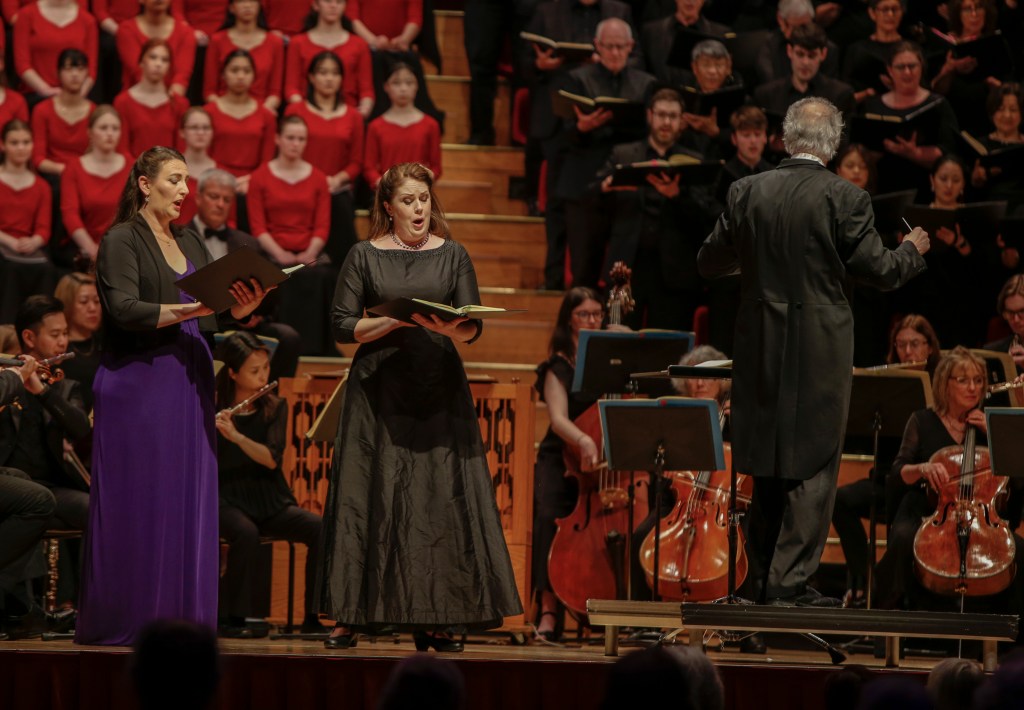
Sarah Court, Anna Leese and Uve Grodd Image Hazel Thomas

The two of them sang the only  duet in the work,  “So ist mein Jesus nun gefangen,” where the oboe and flute wail their lament at the seizing of Jesus and the chorus cries out “Let him go.” The two women delicately shared the melodies before the choir erupted with their response, calling on lightning and thunder with a forceful clipped sound.

Another exceptional sequence was  the concertmaster Alexander Pilchen accompanying Sarah Court as she sang the poignant aria “Erbarme dich,” where she seeks mercy for the world’s sins.

Alexander Pilchen’s playing was a delight. His performance was that of a more urgent contemporary violinist providing a skilful and moving account.

Some of the lesser  roles were sung by members of the choir including  John Mitchell as Judas.

The choirs, Auckland Choral and Cantare Westlake Girls Choir could not be faulted. From their full-throated raging to their gentle pleading they gave the words and emotion a genuine authenticity

To subscribe or follow New Zealand Arts Review site – www.nzartsreview.org.

The “Follow button” at the bottom right will appear and clicking on that button  will allow you to follow that blog and all future posts will arrive on your email.

Or go to https://nzartsreview.org/blog/, Scroll down and click “Subscribe”
Categories
Reviews, News and Commentary

In The Temple: thoughtful  poems and the wistful illustrations

Reviewed by John Daly-Peoples

In The Temple

By Catherine Bagnell and Jane Sayle

Massey University Press

RRP $35.00

Reviewed by John Daly-Peoples

“In The Temple” is a new collaboration between artist Catherine Bagnell and poet L. Jane Sayle which follows on from their previous work “On We Go” published two years ago.

The small pocket-sized book of 26 poems and 21 watercolours is like a breviary or book of the hours, to be referred to for inspiration and reflection. Both the thoughtful  poems and the wistful illustrations have much to offer.

The Temple of the title is no man-made structure but is situated in the natural world, and where poet and artist find solace and tranquillity. It is a place which holds memories and ideas, both transient and enduring. Both the poems and the illustrations are a mix of the observed and the imagined, evoking both the physical and contemplative aspects of encountering the environment.

One of the poems, “The Singing Tree” is something of  an advisory to the reader about the accessibility and understanding of poetry.

Thank you for your poem

I think I understand it

Its just with the watermarks

The old buff paper

Your scrawl

This image of the handwritten poem is given form in “John Weeks” and “Englischer Garten” where watermarks or tears blot some of the words.

The poems range from the haiku-like “Scroll White”

And when I close my eyes

black shagreen

Through to the longer pieces such as  “GPS” describing  actual place and event.

Many of the poetic images Sayle creates have a slight surreal quality as with “In Camellia Time” with the image of “a puppy drowning” oddly matched with Bagnall’s watercolour of a mourning figure that has shed formal gloves while the tears or petals of a camellia float down.

The words and pictures touch each other lightly and there is a sense of the visual and poetic images being in parallel dream worlds where  images and ideas flicker and merge.

In some cases there could be the need for  a footnote and explanation as Sayle says of the lines

I can’t hear myself think  

for the whales 

singing in the harbour

That they are based on comments made by early English settlers to the Wellington area about how noisy the whales in the harbour were, and she wonders whether such an event would ever happen again.

Some of these images exist in a dreamlike world while others are rooted in real, natural places such Paradise Valley or the Makara coast but once there the reader is deftly transported past glimpses of exotic locations such as Florence or Nablus.

Catherine Bagnell’s watercolours are a cross between a nineteenth century children’s book and a set of symbolist, colour experiments where figures flit through wooded places .These figures include humans, rabbits and black birds, all suggesting loss, remembrance and discovery.

Jane Sayle says of the title poem , that it “ honours the act of sacred daydreaming in specially consecrated feminine places. And these places are to be found everywhere: special clearings in a forest or where a stream runs out of the bush, a stone ruin from antiquity or a home that suddenly shines when everyone else has gone out, a bay at dusk. And, crucially, this work is not to be interrupted.”

To subscribe or follow New Zealand Arts Review site – www.nzartsreview.org.

The “Follow button” at the bottom right will appear and clicking on that button  will allow you to follow that blog and all future posts will arrive on your email.

Or go to https://nzartsreview.org/blog/, Scroll down and click “Subscribe”

Categories
Reviews, News and Commentary

New insights into the art of Gordon Walters

Review by John Daly-Peoples

Gordon Walters by Francis Pound

With a Foreword and Afterword by Dr Leonard Bell

Auckland University Press

RRP $89.99

Reviewed by John Daly-Peoples

A new book by Francis Pound on the abstract artist Gordon Walters (1919–1995) provides insights into the career of this remarkable artists as well as giving  the reader  an understanding of the development of abstract art in New Zealand

The book traces the development of the artist’s work from his early experimental works up to his 1966 exhibition at New Vision Gallery which is considered to be a significant point both in the artist’s career as well as the public’s  awareness of his work. 

Not only do we get to understand the ways in which Walters developed his vision and his art, we also get to understand something of the development of abstract art both within New Zealand and internationally.

Pound quotes Walters commenting on his own career, “Essentials of my work have not changed much. It has been largely a matter of developing insights into painting and a struggle to free myself form nature; that is working form nature. Essential character of my work has just become clearer as I have continued, but not without such struggle, false starts and wring directions”.

Walters more than any other artist in New Zealand was aware of and responded to intentional art movements including  post war American art. Colin McCahon who also encountered American abstract art did not use it in the way Walters did. Walters incorporated the ideas and stylistic features in a way which indicates a deep understanding of these overseas movements.

Pound meticulously follows the life and career of Walters with detail and understanding so that we understand both the creative genius of the artist but also the way he absorbed and adapted the work of others. The influences on the artist were wide-ranging from Picasso, Klee and Mondrian to Māori cave art and the unusual art of the Rolfe Hattaway He was also aware of the work of  Sophia Taeuber-Arp, Auguste Herbin, Giuseppe Capogrossi, and Americans such as Frank Stella.

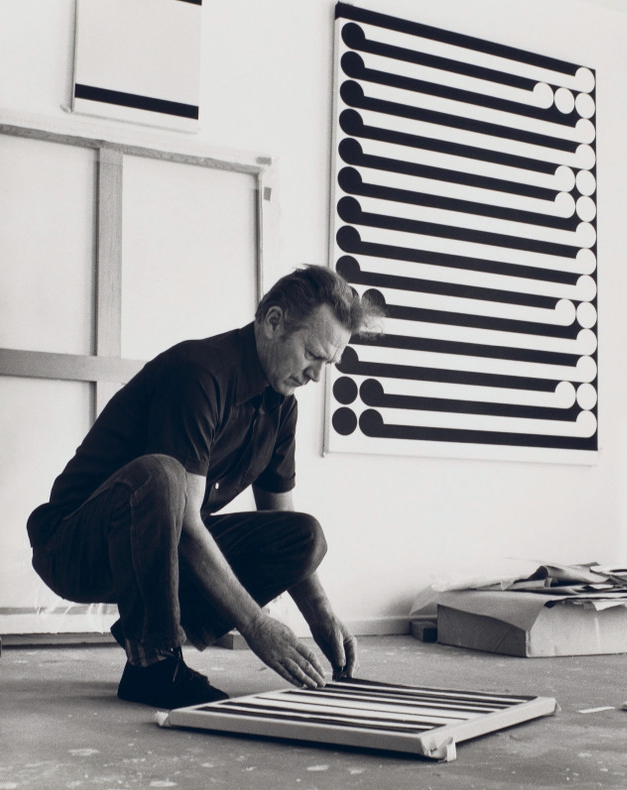
Pound examines many areas of abstraction with an emphasis on the the Koru paintings but as well as this major series he also deals with what he terms the Vertical or Horizontal Men, the Spirals, the Bars and Balls, the Wandering Rectangles and the Diagonals. With all these series of works  the author takes an almost forensic approach in discovering and outlining the artist’s inspirations, visions and stylistic approaches.

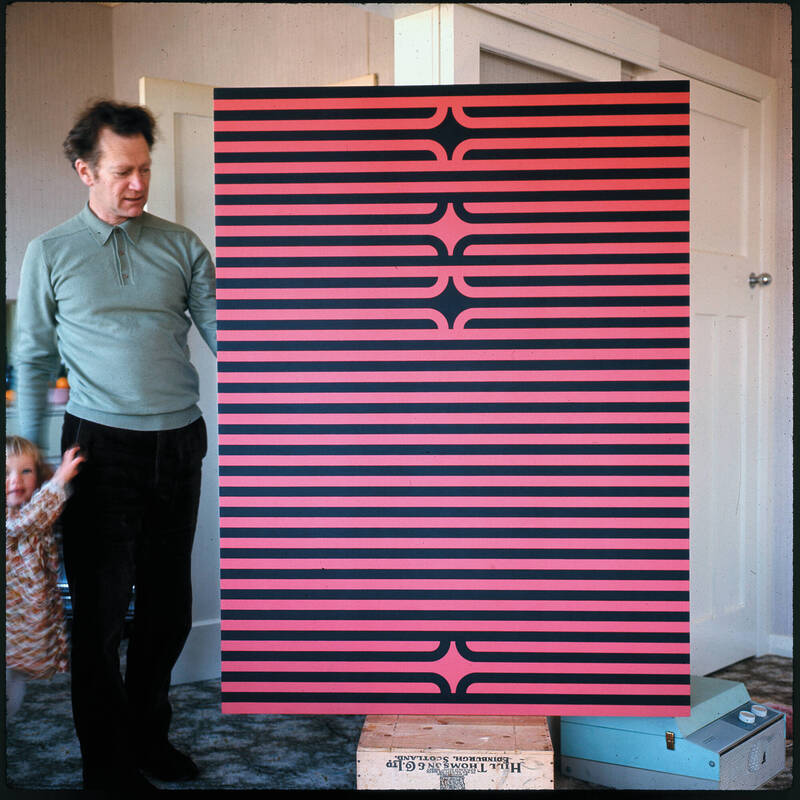
Walters with Black and Red, 1970, PVA and acrylic on canvas, 1527 x 1143 mm
Walters Estate, Auckland

The Rauponga series he produced were inspired  by his  interest  kōwhaiwhai patterns as well as Māori rock drawings which he documented along with Theo Schoon.

The book is a one of great scholarship with detailed information on the artist, a wealth of notes and references along with copious photographs of the artist’s work. It is also a book which reads like a biography and we get to understand the artist in much the same way that Pound, who devoted many years studying the artist’s work grew to understand the artist.

This  book and others such as the recently published  two volume work on Colin McCahon by Peter Simpson show there is a great interest in the development of contemporary New Zealand art.

Over the last forty years Pound has had a major impact on thinking about New Zealand art history having produced books which have helped change our perspectives on both historical  and contemporary art. These have included  Frames on the Land: Early Landscape Painting in New Zealand (1983), The Space Between: Pakeha Use of Māori Motifs in Modernist New Zealand Art (1994) and The Invention of New Zealand: Art & National Identity, 19301970 (2009).

Dr Francis Pound (1948–2017) was a New Zealand art historian, curator and writer. He taught for some years in the art history department of the University of Auckland before becoming an independent art curator and writer. His books include Frames on the Land: Early Landscape Painting in New Zealand (Collins, 1983), The Space Between: Pakeha Use of Maori Motifs in Modernist New Zealand Art (Workshop Press, 1994), Stories We Tell Ourselves: The Paintings of Richard Killeen (Auckland Art Gallery and David Bateman, 1999), Walters: En Abyme (Gus Fisher Gallery, 2004) and The Invention of New Zealand: Art & National Identity, 1930–1970 (Auckland University Press, 2009).

 Leonard Bell is an independent art and cultural historian based in Auckland. Among other works, he is author of Colonial Constructs: European Images of Maori 1840–1914 (1992), Marti Friedlander (2009), Strangers Arrive: Emigrés and the Arts in New Zealand, 1930–1980 (2017) and Marti Friedlander: Portraits of the Artists (2020), all published by Auckland University Press.

To subscribe or follow New Zealand Arts Review site – www.nzartsreview.org.

The “Follow button” at the bottom right will appear and clicking on that button  will allow you to follow that blog and all future posts will arrive on your email.

Or go to https://nzartsreview.org/blog/, Scroll down and click “Subscribe”

Categories
Reviews, News and Commentary

Rewi: The story of an architect

Reviewed by John Daly-Peoples

Rewi

Āta haere, kia tere

Jade Kake and Jeremy Hansen

Massey University Press

RRP $75.00

Reviewed by John Daly-Peoples

Rewi: Āta haere, kia tere is a major book exploring the work  of the late architect Rewi Thompson (Ngāti Porou, Ngāti Raukawa) who was  a groundbreaking designer and visionary  thinker. It brings together a range of his projects, from conceptual work  to innovative houses such as his own house and one which was designed for the German artist Katharina Grosse,

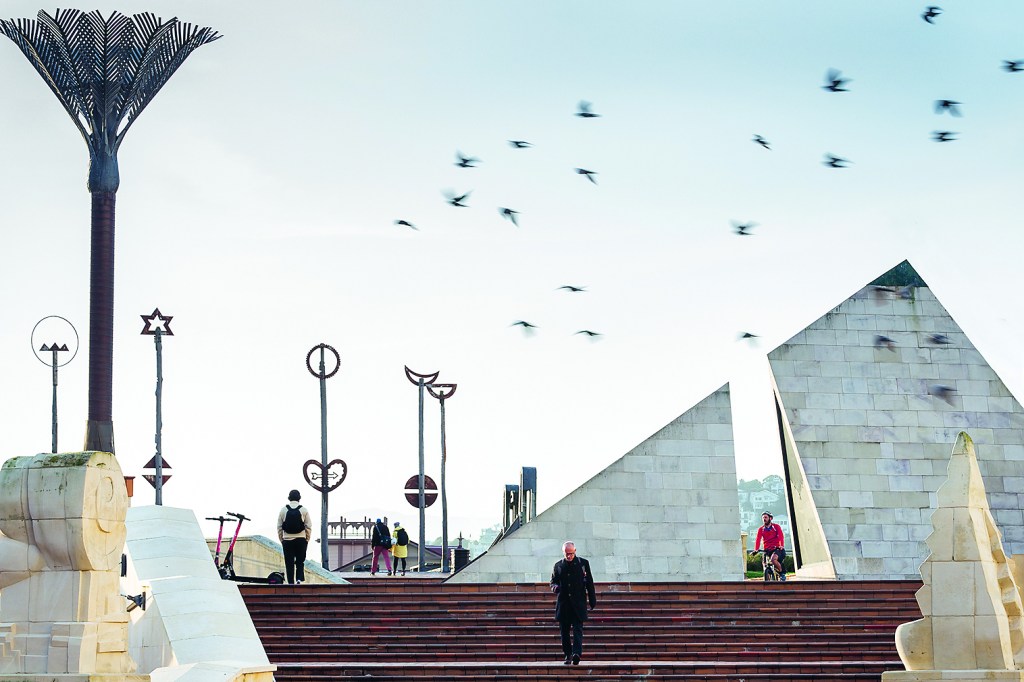
His public projects include Wellington’s City to Sea Bridge, Puukenga School of and  Māori Studies at Unitec in Auckland. He was also involved in a proposal for the new Te Papa Museum in Wellington with Calder, Fowler Athfield Architects and Frank Gehry. This was half a dozen years before Gehry’s Guggenheim  Bilbao. This was one of the great unrealised New Zealand architectural  projects which would have given the country a truly iconic building.

City to Sea Bridge, Wellington

His involvement with projects such as the Mason Clinic the Ngawha Correction facility and the Kaitaia Hospital saw him become influence on the design of prisons and mental health institutions.

He had a wide range of projects including an involvement with the “Future Islands” exhibition where New Zealand exhibited work at the Venice Architectural Biennale in 2016 which consisted of several dozen models of important New Zealand houses, all floating on clouds.

He originally trained as an engineer at Wellington Polytechnic and, for a short time, worked as a structural draughtsperson at Structon Group before to studying architecture at the University of Auckland. This combination of engineer and architect gave him both a pragmatic and creative approach to his work.

He established his own practice in 1983 and over the years worked with many other important New Zealand and international architects.

While he often dismissed the idea of Māori contemporary architecture and himself as a Māori architect many of his works are based on Māori concepts of design,  inclusion  and development. The subtitle of book Āta haere, kia tere  roughly translates as  “go slow go fast”, the idea of thinking thoroughly through a design issue before embarking on the actual design. It was concept which applies to Thompson’s way of working whereby he sought to understand the needs of the client, the challenges of the site  and the aims of the projects, fully before producing his designs.

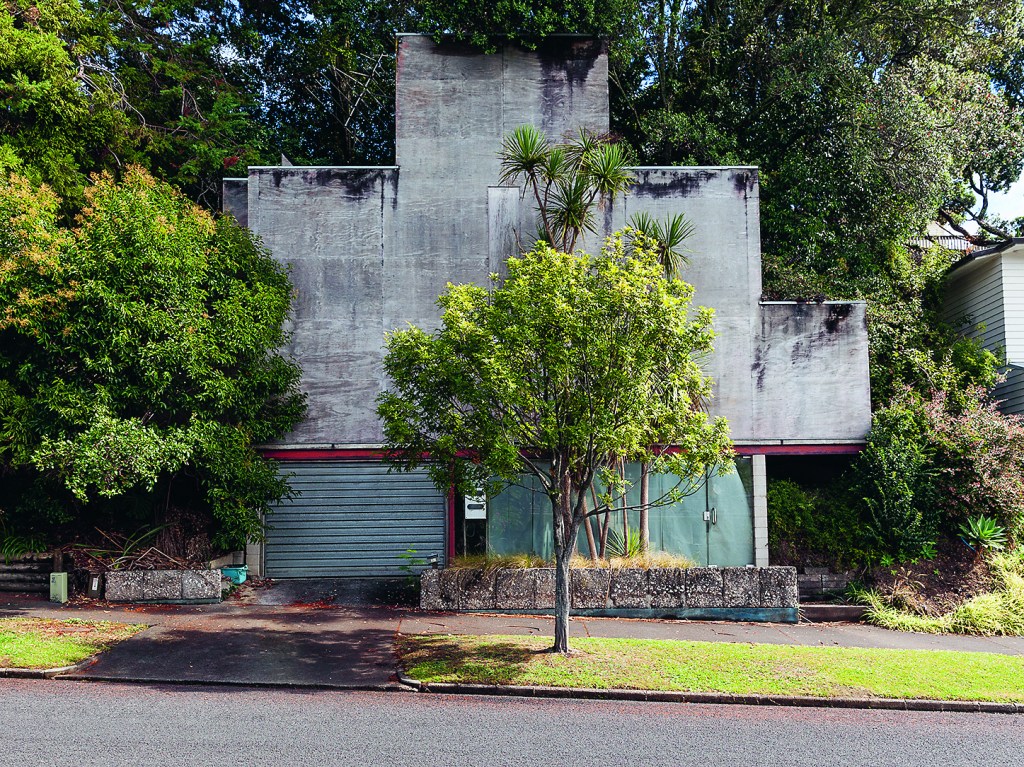
Thompson House, Auckland

His own house which has only recently been saved from destruction  has a ziggurat form which references the Māori poutama (stairway to heaven) tukutuku pattern as well as well as referencing the ideas of geometric abstraction.

Through his connections to Ngāti Porou and Ngāti Raukawa  fundamentally concerned with land and people, and conviction that architecture could return identity and well-being to people suffering from cultural estrangement.

The 455-page book is filled with images of his buildings which include many of his sketches which provide an understanding of his thoughts and spatial concerns.

The authors have  also included a Creative Process section which features dozens of his drawing not necessarily linked to any particular project but they give a sense of the man who thought visually and spatially.

The book includes many of his own writings as well as a number on extensive interviews with people who knew him and worked with him all if which help expand an understanding of the way he thought and worked.

.

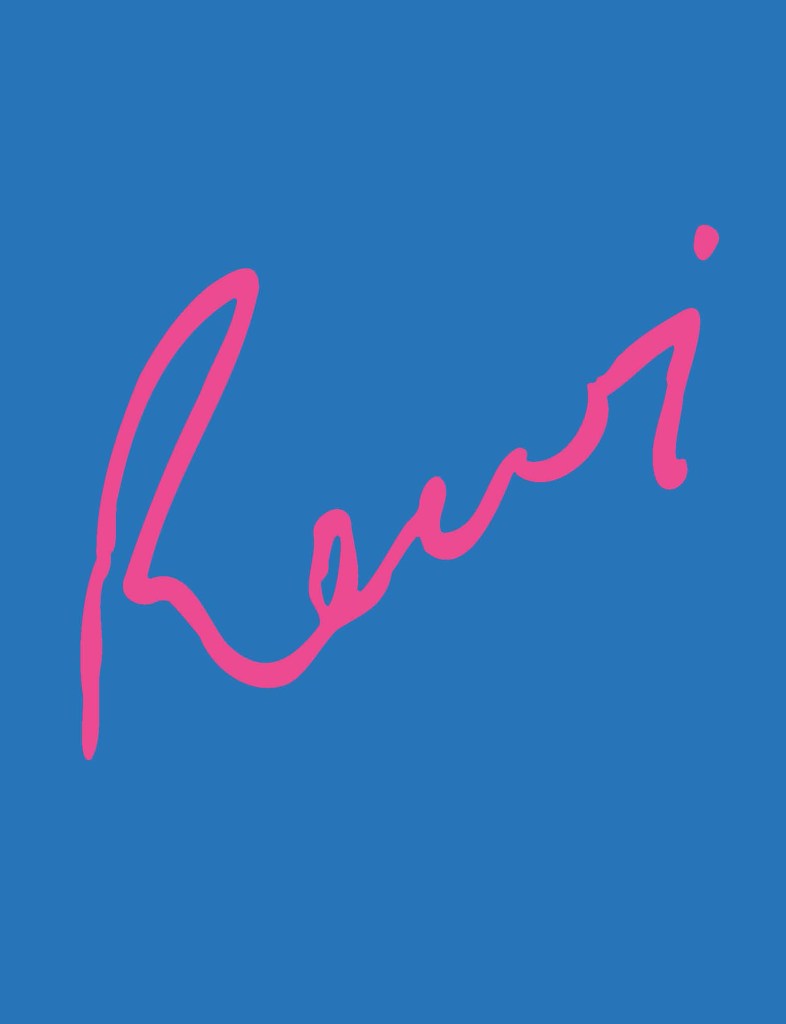
Rewi’s  bright pink signature on the cover of the book is a reference to a project he undertook as a mature first year architectural student  with his  bach on an exposed bush-clad site. All the other students had tried to integrate their designs into the bush but Rewi painted his bright pink which was both an indication of his innovative approach to architecture as well as a more subtle understanding of the way architecture sits on the landscape.

Categories
Reviews, News and Commentary

Switzerland is a slow burner thriller

Reviewed by John Daly-Peoples

Edward (Jarred Blakiston) and Sarah Peirse (Patricia Highsmith)

Auckland Theatre Company

Switzerland by Joanna Murray-Smith

ASB Waterfront Theatre

Until October 7

Reviewed by John Daly-Peoples

Patricia Highsmith is one of the few twentieth century crime writers whose work has transcended the genre, creating a body of work which deals with the complex mind of the murderer /  psychopath. With many of her Ripley  books, unlike most crime writers she creates a seemingly mundane environment with only a hint of suspense into which she inserts sudden moments of terror as Tom Ripley shows his true self.

With Tom Ripley she created a character who was both intelligent and unpleasant suave and self-conscious. He is the arch manipulator who spends most of his time creating the environment for his crime.

In her play “Switzerland” Joanna Murray-Smith has a young publishing executive from New York visit the writer in her modernist alpine hideaway. He has come to persuade her to write a sixth novel featuring her iconic anti-hero – an idea she is opposed to and has previously rejected.

Highsmith takes an instant dislike to Edward and their conversations become a duel of wits as she and Edward do a complex  literary dance around her lounge / study.

She allows Edward  to stay the night on the condition that he invents the means of murder for a storyline featuring Ripley which the two of them have developed.

They traverse many topics related to publishing, the creation of character,  the nature of crime fiction and the impetus to write. We get a portrait of the writer set within with a Highsmith story line.

We get a sense that there is more to Highsmith’s rejection of the idea of bringing to life her Tom Ripley just as there is more to Edward’s doggedness in convincing her of the need to give the character a new outing.

Sarah Pierse’s Highsmith is brilliantly acerbic, her witty ripostes recalling  Oscar Wilde- “I’m not ignorant, I’m just mean” “I can tell you have an inquiring mind but an inert imagination” – and she has opinion on a range of people and issues – Kurt  Vonnegut, Tom  Wolfe and Francis Bacon. She shows her unpleasant nature when she expresses her dislike of victims an admiration for  murderers. She becomes animated when she discovers that Edward has had a violent and unhappy childhood.

Jarred Blakiston’s Edward is intelligent and unpleasant, suave and self-conscious, slowly revealing complex dimensions to the character. He also introduces a couple of disturbing he alluding  to Highsmith previously threatening one of her publishers with a knife and Edward wonders whether the author has entered his bedroom.

Murray-Smith has created brilliant Highsmithian dialogue, director Sarah Goode a suspenseful atmosphere and Miichael Scott-Mitchell a perfect interior set.

Switzerland is a slow burner thriller with excellent casting, superb twists and turns of plot and a riveting dialogue.

To subscribe or follow New Zealand Arts Review site – www.nzartsreview.org.

The “Follow button” at the bottom right will appear and clicking on that button  will allow you to follow that blog and all future posts will arrive on your email.

Or go to https://nzartsreview.org/blog/, Scroll down and click “Subscribe”
Categories
Reviews, News and Commentary

Voila: A Compelling Breath of Totally Fresh Air

ÉMILIE
By Sophie Lindsay

Writer, Composer, Director: Sophie Lindsay
Music Director: Peau Halapua
Set, Costume and Props Design: Nati Pereira
Lighting: D. Andrew Potvin
Technical: Sam Mence (CASTL)
Graphic Designers: Gustavo Garcia

With: Beth Alexander, Justin Rogers, Bronwyn Ensor, Clementine Mills

Music: Peau Halapua (violin), Sarah Spence (cello) and Sophie Lindsay (pre-recorded piano)

Q Theatre Loft

Until 23 September

Reviewed by Malcolm Calder

Justin Rogers (Voltaire) and Beth Alexander (Émilie)                                                          Photo: Billy Wong

It’s tough making one’s way in Aotearoa’s creative sector.  Especially so in Covid times where ill-timed lockdowns, stay-at-home audiences and shrinking budgets have all made life rather perilous. 

As a result the Covid years have seen many projects created in near-isolation or in small-group contexts.  Many have been the work of early-career creatives, the majority are subjective and some even highly personal.  Perhaps understandably their predominating world-view and potential audience has been a small one. I have seen many and my sense of ennui has grown accordingly.

So when a Covid-period piece that is intelligent, mature and authentic pops up reeking of class it is to be prized.  And when it does so with vigour and a multi-textured vitality that deftly touches actual events and real people, it is like a breath of fresh air.

Émilie is one of those shows. 

Sophie Lindsay tells an 18th century tale of love and ambition between two people.  Philosopher-poet Voltaire, scion of the Age of Enlightenment, falls for Émilie du Châteletwife, mother, mathematician, scientist, essayist and translator.  And she for him.

Set in the realm of the French lesser nobility – its customs, attitudes, dress and social mannerisms are all well realised in what is a fairly simple staging – Émilie and Voltaire rapidly develop an interdependence, a mutual appreciation and yet an insistence on pursuing the outcomes of their own minds.   For this is a love story.  And, far more than a mere infatuation, this love story runs the gamut of both their emotional and their rational minds.  It embraces disagreement, sarcasm, encouragement, some very funny moments and an appreciation of beauty.  It is built on mutual support, encouragement and intellectual rapport.  It is moving.

Beth Alexander plays Émilie with an assured authority that allows us to see the occasional scraps of Émilie’s fragility sneaking in occasionally.  But ultimately she is driven by her own knowledge and sense of self – something uncommon in 18th century France.  Not for one second does she doubt her own capabilities though.  Nor her love for Voltaire.  Both intellectually and emotionally she is a polymath

Justin Rogers (Voltaire) is portrayed as a slightly less multi-dimensional, but perhaps Sophie Lindsay felt her audience already knows him pretty well and focussed on some of his specific personality traits and their outcomes.  Nonetheless I left the theatre never doubting his partnership with Émilie. I felt I had been enlightened about his inner self and truly felt his heart break at her death.

They are superbly supported by two salonnières who double as ladies-in-waiting (Bronwyn Ensor, Clementine Mills).  Each is clearly established, their differences acknowledged and the subtlety of their contrapuntal comedy works very well indeed.

Supporting everyone is the incidental onstage music also written by her Sophie Lindsay.  Peau Halapua’s violin coupled with Sarah Spence’s cello (and some prerecorded piano by Lindsay herself) is something we rarely see in this country. It echoes and reflects, while the simple, haunting Émilie’s Theme remains with me as I write.

Nati Pereira’s set for this production of Émilie is simple and quite appropriately suggests rather than states.  Likewise her costuming is simple, effective and the changes are both subtle and apt.  I didn’t know how much one could achieve with a French Fan.

Émilie is very definitely a breath of fresh air.  It may have also revealed a playwright who will go far.

I understand that this production is partly funded through Boosted and has not reached its target at the time of writing.  Support for shows like Émilie is precisely what the Boosted scheme is all about.

Categories
Reviews, News and Commentary

Looking at Len Lye through a childs eye

Reviewed by John Daly-Peoples

Ziggle! The Len Lye Art Activity Book

By Rebecca Fawkner

Massey University Press

RRP $35.00

Reviewed by  John Daly-Peoples

“Ziggle! The Len Lye Art Activity Book” is  an art activity book filled with ideas and inspirational ways of looking at the art of Len Lye and the way artists create art. The book has been developed by the author and education team at the Len Lye Centre in New Plymouth and has grown out of the years of experience the team at the gallery has gained in their approaches to the  art  of Lye.

Rebecca Fawkner notes about her personal;  connection with Lye’s work saying “ I didn’t meet Len’s art until I was a grown-up, but it was love at first sight. I was inspired to really pay attention to things I hadn’t taken time to focus on before, like the particular way the waves roll over or the pattern the twinkles of the sun make on the sea. I also loved his idea of ‘empathy’ or ‘Body English’ as he calls it. It hadn’t occurred to me that the sensation of feeling movement made by another in one’s own body could be an inspiration for art. I think any of those noticing and sensing activities are my favourites. Oh, and the shadow puppet play — always so much fun.

The book has 65 activities along with  a short history of the artist’s work across a range of media with numerous quotes from the artist as well as many illustrations of his work.

While the book has been developed as a resource for teachers it is also a great source of ideas for parents to use both within the gallery environment or at home, to engage with children, providing many hours of thoughtful and creative approaches to art making..

Even though the book is aimed at children it is also a great introduction for adults to the art and ideas of Len Lye. In taking a simplistic approach to the artist’s work the various chapters provide a set of ways of looking at the artist.

The author places a lot of emphasis on using all one’s senses in responding to the artist’s work, so as well as  looking the viewer should be aware of texture, sound, taste, smell and text.

Many of the exercises demonstrate the nature of Lyes art with an understanding and  simplicity.  One of the activities involves the making of a set of  poi which leads onto the idea of movement and the way that Lye created art works which move, rotate, describe shapes and trajectories.

This is  great book for teachers, parents and children, presenting the art of Len Lye and art in general in an entertaining and inspiring way.

To subscribe or follow New Zealand Arts Review site – http://www.nzartsreview.org .

The “Follow button” at the bottom right will appear and clicking on that button  will allow you to follow that blog and all future posts will arrive on your email.

Or go to https://nzartsreview.org/blog/, Scroll down and click “Subscribe”
Categories
Reviews, News and Commentary

APO’s “Mozart 40” features an electrifying performance  of Prokofiev’s “Violin Concerto No 1” by Ilya Gringolts.

Reviewed by John Daly-Peoples

Ilya Gringolts Image Kaupo Kikkas

Mozart 40

Auckland Philharmonia Orchestra

Auckland Town Hall

September 14

Reviewed by John Daly-Peoples

The APO’s “Mozart 40” concert opened with  Swedish composer Andrea  Tarrodi’s “Lucioles” (Fireflies) which was influenced by the haiku,

 “By the lily leaves

The fireflies anchor

The lake is illuminated”

It was the three images of leaves, firefly and lake which the composer takes as the core of the creation, illustrating the simple to expose the grandeur of Nature.

The piece opened with the music conveying a shimmering atmospheric sound with the percussion instruments providing a  throbbing undertone signifying a life force. The agitated  strings gave a sense of darting insects and their flickering lights.

The music managed to capture not only the physical qualities of leaves, fireflies and water  but also the notions of  light, sound, movement and reflection.

The work seemed to expand from the depiction of the fireflies over the lake to a vision  of the night sky, the insects becoming metaphors or symbols for the cosmos. The feelings the work generated were those we have in encountering the vastness and intricacy of  Nature.

The second work on the programme was an electrifying performance  of Prokofiev’s “Violin Concerto No 1” by Ilya Gringolts.

After the slow ethereal opening his playing became more impassioned with some frantic bowing, displaying  a deep understanding of the work. He produced some taut emotional playing, conveyed through his total control without the need for unnecessary display. There were raw aggressive moments  as well as softer, tentative sequences while at other times his playing was enigmatic. There were also passages of whimsical playing while at other time it was extravagant but at all the time he was formidably focused on the music.

The fairground themes of the second movements which foreshadow the composers later compositions for film  were soon turned into more robust sounds with some powerful contrasting passages.

His playing was technically brilliant and his duets with various instruments of the orchestra were all precise and incisive.

Eivinf Aadland Image Alastair Bett

During Gringolts performance one was constantly aware of the interaction between the violinist, the orchestra and  the Norwegian conductor Eivind Aadland. With the major work on the programme, Mozart’s Symphony No 40 the conductor’s role was very evident.

Like the composers’ operas, the symphony was operatic in nature, filled with drama, humour and emotion. Aadkand ensured that these qualities were expressed and his own bodily movements  displayed a physical response to the music. Along with his formal conducting gestures he displayed a flamboyant style worthy of a Southern European conductor and he often moved with a dancer’s litheness and intensity.

He made one aware of  Mozart’s evolving contracts and changing dynamics with a precise attention to detail. He also drew attention to Mozart’s innovative ways of using instruments and the inventive ways in which he made transitions between themes and instrumentation.

The operatic nature of the work was particularly evident in the final movement where the instruments appeared to be involved in elaborate  and dynamic conversations mirroring the robust conclusions of his operas.

As an added bonus to the concert Jonathan Cohen the Principal Clarinettist along with Ingrid Hagan, Principal Bassoonist gave a brief introduction to next week’s Mozart’s Clarinet concert where  Annelien van Wauwe will be playing the work on a basset clarinet which would have been the type of instrument Mozart would have composed it for.

The two Apo Principals gave a spirited master class on the differences between the new and older clarinet with extended examples.

To subscribe or follow New Zealand Arts Review site – www.nzartsreview.org.

The “Follow button” at the bottom right will appear and clicking on that button  will allow you to follow that blog and all future posts will arrive on your email.

Or go to https://nzartsreview.org/blog/, Scroll down and click “Subscribe”
Categories
Reviews, News and Commentary

Gill Gatfield’s virtual sculpture floats above Wellington Harbour

John Daly-Peoples

Gill Gatfield, HALO

The Wellington Sculpture Trust is celebrating its 40th Anniversary by gifting an extended reality Sculpture to the city.

The work ‘HALO’ by artist Gill Gatfield is a giant marble circle created in the Metaverse and available to all Wellingtonians via their mobile phone. The work will be visible from the Wellington waterfront promenade, and an outdoor terrace outside the kiosk within the Bush Walk at Te Papa Tongarewa Museum of New Zealand.

The virtual sculpture floats over the harbour, Whanganui a Tara, connecting the sea and sky. Suspended virtually 25 metres above the water and over 21 metres round. Gill Gatfield says of the work: “The origins of HALO’s primordial stone trace back to the fault lines that formed Te Riu-a-Māui Zealandia.

Treasured for its beauty and strength, the unique Tākaka marble was extracted in the early 1900s for the construction of monuments and government buildings including New Zealand’s Parliament House.

“Defying gravity, HALO appears out of the ether, an ancient stone circle and futurist monument. Its crystalline stone and ephemeral form evokes optical phenomena as well as celestial haloes. A circular symbol of unity, the sustainable sculpture honours the past and conjures new possibilities,” Gill said.

Revealing the ephemeral monument at a 40th Anniversary celebration at Te Papa, Sue Elliott, Chair of the Wellington Sculpture Trust said, “the work is a fitting gift to the city – its monumental classical form commemorating the work the Trust has done, and the virtual experience a nod to the Trust’s future.”

The Wellington Sculpture Trust has given 40 years of dedicated and voluntary work to provide innovative contemporary public art for Wellington City. Sue Elliott said: “Over this time the Trust has installed 30 permanent works within the city centre. They also commissioned Len Lye’s Water Whirler and Quasi by Ronnie van Hout on top of the City Gallery in 2021.

The site-specific works have become increasingly ambitious and complicated, harnessing not only the wind and water, but also new technologies. The celebration and unveiling was a chance to come together with former and current artists, trustees, administrators, arts advisors, major donors, partners, and honorary advisors including engineers, accountants, auditors and many others who have given their time freely.

The occasion was also used to appoint three new Life Members: Artist Tanya Ashken, whose work Albatross saw the formation of the Sculpture Trust in 1983, Neil Plimmer chair from 2001 to 2013, and long term honorary financial adviser, Pat Sheehan who has worked with the Trust for over 20 years. Dame Fran Wilde, Chair of Te Papa, said: “The Sculpture Trust continues to add extraordinary value to Wellington, and nationally to sculptural practice.

 Its contribution to Wellington has been enduring and enriches the visual, aesthetic, and creative atmosphere of the city, making art accessible and adding to Wellington’s creative capital reputation.”

Gill Gatfield has won national and international awards, commissions for site-sensitive public art, and is represented in collections worldwide. Significant works have been presented in UNESCO Geopark Kefalonia & Ithaca Greece 2023, Venice Art Biennale 2022, Kunstverein am Rosa Luxemburg Platz Berlin 2022, Conversations on Spatial Architecture Brisbane/Sydney 2021-22, Sculpture by Sea Perth Sydney 2021, NZ Government House 2020, Venice Architecture Biennale 2018, Blueprint for Better.

Notes on viewing HALO Made using your mobile phone or tablet, the ephemeral monument will appear over the harbour in the ‘bay’ created by the wharf area between Te Papa and the Star Boating Club. The work will be there for six months to be enjoyed through the summer months – at 3 locations.

Signage for the sculpture including the QR code can be found:

+ On the water’s edge on the waterfront promenade in front of Te Papa, past Te Papa’s Bush Walk wall.

+ On the water’s edge over the bridge, in front of the Star Boating Club

+ On the outdoor terrace at Te Papa, accessed from the kiosk on level 2 of Te Papa just beyond the Te Taiao nature zone or accessed from the bushwalk itself.

Instructions are: Scan the QR code and through this you will:

• Download Gatfield XR App • Enter the XR Exhibition

• Use the app’s GPS system • Look up and see HALO in 3D

To subscribe or follow New Zealand Arts Review site – www.nzartsreview.org.

The “Follow button” at the bottom right will appear and clicking on that button  will allow you to follow that blog and all future posts will arrive on your email.

Or go to https://nzartsreview.org/blog/, Scroll down and click “Subscribe”