The Writer by Ella Hickson A Silo Theatre production Q Theatre (Rangitira) Until September 18 Reviewed by Malcolm Calder
Push or Pull
It’s about 4 years since Ella Hickson’s new play The Writer was first performed at the Almeida Theatre in London. At the time it was contentious, eliciting either howls of outrage (because some saw it as attempting to trample over and challenge the theatrical forms and practices of the very sector of which it is a part) or delighted screams of excitement (because others saw it as enabling explosive new opportunities to further develop the creative role of women).
Four years later, in Tamaki Makaura, the same issues remain. But a lot has happened in those four years. Covid has scythed its way through the sector wreaking havoc on everyone concerned, contemporary feminism has become a very complex thing indeed, Gender issues have become both established and acknowledged and everyone has had four years of further reflection.
In The Writer the unnamed key character duels verbally and perhaps physically too with her protagonist, a Director. It is about aspiration and actualisation, control and domination and it is about women and sexual stereotypes.
At one level it is binary, at another it is truly complex. In Sophie Roberts outstanding Silo Theatre production The Writer opens with a searingly intense confrontation on an empty stage between the protagonist, a passionate and angry 26-year-old who despises the conventions of male-dominated modern theatre and believes her writing to be a tool that can ‘overturn the patriarchy’.
Her somewhat passive antagonist, who might be a director, is very definitely the voice of the establishment and governed by a cautious pragmatism that’s more concerned with keeping the theatre afloat than breaking new dramatic ground.
The two standpoints are diametric opposites and doomed to never meet. Theatre-as-a-sacred-space with a political purpose is confronted only with a mixture of amused condescension and a vain attempt to co-opt the fire in someone else’s belly. It’s just not going to happen – which is a credit to how brilliantly Ash Williams and Matt Whelan make this scene leap off the page. What it does do though, is provide a context for much of the ensuing or prior action conducted in a series of semi dream/realty sequences between the Writer and the Director.
These move backward in time (could be forward but that’s not important) to a rehearsal setting on-stage complete with questions from the audience, to before and after versions of an apartment, to an idyllic chalk circle. Initially the push-pull is between the Writer and her Needy Boyfriend. He sees her as good for sex, her passion as an income-generating opportunity (‘movie scripts pay better’) and insecurely resents not being the centre of her world.
He is dismissively consigned to the past-his-use-by-date pile. Spoiler Alert – as the publicity says, things do explode and walls do collapse in this play, revealing the flimsiness behind the physical reality of what we see. Then the Writer jumbles him up with the Director (Steven Lovatt) – suggesting but never telling and ever the affable master of the laid back manner and the laconic response – yet with a biting rebuff always up his sleeve.
The Writer moves on to join a tribe of women living a new world order that’s bereft of men. This generates both an income stream and a relationship with New Girlfriend living in an apartment that mirrors her former relationship with Needy Boyfriend. It wrestles with the increasing complexity of contemporary feminism. Spoiler Alert – yes, there is a baby in this play or are there two? And what physical reality do they reflect? The Writer closes with an anecdote about Pablo Picasso up a ladder painting Guernica whilst his two lovers have a fist fight.
Picasso, so the legend goes, obliviously continues painting. Clearly male artists have been granted the privilege of pursuing their art untrammelled by domesticity in a way female artists haven’t – and still aren’t. But it’s not that simple either and nothing is neatly resolved by the end of the play. Sophie Roberts has cast outstandingly. Ash Williams and Matt Whelan command the stage particularly in that opening scene. Sophie Henderson endows the Writer with passion, intelligence and commitment that is the soul of the play and, while Lovatt’s Editor has few lines, his underplayed contrapuntal presence is the perfect foil.
Did I like The Writer? Wrong question. For me, this play tends to trip over its own binary standpoint. It is about something far bigger and far more complex, and raises more questions than it answers. The more I think about it, the more questions it raises. What The Writer does do is provide a riveting two hours. But make sure you’ve got someone to discuss it with later because there’s lots to talk about. After all, that’s what makes good theatre good.
The last couple of years has shown just how dependant New Zealand is on overseas workers filling many lower paid jobs in the economy with many sectors in the economy crying out for immigrant workers, especially from the Pacific. The issue of cheap labour has been a continuing factor in New Zealand since WWII when Pacific Island immigration increased with the encouragement of government and business. Pacific Island workers provided an important source of labour for expanding industries.
In the 1970’ however there was a downturn in the economy, unemployment was rising, and an increasing number of Pacific Islanders were arriving on visitors’ permits. Many remained in the country to work and these ‘overstayers’ became scapegoats for those looking for someone or something to blame for the social and economic problems facing the country.
The dawn raids began in the 1970s in Auckland. They represent a low point in the relationship between the government and the Pacific community. It was a time when the New Zealand Police was instructed by the government to enter homes stop people on the checking for visas and passports.
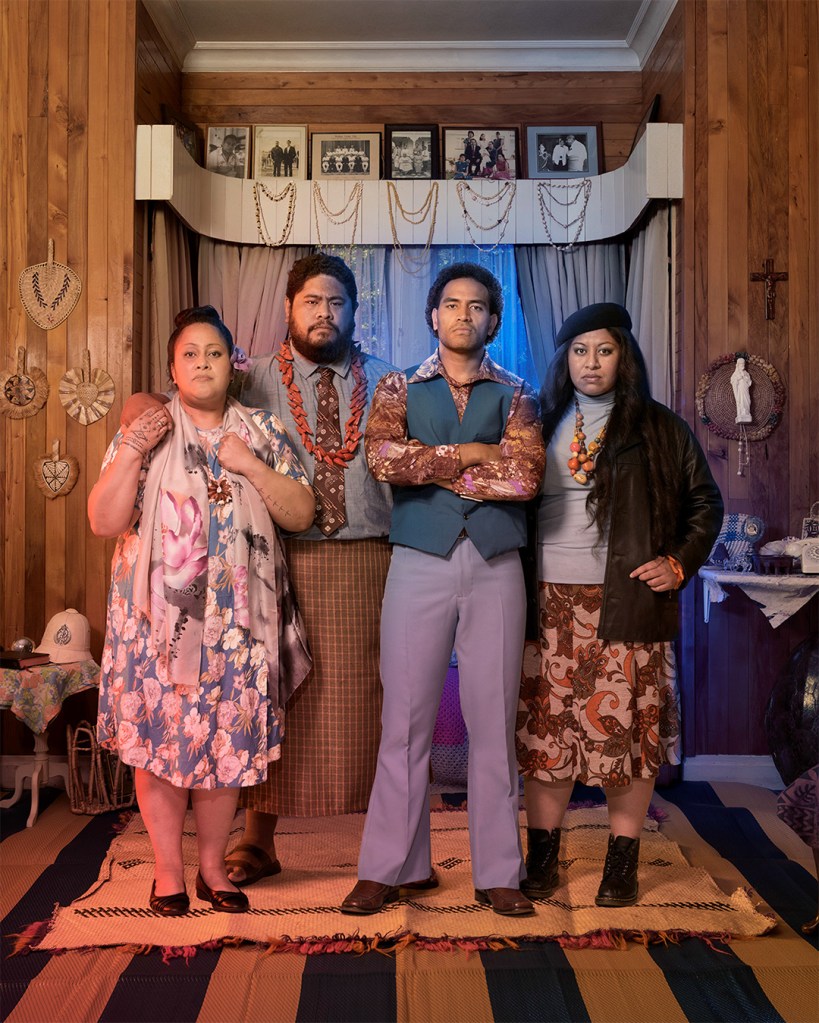
Oscar Kightley’s “Dawn Raids” is set in 1970’s Ponsonby with police raids on the street, the pub and in homes.
In the play we encounter one family whose lives are in a delicate balance as they are sheltering an overstayer, Fuarosa, who is the fiancé of their son Sione. Her presence creates all sorts of tensions with the ever-present threat of her discovery looming over them. There are conflicts between the couple and with the father Mose, who sees that even walking to the letterbox could attract unnecessary attention to the family.
We also connect with the family’s aspirations. The mother To’aga who has an unfulfilled dream, the sister Teresa who is following her ambitions studying Law at University as well as pursuing a radical path in joining the Brown Panthers.
Then there is Sione who we initially encounter in his stage persona of Fabian, pursuing his dream of being a star but is now performing as an ‘Hawaiian’ singer and Elvis impersonator singing with the Noble Hawaiian Sabretooth Tigers who in the final moments of the play morph into the Noble Samoan Sabretooth Tigers.
The play could have taken a more political approach peppered with polemical dialogue but Kightley has resisted this instead only briefly alluding to politics and history. What the play dose is show the impact of the raids on the one family and their close contacts.
This makes for an emotionally charged work which sees history in terms of individuals and their individual experience.
Each of the characters combines elements of the stereotype along with nuanced individuality which are brilliantly expressed
Lauie Tofa’s Mose as the laid-back patriarch who has difficulty controlling his family, especially Teresa is the comedian of the piece delivering his one liners and wry observations to create a man wanting to retain the good and the bad of village life and he also aspires to integration.
Bella Kalolo-Suraj as Mose’s wife To’aga is the voice of reason and solidity conveying much of the emotional richness of the play as she negotiates her children’s desires and her husband’s dictates.
Michael Falesiu’s performance as Sione/Fabian is brilliant. He has the voice and stage presence to make his cabaret appearances thoroughly entertaining. He also manages the complex of the character, cleverly juggling stage career and domestic future with a palpable tension while Gabrielle Solomona as his fiancé Fuarosa, captures the wide-eyed innocence and eagerness of the newly arrived.
As Teresa, Talia-Rae Mavaega gives a forceful portrayal of a young woman with a passionate revolutionary spirt confronting political and social issues as well as the issues of control within the family
In the minor roles Italia Hunt gives a finely judged performance as the conflicted policeman Steve as does Jake Tupu as the politically ambivalent Bene.
Kightley’s play is an astute balance of the personal and the political, the humorous and heartbreak. Dialogue and music complement each other and there is effective use of the various settings of club, bar street and home. Kiightkly’s use of humour and the everyday makes the police raids, the sirens and the barking dogs all the more dramatic and threatening demonstrating the playwrights profound understanding of stage craft and of realising dark truths.
The play is great reminder of one of New Zealand darker periods but it is also a reminder that we have some great dramatists whose work often doesn’t get shown enough.
Jukebox musicals have been around for a long time. Typically using a fairly simple storyline and intermixing this with known songs, the two elements then combine to develop a whole that complements itself. This genre goes all the way back to John Gay’s Beggar’s Opera in the eighteenth century and has been used in many successful films and stage productions and films ever since. More recent popular examples include Mamma Mia, Jersey Boys and Moulin Rouge.
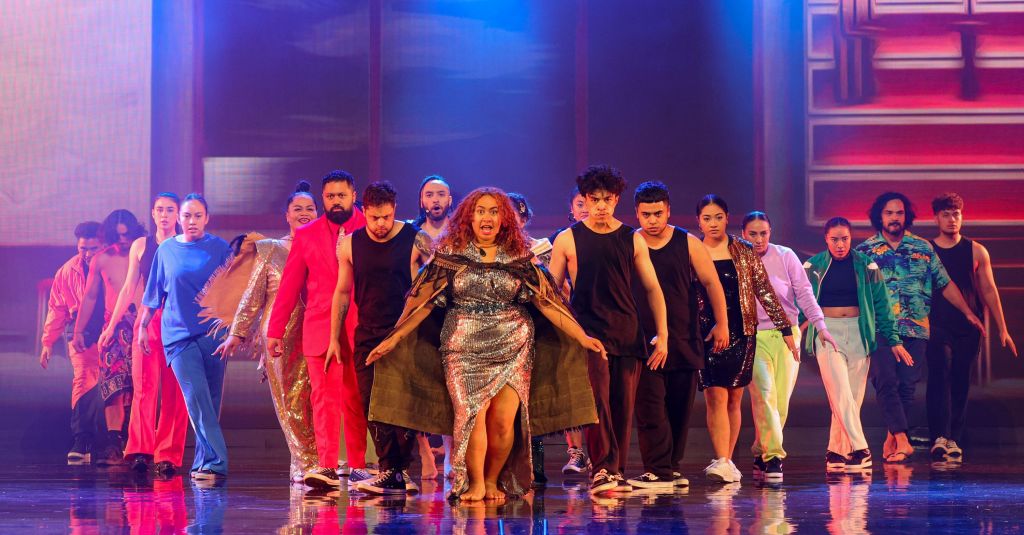
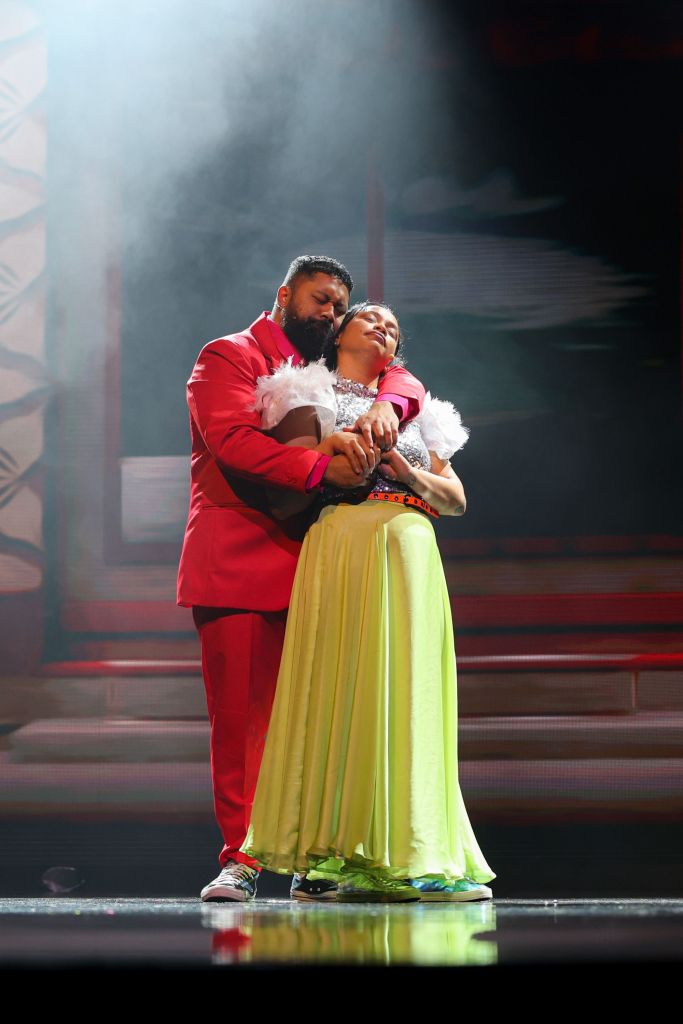
Pacifica the Musical is the latest. It’s likely to be a hit in Auckland or in any of our largest cities and, could well go on to realise its creators aspirations and achieve a more international life expectancy.
This show is a credit to those who have put it together. It weaves a storyline across 300 years, telling of a mysterious missing taonga in a “little black box”, and then travels to and fro from some unspecified part of Polynesia to New Zealand. It crosses generations and ultimately demonstrates that some truths are eternal. There’s some genuinely funny interaction, love and legend are woven throughout and holding everything together is a melange of songs by some of our favourite composers and artists.
These days I frequently leave a venue with depressed amazement at the dark thoughts some creatives dream up. But not this time. Delightfully, there is not a scrap of angst in this show. With Pacifica i felt only joy, happiness and a sense of celebration. tradition is honoured, family is respected and Aotearoa’s Pacific immigrants are clearly and firmly established as an integral part of this country.
When I left the theatre I was smiling. And so was every single face I saw. Pacifica is the work of producer/director Pak Peacock and a highly credentialled team. The digital set is skilfully established by Delaney Kennedy and the deft choreographic work of Hadleigh Pouesi can be spotted – especially among his hip-hop dance crew, a masterstroke of casting.
Jerry-Moses Roebeck (Tanga) and Irene Falou (Venus)
Other cast, some of them very young and early in their careers, simply fizz with energy and their voices are a joy to behold. Jerry-Moses Roebeck (Tanga) and Irene Falou (Venus) in particular. They are given strong ensemble support and assurance from established actors like Nick Afoa.
Composing a new score is a complex process, fraught with risk and often takes years to reach its final form. So it was probably wise for Jacob Nansen to simplify things and reach out through music and songs already known to his audience. To say it was well-received is an understatement. On opening night there almost appeared to be separate cheer squads in the audience as each new tune was rolled out. Anika Moa’s mob hooting over on the left, Annie Crummer’s supporters hollering over on the right, Neil Finn’s appreciators at the back, and Six60’s straight down the middle. Jacob has done a masterful job bringing these different musical styles into a homogenous whole and bookends them to perfection with two from Dame Hinewehi Mohi – her mesmerising Pukaea and Kotahitanga.
On balance, Pacifica could perhaps handle a slight trim or edit in a couple of places. But that’s minor and will no doubt happen. in the meantime, go see it. You won’t be disappointed.
Yes of course the taonga is recovered. and the girl get the boy. That’s what music theatre is about after all!
Culture in a Small Country: The Arts in New Zealand by Roger Horrocks
Atuanui Press
$45.00
A Book of Seeing by Roger Horrocks
Atuanui Press
$38.00
Reviewed by John Daly-Peoples
With his two new books, “Culture in a Small Country” and “A Book of Seeing” Roger Horrocks has provided an excellent addition to books about New Zealand art and culture.
Where “Culture in a Small Country” provides an overview of New Zealand culture “A Book of Seeing” is the authors more personal approach to investigating and understanding art and culture and how we perceive it. One is a wide-ranging exploration of our cultural history the other is something of a guide to the way explore our world .
Horrocks is well qualified to take on the immense task of describing and interpreting culture. He taught at the University of Auckland on a range of subjects including poetry, film, TV and media.
He has published many books including a biography of the artist Len Lye and he wrote the libretto for Eve de Castro-Robinson’s 2012 opera about Lye. He has made films and published two collections of poetry, and he was a co-editor of innovative literary magazines.
He has been influential in a number of cultural organisations including NZ On Air, the Auckland International Film Festival, Script to Screen and NZ on Screen. In 2019 the Royal Society Te Apārangi gave him its Pou Aronui Award and was [previously awarded a New Zealand Order of Merit.
The topics included in “Culture in a Small Country” are an indication of his range of interests – Writing, Publishing, The Visual Arts, Film, Classical Music, Popular Music, The Digital Age as well as a chapter on the impact of the pandemic.
Within those general headings he provides a wealth of information and commentary which will remind the reader of our distant as well as recent past and the huge developments which have occurred in the arts in the last fifty years.
He knits together the multiple stands of our culture, the interwoven artists and events which have provided a rich tapestry of histories and ideas
The book combines the elements of an academic treatise with extensive notes along with a down to earth readability with anecdotes and lively information. He has also drawn on personal experience as well as relationships with a wide range of New Zealand painters, writers, composers, filmmakers and other artists.
The mini-interviews and biographies of well-known and influential practitioners helps give the book an informal tone whereby serious subjects are negotiated without too much erudition.
“A Book of Seeing” is a meditation and reflection on range of topics related to seeing. Here the topics cover the various ways we look at, experience and comprehend the arts. The more than thirty chapter cover a number of topics – The Experience of Colour, The Origins of the Eyes, Viewing Films, Science and Seeing, Visual Modesty, Philosophers See Time and Language and Seeing.
In this sweeping and elegant approach to his subject the author follows writers such as John Berger who, fifty years ago in his books “Ways of seeing” noted that “Seeing comes before words. The child looks and recognizes before it can speak”. This recognition that seeing is at the core of the way we need to approach art and that the way we see is conditioned by many personal, social, cultural and scientific factors.
Horrocks takes a personal approach to his subject and in his opening chapter, describes his teenage writings about the suburb he lived in at the time. He reflects on his early intentions and ability to look at his environment and then attempt to describe his thoughts through writing. It is a practice which he has followed since then in all his critical endeavours and it also sets the tone for the rest of the book
He seamlessly brings together ideas, comments and reflection by artist, philosophers, writers, poets, musicians and scientists -Wittgenstein, Baudelaire, Francis Crick, Borges and Lucretius along with New Zealanders Peter Simpson Michele Leggott and Allen Curnow.
He manages to explore some very simple questions – How do we see? What is it we actually see?, How much of what we see is conditioned and learned?. In answering these questions Horrocks combines simplicity, a keen perception and an intellectual precision which is revealing and rewarding.
It’s almost fifty years since Hundertwasser burst onto the art scene in New Zealand with his major exhibition at the Auckland Art Gallery. That show which opened in April 1973 was the start of an interconnected, almost symbiotic relationship between New Zealand and the Austrian artist.
The catalogue for that show sold in its thousands and it seemed that most New Zealand art lovers had a copy of it. The book went on to be published in 18 editions selling over 750,000 copies.
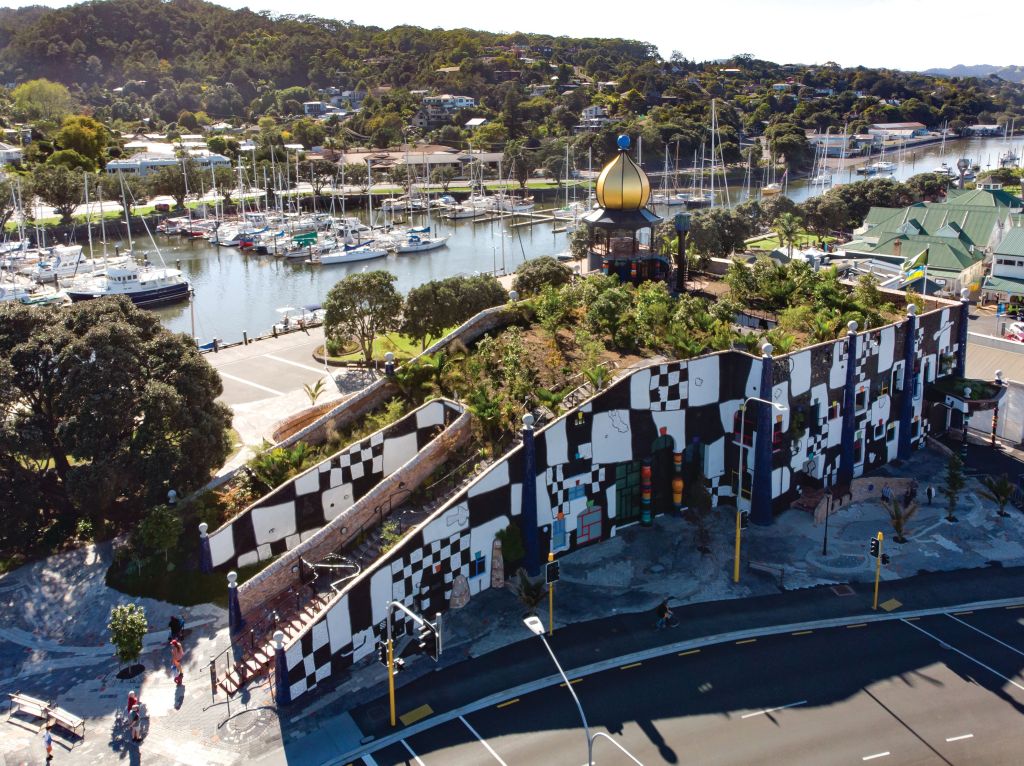
Hundertwasser’s connections with New Zealand went further than that exhibition. Not only did he design a new flag for the country which almost became the official flag but he designed one of the country’s few ’iconic” architectural works with the Kawakawa public toilets. The recent opening of the Hundertwasser Art Centre in Whangarei which he also designed has further cemented his creative impact on New Zealand society.
Hundertwasser Art Centre
In some ways Hundertwasser could be seen as the archetypal New Zealand artist / architect. He displayed the No 8 wire mentality in his approach to architecture and design as well as a desire to own his own piece of land and developed an affinity with Māori. He also drew inspiration from the landscape as well as seeing the need to integrate the individual into the physical and natural environment.
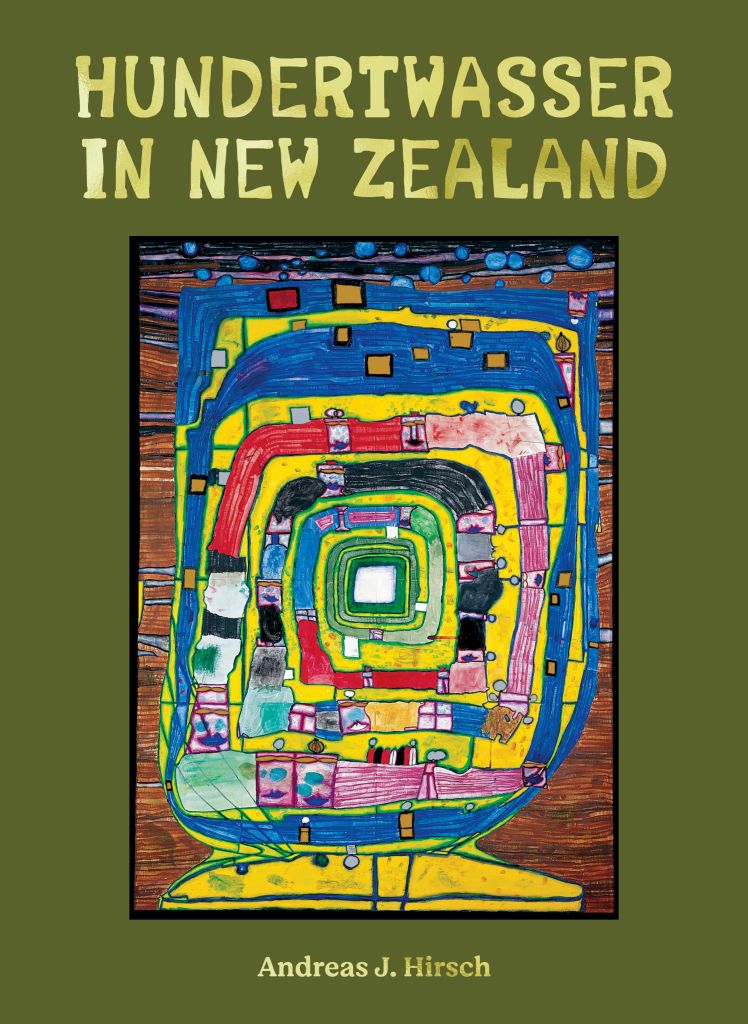
A new book “Hundertwasser in New Zealand” by Andreas Hirsch, a long-time friend of the artist provides insights into this latter-day New Zealand citizen who had a major impact on the arts, the environmental movement and Northland itself.
The book records his journeys around the world including the voyages on his boat, Regentag which sailed from Europe to New Zealand, metaphorically linking his European life to his New Zealand life. The book is also a record of his artistic journeys as he developed his artwork and the themes he was fascinated with. There is also his journey within New Zealand as he sought to acquire property and then his years of developing his farmland in the Kaurinui Valley.
In the book much is written about his career up to his major Auckland show at a time when his work was becoming internationally recognised . As the German curator Wieland Schmied noted at the opening of the exhibition in Auckland. ‘The themes of Hundertwasser’s pictures are labyrinthine architectural structures, hill-like houses surrounded by protecting fences, house-like steamers surrounded by protecting waves, leaf-like windows surrounded by protecting spirals, the spirals running inwards with many convolutions like paths leading towards a cave of security.’ These are themes which were much in keeping with Māori creative approaches.
His interest in alternative architecture is outlined from his early rooftop living in Vienna in a building designed by Otto Wagner to his encounter with the New Zealand architect Ivan Tarulevicz whose house in Tauranga Hundertwasser saw as a functioning implementation of his vision of green roofs with sheep grazing on the roof. Several years before Tarulevicz had been responsible for getting Buckminster Fuller, a proponent of the geodesic dome to come to New Zealand to talk.
The book also expands on the way that Hundertwasser came to acquire land in Northland and his growing understanding and respect for Māori. At the same time, he was expanding his commitment to ecological and conservation issues which were in turn were linked his artistic work, producing paintings and posters related to these ideas.
For many New Zealanders, Hundertwasser’s career centre on that 1973 exhibition but the book expands on his twenty years of his output before arriving in Auckland. His early life and much of his outlook was built on his Jewish / Aryan heritage and like many in post-war Germany he saw the need for a social revolution. There is also material about the process leading up to that Auckland show and the efforts of his Australian dealer Hertha Dabbert who had given hm a Melbourne show in 1970
The texts also provide ways of insights into the artists approach to art and life, notably with his notion of the five skins of the human being, the importance of the spiral and his ideas about the horizontal (the domain of nature) and the vertical, (the domain of man).
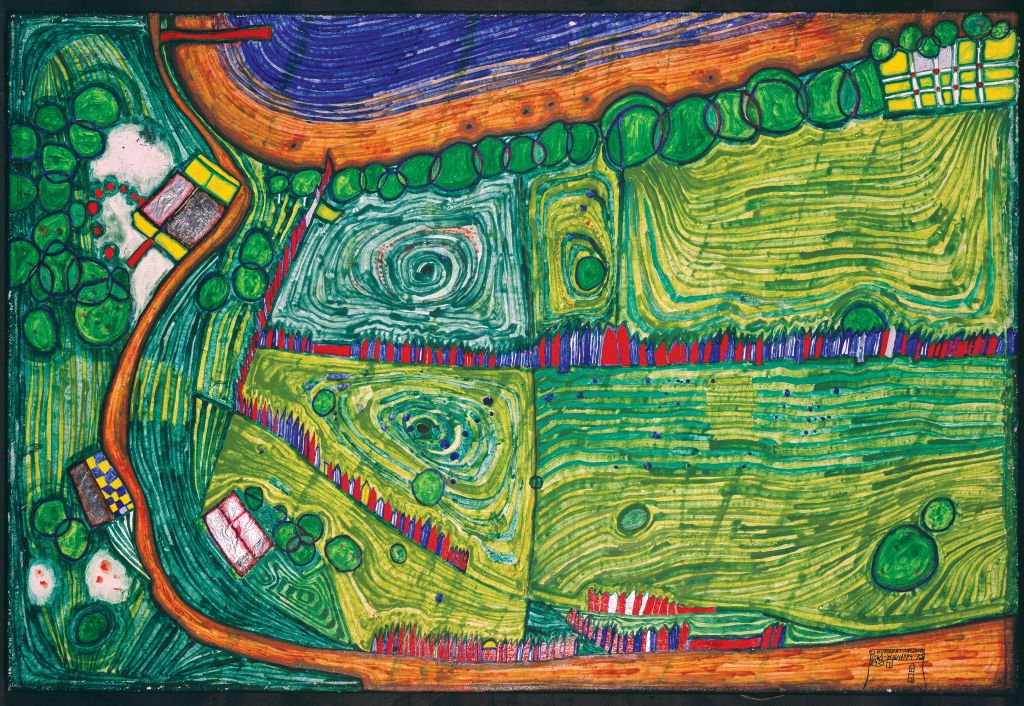
Hundertwasser, Fagan’s Farm
The book manages to show how the artist’s career and ideas are reflected in his art and the way the works become the visual diary of his physical, intellectual and social progress. Paintings such as “Fagan’s Farm” which have many of the features of his work is based on the farm owned by neighbours of his in Northland. The painting is a plan of the farm with many features of the landscape but it is also something of a metaphysical map as well, embodying the notions of “crop circles” inherent in the land as well as the idea of the spiral or koru which refers to the endless cycle of growth and renewal.
It is a handsome publication with a number of full colour illustrations of his work along with images of his architectural work both here and elsewhere. There are also preliminary sketches of the Arts Centre as well as illustrations of early concepts of building with nature.
It is a book which traces out the history of a visionary creator but also provides insight into the way in which an individual can help change thinking in terms of social issues and our ways of seeing.
In the final concert of his three concert series, pianist Paul Lewis gave a magnificent performance of Beethoven’s Fifth Piano Concerto. The work which had gained the title of “Emperor” was one which Beethoven rejected because of its association with Napoleon. but has nevertheless prevailed
Beethoven was born in 1770, one year after Napoleon and like many of his generation, initially believed the French revolution with its ideals –of liberté, égalité, fraternité, heralded a new dawn, that mankind could be reborn, that a new society was imminent and that great men like Napoleon would lead the way to this new society.
Beethoven’s enthusiasm for Napoleon peaked with the Eroica symphony of 1804 but by the time of writing the fifth piano concerto he had lost faith in the man who was then at the gates of Vienna.
Despite the composers misgivings about Napoleon the piano concerto has all the features which stemmed from the revolutionary fervour of the time – notions of the heroic, the innovative and the challenging. This was evident in the music but also in Lewis’s approach to playing.
A great pianist can make Beethoven’s work seem relatively easy to play but is also easy to forget just how difficult a work like the Emperor Concerto can be to play.
Lewis’s mastery of the work was his ability to provide a real sense of cohesion and an understanding of the structure of each of the movements as well as the work as a whole. He never allowed the simple demonstration of his own technical facility to obscure his larger purpose.
He fully captured the textures, scope and power of the work and the heroic spirit as conceived by Beethoven is revealed to be both physically robust and spiritually refined. From the virtuosic opening of the first movement through the dramatic contrasts of the Adagio to the impressively optimistic finale, Lewis demonstrated an effortless strength as a concerto performer. There was a cerebral focus and an understanding of the work in the way he played. Rhythmically, he was in total control, never too soft or loud, never to fast or slow, with his magical fingers conjuring up the emotions of the piece and at all times he was in sync with conductor Gemma New and the orchestra
Few pianists would have the sheer technical skill, understanding and stylishness he demonstrated.
Praise should also go to Gemma New and the NZSO who gave a sympathetic accompaniment. They also realised the full symphonic nature of the work ensuring that the drama, subtlety and excitement of the concerto was fully expressed.
The latest NZSO concert ”Truth & Beauty” opened with John Rimmer’s “Lahar” which he wrote in the 1970’s as part of his Ring of Fire orchestral work. It was a volcanic lahar of melted snow and ice which caused the Tangiwai disaster on the Whangaehu River in 1953.
While Rimmer does not reference the disaster directly in the work one can sense the various forces of nature – geological and atmospheric which contributed to the disaster represented in the music.
Conductor Gemma New reinforced the aspect of peril inherent in the work with her arm movements which at times looked like short sharp semaphoric, movements signalling danger.
The percussion instruments created the opening growling sounds of the volcano and the tectonic shifts, while other instruments captured the sounds of the forest such as the twittering piccolo and flutes representing the bird life.
The work ended with a plaintiff piccolo solo, a lament in honour of the victims of the Tangiwai disaster.
The big work on the programme, Dmitri Shostakovich’s Symphony No 5 had some of the same brooding and reflective quality to it as the Rimmer work.
In the 1930s, the Soviet Union the purges of Joseph Stalin meant that traditional music and composers were declared decadent and even Dmitri Shostakovich saw the need to adapt. In a cynical nod to political correctness, he subtitled his symphony “A Soviet Artist’s Response to Just Criticism.” While there are many lyrical and heroic aspects to the work there is a sense of despair beneath the almost romantic melodies.
The symphony feels as though it is contemplation of the battlefield, the horror of battle and the eerie aftermath. But this is not some reimagining of Tchaikovsky’s triumphant 1812 and it sems very relevant to the present day as Ukraine had been focus of Russian territorial ambition in WWI and the site of much fighting and destruction.
The work opens with the great percussion roar of war and destruction followed by the various colours and moods of the battlefield landscape where the souls and spirits of the dead lie. Then there are themes which could be derived from folk melodies which eventually morph into driven militaristic music.
The second movement which has some links to dance, but this is not folk dance or the waltz but rather a dance of death. Then as with most of the bright and colourful themes in the work the music eventually returns to the militaristic the dramatic and the chaotic.
The slow third movement was almost a requiem with mournful sounds provided by flute and harp and the work eventually moves to a transcendental mood conveyed by the flute. In the fourth movement New extracted nuance and subtly giving the work a lightness and innocence before erupting into a joyous reworking of the opening theme
At times throughout the work Gemma New’s elaborate conducting style saw her more as a magician than conductor and her baton more of a wand.
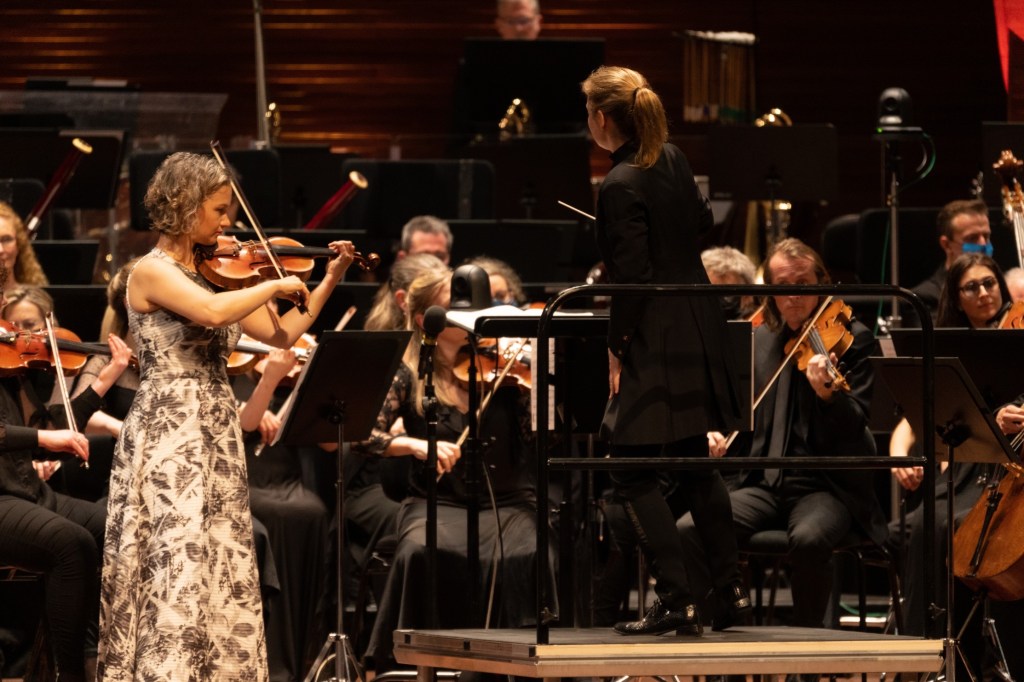
While the Shostakovich was the big symphonic work on the programme it was Hilary Hahn’s electrifying performance of Prokofiev’s Violin Concerto No 1` which was the highlight.
After the slow ethereal opening her playing became more impassioned with some frantic bowing displaying a deep understanding of the work. Her own bodily movements also displayed a physical response to the music moving with a dancer’s litheness and intensity.
The fairground themes of the second movements which foreshadow the composers later compositions for film were soon turned into more robust sounds with some powerful contrasting passages.
Her playing was technically brilliant and she handled the more difficult sequences of playing on the bridge of the instrument and plucking with consummate skill. Her duets with various instruments of the orchestra were all precise and incisive.
Her playing ranged from the whimsical through the serene to the extravagant and all the time she was formidably focused on the music. There were times when she seemed to be in trancelike state while at other times she seemed to be in a rage. Throughout it was as though there was no effort being made and that the technical wizardry and sumptuous music flowed effortlessly from her instrument.
Roy Good’s latest exhibition “Squares Cascade” continues his experiments and enquiry into shape, and colour. For the most part each of the works echo the title of the show with squares of colour seeming to fall, rotate and displace in an endless search for possibilities.
A lot of the artist’s work in the past was built on, and a homage to some of the abstract artists of the past and in this show the square shapes are variations on the geometric paintings of Kasimir Malevich. As with the coloured squares of Malevich, what at first seem to be flat coloured shapes start to reveal differences in colour and texture. So, in “Squares Cascade – Eight Rotate” ($8500) some of the shapes are flat colour while others have subtle variations of texture such as one might find in marbles and granites.
There is an architectural quality to these works particularly apparent in the stacked works such as “Squares Cascade – 5 Squares, 4 Rectangles” ($14,500) or “Squares Cascade – Stack” ($7500) where the shapes are built on top of each other. In others this architectural quality can be seen in the depiction of planar forms as in “Squares Interlock” ($19,500).
With many of the work it is as though the artist has based the shapes, placement and connections on mathematical or geometric principles. There might even be a hidden code or an enigmatic symbolism attached to them.
From medieval times artists and architects regarded number symbolism as important with. certain numbers and ratios having magical or talismanic properties. They also had an ethereal existence and were models for theology and an analogy for creation itself.
One is alerted to the mathematical quality of some works partly by the title such as “Squares Cascade – Arithmetic Progression” ($18,500) where the assemblage of varying shapes seem to conform to a predetermined set of principles and not just random placement.
Roy Goode, “Square Cascade – Dance The Line”
There are the set of work which have dance in their titles where the shapes follow the logic of the dance steps. In “Square Cascade – Dance The Line” ($6500) the various coloured squares negotiate a shifting central line and with Squares Cascade – Square Dance 1” ($8500) the squares follow the ordered nature of the traditional square dance. Then there is “Squares Cascade & Rotate” ($19,500) where the mathematical and dance notion collide in an unexpected combination of regular and off-centre shapes.
Good has always had an interest in shaped canvass and in these works, there are a variety of shapes , both of the exterior frame as well as within the frame .
There are the more complex ones such as “Squares Ascend No 1`” ($25,000) which is like an upended ziggurat and “Squares Cascade – Fault Line” ($25,000) where the descending coloured squares appear to have dislodged part of the the frame
There are the couple of works which owe much to the Israeli artist Agam with the raised triangular forms producing an op art sensation with changing perspectives . “Squares Cascade Kinetic No 2” ($19,500) explores space and movement in an intriguing manner touching on the ides of meditation and contemplation,
Jim Allen who last week turned 100 has been developing his artistic practice since the 1950s, and was a pioneer of post-object art in New Zealand in the 1970s.
Nearly fifty years ago in 1974 I interviewed him as part of a series of video interviews with leading artists -“ Interviews with six NZ Artists” (Allan, Albrecht, Binney, Ellis, Hanly, Twiss.). This is a transcript of the interview.
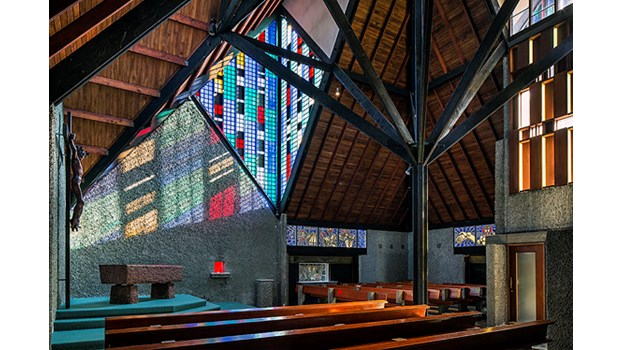
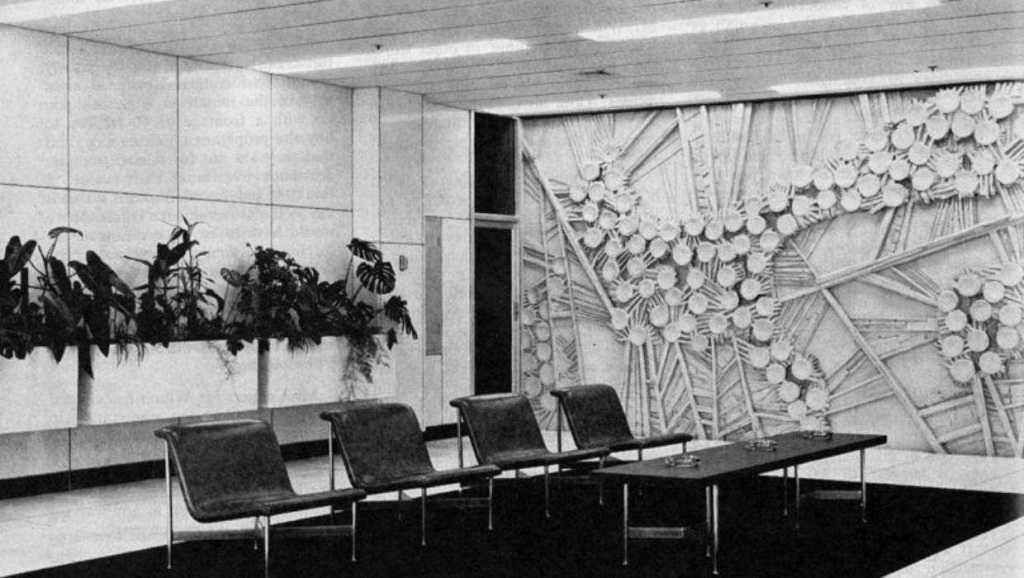
At that time his major works included the designs for the windows, stations of the cross and crucifix for Futuna Chapel (1961) in Wellington, the ICI mural (1965) in Wellington ,”Wairaka” Lady of the Rock (1965) in Whakatane and his first post object exhibition at Barry Lett gallery including Tribute to Hone Tuwhare, 1969,
John Daly-Peoples: How do you describe the work that you now produce You don’t do figurative or representational work – why don’t you, and what you see as a sculptor’s aim, or your aim as a sculptor?
Jim Allen: Well I have to talk about my own personal aim and it’s not that I dislike realist work, or have no interest in it, for instance, I get a lot of enjoyment from the work of
Brancusi and people like this. And it’s not as if I’ve turned my back completely on that in terms of appreciation. It’s just that my own preoccupations appear to take me a very long way from those kind of realist things. But my work seems to have two kinds of polarities – one is where I’m involved with a physical problem, which leads me to the evolution of structures to solve the physical problem, and here I’m talking about work of a more architectural nature. For instance, the work which I did at Palmerston North Teachers College, the design solution was based upon the architectural elements of the spaces surrounding the sculpture and the floor plan, on which the sculpture was standing on. And the fact that there was a considerable number of, flow of people walking backwards and forwards within the space which it’s situated in- And it’s very much a practical problem to evolve something which will complement the architecture stylistically, and also not to clutter up the foreground so as it becomes an obstacle for people to have to walk round, and so on.
When I get a problem I tend to approach it from a structural design analysis point of view, and produce a solution which meets the problems inherent in the site, rather than carrying an idea to the site and imposing it upon that situation. Now I’m not against that, I’m just saying, this is what I tend not to do. And the other thing, which is the other polarity, is where I’m concerned about ideas, and I seek to use materials, and methods to get to grips with the idea in a visual physical way. But, primarily I’m concerned about ideas, and the significance of ideas, in different kinds of relationships, and then I seek to use materials which will begin to deal with these ideas in a visual kind of way. And that leads me to use media which would be classed as being non-traditional, and in fact it leaves the whole media opportunity completely open, because when you’re dealing with ideas, anything becomes appropriate, as to that which will best explain, or demonstrate the idea. And I guess a lot of people have difficulty in getting close to my work because the materials which are used, and the way in which they’re used, differ greatly from traditional types of medium, to traditional types of usage of media. But it’s because I’m more interested in the idea, or ideas which can be generated by materials, rather than doing a purely formal exposition.
Jim Allen, Futuna (1961)
JDP: It would seem that the idea itself, was important – not so much the piece of sculpture or what comes out of it, but rather the actual involvement in the process.
JA: Yeah, on a lot of occasions the intentions are modified by the events as they occur at the time, particularly with this kind of work. And, with “Sonic MI”, what nobody else realises, but the problem is that had three things worked out for “Sonic W’, and that each of them was cancelled out, one after the other, because the venues, or the space available for me to perform these works, was changed. was told that was going to – I had the dining room as a space, and I evolved a work for that space, then that disappeared because they wanted to use it for coffee, or something. I then evolved a work to the place on the grounds on the lawn outside, in a marque, the marque didn’t materialise, and
twenty-four hours before the start of “Sonic Supers” I was given the room which I was placed in. Not using this as a way of excuse, but it certainly threw me a bit, and the work which has evolved for “Sonic W’ really wasn’t what I’d planned, it was something that I had to rush through, which was unfortunate. But nevertheless it has the bones of the approach which I would had to any of those spaces, which was to create a situation within which a certain amount of participation – free participation – both by performers who are used to the structures I was setting up, and people who would have been seeing it for the first time – could have got some feedback by becoming involved, in a physical situation. And in this sense most of the things I’m involved with are traditional, when one talks about them in these kinds of terms. They involve space, they involve sound, some sets of physical dimensions, but instead of the viewer, or spectator being on the outside of them, he becomes part of them and he becomes part of the sculpture itself, in many cases, not in all cases, but many cases.
JDP From the 1960’s on you are looking at new sculptural methods, you start to try out a lot more ideas than you had previously – would this be so? Or when you talk about abandoning Elam, did you start to have to redefine what you saw as sculpture, and re-examine and explore some of the new aspects?
JA: Well, prior to the 1960’s I’d been employed by the Education Department, doing experimental work in Māori schools in the far North of New Zealand, and I went straight from the Royal College in London to that job. And I think probably it was the best thing that could have happened to me, because it brought me into contact with people, and with children, who are operating at a very early creative stage. And I learnt an immense lot from these people and from the children, in fact they would be the biggest single influence on the way I think, and what I think is important and the way I work, and the values I place on things. When I came to Elam it gave me the opportunity to return to making things, which I hadn’t had for some time, and for a few years there was a heavy physical involvement in casting and moulding and welding, and so on like this. The kind of forms which emerge from those periods are, a generic term which applied to them, that was called “slotsies”, and they were in the main, cast pieces of aluminium which slotted together, and some of them had the possibility of a variety of combinations, you could slot them in different ways, and they formed different shapes. They were concerned about articulation, and things like that. With the “slotsies”, I was very much concerned with the articulation of things, and also, some exploration into casting techniques.
Jim Allen, ICI House mural (1965)
About that time, I did one of the largest castings in Australasia, by the polystyrene method, it involved quite a lot of experimental work in moulding with sand and so on. That’s the work which is in the Bank of NSW in Queen St. So, there was quite a heavy involvement with the experimental techniques with media, of a more traditional kind. But in terms of ideas, I was involved with the articulation of forms. The next sort of development from that, occurred after, or during the period I was on leave, in 1968, in Europe. And it was a very good time to be away. The art schools in Britain were in ferment, they were having riots going on, the schools were being closed, the students and staff were objecting to the administration of the colleges, and the aims and intentions of the courses, degree courses, and diploma courses. There was the French riots
which nearly overthrew the authority in France. There were riots in Germany. And we were in Britain, and I was very closely – I can’t say associated with – but I was in very close contact with the ferment in the art school at that time. We were in France when the riots were on in Paris We were living in an area in London, where groups of students were trafficking from both England to Europe, to France and to Germany, and backwards. And every evening there was a large campfire in this place, and hundreds of young people just sat round, and people were standing up and speaking and talking about what was happening in their country, and what they were concerned about, and what they were trying to do to right what was happening there. And the kind of proposals that were being put forward. And people were discussing for and against the proposals, which were being aired. And there was a time of great vitality, and big things were happening, old established modes of performance and behaviour in quite large sections of society were being set aside, and people were talking about alternatives in a very vigorous way.
I have counted myself being fortunate in Europe at that time. As far as what was happening in the art world – there was a development of multimedia activities, which I. hadn’t come into direct contact with before, there were experimental laboratories with sight and sound situations. There were many instances of development of mixed-media activities, it seemed that the dividing lines between painting and sculpture, and filmmaking, and drama – it was very difficult with many of these activities to set up any dividing line, it seemed to encompass all of these activities, in one way or another. Now this related to me in a very curious way, because it took me back to the experimental work which I’d done in the far North in New Zealand, particularly with a school called Oruaiti, and a teacher called Elwyn Richardson. And I started my activities in that school with him, and he later went on to write a book which is called “In The Early World”. But the main thesis of this activity was, we gained, or made, terrific strides in child growth, by using one activity to reinforce another.
By this means, we had children, for instance, a lot of poetic development, developed in this kind of way is an example; we had children climbing pine trees, and taking handfuls of the pine-needles and chewing them, and just climbing round the trees generally. And when they came back to the ground, we asked them to write about what the trees said to them, and we told them not them not to worry about any problems with grammar or spelling, or so on, just to set down what they felt and what they were thinking about when they were doing this activity. And we got a lot of free and direct poetic utterance through that. We got a lot of work, and a lot of development out of pottery, out of coil forms, and the children made animals. They also made lots of things out of clay. And they were asked to write what they were thinking about when they were making these things, or they were asked to a story about the things which they were making. And they were asked to make paintings and Iino-cuts, about these things.
So, what began to happen after a while, as these activities developed, was that a child could start at any point; he could start by writing a poem and then the images conjured up by the poem he could make a painting, or he could make something in wood-carving or in clay. Or he could start off from the point of making something in clay and then write stories and poetry and so on like that. A lot of the work was based on the measurements of things which they were making, or areas in which they were going to use for making things in. And the ordinary arithmetic processes were dealt with largely in this kind of way, of just measuring and adding things up. A lot of these things weren’t new, except that I think in this case they were fully and well exploited. There was a school shop, operating in the classroom, and a lot of the number work was done through the activities of the shop. And the children made things to go into the shop, so a lot of the activity programme was geared in that direction. They also did a publication, which was a collection of their poems, and stories, and Iino prints. And when they had amassed a sufficient amount of material, they bound it all together and they did so many copies of it and put it out.
Those school magazines now are fairly highly prized in educational circles in this country now, because the kind of creative effort that came from these children has seldom, if ever, been equalled, since. The big lesson for me in it, was the development, or rates of development which could be obtained by the cross-fertilisation of ideas. Where one idea started off in one media and was carried through to another. It seemed that big jumps could be made, in understanding and comprehension, certainly with young children. And it seemed to, from what little I knew of education – well, let’s put it this way – the very young child can be stimulated by having a lot of things around it, which are twinkling and moving, and so on, so it’s attention is… it’s not just left there as a dormant, small being but is stimulated, visually and audibly, and if it’s involved , by adults, in a series of activities, it rates of growth and progression seem to be accelerated. And in a way, this is what we were doing in the schoolroom, we were stimulating the children by involving them in extended activity programmes, and crossing from one media into another, backwards and forwards. And by doing this, reinforced and developed increased rates of leaming. It was good school to work in because, we conducted I.Q. testing at the beginning of the programme and the levels we got were for an average group of children, but from the evidence of work which materialised, people wouldn’t have thought that. Well, I was going to go on and say that, when I went to Europe, and I was involved in all these ideas and different attitudes coming through, and coming up face-to-face with multi-media activities in their various forms, what I was seeing again there, were the developmental work which we’d done at Oruaiti and other schools, materialising at an adult level, and a much more extended level because the immediate facilities were much more extensive and much more sophisticated. But nevertheless, there was a clear identification with my previous activities, here in New Zealand, and with what I found overseas. And it led me to a re-evaluation, a rediscovery of my earlier work in schools, and since I’d returned in 1968, this had been my main preoccupation – the fertilisation of, and development of ideas, and the involvement of ideas, using, involving different medium. And I think it goes a long way to explaining why my present work differs so much from traditional usage of materials.
Jim Allen, Tribute to Hone Tuwhare, Barry Lett Gallery, 1969
JDP: You don’t in fact structure your art for a particular market, the interest is in the ideas, in the exploration of these in any form?
JA: Right…l think…one of the reasons why I concentrate on this, or free myself, to involve myself in this area – which I think is a better way of putting it – is that I have a job, I have the financial means to support myself. And so my object is not to become a successful artist in terms of producing objects which can be sold and given a monetary return to me – though I’m very pleased when I sell things of course, because it gives me more money to be able to develop my work further, and this is also essential. But basically, I operate on a loss. I’ve had to write any notions of being a success and that kind of thing, out. By doing that of course, it frees me to concentrate on problems, which I set myself. My activities are somewhat restricted because I’m working on my salary only, and I use all my salary for these kinds of purposes. And I’m in a continual state of debt because of this. But at the same time, I hold to the situation, that basically I do have a wage to support myself and the family, and I think of the work I do in terms of what’s involved with it and for no other reason.
JDP: Have you done any commission recently? What would you feel about commission sculpture at this point?
JA: Well I usually do commission sculpture if anything is offered to me, to get myself out of debt a little. And I certainly won’t – even in the commission field – I don’t accept any work unless I’m interested enough to do it. In other words, I’ve got to feel some identity with the problem before I’m prepared to spend my time doing that. And some of the interesting problems I’ve had – have been with the Palmerston North Teacher’s College work – the work for the Commonwealth Games in Christchurch, and recently I did a work for Metal Import Company. I made very little money on the Palmerston North Work and also the Metal Import Company, and I owe money on, I operated on a loss for the Commonwealth Games sculpture. So, it’s not a profitable area, either financially, or in terms of my time. But nevertheless, one of the things about commercial work is that there is a certain amount of working capital, and that working capital is money which is not, in ordinary circumstances, available to you. And it gives you an opportunity to make structures which you wouldn’t have otherwise. And briefly speaking, that’s why I accept commissions of that kind – because couldn’t normally afford to do them with my salary.
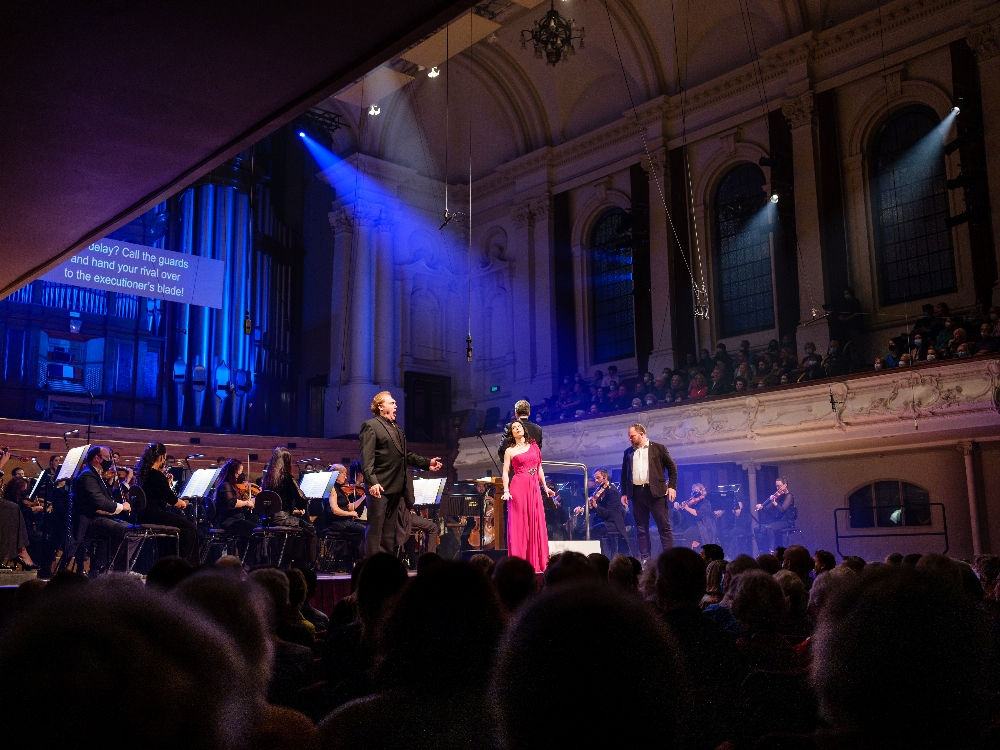
Gustavo Porta (Manrico), Erika Grimaldi (Leonora) and Simon Piazzola (Conte di Luna) Image – Adrian Malloch
Verdi, Il Trovatore
The Trusts Community Foundation
Opera in Concert
Auckland Philharmonia
New Zealand Opera Chorus
July 16
Auckland Town Hall
Reviewed by John Daly-Peoples
A couple of weeks ago we heard four great singers on stage singing Verdi’s Requiem in the Auckland Town Hall – Gustavo Porta, Erika Grimaldi, Olesya Petrova and Petri Lindroos. That tremendous concert was only their warmup to last Saturday’s triumphant performance of Verdi’s Il Trovatore in which they all exceeded expectations.
Central to the story of Il Trovatore is the image of a woman being burned at the stake. This image of flames devouring a human being dominates much of the story and the characters of the opera. The twin notions of the flames of love and the flames of destruction are ever present.
The opera takes place during a Civil War in Spain and has two intertwined stories. One is centred around Azucena and her quest for vengeance against the Count di Luna for burning her mother at the stake because she had bewitched the count’s infant brother.
The other plot concerns a love triangle between the count who is pursuing Leonora, who is actually in love with the troubadour and rebel leader, Manrico, who serenades Leonora.
The count challenges Manrico to a duel, but Manrico is unable to kill the count despite gaining the advantage. Azucena is revealed as Manrico’s mother and then it turns out he is the infant brother the count believed was dead so when the count executes Manrico, Azucena has her revenge by declaring that the count has killed his own brother.
The imagery of the devouring flame is heard at its best at the beginning of the second act when the vengeful Azucena, sung by Olesya Petrova recalls the fire that killed her mother in the aria “Stride la Vampa” (“the flames are roaring). She describes her drive to see vengeance on Count di Luna, singing that “The dreadful memory torments me -It makes my blood run cold.”
Her telling of the horrific tale would have made the audiences own blood run cold as well. She also conveyed the idea of the obsessed gypsy being driven mad by her memories in a vital and nuanced emotional delivery.
Soprano Erika Grimaldi was an impressive Leonora with a heavenly voice which, along with her facial and body language was able to express a sense of ecstasy when singing of her love for Manrico.
Gustavo Porta as Manrico had a commanding stage presence with a robust voice which captured a sense of the heroic along with that of the ardent lover.
Simone Piazzola as the Conte di Luna gave a great performance expressing his jealous rage. His sharp looks and menacing gestures were the embodiment of the ruthless, spurned suitor verging on mad man. His ability to reach and hold high notes without being forced was very impressive.
In the first act when the two men and Leonora sang about love and death, they gave an inspiring and moving account.
In the third act when Manrico and Leanora sing of their love, the two singers and orchestra merged in a spine tingling display. Then in the final moments of the opera Leonora’s sweet, anguished voice erupted, soaring above the orchestra, as though in the throes of passion.
The chorus did a splendid job notably in the popular Anvil Chorus where their singing of “Vedi! Le fosche notturne spoglie” (the sky reveals her nightly garb) reinforced the flame imagery.
In the minor roles Petri Lindroos as Ferrando made his bold entrance from the auditorium, striding up the aisle displaying an elegant manner with precise gestures and a authoritative voice while Morag Atchison’s Ines was nice foil to Leonora
Throughout the performance conductor Giordano Bellincampi ensured that the orchestra served the needs of the singers, providing them with the necessary emotional emphasis and musical drama.








 New Zealand Arts Review