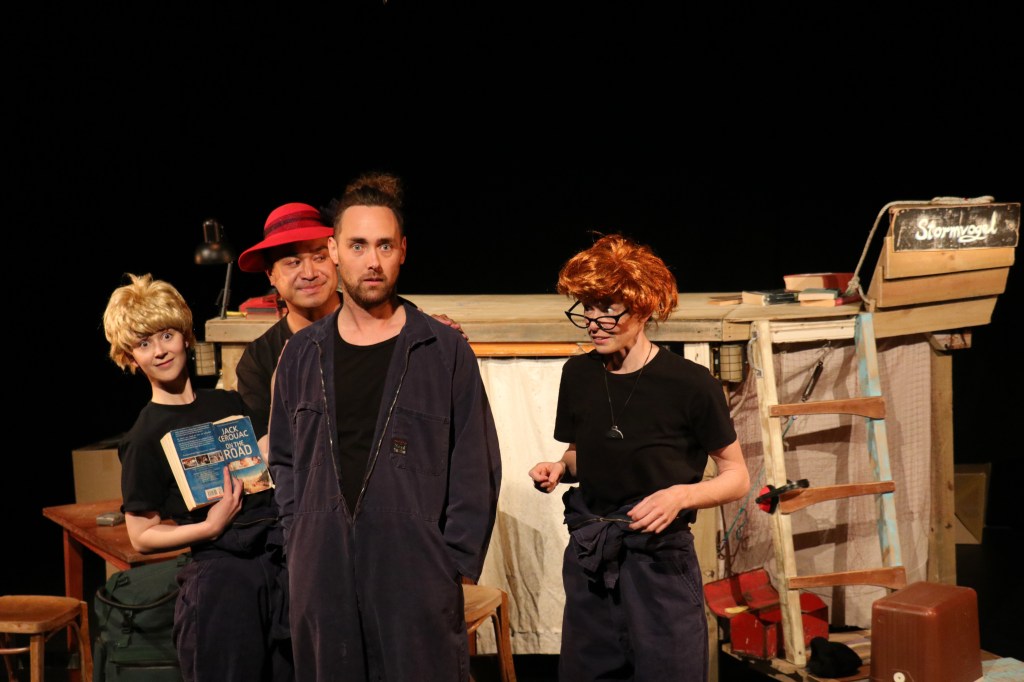
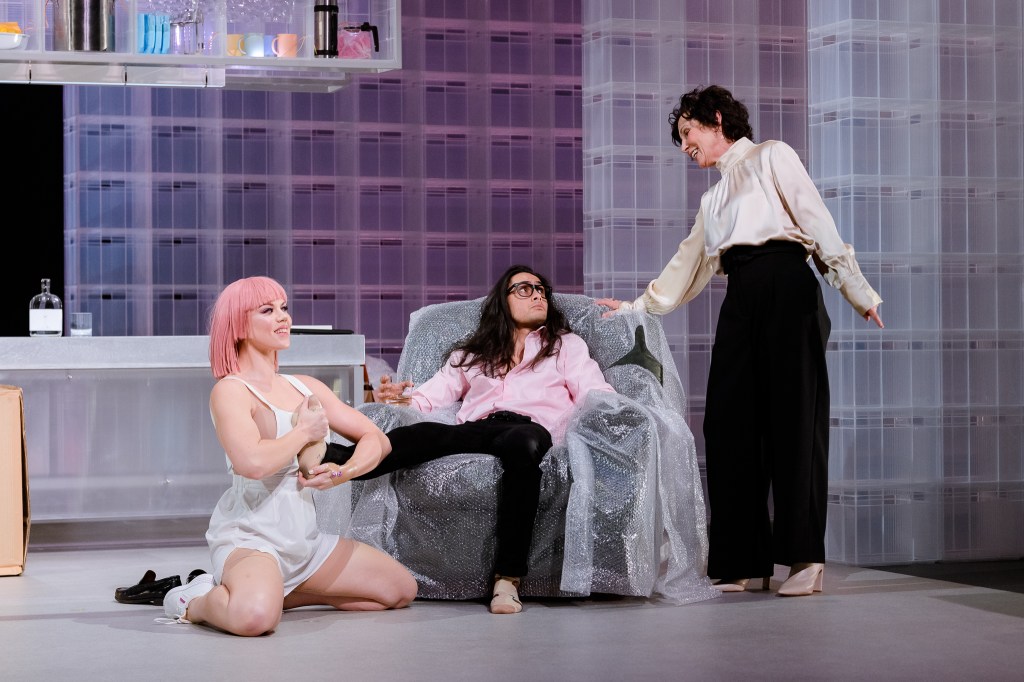
Ruth Steiner (Elizabeth Hawthorne) and Lisa Morrison (Michelle Blundell)
Collected Stories by Donald Margulies
Plumb Productions
Pitt St Theatre
Until July 10
Reviewed by John Daly-Peoples
Playwright Donald Margulies 1997 work Collected Stories is a brilliant piece of writing for a couple of actors with its musing on the mentor- pupil relationship. Here we find Ruth Steiner (Elizabeth Hawthorne), a gifted New York writer (she must be important as she gets calls from Norman Mailer and Susan Sontag) and university lecturer with a keen sense of humour who lives by herself.
She has private sessions with aspiring writers and one day encounters the lively , ambitious student writer, Lisa Morrison (Michelle Blundell) who so captivates Ruth that she takes her on as student and hires her as her personal assistant.
Over the course of several years, we listen to their conversations, learning much about the processes and perils of writing with Rath explaining and expounding on her own writing career including her time as a poet in Greenwich Village and her affair with one of the great Beat poets. She talks about various approaches to writing including the concept of taking inspiration and ideas from any and all sources.
Over time the pair become close in a symbiotic relationship with Lisa growing in stature as a writer with the publication of her collection of short stories and eventually a novel. Ruth is both impressed and happy with the book of poetry but when she reads the novel, she is appalled by the fact that Lisa has used Ruth’s Jewish background, her experiences of becoming a writer and her affair with the poet as the basis of the tale.
The relationship becomes tense with Ruth seeing Lisa as a parasitic and Lisa unable to comprehend why her mentor’s advice which she has taken is seen as some form of identity theft.
The play traverses notions of who should and can write about other people’s lives – is there a need for consent, how far does appropriation go, whose voice can be used.
But at it heart the work is about relationships and both characters have to deal with issues around trust, loyalty, and mutual needs in a complex web of circumstances.
It’s a superbly written play and director Paul Gittins has managed to bring together designers and actors who make the work immensely enjoyable and satisfying.
Elizabeth Hawthorne is it her best moving from the sharp academic to offended and hectoring ex teacher while Michelle Blundell’s developing character gains in confidence and understanding. She is particularly spirited in her book-reading scene standing in front of the audience.
The two women create a nuanced, layered relationship and our sympathies are divided with the two characters laying out their lives and motivation.
Designers John Parker, Elizabeth Whiting and Michael Goodwin have done a remarkable job with the set, costumes and lighting to capture the period and the location. The back projection of black and white film of late century New York are particularly effective.
Book Reading scene. Lisa Morrison (Michelle Blundell) and Ruth Steiner (Elizabeth Hawthorne)
I had spent an hour with Gilbert and George talking about their work and a range of art issues. They were affable and measured in all the comments and views, genteel in their demeanour.
But as we were leaving the exhibition space a group of school children filed past and George heard one of the attendants say something to one of them. For the first time, George raised his voice and became agitated. “What! you’re not letting children into our exhibition“. It was quickly explained that this was a paying exhibition and that children didn’t automatically get admission. But George was still furious. This was an offence against his notions of the democracy of “art for all”, that culture which is the main driver of Western society was somehow being denied to a young child.
The idea of being denied access to culture was something that troubles the two artists who often rail against cultural institutions. They know that there are too many artists and not enough spaces and walls to show all the art but the cultural gatekeepers wield too much power. But the are also aware of the contradictions of their stance in being feted by the institutions they criticise.
They know that the Tate in London has twenty-three of their works but rarely shows them. They also believe there has been a lot of hostility directed towards them and were never perceived as being part of the art world. It is why they in the process of building the four storey Gilbert & George Centre in London’s East End as part of the Gilbert & George’s Art Foundation, and which will display their works through changing exhibitions.
They like to think that they are enabling people to change, letting them see the liberalism in the conservative and the conservativism in the liberal. They want people to change but will not tell them how to. For them the only way that society will change through, is by engaging with culture.
They believe that the greatness of Western culture has been achieved through culture, not wars or politics, that Western culture with its art, books and music has given us the freedoms we have from oppression of religion and tyranny.
Their work is generally anti-establishment, either gently mocking or offensively savage in rejecting the constraints of authority and giving the underbelly of society a voice. With the “Beard Paintings” they include the small advertisements which are found on lampposts and telephone boxes exposing the often-hidden world of sex escorts, fetishes and desperate aspirations.
These stand in contrast to the newspaper billboard works which show the media’s preoccupation with certain words such as “Death”, “Knife”, “Kill” and “Terror”.
Gilbert and George, Knife Straight
Many of their works take anti-religious position with works such as “Jesus Jack” and “Carry On” with a medieval Christ dismissed with a red cross. There are also anti-Islam images such as “Mile End” and “Puttee” with burqa clad figures.
But when I note that in one of their works, “Bag Day” a reclining Gilbert looks like an ecstatic St Cecilia by Bernini he is almost offended as they have a distaste for religious art and religious thinking. George does say however that they would probably change their stance if the religions would apologise for all the wrongs they have perpetrated
While expressing many conservative views, their main concern is what they refer to as the world outside their door, the people of Spitalfields and their daily lives and environments. They look on their local area as part of their studio and walk through the area every day. Walking is their research method and where they gain inspiration. They photograph graffiti, unusual images of street life, newspaper billboards, figures in burqas. They also use the things they find on the street – the small nitrous oxide capsules, balloons, rubbish and they photograph themselves with landmarks like the local bus shelter – all of which make their way into their montage prints.
The newspaper agent’s billboard which are used in a number of their works such as “Knife Straight” are stolen when they go for their walks and currently they have a stock of more than 5000 of them. .
These collections of objects, people and events build up a portrait of East London as well as documenting the pairs journey through their suburb and lives.
They made the decision to become living works of art shortly after leaving St Martins Art school, announcing their relationship by painting their faces silver and posing like two robots. From that time on they turned their very existence into works of art
They consider themselves something of outliers in the art world. They don’t have all that many friends and don’t go to many of the art exhibitions. Some of their contemporaries from St Martins Art School have gone on to be successful in other areas notably Richard Long and Barry Flanagan who I point out to them has a show currently on at Gow Langsford just across the road. In 1969 they hosted The Meal, an elaborate dinner party that included thirteen people with David Hockney as the guest of honour.
Early on they were entranced on hearing Flanagan and Allen singing the music hall standard, “Underneath the Arches”. This idea of living under the railway arches and dreaming of being artists suited them perfectly and the song has become part of their persona, creating the idea of a “singing Sculpture” in which they sing the song besuited and blank-faced. The exhibition features them singing the song.
They produce all their work from taking the photographs (they take photos of each other), manipulating the images, experimenting with colour and even the printing. They are now fully digital having given up their old cameras, dark room equipment and enlargers
“A lot of modern artists are not doing what we are doing. For us, the centre of our art is a human being. The others have a formalistic attitude, of nice colours and nice shapes. We have a moral dimension: what is good and what is bad in people.”
Its interesting how music can take on a political dimension. Tchaikovsky’s 1812 Overture celebrated Russian nationalism but after the Russian Revolution the finale of the work which features a quotation of “God Save the Tsar” was replaced with one more aligned to Soviet thought: namely, “Glory, Glory to You, Holy Rus”, taken from Glinka’s opera “A Life for the Tsar”.
Listening to Tchaikovsky’s Symphony No 4 the political nature of the work becomes apparent seeming very relevant to the present day with its menacing and fateful tones.
In a letter to his patron, Nadezhda von Meck, Tchaikovsky had outlined the central concept of his Symphony No. 4 explaining that the ominous opening fanfare represented fate hanging over one’s head like a sword.
While the composer may have intended the work as a depiction of his own psychological state it can be seen as a depiction of the tragic history of Russia both then and right now with the disastrous war engulfing Ukraine
The APO’s horns and bassoons delivered the necessary strident sound of the work brilliantly with echoes of the 1812 Overture. Here also was the sweep and grandeur of the Russian landscape and the following themes suggested an all-consuming gloom interspersed with glimpses of happiness, indicated by some lighter dance melodies. But then the movement ended with some brash militaristic sounds
The second movement also provided a contemplation on the composer’s melancholic state as well as an uplifting portrait of an idyllic Russian landscape.
The unique third movement was tour de force both for the composer and the orchestra with its pizzicato strings along with similar sounds from the woodwinds and brasses conveyed exhilaration of a peasant style dance theme.
The dramatic and colourful finale was devoted to the development of three themes and at times recalled the composer’s ballet music with an affirming energy
Replacing the scheduled Shostakovich’s cello concerto the orchestra played Schubert’s two movement unfinished Symphony No 8 with the music sounding its distinctiveness from the very beginning. There was a weight and expansiveness to the music and we seemed to be in the midst of a dream state filled with mystery, verging on the mystical. the music sounding as though on the edge of encountering a dramatic event
This state of reverie was well conveyed by the oboe and clarinet floating over the nervous shimmer of the strings. The music also gives a nod to Beethoven’s 5th in his use of the trombone to convey a spiritual dimension
The first work on the programme was the 92-year-old Sofia Gubaidulina’s Fairytale Poem was a fantasy written in 1971 for a radio broadcast of the Czech fairy tale called ‘The Little Chalk.’ who dreams that someday it will draw wonderful castles, beautiful gardens with pavilions and the sea.
The various instruments conveyed the various period of the chalks journey from boring classroom to being used to create the beautiful drawings. There was the, pizzicato strings opening the nightmarish sounds of the xylophone, then the lovely celeste and abrasive piano through to the scratching violins and fierce percussion.
Conductor Bellincampi directed the various instruments expertly in a work which was both accessible, experimental and satisfying.
Forthcoming Concerts
July 7
Verdi Requiem
Auckland Town Hall
Soprano Erika Grimaldi Mezzo-soprano Olesya Petrova Tenor Gustavo Porta Bass Petri Lindroos
With New Zealand Opera Chorus Members of Voices New Zealand The Graduate Choir NZ Chorus Director Karen Grylls
July 16
Il Trovatore
Auckland Town Hall
Leonora Erika Grimaldi Azucena Olesya Petrova Manrico Gustavo Porta Ferrando Petri Lindroos Conte di Luna Simone Piazzola Ines Morag Atchison Ruiz Andrew Grenon Messenger Lachlan Craig Old Gypsy Sashe Angelovski with the New Zealand Opera Chorus Chorus Director Claire Caldwell
Stage Direction Stuart Maunder
July 22
Auckland Town Hall
Stravinsky Symphonies of Wind Instruments Bartók Piano Concerto No.2 (Pianist Piano Jean-Efflam Bavouzet)
“ In the Beginning how the Heavens and Earth Rose out of Chaos”
John Milton, “Paradise Lost”
Philippa Blair latest exhibition at Orexart “A Diary of Events” evokes many of the notions that Milton touched on in his depiction of the creation of the world, the idea of life surrounded by or emerging from unrest and disorder.
At the heart of her work is the uncertainty and contradictions between chaos and order. This contrast can be seen in both the ideas which pervade the work as well as the physical making and arrangement of the paintings themselves. Even the fact that that all the works are diptychs speaks of a duality which exists between the physical and the spiritual, between the random and the deliberate.
The works in the exhibition can be read in a variety of ways – as images relating to events in her personal life, those of the wider world or of abstract conceits.
Philippa Blair, Weather Report
“Weather Report” ($12,000) with its aerial view of a cloud covered landscape with the coloured lines of air fronts, isobars and other abstract symbols of weather mapping could be addressing issues around the impact of climate change and rising water levels on our lives.
“The Swan Plant and the Butterfly” ($12,000) is a meditation on the links between the various parts of the natural world – the symbiotic relationship between the caterpillar feeding on the swan plant and its evolving into the butterfly. Are those the forms and colours of the plant? Are those the lines tracing out the butterfly’s flight?
The works all have an inherent volatility and tactility, not so much the artists applying paint but rather the colours and forms erupting out of the canvas to envelop the viewer
While there is a tension between the notions of order and chaos implicit in the works there is also the physical tension between the both the myriad colours she uses and the various techniques she employs which sees areas of colours resisting, merging and colliding.
The worlds she creates out of colour, form and gesture are both the macrocosmic and microcosmic views. attempts to comprehend a large-scale view of the world as well as a study of the intimate detail of the microscopic world.
There is a vibrancy to the artist’s work implied by “Salsa/Salseros” ($12,000) and the idea of the dance. Her paintings dance with colour, shape and movement and at the microscopic level it is the dance of the atoms and at the wider view they are the dance or trajectories of the cosmos.
Nathan Joe’s “Scenes from a Yellow Peril” is the latest in a very short list of plays about the experiences of contemporary Chinese in New Zealand. The playwright, Nathan Joe notes that for some time he had avoided writing about being Asian but there had been an underlying need for him to write something and so the play is, as he says, “the result of all those feelings of internalised racism slowly being corrected.”
The result is a thoughtful snapshot of clashing cultures – alternately comic, poignant, anguished and angry in a condensed contemporary history of assimilation, along with the complexities of communication.
The sub-title of the play is “Scenarios for the Assimilated Asian” and the work consists of fourteen scenes in which five actors address issues around ethnicity, racism, colonisation and cultural displacement.
They explore the personal, social and cultural dimensions of these issues under various titles such as “ A Short History of Humiliation”, “Love in a Time of Colonisation’, “How to End Racism” and “They Shoot Chinese Don’t They”.
The actors speak of the European perspective of Asians and the comic aspects of being Asian in New Zealand today. They also speak of the bewilderment and hurt of everyday events and the pressure to adapt and conform. But, at the heart of the play is the anger against the system and the oppression. Here, pure rage is distilled, displaying the anger of reacting to the stereotypes.
The play opens gently enough with the Director of the play Jane Yonge interviewing each of the cast in a game show format where we learn about the range of their East Asian ethnicities – Chinese, Korean Singaporean, Japanese Fijian/Indian, along with their various careers. After that the cast embark on a dissection of the issues.
The dozen scenes are delivered in a range of styles – panel discussion, poetry, polemic, stand-up comedy, cabaret and game show. This all creates something of a Chinese banquet – a mix of sweet and sour, some spicey morsels as well as some bland bits
Each of these scenes explores a different dimension so that in “You Often Masturbate”, the characters muse on looking for Asian porn and the fraught feelings and reactions of engaging with it, the confusing sense of liberation and guilt at finding Asian porn and the reflecting on whether this is “exotic”.
One of the standout performances is Louise Jiang in the ”Decolonise The Body. We are All Meatsacks” segment where she gives a scorching delivery with her long poetic monologue of almost operatic dimensions, culminating in a ferocious dance routine.
Nathan Joe gives some eloquent deliveries notably his ”sorry for being sorry” speech about making the audience feel guilty as the huge red curtain slowly descends on him in the final moments of the play. Amanda Grace Leo does a fine comic turn in “I Cannot invite my Parents to My Play.”
Uhyoung Choi, and Angela Zhang all give spirited performances and the three-piece band of Rhohil Kishore, J Y Lee and Daniel Mitsure McKenzie provide a well-judged accompaniment composed by Sound Designer and Composer Kenji Iwamitsu-Holdaway.
The cast are dressed in strangely enveloping costumes which are a combination of traditional Asian monks, and straightjackets and they seem to be constrained by what they are wearing so they seem to be metaphorically limited by both historical and contemporary cultures.
Production Highlight from Scenes from a Yellow Peril at
When galleries, art fairs and auction salesrooms went dark when the Covid 19 struck art institutions previously slow to innovate digitally found themselves with no choice but to use online platforms to reach buyers.
An art market report published by UBS and Art Basel in 2021 showed galleries reported that more than a third of sales had taken place on dealers’ websites or through art fairs’ online viewing rooms climbing 7% to about $13.3 billion.
Figures for the New Zealand market are not disclosed but many galleries have experienced increased online sales and the auction houses have experienced more interest in the digital platform. Because of Covid 19 restrictions many galleries restricted viewing to online viewers only and in one example Suite Gallery sold the majority of a Richard Lewer exhibition to online collectors.
Most galleries make it simple to buy online and sites like nzartbroker.com offer sales via a fixed price listing. All works listed are offered exclusively to members for a 7-day period prior to full release.
Many of these galleries and sales sites have limited number of artists and range of works by individual artists so the big problem for buyers / collectors is having access to a single site where a range of work can be viewed and purchased,
The newly launched www.artfull may be able to provide such an enhanced service.
The website currently has work by two dozen artists including notable practitioners such as Paul Hartigan, several mid-career artists such as Elliot Collins and Kathryn Stevens as well as number of recent graduates and emerging artists many of whom have won awards.
Kathryn Stevens, Cell 1 ($3500)
The site makes it easy to select and purchase works and buyers are also able to make use of MyArt which offers collectors interest-free loans to buy art from galleries in New Zealand and Australia.
The site once it is up and running should provide something of a snapshot of current practicing artist in much the same way as an art fair.
Hopefully if they expand to Australian and international artists it will make the purchase of artists from around the world easier.
The two innovators behind the site are Jessica Agoston Cleary and John Barnett. Cleary has background in corporate branding and advertising. She also has a post-graduate degree in Art History and has worked with leading gallerists and contemporary artists as well as on a number of public art project
John Barnett is well known for his work through South Pacific Pictures and as the producer of some of New Zealand’s most important films such as Whale Rider and Sione’s Wedding .
He has been recognised for his contribution to the screen industry with a CNZM.
He has been an active collector of New Zealand and international art for over fifty years.
Andrew Beer and James Feddeck Photo Adrian Malloch
Auckland Philharmonia Orchestra
‘Ebb & Flow’
James Feddeck (Conductor) Andrew Beer (Violin)
Dame Gillian Whitehead, Tai timu, tai pari (world premiere)
Rachmaninov Symphony No. 2.
Auckland Town Hall, June 10
Reviewed by John Daly-Peoples
The APO’s latest “Ebb and Flow” concert opened with a new commissioned work from Gillian Whitehead “Tai timu, tai pari”
Thetitletranslates as “low tide, high tide” and Whitehead notes that this reflects her observation from her studio window overlooking the Otago Peninsula, an area host to many seabird species including the yellow eyed penguin, red billed gull, white fronted tern, and sooty shearwater
“The tide ebbs and flows, light plays on the water, birds forage for food, rest on the water, whirl in flocks. But it’s not a soundscape – more than most of my pieces, it harks back to exploring an idea within the traditions and proportions of the classical era.”
Central to the work was soloist Andrew Beer, Concertmaster with the APO who along with his violin acted a commentator and observer throughout the work.
The music conveys much about the landscape, the changing light, the ebb and flow of the waters as well as the bird life. But, with the work having been written over the past two years of Covid there is also an underlying tension.
The opening moments of the work with its soft strings and gentle percussion along with soloist Andrew Beer created a radiant dawn with light shimmering on the waters and a host of twittering birdsong.
Beer’s urgent bowing and sharp plucking heralded birdsong but there were also times when his ferocious and often abrupt playing seems to take on the part of a human presence and an underlying darker tone.
All the instruments contributed to the impressionist depiction of the landscape the fauna and flora, the murmur of the sea, the scudding clouds and the sense of light. – the percussion instruments, the harp, brass and the woodwinds all creating descriptive sounds, revealing both the ingenuity of the instruments as well as the inventiveness of the composer.
While these sounds revealed much about the physical environment, they also provided a sense of the spiritual and emotional reactions we have to the environment.
With much of the work the orchestra created an enigmatic background into which Beer inserted himself. His relentless solo work was stunning, varying from the delicate to the to the dynamic, conveying ideas of hope, wonderment and despair.
“Tai timu, tai pari” with its brilliant evocation of personal and emotional responses to the landscape and nature is a welcome addition to contemporary New Zealand compositions and deserves to be played often.
The American conductor James Feddeck himself gave a splendid performance. At times he seemed to use his baton to sculpt the music out of the air and at other times it was a delicate drawing instrument employed with careful movements. He conveyed tempo and energy as he moved about the podium in precise dance-like steps and at times with his actions; crouching, turning and lunging he seemed like a man possessed.
The main work on the programme was Rachmaninov’s Symphony No. 2, a melodious triumph in which the composer confidently comes to grips with the symphonic form after his less than successful symphony No 1. Rachmaninov once said of the work that he composed it to give expression to his feelings; his melodies proclaim his feelings to have been not only dark and brooding, but also with a romantic warmth.
Just as there was an ebb and flow to Whiteheads work here too is an ebb and flow that is integral to the music such that it feels carefully planned, flowing in an organic fashion.
James Feddeck guided the orchestra expertly. From the film score drama of the second movement to the dynamic shifting moods of the third movement he was in perfect control. The strings had a burnished fullness, well matched by flamboyant woodwinds and brass.
He manged to express the psychological and emotional depths of the music, without the angst of Tchaikovsky or Mahler, featuring a lot more sweetness and joy.
Andrew Beer and Gillian Whitehead Photo Adrian Malloch
Dressed: Fashionable Dress in Aotearoa New Zealand 1840 to 1910
By Claire Regnault
Te Papa Press
$70.00
Reviewed by John Daly-Peoples
The Winner of this year’s Ockham New Zealand Book Awards – Booksellers Aotearoa New Zealand Award for Illustrated Non-Fiction was “Dressed: Fashionable Dress in Aotearoa New Zealand 1840 to 1910” by Claire Regnault. It’s a work of scholarship and research but also one which breathes life into the many illustrated dresses and examines the ways in which women conducted themselves in the nineteenth century.
As the title suggest this is not a history of clothing but of fashionable dress. These are the clothes of the well to do made of quality material by both amateur and expert dressmakers.
While it is a history of clothing the book also provides a generous overview of New Zealand’ s social history of the Victorian period, one dominated by the mindset of Victorian England along with colonial adaptations.
Through the numerous illustrations and descriptions, the reader can trace the changing designs and silhouettes of the prevailing fashion. the degree of exposed neck shoulders and arms and the degree of ornamentation and decoration.
The book is filled with interesting mini histories and anecdotes. We learn of the enterprising individuals who worked as dressmakers as well as those who opened stores, imported materials and were aware of international trends.
The major stores such as Kirkcaldie and Stains Milne and Choyce were important as they imported the new dresses from the England as well as producing their own clothes. By the turn of the nineteenth century Milne and Choyce was employing more than one hundred people in its dressmaking, millinery and mantle workrooms.
Dress with fitted bustle pad manufactured by James Spence & Co of London (Te Papa)
Then there are those who created fashion out of New Zealand indigenous furs and feathers for local and international consumption.
Hector and Elizabeth Liardet not only made and sold a variety of items made from of local exotic skins and furs. They also exhibited their goods at international exhibitions in Australia, London and Paris.
This muff, which belonged to James and Georgiana Hector, is made from the skin of a little spotted kiwi. (Te Papa)
There is even small historical note which could let Walter Buller of the hook. While he has recently been presented as the man who single-handedly destroyed the native bird population in the late nineteenth century, the fault may lie elsewhere. Regnault notes that as a twelve-year-old boy his mother skinned and stuffed four kokako to make into cabinet specimens which he received as birthday present – a gift which may have had an adverse lifetime effect on the young man.
There is a revealing episode which occurred in 1863 when a group of Māori (ten men and four women were taken to London by an enterprising William Jenkins. They caused much news and sensation and were even presented to Queen Victoria. For much of the time when they were in public they dressed in a mixture of European and traditional clothes, indicating that they were civilized. The European clothes were a symbol of that civilization, but some of the men in the party objected to having to wear their traditional mats as they no longer wore them in New Zealand and regarded them as “heathen.”
Many of the dresses and accessors are works of art showing not just the technical skills of the dressmaker but also a genuine creative flair with works such as a magnificent white swan feather evening cape and a vibrant red “newspaper” costume made by Miss Munro for the Strange and Co Department Store in Christchurch.
Miss Munro of Strange & Co made this prize-winning newspaper costume for the Canterbury Times in 1908. (Canterbury Museum)
The book is also peoples by the fashionable people who wore the dresses. So, there is a photograph of Katherine Mansfield’s mother, Annie Burnell Beauchamp, Lady Ranfurly, Dick Seddon’s wife Louise and his daughter May in her militaristic uniform of the Lady Douglas Contingent at the time of the Boer War. There are also fashionable Māori such as Huria Matenga, famous for saving many lives from the wreck of the Delaware.
Huria Matenga – Nelson Provincial Museum
Also included is a section in full colour of example of fabrics from Te Papa’s collection showing the intricate nature, design and quality of some of the fabrics including damask, silk, cotton and velvet.
The book itself is a beautiful creation with a soft pink cover and a pink material bookmark. There are numerous full colour illustrations of dresses along with many historical photographs.
It is an important addition to books which show how New Zealand developed a local culture in art, architecture decoration and design in the nineteenth. It was a culture which was heavily dependent on overseas models but with an increasing degree of local enterprise and creativity.
The bodice of the Tudor-themed costume worn by Lavinia Coates to Lord and Lady Ranfurly’s ball at Government House in 1898. (Tāmaki Paenga Hira Auckland War Memorial Museum)
Dali’s “The Persistence of Memory”. One of many famous works on view at Inside Dali
Inside Dali
Spark Arena, Auckland
Until June 30
Then
Air Force Museum, Christchurch
July 14 – August 26
Reviewed by
With the new exhibition “Inside Dali” at Auckland‘s Spark Arena the remarkable life and the full range of work by the artist is on view.
Following hot on the heels of two previous multi-media exhibitions – “Van Gogh Alive” (also at Spark Arena) last year and “Michelangelo – A Different View” at the Aotea Centre earlier this year comes “Inside Dali”, a multi-sensory insight into some of Salvador Dali’s famous art works.
Dali was the supreme artist of the 20th century not just because of his instantly recognisable melting clocks, surrealist figures and objects but in his ability to create his persona as the celebrity artist.
Where most artists are valued for their individual artworks, Dali brings to mind the man himself with his remarkable flaring moustache, his glaring face and outlandish poses. He is also one of the most enigmatic artists of the 20th century – was his art the expression of a great thinker, that of a visionary or was it the outpouring of a delirious madman.
He combined an extraordinary artistic talent along with showmanship, intellect and wit, gaining publicity not so much for the art as his own behaviour and comments on art and life.
He was not only a surrealist painter as he experimented with other art forms as well. He worked with Luis Bunuel on the films “Un Chien Andalou”, and “L’Age d’Or” which were banned in France for their sexual imagery.
He also worked with Alfred Hitchcock on “Spellbound” and later collaborated with Walt Disney on the animated film “Destino”, a film they started in 1945 but which was not released until 2003.
There are several rooms in the exhibition providing information about the artist’s life, his relationships with other artist as well as Gala, his wife of nearly fifty years.
Gala features in many of the artists paintings
The exhibition provides a journey through the artists life in photographs, text and reproductions of his works as well as immersive visual rooms. Throughout there are several themes which preoccupied the artist – notions of time, sexuality and death.
In addition to Freudian imagery—staircases, keys, dripping candles—he also used a host of his own symbols, which had special, usually sexual, significance to him alone: the grasshoppers that once tormented him, ants, and crutches, and he saw William Tell as his father figure.
One room is showing his rarely seen controversial set of prints illustrating Dante’s “The Divine Comedy”, a surrealist tour of Heaven, Hell, and Purgatory combining the sinister with the sensual.
There is the Mirror Room where viewers will be exposed to Dali’s surrealist work in a 360-degree setting. Here we encounter major works such as ”Dream Caused by the Flight of a Bee Around a Pomegranate a Second Before Awakening” where two tigers leap over the naked body of Gala”, a work filled with Freudian sexual imagery.
“Dali” speaks to the viewers
Central to the show is a large room where the artist’s works are projected floor-to-ceiling in high-resolution moving imagery. It is an immersive experience which provides a sense of Dali’s hallucinogenic dreamscape filled with sexual, political and religious imagery with several the artist’s works which the audience will recognise. As part of this display an illusionistic ” Dali” appears and talks to the audience about his life and ideas.
Dali’s Mae West room
Near the beginning of the exhibition is the ideal social media setup which features a three-dimensional version of the artist’s Mae West where you can sit on the famous Mae west sofa creating your own Salvador Dali image.
This year the NZ Trio celebrates twenty years of bringing music to New Zealanders. While two of the original members, pianist Sarah Watkins and violinist Justine Cormack have moved on the current members, Somi Kim (piano), Amalia Hall (violin) and Ashley Brown (cello) continue to provide a remarkable range of both classical and contemporary music. Over the last twenty years they have commissioned and played over 75 works by New Zealand composers. With each of their concerts they provide inspired programming, insights into the history music, an understanding of the technical issues related to the works
With their latest concert they presented a range of work spanning two hundred years from a Beethoven work of 1911 to a contemporary New Zealand work composed this year.
This was the most intriguing work on the programme – a new commission from Michael Norris. His “Horizon Field Hamburg” was a response to a large art installation by sculptor Antony Gormley, famous for his “The Angel of the North.”
The installation is a vast, suspended floor with a mirror-like surfaces, seven and a half metres from the ground. The suspended floor responds to human movement and small groups are able to swing the whole floor slowly. In moving the work groups need to communicate with others evolving a collective behaviour so that Individual and group experience is mediated through vibration, sound and reflection.
It is these qualities which Norris realised in his work
Much of the time the musicians play their instruments as though they were percussion instruments, Somi Kim plucking and hitting the piano strings, and the other two using their bows to strike the stings as well as creating shimmering sounds by feathering the stings and there were times when their ferocious bowing was like an unsettling siren
They captured the idea of both physical movement and the play of light on a vibrating structure creating a sense of tension.
There was sense that they were describing a complex organisation or mechanical device which moved from being in a state of flux to an out of control. unstable state, exposing its fragility. In the final moments of the work the flurry of sounds saw stability restored.
First up on the programme were two short works by Robert Schumann from his Six Pieces in Canonic Form. The first of these which owed much to Bach was filled with an endless set of variations, developed by the players. Where the first work was almost mathematical in construction the second piece was more fluid and intimate, where the various themes were interwoven and the players seemed to be in their personal reveries.
Also in the first half was a 1998 trio by the Ukrainian composer and jazz musician Nikolai Kapustin.
The trio transformed themselves into a small jazz combo with each of them taking on the appropriate demeanour, notably Ashley Brown who became the quintessential jazz musician. Each of the players took turns in presenting themes which were explored as they fused the traditions of classical piano repertoire and improvised European-style jazz, combining jazz idioms and classical music structures.
The final work was Beethoven’s ‘Archduke,’ which because of its symphonic dimension, dwarfed the other works. It is one of composers last and most difficult pieces of chamber music, expressing exhilaration, melancholy, mystery and a search for love
Throughout, their playing they seemed conscious of each detail of the music along with a sense that whole work was held in fine, intelligent balance. From the leisurely opening they carefully and gradually, explored the qualities of the work including the dance-like scherzo with its contrasting darker mood then giving a logical sense of flow to the Andante cantabile with some elegant playing.
With the final sublime movement, the trio created dynamic flowing ,melodies filled with sweep insistence and drama. Their playing took on an almost mystical feel and they seemed to be tracing out the dimensions of an undefined subject which was always withheld, providing a disconcerting sense of mystery and anticipation leading up to the enthusiastic finale, where the players completed their sophisticated playing suffused in a musical aura.