Categories
Reviews, News and Commentary

A Kind of Shelter: Stories and conversations about the future which entertain, educate and inspire.

Reviewed by John Daly-Peoples
A Kind of Shelter Whakaruru-taha

An anthology of new writing for a changed world

Edited by Witi Ihimaera and Michelle Elvy

Massey University Press

RRP $39.99

Reviewed by John Daly-Peoples

In “A Kind of Shelter Whakaruru-taha” Witi Ihimaera and Michelle Elvy have  brought together sixty-eight writers and eight visual artists, imagining them at a grand discussion group or hui where they share ideas about the future. These local and international artists include fiction and creative non-fiction writers as well as poets.

While the editors aim was to create a political and social framework which would engage with developing ideas about our future, the book is more of an eclectic set of voices who are variously, thoughtful, focussed, uncertain and tentative in their contemplation of the future. The various writings range from the intimate to the didactic, addressing the issues around past, present and future as the explore history, notions of indigeneity, climate change as well as social and political change. They all offer insights and guides to life which entertain, educate and inspire.

Some of the writers take on the serious social matters  of the day like poets Essa Ranapiri and Michelle Rahurahu in their “Ram Raid” where the feelings and aspirations of youth escaping a rules-based society are linked to the actions of Tane in his  separation of Earth and Sky.

Lisa Reihana “Ranginui and  Papatūānuku”

One of Lisa Reihana’s  photographs in the book also illustrated the myth of Ranginui and  Papatūānuku with an image of the  creation of  the cosmos and moody brooding skies.

Then there are the joyous sounds of Ian Wedde’s “Tree House” with his description of the inner-city bird life with their human-like qualities while Cilla McQueen’s “Way Up South” with its panoramic description of Rakiora and references to Hone Tuwhare are eloquent explorations of the land and its history.

While many of the works are short pieces of writing some are more substantial as with “Ancestry, kin and shared history”  a discussion with  Dame Anne Salmond, Witi Ihimarea and the Brazilian indigenous, academic activist Apareceida Viaҫa which provides a wide ranging discussion on The Treaty, indigenous culture, as well as  the thought-provoking differences between Māori and the Wari tribe of Brazil and their approaches to the environment , the animal world and their ancestors. According to Viaҫa most Amazonian people have no concept of ancestry.

In “Come and see it all the way from the town” Laura Jean McKay has written about similar themes which she previously developed in her book “The animals in that Country” exploring the natural  world through the eyes and speech of animals and inanimate objects.

Among the  more experimental works is Harry  Ricket’s “Loemis song cycle: Epilogue” which follows the conception, production and performance of a requiem style musical work  with five writers accompanied by an ensemble of musicians which explore a series of unrelated events, evoking ideas around transition, inevitability, optimism and infinity.

Through these writing the authors talk of journeys both physical and psychological, of crises such as Covid 19 along with other encounters and events which have shaped and changed their lives. Some writers dwell on the present, others on past histories and families which also become  reflections on the future.

Wendy Perkins “At the Kauri Museum” where personal history and colonial history are tied to the history of the gun and kauri in shaping the land and society.

Yuki Kihara, “Otamahua Quail Island”

Another of the photographers included in the book is Yuki Kihara who represented New Zealand at last year’s Venice Biennale. with her work “Otamahua Quail Island”  In the photographic series “Quarantine Islands” the artist dressed as “Salome”  travelled across time uniting the various histories and forgotten stories of the islands with their connections to the Covid 19.covid pandemic.

Other writers  include Alison Wong, Paula Morris, Tina Makereti, Ben Brown, David Eggleton, Hinemoana Baker, Erik Kennedy, Nina Mingya Powles, Gregory O’Brien, Vincent O’Sullivan, Patricia Grace, Selina Tusitala Marsh and Whiti Hereaka. Guest writers from overseas include Jose-Luis Novo and Ru Freeman.

To subscribe or follow New Zealand Arts Review site – www.nzartsreview.org.

The “Follow button” at the bottom right will appearand clicking on that button  will allow you to follow that blog and all future posts will arrive on your email.

Or go to https://nzartsreview.org/blog/, Scroll down and click “Subscribe”.

Categories
Reviews, News and Commentary

Adolescence and Change can be Tragic

Reviewed by Malcolm Calder

Leo (Eden Dambrine) and Rémi (Gustav de Waele)

Close

A film by Lukas Dhont

In NZ cinemas from May 11

Reviewed by Malcolm Calder

Growing up on a farm in the country, I don’t recall having any one special friend but of having many – albeit some closer than others – and all in a lifestyle largely shaped by my family and my then school friends.

When I was about the same age as Leo and Remi the central figures in Lukas Dhont’s Close, I too moved to a much larger secondary school but have only a semblance of memory about the significant and protracted leap this entailed.  From a childhood built around play and make-believe I was slowly and irrevocably thrust into an adolescent world where choices were broader, responsibilities and aspirations took on a different shape and my own personality became more sharply defined in a context of my peers and by the world around me.  Somewhere and somehow I learned that each of those peers was different.

This step into adolescence is the lynchpin for Lukas Dhont’s remarkable film which illustrates two protagonists approaching this new adolescent world … but differently.  Growing up together the two boys have become inseparable.  They frolic together in Leo’s parents’ flower farm, race each other on their bikes and share each others’ parents, meals and sleepovers.  Their lives and their view of the world has been built around a make-believe they have created together.  It is one of joy.  Of fun.

In their newly-arriving adolescent world, however, intrinsic differences starts to become apparent.  Leo is starting to emerge as more of an extrovert, discovering additional new friends, taking up new sports and developing his own self-confidence.  Whereas the more introverted Remi is growing into a quieter and more sensitive soul who finds joy in more personal and immediate things.  He immerses himself in his art, plays the oboe like an angel and finds the much larger peer group something of a challenge.

But as the film progresses it becomes clear that more is going on here.  The two are slowly growing into two different people only subconsciously aware that they are growing away from each other.  And so too are their emerging differences becoming apparent to others in terms they can neither grasp nor understand. One day a young female classmate puts Leo on the spot by asking whether or not they are ‘together.’  Leo immediately sets the record straight explaining that they are simply best friends. When she persists, he becomes defensive while Remi quietly observes.  But that is not enough and the drama all comes to a head when Remi heatedly confronts Leo about what he perceives as an increased alienation. The discussion soon turns into a full-on schoolyard tussle and the two must eventually be separated by a teacher and an older brother. 

There is pain and confusion for both, all built on an inability to understand, to articulate, to appreciate. For this is what happens during the years of adolescence and puberty when people are at their most vulnerable and when the most innocent comment can be misunderstood, can hurt and shape one’s future.

No spoilers here about where all this leads but the ending is both unexpected and tragic.  At the same time it also points to challenge and promise.

This film is lyrical and beatific with some beautifully-crafted cinematography with very few fades between scenes, being both smooth and polished.  The dialogue (a mixture of French, Dutch and Flemish) is sparse and rudimentary as befits this refreshingly simplistic style of storytelling.

If I have a criticism it is perhaps that the imagery becomes a little over-powering at times: mechanical tractors destroy the remnants of a fragile flower crop; delicate fingers quickly learning to plant anew; Leo is isolated from his friend Emil behind the grill of an ice-hockey mask; the cutting off of a plaster cast from a broken arm signifies a new beginning; the use of repeated frantic cycle-riding indicates the speed with which things happen and, of course, that almost-clichaic a bare and empty room.

This is an astute and delicately crafted film about a crucial period in the life of all adolescents.

To subscribe or follow New Zealand Arts Review site – www.nzartsreview.org.

The “Follow button” at the bottom right will appearand clicking on that button  will allow you to follow that blog and all future posts will arrive on your email.

Or go to https://nzartsreview.org/blog/, Scroll down and click “Subscribe”

Categories
Reviews, News and Commentary

Alan Ayckbourn’s Nostalgic Delight

Louise Wallace as Sheila and Edwin Wright as Philip

Reviewed by Malcolm Calder

Relatively Speaking

By Alan Ayckbourn

Tadpole Productions

Directed by Janice Finn

With  Benjamin Murray, Michelle Blundell, Louise Wallace, Edwin Wright

Pumphouse Theatre, Takapuna

Until 14 May

Knowing this play is 55 years old, and not having seen it for many, many years, I decided to go back for a quick dip before committing to pen these words.  Long regarded as one of England’s more outstanding playwrights of the twentieth century, Alan Ayckbourn created Relatively Speaking, a near-definitive comedy of manners in 1967, among the earliest of his 80-odd plays and his first big hit.  I’m so glad I did, having forgotten at the marvel that is his structure, language and observations of human idiosyncracy.  So I couldn’t wait to see what Janice Finn and a good, strong cast would do with it for Tadpole Productions.  Well maybe not entirely, as Ayckbourn’s context is itself a bit passe well into the 21st Century and probably adds a bit more piquant layering all by itself,

Timing is everything in comedy and, judging by the sniggers, guffaws and belly laughs on opening night at the Pumphouse, comic-timing in this production is impeccable.  That is largely down to Janice Finn who has pretty much played this the way it was written, supported by a talented cast who also know a thing or two about ironic comedy.

A gangling Benjamin Murray gave us a Greg who my mind suggested bore some kind of resemblance to a very very young Mick Jagger (although my accompanist felt Bowie was more apt) pursuing a Ginny (Michelle Blundell, who I had could have sworn I’d seen on TV only a couple of weeks previously in most of the obituary-clips about a young Mary Quant).

Generationally removed, Edwin Wright’s comic role of Philip manages to become confused, apoplectic and devious – sometimes all at the same time – playing it straight all the way without a shred of hamminess whatsoever.  Sheila (“she costs me thirty quid a week to run and that doesn’t include overheads”) is his world-weary-wife, created with the classic skill, awe and sometimes stunned amazement that audiences have come to expect from Louise Wallace.

The tight stage and only two sets called for some deft and inexpensive design, that included a tiny London flat and a somewhat more spacious garden.

At the Pumphouse Theatre for another couple of weeks, Janice Finn’s production of Relatively Speaking for Tadpole is well worth a nostalgic night out that will leave you chuckling all the way home.  There’s something rather comforting about a play that has been performed to packed houses since 1967, and especially one that can make even a well-chilled social media audience of today roll over with laughter.

Oh yes, what’s it all about ?  Well, as Ayckbourn himself has witten …

“…The characters are not aware of their situation – or at least never for more than a few seconds at a time. Greg never knows what’s going on; Philip does for a few minutes … but by the end of the play he’s as baffled as ever; Ginny starts the ball rolling with the initial lie but … rapidly loses her grip on the situation; the irony of the play is that, at the end, it is Sheila who, ignorant of everything up to that point, suddenly realises the whole situation. Not only that, but for the first time she introduces with the last line of the play a plot element of her own invention”.

Sums it up really. 

To subscribe or follow New Zealand Arts Review site – www.nzartsreview.org.

The “Follow button” at the bottom right will appearand clicking on that button  will allow you to follow that blog and all future posts will arrive on your email.

Or go to https://nzartsreview.org/blog/, Scroll down and click “Subscribe”

Categories
Reviews, News and Commentary

Witi’s Wahine: ordinary lives full of humanity

Reviewed by John Daly-Peoples

Witi’s Wahine by Nancy Brunning

Auckland Theatre Company

Auckland Waterfront Theatre

Until May 20

Reviewed by John Daly-Peoples

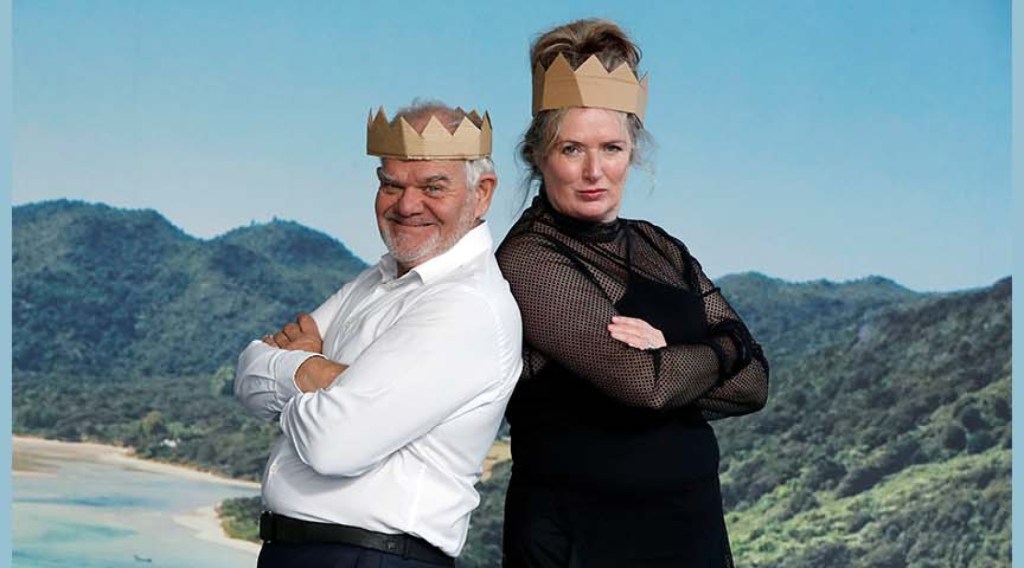
With “Witi’s Wahine” playwright Nancy Brunning has delved into the many books of Witi Ihimaera and re-presented them in a new dramatic form which shows both the richness of the authors writing and his ability to tell meaningful stories which are also fables and parables which offer insights into Māori life and culture.

As Witi and others  have noted, the meeting house is both a metaphor and a living entity representing the ancestors, the past tales, myths and aspirations of the iwi. It this concept that is at the heart of “Witi’s Wahine”. The  actors and performers both act out and share the stories and experiences of several women who we have previously encountered in Ihimaera’s fictional world but feel as though they have had a much greater impact.

They become part of the whare nui as the posts which support the structure and their tales are the tukutuku panels providing stories and metaphors.

Just as the tukutuku panels are made by weaving strands of material so the various stories which are recounted build, up a woven history of ancestors, individuals and families.

All these stories focus on the female protagonists, on the matriarchs who are healers, storytellers, keepers of children (and husbands) and truth-seekers. Māori myth and  cosmology is full of  stories of powerful women, and they have been given new life through  through the work of Ihimaera as well as female writers such as Robyn Kahukiwa and Patricia Grace.

The main actors – Pehia King, Olivia Violet Robinson-Falconer, Roimata Fox, Awhina-Rose Henare Ashby are like a group of Aunties engaged in a korero; relaxing, playing cards, remembering, guiding and instructing. They also engage with the audience as a whole as well as some individuals so we became part  of the story sharing which contributed to emotional dimensions of the work.

The stories they tell are range from the mythic tales of creation through to contemporary times and their locations range from the small East Coast town of Waituhi where Ihimaera grew up  to the  deserts of Tunisia.

Nancy Brunning has taken vignettes from several of  Ihimaera’s book as well as including the author’s first youthful piece of writing which is a reworking of the Rapunzel fairy story. The stories are drawn from his first book, Pounamu, Pounamu, Tangi, Whanau, The Matriarch and several others including The Whale Rider with its retelling of the myth of Paikea.

There was a subtle soundscape featuring the sounds  of birds, bees, whales and heartbeat along with two sets One is just the bare stage while the other a more abstract one with six openings suggestion  passage to the past and future. It is the actors who describe the settings with a minimum props and minimal action although the various dance performances are spirited and the re-enactment  of Te Kooti’s  battle and withdrawal  at Ngatapa was a  dramatic and stirring sequence.

In several scenes featuring dance and waiata that the other members of the cast – Raiha Moetara, Matawai Hanatia Winiata, Maramaria Ki-Tihirahi Moetora, and Pepi-ria Moetara-Pokai added a rich dimension to the play. The stories range over themes of birth illness, death, guilt and  discovery. Some are witty, some polemical, some tell  of myth and history most tell of the ordinary lives of delightful characters, rich lives full of humanity.

To subscribe or follow New Zealand Arts Review site – www.nzartsreview.org.

The “Follow button” at the bottom right will appearand clicking on that button  will allow you to follow that blog and all future posts will arrive on your email.

Or go to https://nzartsreview.org/blog/, Scroll down and click “Subscribe”

Categories
Reviews, News and Commentary

The magical panoramic Auckland paintings of George Baloghy

Reviewed by John Daly-Peoples

George Baloghy, Mt Eden to One Tree Hill

The magical panoramic Auckland paintings of George Baloghy

George Baloghy, Urban Pastoral

Artis Gallery

Until May 22

Reviewed by John Daly-Peoples

George Baloghy’s latest exhibition “Urban Pastoral” continues the artists interest in documenting and appreciating Auckland’s urban landscape  which his art practice has been concerned with for over fifty years.

The works in the exhibition highlight the fact that much of Auckland City is blessed with green open spaces, much of this made possible  through the protection of the city’s many volcanic cones. The paintings, like the city are dominated by these cones and green spaces such as Mt Eden, Mt Hobson, One Tree Hill/Cornwall Park and  Mt Victoria. They also highlight just how green and lush the landscape is.

George Baloghy, Mt Victoria to North Head

Not only has Baloghy a history of painting urban views he is part of a long tradition of such painters going back hundreds of years with artists such as Canaletto, Vermeer and Pissarro.

With his paintings he also follows in the footsteps of artists like the Valentine Brothers whose photographs documented early Auckland. Like those photographs they were mainly taken from the high vantage points of the city such as  Mt Eden  partly  to capture the panorama but also as with Baloghy, to avoid the encroaching trees and buildings which could compromise the views.

The paintings are all recognisable images of Auckland and focus on the contrasts between the built environment and the natural landscape as well as referencing the changes which have occurred in Auckland over the course of its history.

In “Mount Hobson to Mount Eden” ($14,000) the curve of the motorway is  a reminder of the way the motorcar has defin3ed the city as much as its topography while “Mt Eden to One Tree Hill” with the  memorial atop the hill a reference to both Māori occupation and European settlement.

One is also conscious of the architectural changes which have altered the urban landscape not only with the large building projects such as Green Lane Hospital but also the slow displacement of the older villas by newer contemporary houses.

George Baloghy, Devonport Wharf

One of the more dramatic works is “Devonport Wharf”  ($12,500) which features a panoramic  view of Mt Eden as well as an impressive  view of the Waitemata along with much boat activity on the harbour. “Mount Eden to One Tree Hill” ($14,000) is also impressive with its dramatic vista like some  sort of homage to Cezanne’s iconic views of Mt St Victoire,

The views which Baloghy has produced are almost magical, encouraging the viewer to explore the city from multiple viewpoints and even though his views are recognisable, the impression is of a city of heightened colour, sharper light, tidier and more carefully arranged – like a model of the city rather than the real one.

To subscribe or follow New Zealand Arts Review site – www.nzartsreview.org.

The “Follow button” at the bottom right will appearand clicking on that button  will allow you to follow that blog and all future posts will arrive on your email.

Or go to https://nzartsreview.org/blog/, Scroll down and click Subscribe

Categories
Reviews, News and Commentary

Celebration and reflection in NZSO’s Enduring Spirit concert

Reviewed by John Daly-Peoples

New Zealand Symphony Orchestra

Bloch & Shostakovich, Enduring Spirit

In association with The Grand by SkyCity.

Auckland Town Hall

April 29 

Reviewed by John Daly-Peoples

The renowned Scottish conductor Sir Donald Runnicles made his New Zealand Symphony Orchestra debut last week with performance in Wellington and Auckland alongside German-French cellist Nicolas Altstaedt who has not performed in New Zealand since 2015.

The Enduring Spirit programme comprised Aaron Jay Kearnis’ “Musica Celestis”, Ernest Bloch’s cello composition “Schelomo”, and Dmitri Shostakovich’s “Tenth Symphony”, all works which were celebrations of. or reflections on belief system which have inspired or distorted the lives of people.

Kearnis previously said of his work  “Musica Celestis is inspired by the medieval conception of … the singing of the angels in heaven in praise of God without end.” He also notes the influence of “the soaring work of Hildegard of Bingen”.

This debt to medieval music was apparent from the opening with floating strings suggesting the  wispy shapes of angels and throughout the work  there was the impression of  the softly beating wings of angels.

The throbbing plucked sounds of the double basses at times contrasted with the insistent strings providing something of a conversation, a debate between the good and evil angels.

But this all resolved into blissful  vistas of heaven with all its imagined  mythic creatures –  cherubim, seraphim, archangels.

Bloch’s “Schelomo” was a significant work to be played this year as it is now the seventy fifth anniversary of the founding of the modern  state of Israel, an event Bloch can only have imagined when he composed the work in 1916. The final work in his “Jewish Cycle” it builds on much Jewish heritage and the prayer which ended many important Jewish events –  “Next year in Jerusalem”,  

“Schelomo” was intended to “express the struggle of King Schelomo (called Solomon in the Bible) to resist the world’s earthly pleasures … Bloch himself described the cello as the voice of Schelomo himself, specifically expressing the sentiment held in texts from Ecclesiastes… In contrast, the orchestra represents the tempting material world, including his wives and concubines”.

Nicolas Altstaedt

The work opened with a single high note from the cello  like the voice of a Jewish cantor calling on God and cellist Nicolas Altstaedt  seemed to be  both the voice of the composer and that of the spirit of the Jew.

This was followed by troubled strings and brass which conveyed a sense of physical and spiritual oppression, distance and dislocation, and as in Kearnis’, “Musica Celestis” there were visions of angels and  prophets.

The work touched on the notion of the  individual / state confronted by oppression and tumult in a continuation of the history of the Jew and the fate of Jerusalem / Israel.

Nicolas Altstaedt  played with a distinctive detachment as though in contemplation but he produced exquisite  sounds which were like agonising pleas which dissolved into melancholic acceptance.

Shostakovich said of his  Symphony No. 10 that “I did depict Stalin …. I wrote it right after Stalin’s death, and no one has yet guessed what the Symphony is about. It’s about Stalin and the Stalin years.”

While that is certainly the case it is also a depiction of the composer himself and his reactions to living under the Soviet regime of the time.

From the opening dark mummering of the strings one was conscious of the sombre mood which pervades the work and throughout  the symphony there are themes which represent the composer and Stalin and what might be the voice of Mother Russia.   

The composer is represented by a  more pensive  theme and that of Mother Russia looking back to pre-revolutionary times featured a feminine motif rendered by woodwind which conjured up images of Russian landscape. In the third movement there was also an enigmatic slow march which also seemed to hark back to a time of Russian folklore.

Sir Donald Runnicles

The second movement with its reckless martial sounds directed by the agitated Runnicles was an obvious portrait of the dictator and the regime. There was also an undercurrent of dark strings appearing throughout the work. 

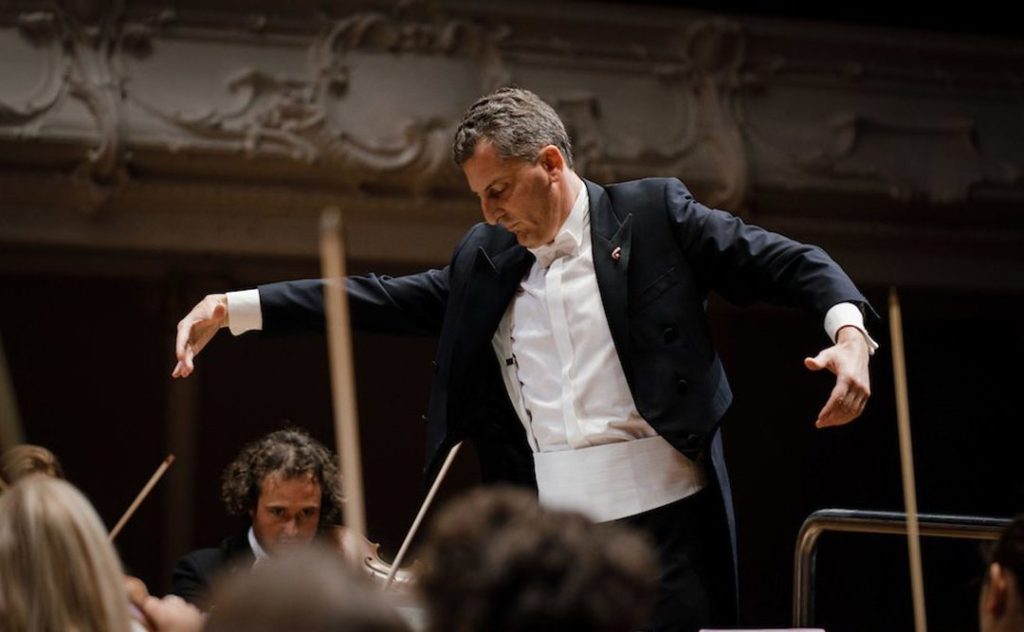
At all times Runnicles controlled the orchestra with a supreme confidence. In the first movement he impressed with his grand gestures and his body at times wrestling with the music while at other times he was moving to the dance-like sounds.  He also showed great skill in moderating the volume taking the music from the  riotous through to barely a  whisper.

In the  last movement the various instruments saw moments of joy as well as a hectic battle between the sections of the orchestra leading to a final cacophony of sound.

To subscribe or follow New Zealand Arts Review site – www.nzartsreview.org.

The “Follow button” at the bottom right will appearand clicking on that button  will allow you to follow that blog and all future posts will arrive on your email.

Or go to https://nzartsreview.org/blog/, Scroll down and click “Subscribe”

Categories
Reviews, News and Commentary

Stage of Being: dance addressing contemporary issues

Reviewed by John Daly-Peoples

Stage of Being

The New Zealand Dance Company

ASB Waterfront Theatre

April 22

Reviewed by John Daly-Peoples

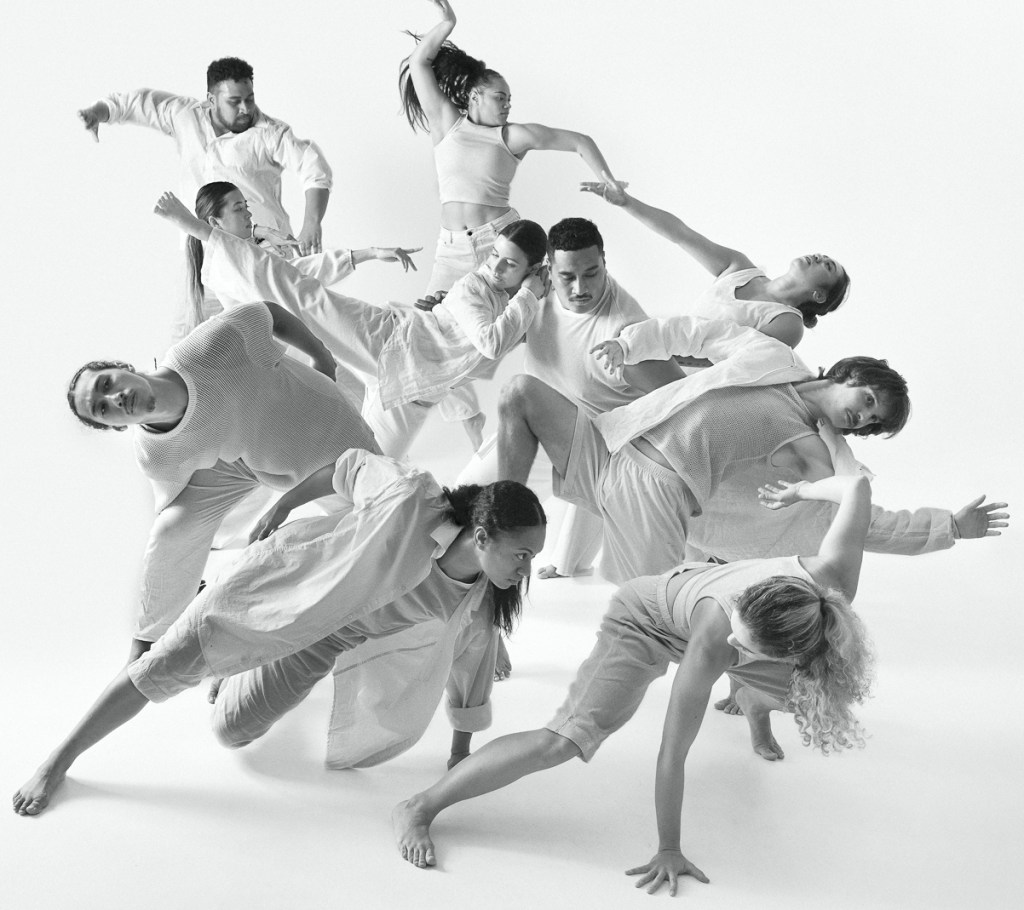
The New Zealand Dance Company’s “Stage of Being” featured two dystopian works in which we encounter worlds where there is displacement, division and oppression.

“LittleBits and AddOns” by choreographer Tupua Tigafua and “Made in Them” by Xiao Chao Wen and Xin Ji  are fine example of dance addressing contemporary issues.

In “LittleBits and AddOns” the dancers are involved in changing and evolving interactions. Figures enter and leave, collect object, remove them, return and rearrange. The dancers by turns perform in a casual manner, robotically or with bird-like characteristics. These purposeful  movements contrasted with some more expressive and expansive movements. The anthropomorphic aspect of the dance seem to have connections with Laura Jean  McKay’s Book “The Animals in that Country” in confronting the notion of  inhabiting the consciousnesses of others. 

The  “birds” dance with avian-like gestures, movement and sounds and at one point provide themselves with hand shimmering plumage.

The various vignettes, each simple in themselves, build a surreal fable or metaphor about the connections between the animal and human worlds. This aspect is also highlighted by various figures who are contained or captured within capes or sacks.

In both these works the soundscape is  a dominant feature exerting a powerful force on both dancers and audience. In “LittleBits and AddOns” composer David Long combined deep sonic sounds, traditional guitar, French baroque music and eloquent silences to great effect.

As well as being animated by the music the dancers responded to a disembodied voice which offered commands and instructions. At a couple of points, the dancers also contemplated the projected image of the “Windows” symbol as though acknowledging another dimension and influence.

“Made in Them” was  a much more dramatic work with a dense, electronic soundscape designed by Benny Jennings. Where “LittleBits and AddOns” began with silence “Made in Them” opened with a dramatic bang accompanied by a huge set of light on a boom which was lowered, redefining the enclosed theatre space.

We are immediately in an otherworldly environment which is further emphasised by the appearance of figures wearing globular black masks like some alien creatures.

The lights continued to flicker through much of the work accompanied by pulsing electronic sounds to which the dancers respond, buffeted, twisting, and weaving with convoluted movements along with frantic gasps of breath.

There was much emphasis on weight and tension, action and reaction, intimacy and distance, the dancers continually in movement. In one sequence two bodies were intertwined in a mix of wrestling and sexual coupling.

There were also many sequences where the black helmeted figures act in a robotic manner, the light reflected on their helmets making them look like overgrown insects. Their taut  marching style and their sharp limb movements were like some form of semaphore signalling and conveyed a sense of aggression and coldness reinforced by regular disembodied announcement to the  “Dear Passenger”.

The two works build on earlier dance works such as “The Rite of Spring”, particularly  the more recent version by Pina Bausch where the emphasis is on the notion of ritual.

To subscribe or follow New Zealand Arts Review site – www.nzartsreview.org.

The “Follow button” at the bottom right will appearand clicking on that button  will allow you to follow that blog and all future posts will arrive on your email.

Or go to https://nzartsreview.org/blog/, Scroll down and click “Subscribe”.

Categories
Reviews, News and Commentary

New APO conductor explores “City of Dreams”

Reviewed by John Daly-Peoples

Shiyeon Sung

City of Dreams

Auckland Philharmonia

Conductor, Shiyeon Sung

Auckland Town Hall

April 20

Reviewed by John Daly-Peoples

The APO’s latest concert “City of Dreams” was significant for  a number of reasons, notably that this was the first appearance  of Shiyeon Sung who is now the Principal Guest conductor with the orchestra. This appointment  Along with that of Gemma New, as the Principal Conductor of the NZSO makes New Zealand a leader in promoting female conductors.

Shiyeon Sung made her first appearance with the orchestra just on a year ago when she conducted the first concert in the Auckland Town Hall for an audience  of two hundred as we were coming out of Covid 19 restrictions.

The “City of Dreams” concert opened with Beethoven’s “Coriolan Overture” which was originally written for a play by the Austrian dramatist Heinrich von Collin’s and follows much the same plot line as Shakespeare’s “Coriolanus” where the titular hero has to choose between an attack on the Roman Empire and acceding to his mother’s plea to desist and seek peace.

These two aspects are represented by two musical ideas which are at heart of the work and Sung ensured that the contrasts between percussive onslaughts and agitated strings served to highlight the conflicted drama of the work.

The intensity of the work was emphasised by the dramatic flourishes of Sung’s conducting as she shaped the music with elegant hand gestures and at other times seemed to exude an electrical force directed at the orchestra.

Following the Beethoven, the seventeen-year-old Korean cellist Jaemin Han  performed  Haydn’s Cello Concerto No1. It’s a work which allows the soloist to display their technical ability, an understanding of the music’s complexity along with exposing the works emotional  core.

Jaemin Han

Han’s performance was one that would be expected of a musician many years older. He played with an assurance and intensity which was riveting and much of the time he appeared to in a sort of reverie searching for inspiration.

The contrast between the gentle flow of the orchestra reading of the Baroque music and the cellist’s fervent playing was a true highlight. At time Han attacked his cello with an intense ferocity while at other time he was thoughtful, engrossed in the detail  of the music with a whispered contemplation.

Haydn has never sounded so modern with Han displaying not only a technical mastery but finding a sensuousness and an ecstatic energy in the music.

After interval and an outstanding Bach cello piece by Han the orchestra offered two twentieth century works.

The first was the short ”Dance in the Old Style by Erich Korngold which foreshadows the composers “Die Tote Stadt (The Dead City) which the APO will perform in July.

The work written by the composer when he was in his early twenties reveals much of the lyricism which was to be found twenty years later when he was a composer for Hollywood films.

His graceful inventive approach combining aspects of early minuets, late nineteenth century romanticism with traces of modernism was thoughtfully delivered by the orchestra.

The final piece on the program was a symphonic version of Paul Hindemith’s opera “Mathis der Maler”.

The work was an exploration of the clash between artists’ responsibility to their art and to the social and political issues of their time, which he based on the life of the 16th-century painter Matthias Grünewald, the  religious wars of the 16th century  and  the creation of Grunewald’s masterpiece, The Isenheim Altarpiece.

The Isenheim Altarpiece

Like the altarpiece the work is, musically epic with a sense of narrative  and full of  energy. In the first movement the edgy horns and the lyrical strings created a tautness which was also seen in the conducting of Sung with her crisp hand directions and sharp finger pointing reinforcing the drama.

The brass which was heavily used throughout the work ranged from the burnished to the silky and  Sung  blended the various orchestral sections together to get perfect balance of sounds

After the dynamic opening movement the short second movement had an otherworldly or visionary sense. This was followed by the lengthy final movement with its denser darker sounds tinged with a savagery which seems relevant both to the time of Gruenwald and the Hindemith’s time in Nazi Germany when the work was written. Sung brilliantly negotiated the various mood and tempo changes, building tensions through to the  turbulent finale.

To subscribe or follow New Zealand Arts Review site – www.nzartsreview.org.

The “Follow button” at the bottom right will appearand clicking on that button  will allow you to follow that blog and all future posts will arrive on your email.

Or go to https://nzartsreview.org/blog/, Scroll down and click “Subscribe”.

Categories
Reviews, News and Commentary

An AI review of an AI exhibition

John Daly-Peoples

Gryffin Cook, Listen

Gryffin Cook, Moonshot

Scott Lawrie Gallery

Until April 29

Reviewed by John Daly-Peoples and Listen

Gryffin Cook’s Moonshot exhibition is described as navigating the conflict between the promise and threat of new technology. The works  explores virtual worlds, currencies, blockchains, simulations, and artificial intelligence to make sense of our current inflexion point between technology, art and culture.

Virtual realities, Artificial Intelligence, Web 3.0, Cryptocurrencies and Non-fungible tokens (NFTs) represent an emerging way of life ‘augmented’ by digital technology. This new model envisions a techno-utopia that transcends traditional hegemonic structures, makes us more connected as a species and accesses virtual worlds of infinite possibilities. 

This reviewer developed this AI review making use of one of Cook’s interactive works to provide a critical response to the work itself.

The work, Listen ($1750) allows the viewer to speak to it and as one speaks voltage fluctuations from microphone are processed as fragments which appear on a screen. If it is asked a question and the algorithm is confident it has heard something the sentence is sent to a language model (GPT 3.5_turbo) with modified system parameters and a response is printed on the screen. The work is a diagram of itself, wires tracing a map between the constellation of interconnected components. In real time data is translated, transported, fragmented, deconstructed, reconstructed and mistranslated.

The work was asked to describe its own work.

“Gryffin Cook’s work invites the viewer to explore themes of identity, history, and resistance through bold compositions and smart juxtapositions. Visually captivating and emotionally resonant, Cook’s pieces resist easy categorization, eliding convention to praise daring explorations to blazing mastheads of feeling and surprise.
Combs and contrasts create instinctual relationships at the core of the artist’s provocative questioning of widely embraced cultural values. Through painting bucolic forests dotted with lively birds, colorful trees whose jacquardally stylized shall flourishes throughout painted grounds installed on sculpture, stages of memory.” 

The asked if there was an emotional content to the work?

“Imagine entering an unfamiliar neighborhood and coming across a brightly painted mural of expert slicing and sauteeing the vibrant hypnotic gears clicking through cooking conglomerates falling skillfully, swimming waves creating flavorful meals afterwards guiding through this unknown realm like Piet Parra’s food cartoon action activated vistas made for passante conversations astonished to add graffiti depths enveloping expert sculptures. Finally reaching Pastels mooncheese style cover roasted cold walls grasping controlled digest forged framework glyphs run. Essentially, art unfolds experiences this colorful imagery promotes. “

And then asked if the work created its own content?

“Art generates its own language system and network that seeks to communicate its subjective image and ideas without the use of words. An artwork creates substantive statements and lures amazing narratives representations significant experience sculptural cathedras phenomenological prompts without means of causal talks.”

Another work in the show Ownership Machine ($1750) has a screen featuring the image of a SOLD work in a homage to Billy Apple’s SOLD works. The work is the receipt of transaction and is owned by the holder of the non-fungible token ‘Obsession of Pure Ownership’ on the Tezos Blockchain. 

Gryffin Cook, Ownership Machine

To subscribe or follow New Zealand Arts Review site – www.nzartsreview.org.

The “Follow button” at the bottom right will appearand clicking on that button  will allow you to follow that blog and all future posts will arrive on your email.

Or go to https://nzartsreview.org/blog/, Scroll down and click “Subscribe”

Categories
Reviews, News and Commentary

Wherefore Art Thou Isis ?

Review by Malcolm Calder

The Golden Ass by Lucius Apuleius

Adapted & Written by Michael Hurst
Additional Text by Fiona Samuel 
Music & Original Direction by John Gibson
Set Design by John Verryt

Q Theatre Loft, Until 15 April

Then Artworks Theatre, Waiheke Island, 28-29 April

Then Dolphin Theatre, Onehunga, 5-6 May

Reviewed by Malcolm Calder

I had no idea that Michael Hurst was alive nearly 2,000 years ago nor that he was a close mate of Roman philosopher, writer and orator Lucius Apuleius.  And I had no idea that Lucius Apuleius still lives on nearly 2,000 years later nor that he is a close mate of Kiwi writer and actor Michael Hurst. 

This a simple story that totally transported me for, in this compelling production, the two become one.

Frontispiece from The Works of Apuleius: a portrait of Apuleius flanked by Pamphile changing into an owl and the Golden Ass.

Now nearing the end of a national tour, much of it under the auspices of Arts on Tour, The Golden Ass is something that gives theatre a good name.  After being blown away by the technical wizardry of Sydney Theatre Company’s Dorian Gray,this production brought me back to ground with a resounding thud and reminded me that good theatre can actually be quite simple.   

Sure, having an outstanding actor like Michael Hurst makes a big difference but, to reprise an oft-told refrain, telling a simple story and telling it well is what makes good theatre.     When that actor merges and ‘becomes’ the original creator in the eyes of the audience, it is truly compelling.  Yes, The Golden Ass is funny (hilariously so at times), yes it is contemporised (also hilariously at times) and yes, it is something you should not miss.

Also known as Metamorphoses, this satire on life, society and beliefs was originally written by Lucius Apuleius, about 150CE and is acknowledged as the only remaining Latin novel of its time.  Although widely-travelled, schooled in Greek philosophy and staunchly Roman, Apuleius was actually born in what is now northern Africa and penned the work near what is today known as Tripoli.

His tale recounts the ludicrous adventures of one highly-libidinous Lucius, who experiments with magic before eventually and accidentally being turned into an ass.  In this guise, he hears and sees many unusual things, until escaping from his predicament in a rather unexpected way.   The work was probably never autobiographical, but apparently included many references that weren’t too far removed from Apuleius’ own interests and experiences.  And the man knew what was a ripping good yarn nonetheless.

I also suspect Apuleius’ original took several days to relate whereas Hurst’s 21st century interpretation scales it down to a more manageable 80 minutes that simply flew by for me.   Most importantly, it brings things neatly up to date without losing any of Apuleius’ salacious gusto.  Nor is it without serious commentary and observation, tossing out many contemporary references along the way – sometimes almost as ad libs and asides.

Perhaps most aptly, Hurst’s journey with this work echoes the ways of the old travelling theatrical showman – performing in many and varied settings as he moves around the countryside and always ensuring that he hits the spot with his audience.  I regret being unable to introduce him to my own late grandfather – a travelling and bawdy poet, who worked the pubs and halls of Taranaki in a similar fashion during the Great Depression.

Verdict?  This one is a memorable goody.