Categories
Reviews, News and Commentary

King Lear. The eyes have it

Reviewed by Malcolm Calder

Goneril (Andi Crown), Lear (Michael Hurst) and Gloucester (Cameron Rhodes) Image Jinki Cambronero

King Lear

By William Shakespeare

Director – Michael Hurst

Co-director – Benjamin Kilby-Henson

Set Design – John Verryt

Lighting Design – Vanda Karolczak

Costume Design – Elizabeth Whiting

Composer and Sound design – John Gibson

An Auckland Theatre Company production

ASB Waterfront Theatre

Until July 9

Reviewed by Malcolm Calder

Oh what a joy to see a well produced Shakespeare on an Auckland stage.  And an aptly-chosen tragedy at that.

Pre-show, someone confessed they had never actually seen King Lear and what was all about.  Blindness, I replied rather elliptically, with a throwaway line that rather a lot of completely dead bodies were likely to wind up littering the stage. 

What I avoided was the follow-up question – why.  And what I witnessed on Opening Night provided Mr Hurst’s answer.

His King Lear has a timelessness.  At a superficial level Shakespeare’s words are of an ageing king who has accomplished quite a few things in his time.  However, he is growing older, as one does, and considering what to bequeath to which of his daughters and supporters.  But he is blind to their shortcomings, is wilfully ignorant of change that is taking place all around him and completely unaware of the rate at which that change is happening.  In a sort of non-specific modern setting this production remains true to Shakespeare but, at a deeper level, creates an interpretation that is just as valid an observation of today’s contemporary world. That is what makes any play great.

Whether in a traditional or contemporary world this Lear has a smug sense of achievement, of entitlement and of hubris even.  Through it all he remains ignorant of the plotting and the scheming behind his back.  He neither sees nor hears the groundswell of those who are missing out and the rise of greed amongst the many.  His long-held vision of himself is of a once-great king that is sadly out of touch.  This limited vision simply expects things of others and when his assumptions start to go awry, then confusion, disbelief and self-castigation drive him off his rocker.   It is a descent from which he can never recover.

And that gets us rather neatly back to those eyes.  What they can see – or not – and, more specifically, what the mind makes of what they perceive. 

However, this King Lear is also about far more than an old bloke divvying up a realm.  It is really a parable about the world we live in today.  Some might even say that it’s about the end of an age or the end of a generation or, if we’re feeling particularly miserable, even about the end of the world as we have known it.

While some boomers are still hanging on by their fingertips to what they know and hold dear, their footsteps are being dogged by successive generations who have never lived a life without Wikipedia in the palm of the hand; where rising standards of living have made for a ‘must-have’ mentality that edges ever-closer to greed; where war and serious economic hardships have simply never existed; where sexual roles and affiliations have become blurred; where inter-marriage (or more correctly inter-breeding) is slowly blurring ethnic divides; where the seven-second media grab has become a distillation of complex economic policy; and, most importantly, where shouting or ridiculing, rather than listening, have become an increasingly normal means of social interaction.  Arguably, with an election looming this process of change, acceptance and the way ahead is becoming even more acute for when truth is banished, people become blind.

Edmund (Beatriz Romilly) Image Jinki Cambronero

It might be argued that cross-casting three roles in this production serves to reinforce the element of ‘change’ but that had very little to do with the ‘gender twisting’ in this production.  It sat very easily with me.  That Gloucester (Cameron Rhodes) should have an illegitimate daughter rather than a bastard son (Edmund – Beatriz Romilly) was of little moment.  Even when their relationship was falling apart, these two generated some delightful interaction with the strength of Gloucester being unexpectedly matched by that of his progeny.  But Gloucester too is blind to the tension between Edgar and Edmund and he too will join the ranks of those who did not see and did not perceive.

Similarly, Lear’s Fool (Hester Ullyart) adds and arguably enhances the slightly distanced voice of reason that she carries throughout the play.   Jennifer Ward-Lealand was of course simply outstanding as the Duchess of Kent.  And an amazing ability to modify her vocal range as the alter ego Caius only served to further reinforce her role as one of our country’s finest actors.

Hurst himself is incomparable in the role of Lear.

Goneril (Andi Crown) and Regan (Jessie Lawrence) Lear’s older daughters somehow echoed with me as being escapees from one of those dreadful TV series usually entitled ‘the Real Bossy Housewives of wherever’ with their spouses following meekly behind.  While looking stunning.  Yes, to complete my analogy from above – they had the aura of being spoiled, corrupt and living off their parent’s wealth. Hannah Tayeb (Cordelia) looked and sounded very meek and young in comparison.

Edgar (Joe Dekkers-Reihana) grew into his pivotal role as a considered voice of understanding, compassion and tolerance.  Perhaps his voice was the voice of the future.

As expected, the highlight of this production was undoubtedly the storm or madness scene.  It came a little quickly for me as I felt that Lear suddenly ‘flipped’ instead of showing us a more gradual disintegration into madness.  But once there Hurst’s madness was unforgettable.  Water on a stage was once unthinkable.  Here, it is flung about with great abandon, sprinkling those sitting in the front row and mixing with sweat, tears and general mayhem.  One can imagine interval being a busy time in the dressing rooms.

This is a relatively high-tech show enhanced by its white brilliance, moving to near darkness of occasions and also showed off the intricacies of John Verryt’s design.  His mirrored wall serving its several purposes and echoing those audience faces that are bleacher-seated upstage in the traverse position, while becoming a storm scene when called for.  Vanda Karolczak’s moody, sensitive lighting as atmospheric and the whole was further enhanced with Elizabeth Whiting’s timeless costuming and the creative soundscape of John Gibson.

Lear is not the easiest of Shakespeare’s plays and has not been done on this scale in New Zealand for some years.  The late David McPhail gave Christchurch’s Court Theatre a Lear about 15 years ago but even when the Pop-up Globe was still doing wall-to-wall Shakespeare it shied away from the tragedies – especially where eyes are put out and dead bodies are everywhere.  Either way congratulations to Jonathan Bielski for convincing Michael Hurst to put together what can only be regarded as one of his finest accomplishments.

To subscribe or follow New Zealand Arts Review site – www.nzartsreview.org.

The “Follow button” at the bottom right will appearand clicking on that button will allow you to follow that blog and all future posts will arrive on your email.

Or go to https://nzartsreview.org/blog/, Scroll down and click “Subscribe”

Categories
Reviews, News and Commentary

Paradise Rumour: Awesome in the Extreme

Reviewed by Malcolm Calder

Paradise Rumour

A Black Grace Production

Director and Choreograher – Neil Ieremia, ONZM

Composer – Faiumu Matthew Salapu aka Anonymouz

Lighting Designer – JAX Messenger

Costume Design – Tina Thomas

Makeup Design – Kiekie Stanners

Performers – Demi-Jo Manalo, Rodney Tyrell, Fuaao Tutulu Faith Schuster, Vincent Farane, Sione Fataua, Leki Jackson-Bourke

Sky City Theatre, Auckland

June 7

Reviewed by Malcolm Calder

Every so often I feel extraordinarily privileged to see something that stuns me to silence and ultimately exhaustion. That’s what happened when I saw Neil Ieremia’s latest work Paradise Rumour tonight.

Here is an international voice creating something truly international.

Commissioned by the Sharjah Art Foundation and premiered at its recent 15th Biennial, Paradise Rumour was conceived to meet the Foundation’s 2023 theme “Thinking Historically in the Present”.  And that is precisely what Neil Ieremia has produced.

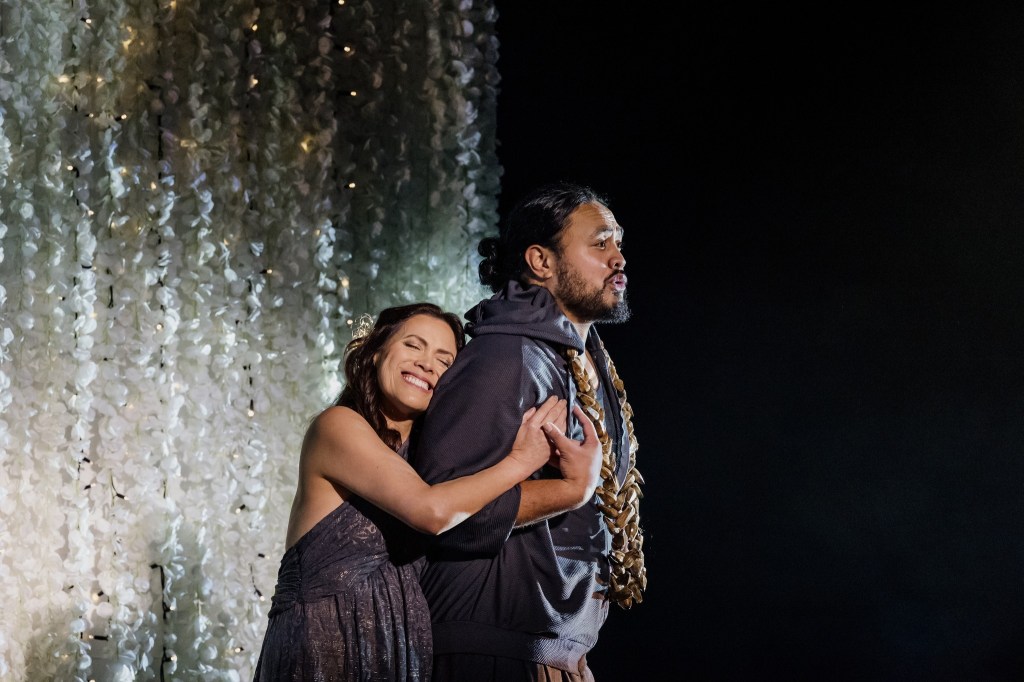
Using threads from his earlier Gathering Clouds (2009), Ieremia has addressed the plight of early Pacific migrants to Aotearoa.  He considers and references the past (traditions, dreams and aspirations) and contrasts them with the present (unattainable shiny things) and revealed where they have got to.   Which is everywhere and nowhere.

But, while starting out before even the arrival of missionaries and the impact of faith on traditional Samoan culture and values, the allusions of Paradise Rumour turn simple story-telling on its head, looking both backward and forward simultaneously, blurring individual and collective memory, and ensuring internal and external hopes merge with triumphs, prejudices, joy and values that don’t gel at all. That terrifying knock on the door at 5am was real for many and contrasts with the glittery things coveted by many that were not.

But it is a multi-layered world we live in today and while Paradise Rumour is firmly rooted in its Samoan origins, it is delivered using a language that is multi-layered for world consumption.  Not only does it have an international breadth, it represents a mature and sophisticated Pacific voice that has the capability to looking outward and inward simultaneously.  At an even more subtle level that voice is quite confident of occasionally merging tradition with modernity, complexity with simplicity, enlightenment with disappointment and humour with sadness.

Faiumu Matthew Salapu’s soundscape is both intimate at times and sweeping at others, engaging audiences with a broad range of musical genres, from Bach and Vivaldi to Samoan hip hop to the more electropop stylings of Lorde.   It completes the marriage with other design elements.

This a stunning production.

Categories
Reviews, News and Commentary

Incidents can be Fleeting but Influence History Forever

Malcolm Calder

Finley Hughes and Patrick Tafa in The Haka Party Incident

The Haka Party Incident

Writer & Director – Katie Wolfe

Kaiako Kapa Haka/ Kaitito Haka – Nīkau Balme

Sound Design& Musical Direction – Kingsley Spargo

Taonga Pūoro – Whetu Silver

Set Design – John Verryt

Lighting Design – Jo Kilgour

Costume Design – Alison Reid

Performers – Roimata Fox, Nī Dekkers-Reihana, Lauren Gibson, Aidan O’Malley, Patrick Tafa, Kauri Williams, Finley Hughes

A Tasman Ray Production

Te Pou Theatre, Henderson

Until June 11

Then touring nationally

Reviewed by Malcolm Calder

In 1979 a group of University of Auckland engineering students rehearsing their annual tradition of a mock haka were confronted by an activist group, He Tauā, who took exception to what was cultural appropriation.  Unlike the Land March, Bastion Point or the Springbok Tour, the haka party incident played little or no part in mainstream consciousness.  It lasted only a matter of minutes, directly involved very few people and received only minimal media attention.  But the ripples it generated joined countless others in contributing to the maturation of a larger social fabric that is helping Aotearoa address institutional racism.

In a way The Haka Party Incident might be termed a fairly static theatre piece wrapped around a history lesson that contributes to this far bigger New Zealand social fabric.

Katie Wolfe uses what is known as ‘verbatim theatre’, something akin to a documentary form that captures reality.  Her script took several years to complete, involved extensive recordings and features the exact words and different recollections of both the students and the activists.  Onstage it uses what she has referred to as ‘delivered verbatim technique’ – using ear-buds that enable each actor to accurately capture the ‘umms’ and the ‘aaaahs’ of everyday speech as well as the sometimes stumbling delivery of some, and the authenticity of each.

However the words are enhanced and reinforced with the deft introduction of waiata and music that weaves its way between them.   And, although there is no formal korero as such, I also sensed echoes of this underpinning some of the interchanges.

Interspersed at various dramatic points in the narrative though are some staunch kapahaka, each delivered with the passion required to reinforce their message.  One in particular is composed by Nīkau Balme, a son of the playwright.

John Verryt has devised the simplest of sets, simply a chessboard floor on a completely open stage.  Jo Kilgour’s lighting makes no attempt to introduce any realism – it simply highlights portions of that floor for dramatic effect when required and where appropriate.

The true social fabric of any civilisation serves to underpin the records of the history books.  It is shaped by many people and multiple small things that together form and reflect opinion, become a part of any country’s social soul and serve to reinforce that larger historical timeline.

The Haka Party Incident is one of those things.  It is an important thought-provoking work and makes an important contribution to that social fabric.

The Haka Party Incident opened at the Waterfront Theatre as a co-production with Auckland Theatre Company and, after a stuttering birth due to Covid, was greeted with widespread appreciation and acclaim.  This remount precedes a national tour that includes Wellington, Rotorua, New Plymouth, Gisborne and Christchurch.

Categories
Reviews, News and Commentary

Butterfly Smokescreen: A Classic Hollywood mystery

Reviewed by Malcolm Calder

Based on true events of a Classic Hollywood mystery that has remained unsolved for almost 100 years, Butterfly Smokescreen is the latest production from award-winning immersive theatre company The Barden Party, in collaboration with Sydney-based Jetpack Theatre.

Ann Orman Photography

Butterfly Smokescreen

Concept by Laura Irish and Jim Fishwick

Development by Laura Irish, Caleb James, Ollie Howlett, Jim Fishwick and Kirsty McGuire

Music by Ollie Howlett

Featuring: Wiremu Tuhiwai, Ollie Howlett, Laura Irish, Caleb James, Matt Bruce, Kirsty McGuire, Julia Guthrey, Sam McIlroy and Mackenzie Gardner

Costuming by Liss Spratt, Innit Creative

Images and Content: Jonny Eagle, Innit Creative

The Barden Party/ Jetpack Theatre

Sea Breeze III, Eastern Viaduct, Auckland

Until 3 August, 2023

Reviewed by Malcolm Calder

An Immersion – No, not in the water

“An intimate immersive theatrical experience on a superyacht” read the invitation.  “Sounds good” I thought.  But I failed to read the fine print.  “Come dressed for a 1924 party”, it read. I wish I had.

I was welcomed aboard with a glass of bubbles, given some very clear shipboard instructions about moving around the ship and my own health and safety and then joined about 30 or 40 others aboard Aotearoa’s largest capacity superyacht where there was a party going on.  Introductions abounded.

However a 100-year time-shift had somehow taken place and the year was now 1924.  The silent film industry was in its heyday, prohibition was making parties like this the domain of the superrich and famed Hollywood producer Thomas H Ince (“Hi, I’m Thomas, better known as the Father of the Western, and you are … ?”) had been invited aboard the prized yacht of newspaper tycoon and the most powerful man in Los Angeles, William Randolph Hearst for the weekend (”Hi, I’m WR, welcome aboard”).

WR is hosting this party because it is Ince’s 44th birthday.  The party guests include film royalty (”my name is Charles –  Chaplin that is – and this gorgeous creature is Marion Davies.  You are … ?”).  There was champagne everywhere, nibbles galore and I gradually worked out that maybe 10 of the people at this party were in fact actors.  So, and despite feeling a bit like an odd-man-odd not being in period costume, I joined in and chattered away about … well, not much really.  Mainly because everyone was so keen and eager to see what was actually going to happen.  We had no idea.

Perhaps interestingly, as we chatted amongst ourselves (maybe there were actors involved, I gave up trying to work out whether Sharron and Bob were actors or simply party-goers), faux Hollywood accents started sprouting all over the place.  Those of the actors weren’t too bad, but some of the attendees’ accents were positively egregious.  They must be contagious I thought.  Or perhaps it’s something in the champagne.  But I gave up worrying about it and just added my own voice to the egregiousness.

After about 15 minutes we were called to order and told to not utter another word, to become invisible – wraiths in fact – without getting in the way of the actors.  However we were free to go anywhere, and to look at, handle or otherwise inspect anything by way of trinkets, papers or other paraphernalia that we chanced upon.

That’s when it became apparent that maybe a quarter of the partygoers were in fact actors and the action started.

It took place over about 7 different spaces on 4 different levels (the stateroom, main cabin, galley, lounge, wheel-house, on the forward and stern decks, etc) sometimes simultaneously.  At first this all seemed very confusing because the action was spread all over the boat and I had no idea where to look next.  Not did anyone else.  But at least I stopped talking and completely forgot about my dreadful accent.

As I moved up and down gangways and listened closely, there seemed to be discussion and/or arguments going on about scandals, castings, payments, investment returns, furtive gropings and even seductions, contracts being read, ripped up and re-written, etc.  All by different characters and all in different places.  Oh yes, I distinctly recall seeing quite a lot of skin at one stage too – must have been on the bed in the main cabin – quite appropriately, I vaguely recall seeing an R18 sign on something at entry.   However a pattern to the shenanigans gradually emerged or at least I thought so.

Ultimately, in true murder-mystery fashion, there is a death. But I have faithfully promised to not reveal who, what, how or why.  That is up to the audience.  You.  Suffice to say the ‘pattern’ I thought I had perceived was utterly and completely wrong.

Based on true events of a Classic Hollywood mystery that has remained unsolved for almost 100 years, Butterfly Smokescreen is the latest production from award-winning immersive theatre company The Barden Party, in collaboration with Sydney-based Jetpack Theatre.

Sea Breeze III was formerly owned by billionaire Graeme Hart and is now the pride and joy of Charlotte Devereux who painstakingly refurbished the 1976 super yacht in an authentic and stunning art deco style with her partner Simon Greenwood.

It is the perfect venue for this boutique and limited affair and is ideally suited to party groups.  As befits the surrounds, it’s not cheap though.  So if you have a big bash  night out planned, then this one is for you.

Tickets   www.boutiquesuperyachts.com

To subscribe or follow New Zealand Arts Review site – www.nzartsreview.org.

The “Follow button” at the bottom right will appearand clicking on that button  will allow you to follow that blog and all future posts will arrive on your email.

Or go to https://nzartsreview.org/blog/, Scroll down and click “Subscribe”

Categories
Reviews, News and Commentary

Soundings: vivid, entertaining and instructive encounters with the underwater world

Reviewed by John Daly-Peoples

Soundings

Diving for stories in the beckoning sea

Kennedy Warne

Massey University Press

RRP $39.95

Reviewed by John Daly-Peoples

It seems that it is only in the last fifty years that we have taken a new approach to  the ocean and our fisheries. Only a few years ago the seas were regarded as the source of endless bounty but now  we realise that there needs to be more careful management and in many cases, preservation of our  fisheries and endangered species.

This move to understanding the blue planet has been championed by individuals such as  Sir David Attenborough but there are also many New  Zealanders such as Kennedy Warne who are bringing a new understanding to the oceans both here and internationally.

Warne is probably best known in New Zealand as the co-founder and editor of NZ Geographic magazine for which he has written for over thirty years.

Internationally he is widely known for his work for National Geographic having been commissioned to write articles about his experiences diving in locations all around the world.

In his new book “Soundings” he revisits his journeys and assignments internationally and locally linking these adventures to his own life in a family which has had strong links to the sea for many generations. With all these encounters he also connects with the social, political, economic and environmental issues around the sea and it’s populations.

He visits locations in Africa, America, Canada, the Middle East, Asia, Australia and New Zealand encountering an amazing range of habitats and species.

His grandfather Leon Warne was much involved with the big game fishing boom of the 1920s having been involved with Zane Grey, the American writer and angler who published his adventures in Tales of the Angler’s Eldorado, New Zealand. With this book he did more to promote New Zealand big-game fishing than any other person.

The accounts of his assignments are informative and entertaining, sometimes they read like adventure stories while at other times more like travelogues.

He visits places that very few of us will get to experience such as The Okavango Delta. a vast inland river delta in northern Botswana which flood seasonally, becoming a lush animal habitat. Here he travels by dugout canoes to find and encounter hippos, and crocodiles. He even comes within arm’s length of a crocodile swimming underwater at night with just a torch to guide him. Here he finds the fishing spider which sits on lily pads anchored by two of its legs, using the other six to  catch small fish.

He also goes to The Magdalen Islands, a small archipelago in the Gulf of Saint Lawrence at the time of the seal hunt. This provides the opportunity for  a history of the harp seal industry and the impact of bans in reducing the wholesale slaughter of the whitecoat pups. He writes of the involvement of local Inuit,  fishermen and scientists and the need to balance the economic and ecological aspects of the trade. As well as the hunting impacts on the seal population he notes that in 1981 because of sea warming  the ice pack which normally carries the seals for the start of their lives completely broke up and all the young seals died.

In the Philippines he observes the tourism encounter with the whale shark where tourists hang off the sides of outriggers to take selfies of themselves and the sharks which turn up each day because they are fed by the local fishermen to create a feeding frenzy. It’s a much easier occupation than catching fish and has created a new industry for the local village. But, Warne points out this is changing  the dietary and migratory habits of the fish which could well have dire consequences in the future.

He links this to his  growing love and respect  for sharks and our changing attitudes to them which have changed over the past few years from an endemic fear of the shark to an appreciation and understanding of their place in the ecosystem and the  need to see the connections between humans and  nature.

His descriptions are vivid, entertaining and instructive. With all these assignments he provides histories of the area, descriptions of the  the local fisheries and the many threats to the ecosystems. He also speaks with experts in a variety of specialist areas who help bring an understanding to the complex underwater world.

His descriptions of his encounters can be poetic at times as when he writes about  Deep Water Cove, in the Bay of Islands

“In 2010, dismayed by the disappearance of marine life, two of the local hapū placed a traditional rāhui — a temporary fishing closure — on Deep Water Cove and the wider Maunganui Bay. Fishing was banned until stocks recovered. The rāhui has stayed in place, renewed every two years,

The rāhui has revitalised the reef. White Reef should now be called Golden Reef, because it is covered in the waving gold, mustard and brown blades of a variety of kelps and other seaweeds. Through the underwater forest swim demoiselles, scarlet pigfish, black angelfish, striped red moki, snapper, eagle rays and pigment-daubed Sandagers wrasse, patterned like a Kandinsky painting. Above the forest float dozens of comb jellyfish, translucent oval animals that show flecks of jewelled colour when they catch the sunlight. I watch four leatherjackets, a type of triggerfish, peck at one jellyfish, reducing the frail creature to strands of jelly. Yellow-tailed kingfish patrol the perimeter, occasionally darting into the kelp to hunt bait fish.”

Kennedy Warne, co-founder of New Zealand Geographic magazine and contributor to National Geographic, often writes about the sea, including the book Let Them Eat Shrimp: The Tragic Disappearance of the Rainforests of the Sea. His most recent books, however, are land-based: Tuhoe: Portrait of a Nation and View From the Road, a collaboration with photographer Arno Gasteiger. He has also produced two children’s books with Northland illustrator Heather Hunt: Cuckoo and the Warbler and It’s My Egg (and you can’t have it!). Once a fortnight Warne speaks about the outdoors, nature and adventure on RNZ’s morning programme, Nine to Noon, in a slot entitled ‘Off the Beaten Track’.

Categories
Reviews, News and Commentary

Cosi Fan Tutte: A triumvirate of creative talent guiding six outstanding voices 

Reviewed by John Daly-Peoples

Jonathan Abernethy (Ferrando), Hanna Hipp (Dorabella), Emma Pearson (Fiordiligi) and Julien Van Mellaerts (Guglielmo) Credit Jinki Cambronero

Cosi Fan Tutte

By Wolfgang Amadeus Mozart

NZ Opera

Aotea Centre

May 31 – June 4

Then Wellington (June 14 – 18) and Christchurch (June 28 – July 2)

Reviewed by John Daly-Peoples

Cosi Fan Tutte is not the most perfect of Mozart’s operas but with NZ Opera’s latest offering the creative  triumvirate of director Lindy Hume, designer Tracey Grant Lord and conductor Natalie Murray Beale  have expertly guided six outstanding voices in a lively farce.

The opera tells of two friends who take a bet with the cynical “old philosopher” Don Alfonso that they would be able to cheat on their girlfriends with ease. They disguise themselves, woo each other’s fiancée and ultimately marry them.

The work reveals historic and contemporary attitudes to love, fidelity and relationships while the mix of comic and serious music makes for a multi-layered depiction of chaotic interpersonal relationships. It juxtaposes notions of true love and fidelity, betrayal and manipulation, farce and genuine human emotion in a mosaic woven together by the composer’s magnificent music.

There are however elements of political incorrectness which can be seen as troubling, starting with the title “All Women are like that” and even librettist Da Ponte’s alternative title “The School for Lovers” could be seen as problematic.

The aspects of misogyny are not reserved to Cosi and can be found in most of Mozart’s operas and in many of the theatrical and literary works of the eighteenth-century including novels such as Fielding’s “Tom Jones” and the thread can be traced back to earlier authors such as Boccaccio.

Early on in the work  the “old philosopher” Don Alfonso makes an observation about women,

Woman’s constancy
Is like the Arabian Phoenix;
Everyone swears it exists,
But no one knows where.

Then, later on, the more  enlightened and cynical bar manager, Despina provides a more pragmatic observation when she sings.

To hope for faithfulness

in men, in soldiers?

Don’t let people hear you, for heaven’s sake!

All men are made of the same stuff;

Lying tears, false looks,

deceitful voices, lying charms – 

these are their outstanding qualities.

There is an ambiguity throughout the work with not only the actions and the text but also the music which ranges from the comic to the serious and all the characters adopt disguises of  some sort.

Director Lindy Hume has attempted to give the work something of a feminist take but ultimately as she says “the work is about four flawed individuals who detach from their dependencies, lose their innocence, give in to sexual desire and have their fragile certainty smashed, but who paradoxically gain far more along the way. Self-knowledge is not the lesson that the cynic Don Alfonso is teaching. Rather it’s a hard-won, bittersweet wisdom to which we as humans aspire.”

Tracey Grant Lord’s modernist set of bar, terrace and lounge functions well but the  notion of the set as a metaphor for the crumbling relationship  mirrored in the  collapsing set is never fully resolved.

The singing of the entire cast was excellent. Emma Pearson was a glorious Fiordiligi, her voice quivering with outrage when first confronted by (the disguised) Ferrando. Later as she reacts to his advances her voice and manner became tense,  expressing a mixture of sadness and wonder before a transformation into passionate longing.

Hannah Hipp’s Dorabella displayed a more physical and urgent demeanor and her robust and mercurial voice contrasted well with Pearson’s nuanced performance.

Both Jonathan Abernethy (Ferrando) and Julien Van Mellaerts (Guglielmo) gave fine comic performances, particularly once they had taken on their disguises.

Abernethy was also able to give an intense display of wretchedness on realizing that Dorabella had been unfaithful while Van Mellaerts rich baritone served him well in his arias with Hipp.

Andrew Foster-Williams gave his Don Alfonso a standout performance with an animated voice. He was the arch manipulator inhabiting roles within the narrative as well directing the characters and events. At times it seemed that he was the conductor of the orchestra, and he was particularly ingenious in the way he summoned up the cast of departing soldiers who marched down the aisle at his command.

Despina (Georgia Jamieson Emms) in this production is changed from being a maid to the two sisters into the manager at the local bar which makes her privy to all the secrets the various characters share. Her sharp voice added expertly to several of the trios and sextets. She showed her acting skills in a nice little vignette singing to the sisters while whipping up a couple of cocktails. However, in her roles as notary and doctor she appeared to take the notions of farce a bit too far.

The APO under the direction of conductor Natalie Murray Beale gave a splendid performance making  Mozart’s music  one of the great delights of the evening.

It is unfortunate that the opening scene takes place in a  bar with a lot of drinking and for some this might be too close to reality with the impact of the recent Mama Hooch trials.

To subscribe or follow New Zealand Arts Review site – www.nzartsreview.org.

The “Follow button” at the bottom right will appearand clicking on that button will allow you to follow that blog and all future posts will arrive on your email.

Or go to https://nzartsreview.org/blog/, Scroll down and click “Subscribe”

Categories
Reviews, News and Commentary

Kinky Boots kicks off with bundles of energy

Reviewed by Malcolm Calder

Kinky Boots

Book by Harvey Fierstein

Music & Lyrics by Cyndy Lauper

Based on the original movie by Geoff Deane and Tim Firth

Director, David Adkins

Music Director, Zac Johns

Civic Theatre, Auckland until 17 June

then

The Opera House, Wellington 28 June to 17 July

Reviewed by Malcolm Calder

Last Thursday night, I dutifully packed up my oh-so-serious mindset and my increasingly jaded cynicism about recent trends towards frothy, glitzy music theatre that doesn’t actually say anything much, and took them along to the Opening Night of Kinky Boots at the Civic.  I like to think I’m fairly open-minded but that niggly little feller who lurks somewhere just behind my left ear was gently prodding me to regard Kinky Boots all as rather ho-hum.

Apparently they’ve been making shoes in Northampton for about 900 years but there seemed to be an awful lot of unsold men’s brogues lying around in the factory by the end of the twentieth.  A woman from Northampton coincidentally sitting next to me nodded and said rather knowingly “… it was mainly the cheaper, better, more fashionable Italian imports that were killing us off as the shoe capital of the world”.

The curtain went up and it was.  Pretty ho-hum.  The set was a fairly functional interpretation of the original rather tired factory, the band made the right noises and the cast sang a few songs in good workmanlike fashion.  But it was all a bit bleak. 

That is …

… until Charlie Price (Nic Kyle), the slightly depressed and highly stressed inheritor of his father’s failing shoe factory chanced on drag queen Lola (Stewart Adam McKensey) in London together with her colourful, dynamic and Angelic dance crew.  From that point on everything changed.  The shoes became boots and they were for anything but walking.

The scenes got shorter and tighter, metaphorically the lighting moved from analogue-drear to digital- crisp and Lauper’s songs became sharper and more energised.  The band became tighter and introduced some nifty key shifts, the laughs grew louder and the physical dynamism of this show shifted to another level.  As for the cast … well, the cast somehow didn’t just change gear.  They got a completely new gearbox.

Charlie and Lola saw an opportunity and took it, rapidly shifting the collapsing Price & Sons into a niche market – one for boots with outrageous heels of course – and glamorously reinventing this collapsing business.  And all would be revealed to the world at a glamorous shoe fair in Milan.

The show is ultimately powered by Stewart Adam McKensey and he is rightly billed as the star of both the Angels and the show.  His skillfully nuanced characterisation of Lola reveals an emotional depth I didn’t anticipate, superbly backed up with impressive vocal strength, impeccable comic timing and seemingly endless bundles of energy, not to mention some pretty fast footwork too.   He is unquestionably Head Angel whether in the boxing ring or in mascara and gives us a Lola who takes pride in both his profession and his life.  

Offsetting him is Charlie (Nic Kyle), the less colourful but still strong Everyman, who proves a strong foil for Lola.  His self-deprecating and even melancholic ‘Soul of a Man’ is heartfelt and reveals his own depth. 

Lola, who becomes the project’s design consultant, overcomes the prejudices of Charlie and some of his workers who aren’t quite adjusted to seeing men in frocks – or thigh-high boots for that matter.  Hardly surprising because both grew up in different worlds.  But both had overpowering fathers.  Rather than succumb to parental expectations, they each choose a new and positive way forward and learn to embrace their differences while creating a line of sturdy stilettos. Ultimately this all comes down to their friendship realised in their touching duet ‘Not My Father’s’ Son.  There’s a lesson in there somewhere.

Naomi Cohen skillfully develops Charlie’s love interest as Lauren, culminating in a hilarious rendition of ‘The History of Wrong Guys’ revealing a sharp and chaotic wit.  In fact comedy is everywhere and adds to the madcap momentum of this thoroughly enjoyable night out.  Director Adkins has clearly worked on this and his cast don’t let him down – none more so than the manly Patrick Jennings (Don) and the nerdy Jeremy Downing (George).  Both of course ultimately look brilliant in thigh-high boots.

But this show touches on a good bit more too.  Kinky Boots is about acceptance, resilience and then recognising and grasping opportunities – and doing so with joie de vivre, energy and boundless positivism.

The only thing I missed in Kinky Boots was that big, memorable song so much a feature of the genre.  There were no ‘Memories’, or ‘Can You Hear the People Sing’, or ‘Do-Re-Mi’ or ‘Maria’ or ‘Defying Gravity’.  Instead we got ‘Hold Me in Your Heart’ – Lola’s big show-stopping lament for her dying father, but I’m unlikely to remember it in ten years time.

So there you have it.  Just a minor quibble in a fun-filled plotline about a factory owner and a drag queen teaming up to save a family business by making fabulous high-heeled boots that’s about so much more, not the least being the city of Northampton itself. 

The sex really is only in the heel.  Kinky Boots is really about Olga’s Step Six – ‘you change world when you change your mind’.

Highly recommended for everyone from pre-teens to Boomers.

To subscribe or follow New Zealand Arts Review site – www.nzartsreview.org.

The “Follow button” at the bottom right will appearand clicking on that button  will allow you to follow that blog and all future posts will arrive on your email.

Or go to https://nzartsreview.org/blog/, Scroll down and click “Subscribe”

Categories
Reviews, News and Commentary

Black Grace – Rumours of Paradise, collecting memories and visions

John Daly-Peoples

Black Grace – Paradise Rumour

SkyCity Theatre

June 7

John Daly-Peoples

Later this week in Sharjah, one of the larger cities of the United Arab Emirates Black Grace will be performing a newly commissioned work at the Biennial Festival 15. Then on June 7th they will perform the same work in Auckland  at SkyCity Theatre .

The new work “Paradise Rumour” has evolved out of the choreographer Neil Ieremia’s  poem which addressed issues of colonisation, adaptation and the pressures of contemporary life.

A line from his text (see below) – “renovating my culture to fit in an apartment box” seems particularly perceptive about the way cultural forms are adapted, reimagined and made relevant.

At a recent  preview of the work four dancers performed with highly charged movements typical of Ieremia’s choreography. The dancing was stylised some of it being performed with three dancers standing one behind each other as though a living totem, At other times they moved deftly around the floor, searching and discovering.

In their totemic like stance the dancer’s arms were like semaphore signalling, a rudimentary form of communication but one which had a delicacy and an urgency.

Neil Ieremia says, “Paradise Rumour is an extension of my 2009 work Gathering Clouds, a response to an economist’s discussion paper on Pacific migration titled “Growing Pains: The valuation and cost of human capital and the impact of Pacific migration on the New Zealand economy”.  The Human Rights Commission released a review of Dr. Clydesdale’s paper titled ‘Pacific Peoples in New Zealand; review of the public controversy about a discussion paper on immigration policy and the economic contribution of Pacific migrants to New Zealand’.  It found that the paper was poorly researched and prejudiced, I couldn’t help but feel that the damage had already been done”. 

Ieremia adds, “The provocation for Paradise Rumour, was based on the central question of, how far have we really come since then?”

Paradise Rumour bounces back and forth through time and space, starting with the arrival of the missionaries to the Pacific, and collecting memories, visions, experiences both personal and collective. 

Weaving together four separate parts of the same experience within the one person, the first dancer represents hope + resistance, the second sorrow + acceptance, the third control + release, and the fourth faith + crisis.

Paradise Rumour with and original soundtrack by Anonymouz features six performers including dancers, Demi-Jo Manalo, Rodney Tyrell and Faith Schuster. 

Paradise Rumour by Neil Ieremia (2008)

Here come the skybreakers, god traders

renovating my culture to fit in an apartment box

with a flat screen and a flat nose

dressed in white with black book measles, muskets and blankets

Flavour said ‘fight the power’

hand vs. knife,

knife vs. gun,

gun vs. bigger gun vs. bigger bomb, vs. bigger budget vs. bigger dick, vs. nothing left

to touch, feel, eat, see, or love

I who am

Must assimilate, replicate, dislocate, shut the gate so the sheep don’t relocate

to Australia, where the tax rate is lower,

human rights is slower

I will return to her someday

Samoa

I owe her

To subscribe or follow New Zealand Arts Review site – www.nzartsreview.org.

The “Follow button” at the bottom right will appearand clicking on that button  will allow you to follow that blog and all future posts will arrive on your email.

Or go to https://nzartsreview.org/blog/, Scroll down and click “Subscribe”

Categories
Reviews, News and Commentary

“Brent Harris: The Other Side” reveals a complex life

Reviewed by John Daly-Peoples

Brent Harris, Here we give thanks to Kelly

Brent Harris: The Other Side

Auckland Art Gallery

September 17  

Reviewed by John Daly-Peoples

“Brent Harris: The Other Side” is the first major survey exhibition of the artist’s work to be held in New Zealand. It includes recent works that reflect the artist’s reconnection with the country as well as paintings and prints drawn from his most important series of works dating from the late 1980s to the present.

The New Zealand born artist moved to Melbourne in 1981 to study at the Victorian College of the Arts where he has lived there since. In 2016, following the death of his father, he felt able to return to his country of birth after an absence of several decades. It was an episode in his life that resulted in an intense period of artistic production.

Over a career of more than four decades, Harris has developed a significant body of work including paintings, prints and drawings. His work combines personal and universal images which deal with issues around self, family, land and the spiritual. These touch on personal elements of  desire, sexuality, guilt, mortality and  identity.

Much of his work shows a stylistic debt to other artists, notably Colin McCahon. One of the first works in the exhibition, “Here I give thanks to Kelly” looks very much like a McCahon of the late 1950’s with its combination of geometry and words. The text itself is a direct reference to  McCahon’s abstract work  “Here I give thanks Mondrian”.

Harris is also referencing the work of the American abstract artist Ellsworth Kelly who often used simple organic shapes.

Brent Harris, The Stations, 1989

Another obvious borrowing is seen in his earlier “The Stations” where he  used  the geometric, abstract shapes of American Barnett Newman. These simple rectilinear lines, intersecting shapes and cross forms become a means of addressing issues around religion spirituality. In this regard his work is also similar to McCahons who used simple lines and symbols to depict the final journey of Christ.

Brent Harris, The Station 2021

A more recent “The Stations” series combines more figurative and landscape elements so the work takes on the sense of a more personal journey.

In both these series of the stations the first image contains a large “O” shape, one which occurs in many of his other works. The “O” shape is like an abstract bullseye where the eye exists as a symbol for the  Biblical all-seeing eye and is  close to the “I” used by McCahon to signify himself and a greater power. This same shape can also be seen as a mirror in which the artist reflects on himself as well as having other figures engaged in self-reflection.

Another borrowing from McCahon is the “The Gate. The Mirror” which combines the symbolism of McCahon’s “Gate” series with their combination of landscape and self-revelation. These elements of McCahon are combined with the minimalist mark making of Jaspar Johns.

Several of the works feature landscapes which are drawn from the landscape of his youth – distant snow-capped mountains like ice cream which are used to  signify an Eden like landscape which also includes an Adam and Eve.

Brent Harris, Swamp Grey

“The Swamp” series feature abstract shapes which resemble wispy  swamp plant forms or creatures which seem to be morphing into humanoid shapes. existing in some sort of dreamworld. This sense of dreamworld is also present in another series titled “The Grotesquerie”,  which have strong psychological aspects, examining his fraught family connections. Here Dali-like stylised  images of his father and mother are observed by the “O” of the artist.

Brent Harris Grotesquerie No.20 2009

With many of his work notably “The Swamp” and “The Grotesquerie” one can detect a surrealist element which can be seen as the artist using his art as a form of psychoanalysis. It enables him to explore and understand his relationship with family and religion. 

The way the artist has used elements of landscape, family figures and references to other artists is one of the  stimulating aspects of the exhibition, discovering how he has created his own visual language and how he has used it.

To subscribe or follow New Zealand Arts Review site – www.nzartsreview.org.

The “Follow button” at the bottom right will appearand clicking on that button  will allow you to follow that blog and all future posts will arrive on your email.

Or go to https://nzartsreview.org/blog/, Scroll down and click “Subscribe”


Categories
Reviews, News and Commentary

RNZB’s Romeo and Juliet full of energy and emotion

Reviewed by John Daly-Peoples

Sara Garbowski (Lady Capulet) and Damani Campbell Williams (Lord Capulet)

Romeo and Juliet by Serge Prokofiev
Royal New Zealand Ballet in association with Avis
Aotea Centre, Auckland

Until May 13

Reviewed by John Daly-Peoples

Of all the great full-length ballets Romeo and Juliet is the closest to real life. There are no fairies, no changelings, no wicked witches or wizards. It is a tale of human dimensions in which individuals make decisions based on their emotions. It is a story about romantic love, but also about the destructive consequences of that love when social norms interfere.

The Royal New Zealand Ballet’s latest production of the work is an adventurous take on the Shakespearean tale choreographed by Andrea Schermoly in a reworking of the ballet originally conceived of by Francesco Ventriglia.  

The sets and costumes designed by the Academy Award-winning designer James Acheson are a masterly combination of realism and inventiveness.  Elements of the architecture of Verona and the facade of San Zeno are combined with images derived from Renaissance art – a crucifix by Giotto and a Madonna and child by Cimabue to create old Verona.

The costumes are ravishing – from the elaborate dresses worn at the ball that could have come straight from an image of the Medici court to the gaudy flounced dresses of the local prostitutes and the colour-coordinated wear of the hot Capulets and the cool Montagues. The staging was also very effective notably with the lush ballroom scene and the two sequences of swordplay which were highly choreographed, provided some electrifying action.

The production is one of the most comprehensively designed the company has had and is an indication of the new heights of creativity that have recently been achieved by the Royal New Zealand Ballet

Romeo and Juliet is still a relevant story today, exploring issues of the personal and the familial and how these conflict with the social and political demands of society.

Romeo and his Montague friends and the rival Capulets may be the testosterone-fuelled youth of Verona but they could be of any time or any place. They follow their own rules but there are also the demands of family. These tensions also become something of a metaphor for the present-day conflict in the Ukraine just as they reflected the tensions  within Soviet Russia at the time Prokofiev was composing.

Katherine Minor (Juliet) and Joshua Guillemot-Rodgerson (Romeo)

Joshua Guillemot-Rodgerson (Romeo) and Katherine Minor (Juliet) have to create characters with the emotional and physical attributes of young people falling in love. They both gave engaging and expressive performances full of energy and emotion.

In much of their dancing in Act II where Minor was  lifted and carried by Guillemot-Rodgerson she gave an impression of lightness  but when she was confronted by her father over her marriage she danced with a blistering angularity displaying the defiance of youth.

She was particularly effective in the drug taking scene where her facial expressions and body movements displayed her reluctance and then acceptance of drinking the potion.

Minor captured the subtle changes of the transformation from child to young woman with a simplicity tinged with apprehension while Guillemot-Rodgerson’s dancing was assured at all times, mixing his macho qualities with an emerging gentleness.

In much of their dancing they achieved a limpid sensuality and in the final sequence, when Romeo danced with the dead Juliet, the two dancers achieved an almost ethereal quality.

There were some outstanding performances by other cast members, with Sara Garbowski investing Lady Capulet with a fury of volcanic proportions while  Damani Campbell Williams as Lord Capulet danced with a barely controlled anger when confronting his daughter about her relationship.

The other young members of the House of Montague, Mercutio (Kihiro Kusukami), and Benvolio (Shaun James Kelly) gave some robust, athletic dancing with their displays of arrogance and wit.

Branden Reiners as Tybalt was a superb, strutting bully and Laura Gretchen Steimie as Juliet’s nurse was able to combine a touch of comedy with her serious colluding.

The great star of the ballet is Prokofiev and his music, which underpins the drama and the emotion of the ballet. The APO under Hamish McKeich ensured the music really was an integral part of the work.

To subscribe or follow New Zealand Arts Review site – www.nzartsreview.org.

The “Follow button” at the bottom right will appear and clicking on that button  will allow you to follow that blog and all future posts will arrive on your email.

Or go to https://nzartsreview.org/blog/, Scroll down and click “Subscribe”