Categories
Reviews, News and Commentary

“Ever Present” offers new insights into Aboriginal Art

Reviewed by John Daly-Peoples

Daniel Boyd’s “Treasure Island”

Ever Present: First Peoples Art of Australia

Auckland Art Gallery

July 29 – October 29

“Ever Present: First Peoples Art of Australia” is a survey show of over 160 artists spanning more than a century of art making in aboriginal communities. While the artworks have been drawn from period 1890 up to the present they span time and place across many centuries connecting histories through stories and experiences.

The exhibition celebrates First Nations Australian art exploring the interlinking themes of Ancestors, Community, Culture, Colonisation, and Identity. Knowledge systems are passed down through oral histories, dancing, stories and songlines or songspirals that tell the creation stories that cross the country and put all geographical and sacred sites into place in Aboriginal culture. These come together to evoke Ancestral creation stories as well as describing the laws and culture of individual communities often  known as The Dreaming.

There a no early example of pre-European aboriginal cave, rock or bark art works but some of  works in the show display many of the characteristics of the classical period. The more recent works deal with urgent political, social and personal issues such as Daniel Boyd’s “Treasure Island” with its multi-coloured map of Australia which is a visual reminder of the richness and diversity of the hundreds of Aboriginal and Torres Strait Islander communities, as opposed to the early colonial maps which  presented the continent as holding mineral treasures and land suitable for exploitation.

In the adventure stories such as Robert Louis Stevenson’s “Treasure Island” those seeking treasures had a map, where X marked the spot and other symbols were used to indicate landmarks, dangers and resources.

In many ways the mark making of aboriginal artists is similar to early  European methods of communication. The lines, dots and colour  link to the semaphore flag system of communication or the primitive morse code system composed of dots and dashes.

As in  aboriginal art the ideas or information is in a coded form and only by understanding the code system does the observer get to understand the message.

Some of the classical aboriginal style works which use chevron shapes  and lines are similar to the European  methods of geological description using distinctive symbols, patterns and colours.

While these designs are similar, the aboriginal artworks are also able to carry notions of history, myth and community. 

Albert Namatjira, Quarta Tooma -Ormiston Gorge

One of the interesting inclusions in the exhibition is the work of Albert Namatjira who was largely ignored in the middle of last century as it was thought that his work showed he had  given way to the  European pictorial tradition and by implication to the of European privilege over the land. His landscapes have now been reassessed and rehabilitated and seen as another form of expression which acknowledge sacred sites and knowledge.

Christopher Pearce, “Beyond the Hay”

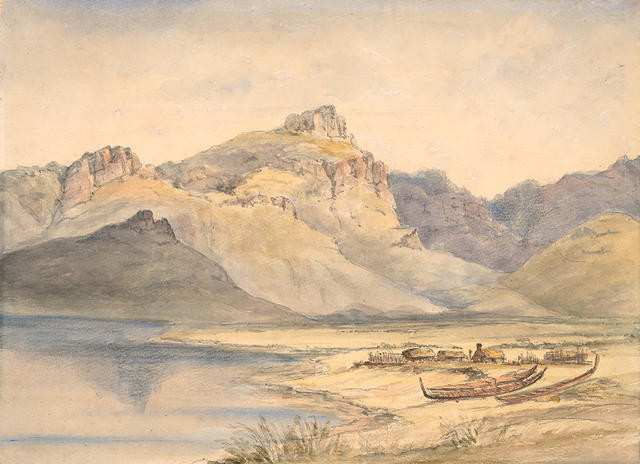
Another work in the European tradition is  Christopher Pearce’s “Beyond the Hay” which reverses the idea of European imposition of the ideal and the exotic. Pearce based his work on a hand-coloured engraving by the British artist John Sykes  “A deserted Indian village” which he had made of an aboriginal settlement in Western Australia. In the nineteenth century anyone caught within the area (beyond the Hay River) faced the possibility of being shot.

Julie Dowling explores the idea of European with her work which has the surreal qualities of a Magritte painting while  Yvonne Koolmatrie’s “Eel Trap”, uses traditional weaving techniques to create art works which transcend their original utilitarian purposes.

In the work of Yhonnie Scarce the dark glass objects in the shapes of the traditional bush fruit and vegetables eaten by Aboriginal become  metaphors for the Aboriginal people and the forceps represent the experiments and invasions by medical and other institutions.

The abstract expressionist works of Emily Kam Kngwarray which trace the lines of travel in the dreamtime also represent the tangled underground root system of the tuber plants such as the yam. These complex twinning lines can also be seen as the representing the complex communication of the cables and lines of our contemporary network of our underground service such as telephone and internet.

Mabel Juli, “Garnkiny Ngarrangkarni”

The severe abstraction of Mabel Juli with her “Garnkiny Ngarrangkarni” is able to use  simple symbols to encapsulate the complex myths about  the relationship between the heavens and humans.

The exhibition provides endless opportunities for discovery about the techniques and range of aboriginal art. They also  allow the viewer to explore connections with art of the European tradition as well as those of the Pacific and Māori.

The National Gallery of Australia’s Curator of Aboriginal and Torres Strait Islander Art, Tina Baum, Gulumirrgin (Larrakia)/Wardaman/Karajarri peoples, says ‘The National Gallery is the custodian to the largest collection of Aboriginal and Torres Strait Islander art in the world and through partnering with overseas galleries to present touring exhibitions like Ever Present, we elevate First Nations voices on a global stage. To fully understand the richness, diversity and depth of Aboriginal and Torres Strait Islander art and culture would take many generations and many lifetimes – but to appreciate it only takes a moment.’

The exhibition includes some of the most influential First Nations Australian artists including Brook Andrew, Richard Bell, Bindi Cole, Karla Dickens, Jonathan Jones, Mabel Juli, Vernon Ah Kee, Kunmanara Ray Ken, Emily Kam Kngwarray, Yvonne Koolmatrie, Alex Mingelmanganu, Archie Moore, Albert Namatjira, Dorothy Napangardi, Christopher Pease, r e a, Yhonnie Scarce, Damien Shen, Christian Thompson and Clifford Possum Tjapaltjarri.

To subscribe or follow New Zealand Arts Review site – www.nzartsreview.org.

The “Follow button” at the bottom right will appear and clicking on that button  will allow you to follow that blog and all future posts will arrive on your email.

Or go to https://nzartsreview.org/blog/, Scroll down and click “Subscribe”

Categories
Reviews, News and Commentary

New Zealand’s first national register of 20th century public artworks

John Daly-Peoples

Pat Hanly, ‘Rainbow Pieces’ (1972), Ōtautahi Christchurch, Christchurch Town Hall

Public Art Heritage Aotearoa New Zealand’s new website publicart.nz was officially launched this week  at Parliament by The Minister for Art, Culture and Heritage, Hon Carmel Sepuloni.

The website is a New Zealand first, providing a single place for New Zealanders to gain knowledge of 20th Century public artworks located in towns and cities across Aotearoa, including works that have been hidden, lost, destroyed, or deaccessioned.

At launch the register contains over 380 works which can be searched by information about each of the artworks, the artists, and their locations.

The register will be an invaluable resource for researchers, the arts community, local communities, and tourists as well as local authorities, schools, hospitals, churches, and other public-facing organisations. Public Art Heritage Aotearoa New Zealand (PAHANZ) is a research initiative based at Toi Rauwhārangi College of Creative Arts, Massey University Wellington, and was established to find, document, and protect what remains of Aotearoa’s 20th century public art. Dr Bronwyn Holloway-Smith, co-director of PAHANZ said today: “Sadly, many 20th Century works have already been destroyed, hidden, or simply lost, while others remain undocumented and at risk due to a lack of public knowledge of their significance and cultural value. Through this initiative, we’re hoping to change that.”

Dr Holloway-Smith and co-director Sue Elliott have spent the past six years researching and documenting these artworks with the aim of sharing their research to help promote and protect these works of significance.

Sue Elliott said: “During the 20th Century and particularly post World War II, many of Aotearoa’s most talented artists turned their attention to enriching public space, often hand -in-hand with leading architects. As a result, some of the largest and most ambitious artworks in the country were placed in publicly accessible sites throughout urban and regional centres.

“Many of these works are hiding in plain sight or have fallen victims to privatisation, and/or contemporary fashion trends among interior designers and architects of the 20th century. PAHANZ has been established to ensure that future generations of New Zealanders have knowledge of, and access to these cultural treasures.”

Molly Macalister, ‘Little Bull’ (1968), Hamilton Gardens, Kirikiriroa Hamilton

Many household names are among those listed on the website: such luminaries as: Rita Angus, Tanya Ashken, Jim Allen, John Bevan Ford, Russell Clark, Roy Cowan, Neil Dawson, John Drawbridge, Fred Graham, Pat Hanly, Ralph Hōtere, Molly Macalister, Paratene Matchitt, Colin McCahon, Guy Ngan, E. Mervyn Taylor, Dame Robin White, and Cliff Whiting to name but a few.

 Holloway-Smith said: “Our ultimate goal is to build a comprehensive database of Aotearoa’s 20th Century public artworks, whether they are still publicly accessible, lost, hidden, or destroyed. Each of the works on the site at present has been researched, audited, and documented, but this is just the start. There are hundreds more that still require this attention, and we plan to continue growing this resource in the future.

Paratene Matchitt ‘Untitled (Maia)’ (1990) Aotea Centre, Auckland

We are also working with Toi Māori Aotearoa to establish relationships with Māori artists, whānau and kaitiaki of artworks on our register, alongside our own work developing connections with the remaining artists, families, estates, and owners. Happily, responses have been overwhelmingly positive to date.”

Hon Carmel Sepuloni said at the launch: “It is inspirational to see the contribution these artists have made throughout Aotearoa New Zealand, and how important this initiative will be in safeguarding these artworks which are much loved by their communities. I am proud the Government was able to assist in helping make this important initiative possible.”

At the time of launching, the website database comprises PAHANZ’s first set of audited works: approximately 380 that are spread throughout the country. But this is just the beginning: PAHANZ currently have a further 900 works recorded that still require research, auditing, assessing, and uploading.

“The site will be organic as we continue our research, but we are also calling on members of the public to assist in building the register and protecting these important 20th century public artworks,” Holloway-Smith said. “We are constantly discovering more works that fall in our scope, through our research and by learning of them from members of the public who contact us with their information about works.”

PAHANZ will be working with Heritage New Zealand and Regional District Councils to gain heritage listings for works of national significance. “We are also pursing the restoration and reinstallation of significant works that have been neglected or removed, and the installation of plaques near unlabelled works of significance to ensure local audiences are made aware,” Holloway-Smith said.

“We were fortunate to have received funding from the Ministry for Culture & Heritage, Manatū Taonga’s Te Tahua Āki Auahatanga Innovation Fund to develop the website and the register launched today. “This is an important milestone, and it was fitting that it took place beneath John Drawbridge’s work in the Beehive’s Banquet Hall: a work that is both on the register, and one of the very few 20th century public works that already has a heritage listing.

Guy Ngan, ‘Taiaha’ (1972), Reserve Bank Building, CBD, Te Whanganui-a-Tara Wellington

PAHANZ also began work four years ago to have the large Joan Calvert/Guy Ngan textile hanging, Forest in the Sun, reinstated in the Beehive entrance foyer. The work was commissioned specifically for the site, and thanks to Te Papa and Parliamentary Services, it was returned to its original site last week,” Elliott said.

The list of works has some major gaps and it is likely that various institutions and councils will alert the register of works which should be added.

A quick perusal of the current list shows that there a number of public art works in Auckland that need to be added. These include Robert Ellis “Aotea Tapestry” and Barry Lett, Red Man both at the Aotea Centre  Richard Gross’s Domain sculpture and Auckland Grammar War Memorial sculpture and George Rickey Double L Gyratory at the Auckland Art Gallery

PAHANZ is seeking the public’s help to continue building the register and assist in the protection of these important 20th Century public art works.

You can find the register at: https://publicart.nz

The site can be navigated several ways:

• Via an Artists/Ngā Ringatoi directory (listing artists and art collectives alphabetically by last name).

• Via an Artworks/Ngā Toi directory where works can be filtered and sorted through a range of options including the status of the work, type, media used, and year of production.

• There is also a map view that shows the distribution of works throughout the country: a handy resource for those planning a trip somewhere who want to know what public artworks they can visit along the way

Send your list of sculptures  to Public.art@massey.ac.nz

Categories
Reviews, News and Commentary

Mr & Mrs Macbeth of Dobson Valley Road

Reviewed by Malcolm Calder

Mark Hadlow, (Tom) and Lara Macgregor (Jo)

Mr & Mrs Macbeth of Dobson Valley Road

By Gregory Cooper

A Professional Theatre Company production

With Mark Hadlow, Lara Macgregor

Director Gregory Cooper

Design Mark McEntyre

Lighting Sean Hawkins

Costumes Pauline Farley

Sound Bob Bickerton

Choreography Natalia Harrington

StarCity Theatre, Auckland

Until Sat 29 July (then other regional centres)

Reviewed by Malcolm Calder

25 July 2023

Vying for one of the longest titles of new work in 2023, Gregory Cooper’s Mr & Mrs Macbeth of Dobson Valley Road opened this week at SkyCity Theatre – an Auckland venue that appears to be losing a little of its dormancy these days.

Cooper has followed a mainstream bent trodden by many.  He firmly establishes the stale, apparently disillusioned marriage of erstwhile and ageing actor-couple Jo and Tom in their shared dressing room just before opening their own production of Shakespeare’s Macbeth.   They snipe, they criticise and they are endlessly dismissive of each other’s foibles and of pretty much everyone else.  Together they represent an anachronism between that ancient theatrical world where tyrannical actor-managers ruled and a much more recent one inhabited by ‘interns’, Instagram and starstruck wannabees.

Be that as it may, their relationship is really what this play is about.  While initially carping and contradicting each other – most of Act I in fact – underneath lies a bittersweet understanding, acknowledgement and appreciation and of each other built on three-decades together as people.

Yes, it’s been done before, but Cooper adds a different twist by introducing Shakespeare’s Macbeth as the device that opens the door to their eventual realisation and appreciation.  As well as to all manner of theatrical one-liners, customs and references which enable him to easily maintain an ever-present bubbling undercurrent of humour.  In fact all of the humour, as this is only a two-hander.  Huge ginormous laughs however, there are few.

The pedigrees on display in this production are indeed impressive and well-known to Auckland audiences.  One of Aotearoa’s finest actors Mark Hadlow gives us a carefully-crafted and nuanced Tom.  At some points he is considered and rational, and at others he becomes a ranting whisky-bottle inspired, near-alzheimic blusterer.

Hadlow’s Tom is partnered by Lara Macgregor as Jo, perhaps most-recently known to Auckland audiences for her direction of ATC’s recent Heartbreak Choir, and many years of outstanding work on both stage and screen, particularly with Court Theatre in Christchurch.  The waxing and waning of power and put-downs and the finely-honed timing between the two is delightful at times.

Playwright Gregory Cooper is also largely Christchurch-based, has worked as an actor, director and writer and many will recall his MAMIL with Hadlow a few years back  Of further note is a very simple set, skilfully-conceived by Mark McEntyre, that enables the SkyCity stage to occasionally become Shakespeare’s stage.

If I have a criticism of this production it is that I feel it may have sat more comfortably in a smaller venue – although hopefully one that still has a proscenium of some type.  And while the ever-present chuckles and smiles never stopped, a really big chunk of belly-wrenching laughter may have enhanced it further.

Interestingly, Mark Hadlow is largely behind the establishment of this new regionally-based company – the aptly named The Professional Company.  Based at Wakatū,near Nelson, it has a clearly articulated regional focus and, if this production is anything to go by, aims to tour extensively.  So congratulations to The Professional Company.  Its new work is not ‘new’, nor ‘leading edge’, nor ‘culturally-focussed’.  It is traditional.  And a lot of people will like that.  

Categories
Reviews, News and Commentary

World Press Photo exhibition

Reviewed by John Daly-Peoples

Evgeniy Malotetka

World Press Photo Auckland

Level 5, Smith & McCaughey’s

22 July – 20 August 2023. 

Reviewed by John Daly-Peoples

After a three-year absence due to COVID-19 the World Press Photo Exhibition has returned to Auckland. The exhibition showcases the winning images of the World Press Photo competition, selected from over 60,000 entries from around the world. 

The World Press Photo Contest has recognised professional press and documentary photographers since it began in 1955.  The 2023 contest has six worldwide regions – Africa, Asia, Europe, North & Central America, South America, and Southeast Asia & Oceania and four categories (Single, Story, Long Term Project and Open Format). The winning entries from the six Regions in each category form this remarkable exhibition with four global winners chosen.

Many of the photographs in the exhibition deal with conflicts around the world including the war in the Ukraine. Evgeniy Malotetka has documented the battle for Mariupol with images of a pregnant woman being carried from the Maternity Hospital, people sheltering in a basement and bodies being put into a mass grave.

Maya Levin

The civil war in Myanmar has been documented by Mauk Khan Wah showing a group of soldiers in his photo “Retrieving the Dead”. Maya Levin has followed the conflict in Israel and one of her photographs is of the funeral of the journalist Shireen Abu Akleh where Israeli troops confront a crowd of Palestinian mourners.

Simone Tramonte

As well as the brutal side of conflicts the photographers have captured more positive aspects of life. A series of photographs by Simone Tramonte titled “Net-Zero Transition” documents developing technologies offering new routes to a  net-zero economy. His photographs include  images of a solar plant in Spain which uses solar heat to provide electricity a fourteen floor vertical farm and a photobioreactor.

On the flip side of this drive  for  sustaining agriculture is the series of photographs titles “Beautiful Poison’, which is an exploration by Christopher Roger Blanquet of the legal but lethal pesticides used in the flower and agriculture sectors of Mexico.

Jonas Kakop

There is also a surreal image by Jonas Kakop of three white clad beekeepers in the Arizona desert who are providing water to bee hives as the  Colorado River dries up.

While there has been mention made over the last decade about Egypt building a new capital there have been few images of this development. A set of images by Nick Hannes show the scale of the construction of the new administrative capital east of Cairo. Here we see the huge scale of the development with multi storied buildings, one of the largest mosques In the world and the huge new Arc de Triomphe. Also included is a large billboard celebrating the new area with an image of President el-Sisi           .

In contrast to these images of the new Egypt is a series of photos by Mohamed Mandy who has documented the canal slums of Alexandria and the eviction of the local residents.

Mads Nissen

Mads Nissen has documented the fate of Afghanistan showing the impact of the Taliban takeover with the image of a 15 year old boy who has sold a kidney to earn money along with  an image of burka clad women begging for bread outside a bakery.


This exhibition was brought to New Zealand by The Rotary Club of Auckland as a fundraiser for charity.

To subscribe or follow New Zealand Arts Review site – www.nzartsreview.org.

The “Follow button” at the bottom right will appear and clicking on that button  will allow you to follow that blog and all future posts will arrive on your email.

Or go to https://nzartsreview.org/blog/, Scroll down and click “Subscribe”
Categories
Reviews, News and Commentary

Violinist Benjamin Beilman the highlight of the APO’s Might & Majesty

Reviewed by John Daly-Peoples

Benjamin Beilman

Might & Majesty

Auckland Philharmonia

Auckland Town Hall

Weber, Euryanthe: Overture

 Bruch, Violin Concerto No.1

 J.S. Bach, (arr. Webern) The Musical Offering: Ricercar

 Mendelssohn, Symphony No.5 ‘Reformation’

July20

Reviewed by John Daly-Peoples

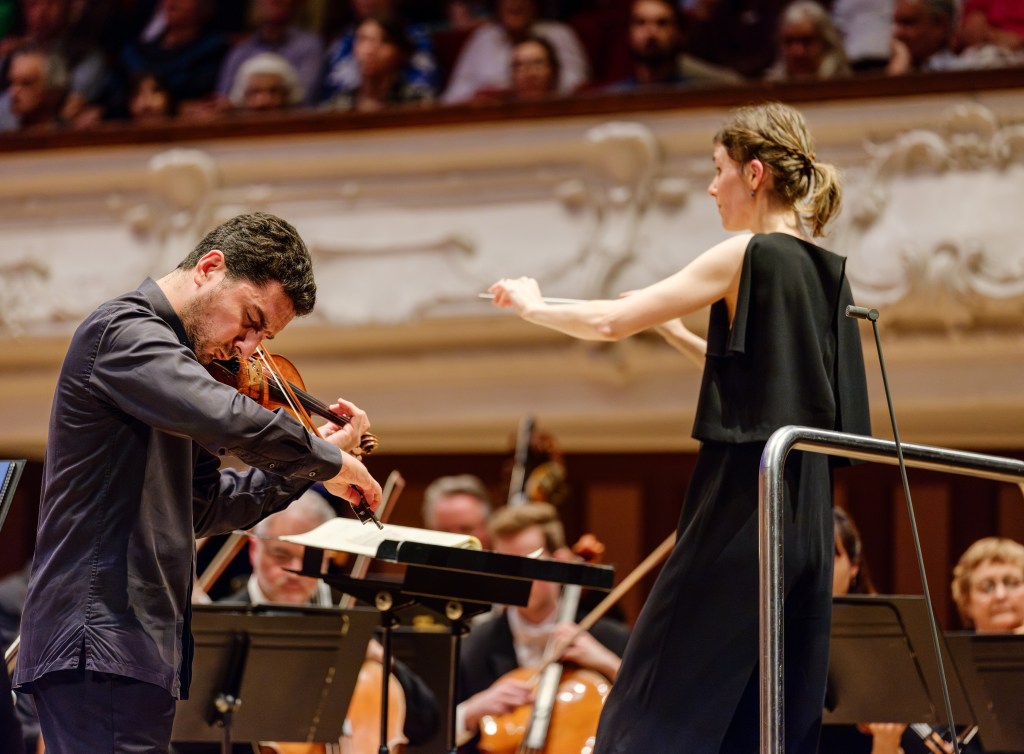
The highlight of the APO’s Might & Majesty concert was Max Bruch’s Violin Concerto played by violinist Benjamin Beilman, a work which offers great rewards every time it is played. Beilman gave an intelligent and passionate account of the work, bringing fresh insights to the work which expresses sorrow, melancholy, regret and ultimately redemption. It was these qualities that Beilman was able to draw from the music.

Following the introduction of  soft timpani and woodwinds Beilman’s  opening plea was forceful and energetic with his whole body responding to the music, quivering with emotion. There were times when his sounds captured the image of a bird taking flight and others where the sounds and images he created seemed to disappear into the ether.

Both the soft, wispy passages as well as the more dramatic ones were given full expression. At times the violin sounded tearful in its grief while at other times there was a restless anger.

He responded to the orchestra’s huge blast of overwhelming sound with his own anguished sound which was also reflected in his tight bodily movements.

In the more lyrical passages, he seemed to dance with the joy of the work while in the final celebratory section his playing became feverish as he skirmished with the orchestra.

Following the thunderous applause of the audience he played a delicate interpretation of Bach’s Gavotte.

Following the interval was another Bach work which offered an interesting history of musical composition. The work’s main theme was originally written for Bach  by Frederick II, the King of Prussia. The composer then developed  the theme into his major work “The Musical Offering”. The kings simple work, probably for solo flute was thus made into a work for a string quartet.

Then in the twentieth century Anton Webern orchestrated the Bach for a full orchestra. This distinctly modernist version of the Bach made one aware of structural nature of the original composition. Webern deconstructs the original with the various sections of the orchestra along with solo instruments  making variations on Bach’s original work, expanding it with  themes and variations.

The opening work on the programme was Carl Maria von Weber’s overture to his opera Euryanthe. While not as well-known as his more popular  Der Freischütz the work had the same spirited music as Der Freischütz with a rich emotional core.

Conductor Giordano Bellincampi ensured that the music evolved from the opening sense of mystery into passages of high energy drama which can ultimately be seem in the later work of Verdi and Wagner.

The major work on the programme was Mendelssohn’s Symphony No 5 (The  Reformation} celebrating the Protestant Reformation  and Martin Luther. The various passages of drama, contemplation and celebration can be interpreted as reflecting Luther’s life and the growth of Protestantism.

The work opened with some delicate, atmospheric sounds  which evolved into grand brass sounds pitted against the soft strings which in turn led to some rousing depictions of natural forms and dramatic landscape portraits with huge natural forces much like  his Hebrides Overture .

The second movement with its jaunty colourful folk dance was followed by more introspective passages.  At this point Bellincampi had chosen to perform Mendelssohn’s original version of the work with a bridge passage between the 3rd movement and finale. This saw some exquisite solo flute playing which evolved into passages featuring all the woodwinds before including the entire orchestra . This passage may have been used by the composer to reference Luther who was an accomplished flute player himself

The big celebratory final movement provides the symphony title of “The Reformation” as it uses the theme from Martin Luther’s “A Mighty Future is our God”  as the work was written for the 300th anniversary celebration of Luther and the Augustan Confession, one of the most important documents of the Protestant Reformation.

 Next Concerts

Violinist Yanghe Yu, APO playing Violin Schubert String Quintet

July 24, Titirangi War Memorial Hall

July 25 St Heliers Church and Community Centre

August 3 Brahms 1

Conductor Giordano Bellincampi
Baritone Benson Wilson

Ross Harris Symphony No.7 (world premiere)
Mahler Songs of a Wayfarer
Brahms Symphony No.1

To subscribe or follow New Zealand Arts Review site – www.nzartsreview.org.

The “Follow button” at the bottom right will appear and clicking on that button  will allow you to follow that blog and all future posts will arrive on your email.

Or go to https://nzartsreview.org/blog/, Scroll down and click “Subscribe”
Categories
Reviews, News and Commentary

Black Grace Company B: I Am a Renaissance

Reviewed by Malcolm Calder

‘I Am a Renaissance’

By Neil Ieremia

A Black Grace Company B Production

With support from Auckland Live

Herald Theatre

Aotea Centre

Until 23 July 2023

Reviewed by Malcolm Calder

Neil Ieremia is by far one of Aotearoa’s most astonishing and prolific home-based creatives.    His ever-growing body of work has easily and unselfconsciously graced stages in many parts of the world and he is rapidly becoming a one-man export machine.  In part this is because of his perfectionism that never forgets the past, stands firmly rooted in the present and yet finds time to seriously address the future – sometimes simultaneously.

It is to that future that he has generated Company B, presently a dozen emerging dancers with varying levels of dance experience and some production personnel.  They come from diverse walks of life, have successfully endured an exhaustive audition process and now have the opportunity to experience life as professional dancers.  Company B members combine different personal histories, different body shapes and abilities, and different musical and dance backgrounds.  These span the range from hip-hop to traditional, to church and to those with a more traditional bent.  Some may find dance opportunities and develop careers as dancers, while others may drop out completely and still others may be offered work in the areas of producing and production, learning alongside Black Grace management.

Rather amazingly, Ieremia has led them through a mere four weeks of workshopping, teaching, and rehearsal to deliver this fully professional production that is astonishing for its vitality and exhausting in its energy. 

‘I Am a Renaissance’ is structured as a series of vignettes with a strong musical underpinning that ranges from pop to hip hop, coupled with music-scapes that underscore the everyday concerns of young people today.  It leaps from recollections of things past to things that might have been and things that are very much of the present, uses the simplest of props and creates some beautiful moments.  None more so than when each dancer reveals their own mobile phone, which becomes a torch, and then a candle.  

Perhaps wisely, much of the choreography is devised for group work and three full-company Black Grace dancers are included in this production, providing reference points, sustaining the tempi and ensuring the end result works.  Above all, it abounds with energy – endless energy – and is well worth a look-see.

Auckland Live is to be applauded for supporting this initiative.

To subscribe or follow New Zealand Arts Review site – www.nzartsreview.org.

The “Follow button” at the bottom right will appearand clicking on that button  will allow you to follow that blog and all future posts will arrive on your email.

Or go to https://nzartsreview.org/blog/, Scroll down and click “Subscribe”
Categories
Reviews, News and Commentary

The Auckland Chamber Orchestra returns with a fabulous concert

Reviewed by John Daly-Peoples

Eve de Castro-Robinson and Janet Jennings

Auckland Chamber Orchestra

Beethoven and More

Raye Freedom Centre

July 16

Reviewed by John Daly-Peoples

Last Sunday’s performance by the Auckland  Chamber Orchestra was the first this year and  a welcome return for the performers led by Peter Scholes whose organisation has presented some of the most innovative programmes on the Auckland music scene over the last two decades.

The first work on the programmes was Janet Jennings “Prelude, Fugue, Variations and Chaconne” which has been one of the most voted for works from Aotearoa in RNZ’’s  “Settling the Score”.

Featuring David Kelly (piano), Rachel Guan (bassoon) and Luca Manghi (flute)  the four sections are based on tradition  musical forms but are given a more contemporary feel with changes in tempo and rhythmic patterns.

The piano provided a flowing , evolving background with images of tinkling water, scudding clouds over which images created by the flute and bassoon were inserted  – flickering light, murmured sounds of birds and the rustle of foliage.

Flute and bassoon engaged in gentle conversations studded with bursts of energy which also suggested different times of the day or the seasons.

At times there was a playful mood at other times there was a sense of nostalgia and reminiscence with the passing time of day reflecting personal moods 

The  performance was notable for the precision and clarity of the individual performers with Rachel Guan’s haunting bassoon, Luca Manghi’s honey-toned  flute and the exactitude of pianist  David Kelly.

Second on the programme was a 1995 work “Three Thumbnails” by Eve de Castro-Robinson. In this absurdist piece of musical theatre, the four musicians (Peter Scholes, clarinet, Sean Martin-Buss, guitar, Eric Scholes bass, Shane Currey, percussion) and the voice performer  Barbara Paterson  were all attired in outlandish circus or commedia dellarte costumes.

They employed a wide range of instruments – clarinet, drums, cymbals, squeaky toys, guitars, piano,  klaxon, castanets, tin whistle and pepper grinder. But these instruments were not always used in a traditional manner with the strings on the double bass being hit with a drumstick.

The work used a variety of texts by the founder of modern music Eric Satie, John Cage and Igor Stravinsky. So, in the first “Thumbnail” Paterson, riding a hobby horse announces that “I am not a musician” and then goes on to list Satie’s list of approved dietary foods.

Within her rambling oration / lecture there are references to musical history, theory, and philosophy with statements which are part  stream of consciousness, part theory and part witty observation.

The overall performance owes much to the work of Satie and Cage as well as the theatrical legacy of Edith Sitwell’s  “Façade” as well as rap music,  Brecht / Weill and Marat / Sade . Paterson, who initially appears striding down the aisle of the theatre conducts herself variously in the manner of an automaton, dancer and gymnast while her playing of the piano was something of an attack . The performers also engaged in a form of semaphore, in mute signalling.

The various instruments interacted with each other in the manner of a piece of Beckett-like absurdist theatre with illogical conversations, dissonance and abrupt changes in plot and mood.

The  major work on the programme was Beethoven’s Septet in E flat major, a work composed in 1800 at the same time as his first symphony.

It  owes much to Mozart but the instrumentation shows a new energy from Beethoven and he attempts  to give the work a orchestral atmosphere which is particularly obvious in the central “Theme and Variations” section.

The work is packed with clever tunes, innovative rhythms and makes use of all seven players and their instruments  – Miranda Adams violin, Ben Harrison viola, Callum Hall cello, Eric Scholes bass , Peter Scholes clarinet, Simon Williams horn and Rachel Guan bassoon.

The mainstay of the work is the three string players – violin, viola and cello led by an impressive Miranda Adams who launched each of the movements with a superb display of urgency and vitality.

Each of the movements evolved from a simple statement by the strings from which developed complex melodies and rhythms along with variations inserted by the other instruments.

Each of instruments added a special quality to the work notably the combined velvet tones of bassoon and clarinet. Even the horn player Simon Williams  gave impressive solo account in the second dance movement.

There were a number special moments as when the strings and woodwinds  engaged in conversation, the double bass’s occasional  growl and the often frenzied excitement of the violin and viola.

Beethoven’s ability to meld the seven instruments into a beautifully devised piece of music was  inspiring, stirring and completely satisfying.

To subscribe or follow New Zealand Arts Review site – www.nzartsreview.org.

The “Follow button” at the bottom right will appear and clicking on that button  will allow you to follow that blog and all future posts will arrive on your email.

Or go to https://nzartsreview.org/blog/, Scroll down and click “Subscribe”

Categories
Reviews, News and Commentary

.co.nz: A delightful and remarkably thoughtful Matariki offering

Reviewed by Malcolm Calder

.co.nz

By Mark Wilson

A Chocolate and Carnage production

Pumphouse Amphitheatre

Takapuna

With

Mark Wilson, Āria  Harrison-Sparke, Jordan Henare and Awatea Timothy

Dir/SM Meg Andrews

Prod Coord Lauren Wilson

Des Julia Rutherford

Until 15 July

Reviewed by Malcolm Calder

Delightfully Thoughtful

Āria Harrison-Sparke, Mark Wilson and Jordan Henare in .co.nz
(Photo James Bell)

Although billed as Absurdist Theatre, I found this delightful and remarkably thoughtful Matariki offering more an exploration of an Aotearoa grappling with its own social maturation.  Both Māori  and Pakeha.

As Mark Wilson has observed ‘there are no neatly bound beginnings, middles, and ends … our stories are only woven in complexities which are in never-ending jagged, imperfect circles’.  Yes, he addresses the Pleiades.  Yes, Ngā Mata o te Ariki Tāwhirimātea remain a catalyst.  But.co.nz quickly moves to the individual and to different appreciations, understandings and celebrations of mātauranga and knowledge of Māori.  Or don’t.  It is expressed in both internalised terms –  iwi, hapu and whanau – within the broader community, and in the perceptions of others.

.co.nz kicks off in a somewhat disorganised on-line distribution centre that sells mobile phones.  It subsequently returns to this at various stages during the performance and provides the continuity from which everything spins almost as a stream of consciousness.  A dream perhaps, but this did not strike me as absurd at all. 

Initially an archetypal customer complains – not in person, mind you, only via email – because the centre will be closed for ‘some Māori  holiday’ and he can’t get instant service.  Customer ‘Darren’ then goes on to quickly abuse the business and everyone in it, particularly staff who can’t or won’t speak ‘proper’ English, insisting they should be replaced by ‘ordinary’ kiwis that he can understand.  Which only serves to result in peals of laughter at his own unwitting use of a te reo Māori word. 

Aria Harrison-Sparke, Mark Wilson, Awatea Timothy and Jordan Henare in .co.nz (photo James Bell)

Fairly unexpectedly, this leads almost immediately to why different people hold different views of the maori-pakeha divide, and how different communication forms have quickly led to ever-narrowing viewpoints of just about everything.  Social media take a bow.  Full marks to Mark Wilson for getting this out of the way up front and for moving fairly swiftly to what this play is really about.

His own words from the stage, wrapped in a very warm blanket on a very cold evening, have an almost a monosyllabic inanity that becomes clearer as things unpack.  At times his culture is confused, at others merely bemused.  While attending an urban secondary school, for example, his character TJ enrols for kapa haka but finds himself isolated and confused – the only other kapa haka takers being a Korean boy and four girls.  Not dissimilarly Āria Harrison-Sparke’s T-Dub recalls being rejected by both her Pakeha mother and her Māori father.  Weaving to and fro between them, and occasionally holding central focus himself, Jordan Henare (Mā) remains a commanding figure on stage, mostly in control of his own perceptions and demonstrating his strength at all times – perhaps over so at times.  While Awatea Timothy provides a closing speech almost as a summation of what has gone before, in addition to providing some gentle music that had the audience quietly hum-singing along pre-show.

The vast majority of new playwrights aim to educate and inspire.  Some become so enmeshed in this that they become didactic and even forget the third element – providing intelligent entertainment for their audience.  Mark Wilson does so or, as he would put it, by absorbing lessons from Te korekore, te whaiao and te ao māra (past, present and future) and then knowing how to sift out the weeds may even lead to the ultimate evolution of a universal Ngati Matariki.

To subscribe or follow New Zealand Arts Review site – www.nzartsreview.org.

The “Follow button” at the bottom right will appearand clicking on that button  will allow you to follow that blog and all future posts will arrive on your email.

Or go to https://nzartsreview.org/blog/, Scroll down and click “Subscribe”
Categories
Reviews, News and Commentary

A Dead City filled with loss, grief and sexual obsession

Reviewed by John Daly-Peoples

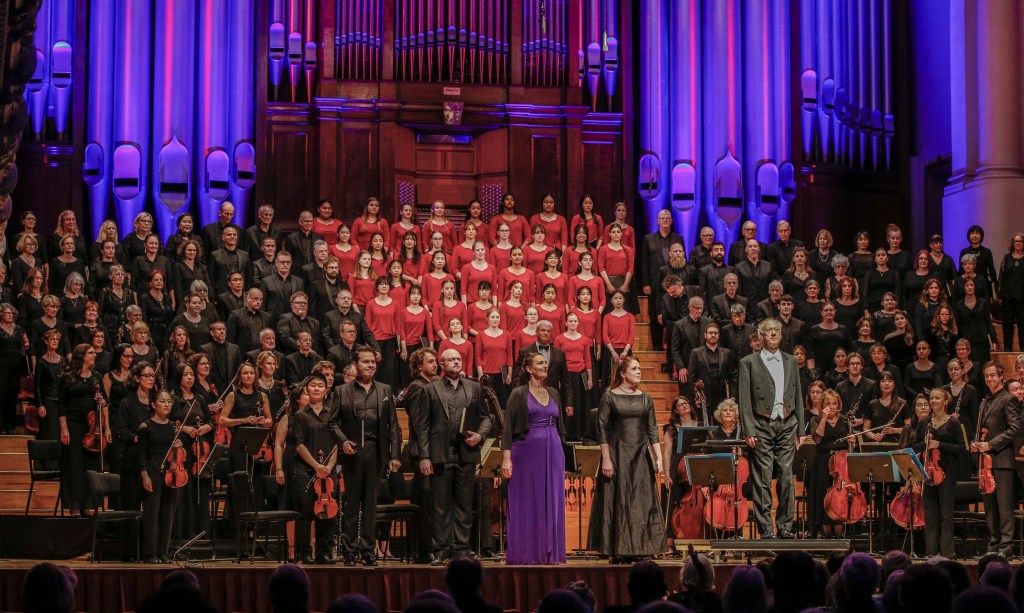
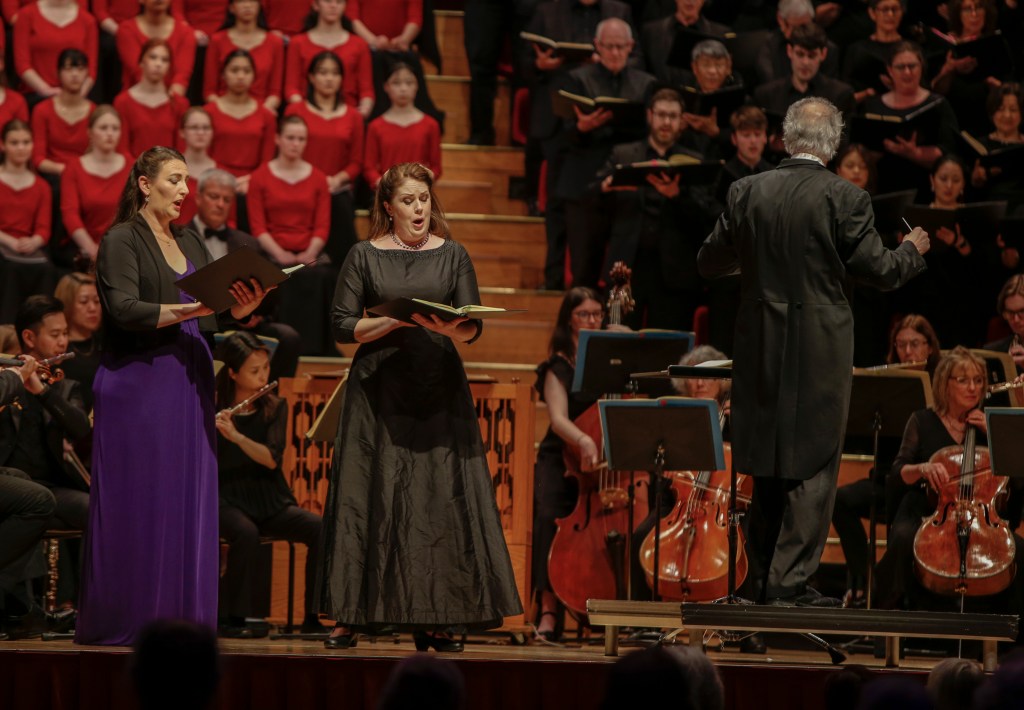
Manuela Uhl (Marietta) and Aleš Briscein (Paul) with the APO. Image Adrian Malloch

The Trusts Community Foundation Opera in Concert

Die Tote Stadt (The Dead City) by Erich Korngold

The Auckland Philharmonia and The New Zealand Opera Chorus

Auckland Town Hall

July 8th

Reviewed by John Daly-Peoples

Erich Korngold’s music is not generally well known and the most people will have heard of variations of his film music in the work of John Williams. The dramatic music of Star Wars and Indiana Jones owes much to Korngold’s innovative stylistic approach.

He was probably one of the most important film composers of the mid twentieth century with work which transformed the way in which film music was composed. His successes earned him numerous awards including two Oscars, notably for the Errol Flynn film “The Adventures of Robin Hood”.

His opera Die Tote Stadt (The Dead City) when it debuted in Germany in 1920 was considered to be an important work and was performed around the globe at the time. However, his work was banned under the Nazi regime and it was some time before it began appearing in opera houses.

While it was performed in several European opera houses in the late twentieth century it only had its first UK staged performance in 2009.

The work tells of Paul, living in Bruges, who some years ago lost his wife Marie and his infatuation with her dominates his life. He keeps a room in his house as a shrine devoted to her which contains various memories of her – clothes, scarves, images of her and a long tress of her hair along with candles and fresh flowers.

He meets Marietta who reminds him of his wife but the relationship for him is not for a new start in life but for Marietta to replace his wife as a simulacrum of her. His housemaid Brigitta and best friend Frank remonstrate and plead with Paul about his preoccupation with his retaining the memory of his wife.

He tells them that he has a new girlfriend Marietta and that things will change. When she arrives at his house it is clear that it is her resemblance to his dead wife which attracts him to her.

After Act I the other two sections have a surreal quality to them and can be seen as distortions of Pauls mind. He sees Marietta  leading a group of nuns and a theatre troupe perform spontaneous cabaret event with references to sex and death.

He eventually strangles Marietta which brings him back to reality and in the final part of the work Marietta returns to say farewell along with Frank who urges Paul to leave Bruges with him.

The opera’s theme of the loss of a loved one, coming to terms with grief and moving on was a theme which was particularly relevant to a Europe which had suffered widespread loss during World War I. The work can also be seen in terms of sexual obsessions and the influence of Freud\s “Interpretation of Dreams” which are suggested in the dream sequences.

These elements underscore the preoccupations and tensions between sex and death as well the notions of pure and profane love. Paul wavers between being a rational, normal person with feeling for Marietta and a man on the edge of madness or sexual obsession and is outraged when Frank admits to an affair with Marietta.

Korngold’s music is expressionist as was much of the art of the period but he manages to combine this with the romanticism of the nineteenth century along with a melodic modernism. There are traces of Verdi and Puccini as well as Strauss and Lehar with the music provides a strong melodic line which gives great scope for all the singers.

Paul sung by Aleš Briscein was able to show a range of emotional states with singing that ranged from the serene to the nervous, through to the cruel. Several of his sequences showed a voice racked with an  anguish touching on madness.

 Manuela Uhl sang the role of Marietta as well as the lesser role of Marie. She was able to convey the complex character of Marietta changing the power and the mood of her singing to emphasise the varying aspects of her personality ranging from the tender to the coquettish and angry. She appears to be in love with Paul, intrigued by her power over him, fascinated by her attraction to him and shocked at his use of her as a surrogate.

Her singing of “Marietta’s Song” in Act I which touches on happiness and sorrow was exquisite and Korngold cleverly inserted the theme into the work on several on other occasions throughout the work.

Paul in his attempts to woo Marietta is convincing in the way he conducts himself and expresses his love but this is really all about transference and requires Marietta to be just like his wife. Whenever Marietta strays from his script or asserts herself, he becomes agitated and violent. In the penultimate scene he attacks Marietta, strangling her with his wife’s length of hair.

There were times when the singing of Uhl and Briscein was blissful and lyrical, taking them to an idyllic place and then it would evaporate to be replaced with a savage acidity.

It’s a great pity that the role of Brigitta has only  a couple of short sequences. Sung by Deborah Humble her bright clear voice and simple and straightforward manner emphasised the sense of the despair she displays in agonizing about Paul’s predicament. Richard Šveda’s Frank is the voice of reason in contrast to Paul. His serene, composed singing highlighted the differences between the two male characters.

There was no set but a smoky haze hung over the orchestra and singers intended to represent  a mist shrouded Bruges and its canals.

The orchestra under Giordano Bellincampi gave a stirring performance, providing atmospheric tones as in the misty opening of Act II as well as dynamic deliveries of Korngold’s dramatic, cinematic  style compositions .

To subscribe or follow New Zealand Arts Review site – www.nzartsreview.org.

The “Follow button” at the bottom right will appear and clicking on that button  will allow you to follow that blog and all future posts will arrive on your email.

Or go to https://nzartsreview.org/blog/, Scroll down and click “Subscribe”
Categories
Reviews, News and Commentary

Dirty Work: Mining absurdity

Reviewed by Malcolm Calder

Catherine Yates (Joy), Justin Rogers (Neil) and Tessa Rao (Zaara). 

Dirty Work

By Jacob Rajan

Directed by Jacob Rajan/Justin Lewis

Musical Director : Josh Clark

Set Design : John Verryt

Lighting Design: Jo Kilgour

Costume Design: Elizabeth Whiting

With Justin Rogers, Catherine Yates, Tessa Rao and the Choir(s)

An Indian Ink Production

Q Theatre Rangitia, until 2 July

Then Nelson, Christchurch, Wellington and Tauranga until 20 August.

Reviewed by Malcolm Calder

Jacob Rajan describes Dirty Work as the biggest, most ambitious and most bonkers idea the company has ever had.

It stems from Albert Camus’ 1942 essay The Myth of Sysiphus and is set locally in the modern branch office – or maybe call/service centre – of a Bangalore-based company known as Sysiphus International.  There is a total cast of about 25.  Or more.  Or less.  Don’t worry, maths was never my strong suit either.

However only three are what we might call actors.  Justin Roger (Neil) crafts us a self-important middle manager who is barely starting to catch a glimpse of his own shortcomings and incompetencies.  He might or not fancy his offsider Zaara, who Tessa Rao carefully develops as a fairly bright, trendy and upwardly mobile young woman with a carefully honed eye towards … well, herself actually.  And wandering amidst them in her own self-contained world is a cleaning lady (Catherine Yates), who is struggling to meet her domestic obligations but does her best to cheerfully carry out her work chores each day and is pretty much ignored by the workforce.  I can’t recall her name.  Must be in the songlist somewhere!  However the poor woman suffers from some kind of speech or dental impediment because, no matter how hard she tries, the best she can manage is ‘Syphilus International’.

Despite Neil’s polyphonic, pious platitudes to the contrary, no one really gives two hoots about Sisyphus International.  It’s just a job.  And it provides income.  

Supporting them, and the point of difference of Dirty Work, are the 20-odd community choristers who double as work-station workers brought together under the musical direction of Josh Clark (who gets a work station all to himself – a wider one.  Something to do with a keyboard). 

They don’t give two hoots about Sysiphus International either, probably because there is a different choir for each performance, few of them know each other and the vast majority have never met the actors, seen a script nor even understand what Dirty Work is actually about.  

And it’s about seeing people for who they really are.  And empathy.  And understanding.  And it shakes a small fist at workplaces where people are merely seen as nameless work-cybers or automatons rather than as individuals with their own hopes, aspirations, sensitivities and shortcomings.  I wouldn’t be surprised if there’s a deeper workplace metaphor in there somewhere too.  But you’ll easily get the plot.  Enough said.

The idea of the large and revolving choral cast (and presumably locally-auditioned singers when Dirty Work goes on the road later in the year) is not a new one.  It is certainly a way of reaching out, of increasing community involvement and of improving accessibility.  And it’s not such a silly idea about growing audience numbers too. I have no idea of the total involved but it must be considerable.  I pity the poor choir wrangler. 

There are about 8 songs that range from Puccini‘is Humming Chorus, to a resounding version of Beethoven’s Ode to Joy, a couple of traditional tunes, the key song from Slumdog Millionaire and everything concludes with Lorde’s Royals.

There are a lot of chuckles in this show.  Although I feel with a bit more familiarity from choristers, and even some carefully written lines allowing for a wee bit more interraction, these could easily become far bigger outright laughs. And even a big, bright, brassy Bollywood version of a couple of the songs wouldn’t go astray either.

To subscribe or follow New Zealand Arts Review site – www.nzartsreview.org.

The “Follow button” at the bottom right will appearand clicking on that button  will allow you to follow that blog and all future posts will arrive on your email.

Or go to https://nzartsreview.org/blog/, Scroll down and click “Subscribe”