Categories
Reviews, News and Commentary

Switzerland is a slow burner thriller

Reviewed by John Daly-Peoples

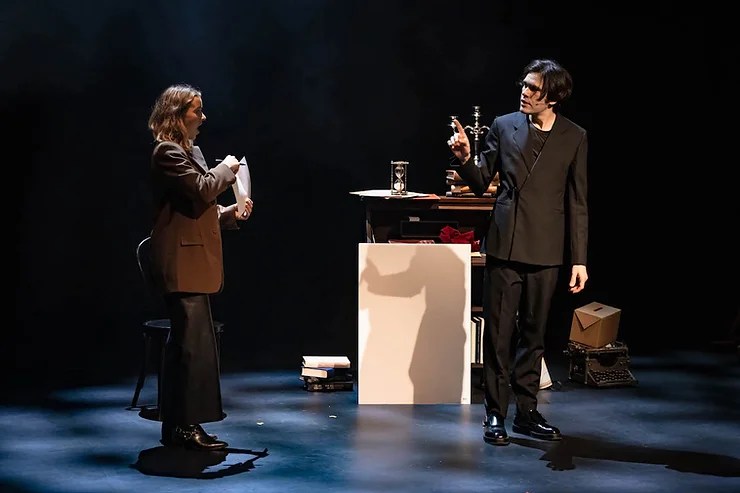
Edward (Jarred Blakiston) and Sarah Peirse (Patricia Highsmith)

Auckland Theatre Company

Switzerland by Joanna Murray-Smith

ASB Waterfront Theatre

Until October 7

Reviewed by John Daly-Peoples

Patricia Highsmith is one of the few twentieth century crime writers whose work has transcended the genre, creating a body of work which deals with the complex mind of the murderer /  psychopath. With many of her Ripley  books, unlike most crime writers she creates a seemingly mundane environment with only a hint of suspense into which she inserts sudden moments of terror as Tom Ripley shows his true self.

With Tom Ripley she created a character who was both intelligent and unpleasant suave and self-conscious. He is the arch manipulator who spends most of his time creating the environment for his crime.

In her play “Switzerland” Joanna Murray-Smith has a young publishing executive from New York visit the writer in her modernist alpine hideaway. He has come to persuade her to write a sixth novel featuring her iconic anti-hero – an idea she is opposed to and has previously rejected.

Highsmith takes an instant dislike to Edward and their conversations become a duel of wits as she and Edward do a complex  literary dance around her lounge / study.

She allows Edward  to stay the night on the condition that he invents the means of murder for a storyline featuring Ripley which the two of them have developed.

They traverse many topics related to publishing, the creation of character,  the nature of crime fiction and the impetus to write. We get a portrait of the writer set within with a Highsmith story line.

We get a sense that there is more to Highsmith’s rejection of the idea of bringing to life her Tom Ripley just as there is more to Edward’s doggedness in convincing her of the need to give the character a new outing.

Sarah Pierse’s Highsmith is brilliantly acerbic, her witty ripostes recalling  Oscar Wilde- “I’m not ignorant, I’m just mean” “I can tell you have an inquiring mind but an inert imagination” – and she has opinion on a range of people and issues – Kurt  Vonnegut, Tom  Wolfe and Francis Bacon. She shows her unpleasant nature when she expresses her dislike of victims an admiration for  murderers. She becomes animated when she discovers that Edward has had a violent and unhappy childhood.

Jarred Blakiston’s Edward is intelligent and unpleasant, suave and self-conscious, slowly revealing complex dimensions to the character. He also introduces a couple of disturbing he alluding  to Highsmith previously threatening one of her publishers with a knife and Edward wonders whether the author has entered his bedroom.

Murray-Smith has created brilliant Highsmithian dialogue, director Sarah Goode a suspenseful atmosphere and Miichael Scott-Mitchell a perfect interior set.

Switzerland is a slow burner thriller with excellent casting, superb twists and turns of plot and a riveting dialogue.

To subscribe or follow New Zealand Arts Review site – www.nzartsreview.org.

The “Follow button” at the bottom right will appear and clicking on that button  will allow you to follow that blog and all future posts will arrive on your email.

Or go to https://nzartsreview.org/blog/, Scroll down and click “Subscribe”

Categories
Reviews, News and Commentary

Voila: A Compelling Breath of Totally Fresh Air

ÉMILIE
By Sophie Lindsay

Writer, Composer, Director: Sophie Lindsay
Music Director: Peau Halapua
Set, Costume and Props Design: Nati Pereira
Lighting: D. Andrew Potvin
Technical: Sam Mence (CASTL)
Graphic Designers: Gustavo Garcia

With: Beth Alexander, Justin Rogers, Bronwyn Ensor, Clementine Mills

Music: Peau Halapua (violin), Sarah Spence (cello) and Sophie Lindsay (pre-recorded piano)

Q Theatre Loft

Until 23 September

Reviewed by Malcolm Calder

Justin Rogers (Voltaire) and Beth Alexander (Émilie)                                                          Photo: Billy Wong

It’s tough making one’s way in Aotearoa’s creative sector.  Especially so in Covid times where ill-timed lockdowns, stay-at-home audiences and shrinking budgets have all made life rather perilous. 

As a result the Covid years have seen many projects created in near-isolation or in small-group contexts.  Many have been the work of early-career creatives, the majority are subjective and some even highly personal.  Perhaps understandably their predominating world-view and potential audience has been a small one. I have seen many and my sense of ennui has grown accordingly.

So when a Covid-period piece that is intelligent, mature and authentic pops up reeking of class it is to be prized.  And when it does so with vigour and a multi-textured vitality that deftly touches actual events and real people, it is like a breath of fresh air.

Émilie is one of those shows. 

Sophie Lindsay tells an 18th century tale of love and ambition between two people.  Philosopher-poet Voltaire, scion of the Age of Enlightenment, falls for Émilie du Châteletwife, mother, mathematician, scientist, essayist and translator.  And she for him.

Set in the realm of the French lesser nobility – its customs, attitudes, dress and social mannerisms are all well realised in what is a fairly simple staging – Émilie and Voltaire rapidly develop an interdependence, a mutual appreciation and yet an insistence on pursuing the outcomes of their own minds.   For this is a love story.  And, far more than a mere infatuation, this love story runs the gamut of both their emotional and their rational minds.  It embraces disagreement, sarcasm, encouragement, some very funny moments and an appreciation of beauty.  It is built on mutual support, encouragement and intellectual rapport.  It is moving.

Beth Alexander plays Émilie with an assured authority that allows us to see the occasional scraps of Émilie’s fragility sneaking in occasionally.  But ultimately she is driven by her own knowledge and sense of self – something uncommon in 18th century France.  Not for one second does she doubt her own capabilities though.  Nor her love for Voltaire.  Both intellectually and emotionally she is a polymath

Justin Rogers (Voltaire) is portrayed as a slightly less multi-dimensional, but perhaps Sophie Lindsay felt her audience already knows him pretty well and focussed on some of his specific personality traits and their outcomes.  Nonetheless I left the theatre never doubting his partnership with Émilie. I felt I had been enlightened about his inner self and truly felt his heart break at her death.

They are superbly supported by two salonnières who double as ladies-in-waiting (Bronwyn Ensor, Clementine Mills).  Each is clearly established, their differences acknowledged and the subtlety of their contrapuntal comedy works very well indeed.

Supporting everyone is the incidental onstage music also written by her Sophie Lindsay.  Peau Halapua’s violin coupled with Sarah Spence’s cello (and some prerecorded piano by Lindsay herself) is something we rarely see in this country. It echoes and reflects, while the simple, haunting Émilie’s Theme remains with me as I write.

Nati Pereira’s set for this production of Émilie is simple and quite appropriately suggests rather than states.  Likewise her costuming is simple, effective and the changes are both subtle and apt.  I didn’t know how much one could achieve with a French Fan.

Émilie is very definitely a breath of fresh air.  It may have also revealed a playwright who will go far.

I understand that this production is partly funded through Boosted and has not reached its target at the time of writing.  Support for shows like Émilie is precisely what the Boosted scheme is all about.

Categories
Reviews, News and Commentary

Looking at Len Lye through a childs eye

Reviewed by John Daly-Peoples

Ziggle! The Len Lye Art Activity Book

By Rebecca Fawkner

Massey University Press

RRP $35.00

Reviewed by  John Daly-Peoples

“Ziggle! The Len Lye Art Activity Book” is  an art activity book filled with ideas and inspirational ways of looking at the art of Len Lye and the way artists create art. The book has been developed by the author and education team at the Len Lye Centre in New Plymouth and has grown out of the years of experience the team at the gallery has gained in their approaches to the  art  of Lye.

Rebecca Fawkner notes about her personal;  connection with Lye’s work saying “ I didn’t meet Len’s art until I was a grown-up, but it was love at first sight. I was inspired to really pay attention to things I hadn’t taken time to focus on before, like the particular way the waves roll over or the pattern the twinkles of the sun make on the sea. I also loved his idea of ‘empathy’ or ‘Body English’ as he calls it. It hadn’t occurred to me that the sensation of feeling movement made by another in one’s own body could be an inspiration for art. I think any of those noticing and sensing activities are my favourites. Oh, and the shadow puppet play — always so much fun.

The book has 65 activities along with  a short history of the artist’s work across a range of media with numerous quotes from the artist as well as many illustrations of his work.

While the book has been developed as a resource for teachers it is also a great source of ideas for parents to use both within the gallery environment or at home, to engage with children, providing many hours of thoughtful and creative approaches to art making..

Even though the book is aimed at children it is also a great introduction for adults to the art and ideas of Len Lye. In taking a simplistic approach to the artist’s work the various chapters provide a set of ways of looking at the artist.

The author places a lot of emphasis on using all one’s senses in responding to the artist’s work, so as well as  looking the viewer should be aware of texture, sound, taste, smell and text.

Many of the exercises demonstrate the nature of Lyes art with an understanding and  simplicity.  One of the activities involves the making of a set of  poi which leads onto the idea of movement and the way that Lye created art works which move, rotate, describe shapes and trajectories.

This is  great book for teachers, parents and children, presenting the art of Len Lye and art in general in an entertaining and inspiring way.

To subscribe or follow New Zealand Arts Review site – http://www.nzartsreview.org .

The “Follow button” at the bottom right will appear and clicking on that button  will allow you to follow that blog and all future posts will arrive on your email.

Or go to https://nzartsreview.org/blog/, Scroll down and click “Subscribe”

Categories
Reviews, News and Commentary

APO’s “Mozart 40” features an electrifying performance  of Prokofiev’s “Violin Concerto No 1” by Ilya Gringolts.

Reviewed by John Daly-Peoples

Ilya Gringolts Image Kaupo Kikkas

Mozart 40

Auckland Philharmonia Orchestra

Auckland Town Hall

September 14

Reviewed by John Daly-Peoples

The APO’s “Mozart 40” concert opened with  Swedish composer Andrea  Tarrodi’s “Lucioles” (Fireflies) which was influenced by the haiku,

 “By the lily leaves

The fireflies anchor

The lake is illuminated”

It was the three images of leaves, firefly and lake which the composer takes as the core of the creation, illustrating the simple to expose the grandeur of Nature.

The piece opened with the music conveying a shimmering atmospheric sound with the percussion instruments providing a  throbbing undertone signifying a life force. The agitated  strings gave a sense of darting insects and their flickering lights.

The music managed to capture not only the physical qualities of leaves, fireflies and water  but also the notions of  light, sound, movement and reflection.

The work seemed to expand from the depiction of the fireflies over the lake to a vision  of the night sky, the insects becoming metaphors or symbols for the cosmos. The feelings the work generated were those we have in encountering the vastness and intricacy of  Nature.

The second work on the programme was an electrifying performance  of Prokofiev’s “Violin Concerto No 1” by Ilya Gringolts.

After the slow ethereal opening his playing became more impassioned with some frantic bowing, displaying  a deep understanding of the work. He produced some taut emotional playing, conveyed through his total control without the need for unnecessary display. There were raw aggressive moments  as well as softer, tentative sequences while at other times his playing was enigmatic. There were also passages of whimsical playing while at other time it was extravagant but at all the time he was formidably focused on the music.

The fairground themes of the second movements which foreshadow the composers later compositions for film  were soon turned into more robust sounds with some powerful contrasting passages.

His playing was technically brilliant and his duets with various instruments of the orchestra were all precise and incisive.

Eivinf Aadland Image Alastair Bett

During Gringolts performance one was constantly aware of the interaction between the violinist, the orchestra and  the Norwegian conductor Eivind Aadland. With the major work on the programme, Mozart’s Symphony No 40 the conductor’s role was very evident.

Like the composers’ operas, the symphony was operatic in nature, filled with drama, humour and emotion. Aadkand ensured that these qualities were expressed and his own bodily movements  displayed a physical response to the music. Along with his formal conducting gestures he displayed a flamboyant style worthy of a Southern European conductor and he often moved with a dancer’s litheness and intensity.

He made one aware of  Mozart’s evolving contracts and changing dynamics with a precise attention to detail. He also drew attention to Mozart’s innovative ways of using instruments and the inventive ways in which he made transitions between themes and instrumentation.

The operatic nature of the work was particularly evident in the final movement where the instruments appeared to be involved in elaborate  and dynamic conversations mirroring the robust conclusions of his operas.

As an added bonus to the concert Jonathan Cohen the Principal Clarinettist along with Ingrid Hagan, Principal Bassoonist gave a brief introduction to next week’s Mozart’s Clarinet concert where  Annelien van Wauwe will be playing the work on a basset clarinet which would have been the type of instrument Mozart would have composed it for.

The two Apo Principals gave a spirited master class on the differences between the new and older clarinet with extended examples.

To subscribe or follow New Zealand Arts Review site – www.nzartsreview.org.

The “Follow button” at the bottom right will appear and clicking on that button  will allow you to follow that blog and all future posts will arrive on your email.

Or go to https://nzartsreview.org/blog/, Scroll down and click “Subscribe”

Categories
Reviews, News and Commentary

Gill Gatfield’s virtual sculpture floats above Wellington Harbour

John Daly-Peoples

Gill Gatfield, HALO

The Wellington Sculpture Trust is celebrating its 40th Anniversary by gifting an extended reality Sculpture to the city.

The work ‘HALO’ by artist Gill Gatfield is a giant marble circle created in the Metaverse and available to all Wellingtonians via their mobile phone. The work will be visible from the Wellington waterfront promenade, and an outdoor terrace outside the kiosk within the Bush Walk at Te Papa Tongarewa Museum of New Zealand.

The virtual sculpture floats over the harbour, Whanganui a Tara, connecting the sea and sky. Suspended virtually 25 metres above the water and over 21 metres round. Gill Gatfield says of the work: “The origins of HALO’s primordial stone trace back to the fault lines that formed Te Riu-a-Māui Zealandia.

Treasured for its beauty and strength, the unique Tākaka marble was extracted in the early 1900s for the construction of monuments and government buildings including New Zealand’s Parliament House.

“Defying gravity, HALO appears out of the ether, an ancient stone circle and futurist monument. Its crystalline stone and ephemeral form evokes optical phenomena as well as celestial haloes. A circular symbol of unity, the sustainable sculpture honours the past and conjures new possibilities,” Gill said.

Revealing the ephemeral monument at a 40th Anniversary celebration at Te Papa, Sue Elliott, Chair of the Wellington Sculpture Trust said, “the work is a fitting gift to the city – its monumental classical form commemorating the work the Trust has done, and the virtual experience a nod to the Trust’s future.”

The Wellington Sculpture Trust has given 40 years of dedicated and voluntary work to provide innovative contemporary public art for Wellington City. Sue Elliott said: “Over this time the Trust has installed 30 permanent works within the city centre. They also commissioned Len Lye’s Water Whirler and Quasi by Ronnie van Hout on top of the City Gallery in 2021.

The site-specific works have become increasingly ambitious and complicated, harnessing not only the wind and water, but also new technologies. The celebration and unveiling was a chance to come together with former and current artists, trustees, administrators, arts advisors, major donors, partners, and honorary advisors including engineers, accountants, auditors and many others who have given their time freely.

The occasion was also used to appoint three new Life Members: Artist Tanya Ashken, whose work Albatross saw the formation of the Sculpture Trust in 1983, Neil Plimmer chair from 2001 to 2013, and long term honorary financial adviser, Pat Sheehan who has worked with the Trust for over 20 years. Dame Fran Wilde, Chair of Te Papa, said: “The Sculpture Trust continues to add extraordinary value to Wellington, and nationally to sculptural practice.

 Its contribution to Wellington has been enduring and enriches the visual, aesthetic, and creative atmosphere of the city, making art accessible and adding to Wellington’s creative capital reputation.”

Gill Gatfield has won national and international awards, commissions for site-sensitive public art, and is represented in collections worldwide. Significant works have been presented in UNESCO Geopark Kefalonia & Ithaca Greece 2023, Venice Art Biennale 2022, Kunstverein am Rosa Luxemburg Platz Berlin 2022, Conversations on Spatial Architecture Brisbane/Sydney 2021-22, Sculpture by Sea Perth Sydney 2021, NZ Government House 2020, Venice Architecture Biennale 2018, Blueprint for Better.

Notes on viewing HALO Made using your mobile phone or tablet, the ephemeral monument will appear over the harbour in the ‘bay’ created by the wharf area between Te Papa and the Star Boating Club. The work will be there for six months to be enjoyed through the summer months – at 3 locations.

Signage for the sculpture including the QR code can be found:

+ On the water’s edge on the waterfront promenade in front of Te Papa, past Te Papa’s Bush Walk wall.

+ On the water’s edge over the bridge, in front of the Star Boating Club

+ On the outdoor terrace at Te Papa, accessed from the kiosk on level 2 of Te Papa just beyond the Te Taiao nature zone or accessed from the bushwalk itself.

Instructions are: Scan the QR code and through this you will:

• Download Gatfield XR App • Enter the XR Exhibition

• Use the app’s GPS system • Look up and see HALO in 3D

To subscribe or follow New Zealand Arts Review site – www.nzartsreview.org.

The “Follow button” at the bottom right will appear and clicking on that button  will allow you to follow that blog and all future posts will arrive on your email.

Or go to https://nzartsreview.org/blog/, Scroll down and click “Subscribe”

Categories
Reviews, News and Commentary

Little Doomsdays; an innovative text by  Nic Low with enigmatic images by Phil Dadson

Reviewed by John Daly-Peoples

Little Doomsdays by  Nic Low & Phil Dadson

Massey University Press

RRP $45.00

Reviewed by John Daly-Peoples

“Little Doomsdays” by  Nic Low and Phil Dadson is the fifth in the series of  collaborations between an artist and a writer conceived and edited by Lloyd Jones. With this work experimental musician and artist Phil Dadson has illustrated the innovative text that is based on sacred texts from antiquity, modern writings and  te ao Māori by Ngāi Tahu writer Nic Low.

The book is an extraordinary combination of fairy tale, parable and scientific enquiry. In it Nic Low in referencing the mythical Ark of Noah, looks at the ways in which humans have attempted to preserve flora, fauna and knowledge over the centuries. He takes the reader to the great Svalbard Global Seed Vault  in Norway which is in the process of preserving examples of all seeds and the Qaitbay Fortress in Egypt where the Rosetta Stone was discovered in 1799, allowing translation of Hieroglyphs.   He also hints at the possible discovery of the flavour  of the Moa, detected in the remains of a long buried umu on the East Coast

Low links the efforts of scientists worldwide with those of past ages who have endeavoured to preserve their culture along with similar attempts by Maori.

With this notion of an attempt to catalogue the history of civilizations the work has certain parallels with the fictions of Jorge Luis Borges  and the remarkable library of Hernando Colón.

Borges’s short stories such “On Exactitude in Science” which imagines an empire where the science of cartography. becomes so exact that only a map on the same scale as the empire itself will suffice or his essay entitled “The Total Library” describing his fantasy of an all-encompassing archive. Low’s themes as with those of Borges, include infinity, reality, elaborate reasoning and labyrinthic concepts.

The idea of the universal library was actually created by Hernando Colón in the sixteenth century. The son of Christopher Columbus he travelled the world to build the biggest library the world had ever seen with the aim of creating a universal library containing all books, in all languages and on all subjects. The resulting collection of between 15,000 and 20,000 books of mainly, contemporary printed material.

Little Doomsdays opens with a typical Borgesian approach from Low, creating an almost allegorical tale – “It’s said — that in the late twentieth century an unstable grouping of scholars, writers and fanatics from several Ngāi Tahu hapū in Murihiku created what has come to be known as the Ark of Arks.”

“It’s said that this project aimed to catalogue all known arks from the last five millennia. It was a failed attempt to capture previous civilisations’ failed attempts to preserve whatever was valuable to them: waka huia, time capsules, caches, burial ships, seed banks.”

Phil Dadson’s illustrations provide a colourful, graphic accompaniment to Low’s texts and have a sense of the enigmatic and the mystifying. Over many years Dadson has visited many sites where the record of humans is marginal but the traces of the simple forms of life are evident. He has documented items from desolate places such as  the Antarctic and the Chilean desert where he photographed the simple life forms he has encountered.

Unfortunately, the book doesn’t give references to these strange locations and images which would have added to the general enigmatic quality of the book.

To subscribe or follow New Zealand Arts Review site – www.nzartsreview.org.

The “Follow button” at the bottom right will appear and clicking on that button  will allow you to follow that blog and all future posts will arrive on your email.

Or go to https://nzartsreview.org/blog/, Scroll down and click “Subscribe”

Categories
Reviews, News and Commentary

(m)Orpheus: Fast Forward to the Past

Reviewed by Malcolm Calder

(m)Orpheus by Christoph Gluck

An Opera in 3 Acts

NZ Opera/Black Grace co-production

Director/Choreographer: Neil Ieremia

Conductor: Mark Taddei

Design: Tracy Grant Lord

Lighting: JAX Messenger

Assistant Director: Jacqueline Coats

Re-orchestration: Gareth Farr

With: Samson Setu, Deborah Wai Kapohe, Madison Nonona

NZO Chorus: Alfred, Emeline, Faamanu, Jordan, Lemauseafa, Stella, Taylor, To Ohorere

Black Grace Dancers: Demi-Jo, Rodney, Fuaao, Sione, Vincent, Ben, Paula

Auckland Philharmonia Orchestra

ASB Waterfront Theatre, Auckland, 6, 7, 9, 10 September

Opera House, Wellington, 20, 22,23 September

Reviewed by Malcolm Calder

Once again NZ Opera reveals strength, innovation and rising stars while Neil Ieremia continues to astound and amaze.

I would not have been surprised to learn that Gluck and Ieremia shared childhoods – they certainly share mindsets. Both have that rare ability to work from clear cultural underpinnings and to innovate. Both build on tradition and to then fill a story with clear characters and real emotion and then generate a revolution in style and content.

Gluck turned the traditional opera world a little on its head in the 18th century when he – shock, horror – veered away from the prevailing highly-mannered teutonic reliance on pretty loose plots that served to primarily to show off singers. He stood by them of course, but added a new twist to a traditional Greek fable by creating a new plot for Orpheus and Eurydice that animated his characters. Courtly audiences soon found this entertaining and other composers were to follow.

Ieremia’s cultural roots are firmly planted too. But his are Pasifika ones and his outlook is decidedly visionary. He says he found Gluck’s ideas on enduring love and loss inspiring, and then goes on to toss in a couple of contemporary issues as well and the result is this high-impact contemporary re-imagination (m)Orpheus.

So, if Gluck led a movement that took opera to a whole new place, then Ieremia starts from a slightly different one and takes it to yet another place.

His key character is Orpheus. Samson Setu gives us a young man who is definitely a man’s man. He probably works in a highly physical environment, lives an industrial life and could easily make it as a rampaging forward for the Warriors. But with the death of his wife, the lovely, delicate Eurydice (Deborah Wai Kapohe), sensitivity to his feminine side is revealed as rather absent and things don’t go so well.

Deborah Wai Kapohe (Eurydice) and Samson Setu (Orpheus) Image Andi Crown

(m)Orpheus is a story of Eurydice’s death and then Orpheus’ search for her under the auspices, guidance and suggestions of a perkily bouyant Amor (Madison Nonoa). But it is also a story about one man’s search for himself through the netherworld of his own mind until he eventually come to terms with life itself.

The power and strength of the principals stand out as they should, highlighting the many fine young voices now rising to the surface of a what can be a cut throat industry. Setu is consistently strong and then wrought, Kapohe personifies eye-rivetting beauty and a strong sense of self, while Nonoa provides a delightful dash of both costumed and vocal pink.

But it is Ieremia’s blend of dancers and chorus into something that moves in fluid singularity that stands out. Somehow singers become dancers, and dancers become singers – at least they did in my mind. He blends Samoan tradition with lyrical movement the fluidity of the whole becomes a thing of beauty itself. It is a joy to see a cast enjoying itself. And this cast does exactly that.

Tracy Grant Lord’s design rests largely on a black and white motif with splashes vibrant colour to high-lighting particular points, all dramatically lit by JAX Messenger. It moves from an industrial setting to a suburban one, then to the netherworld and back again. Yes, there is a rather battered old car. Two in fact.

Gareth Farr’s re-orchestration for small chamber orchestra is entirely appropriate, fitting both Ieremia’s interpretation and this venue well, while the APO is as accomplished as ever under Marc Taddei. (m)Orpheus is sung in English with some Samoan chorus work, full surtitles, and could easily transfer quite easily to anywhere in the world.

As I have written previously, Neil Ieremia is by far one of Aotearoa’s most astonishing and prolific home-based creatives.    His ever-growing body of work has easily and unselfconsciously graced stages in many parts of the world and he is rapidly becoming a one-man export machine.  In part this is because of his perfectionism that never forgets the past, stands firmly rooted in the present and yet finds time to seriously address the future – sometimes simultaneously. In sum, he is particularly perceptive about the way cultural forms are adapted, reimagined and made relevant.

So congratulations to NZ Opera for this production and especially for both introducing younger performers and for innovative programming. And thank you Neil Ieremia for making it happen.

To subscribe or follow New Zealand Arts Review site – www.nzartsreview.org.

The “Follow button” at the bottom right will appear and clicking on that button  will allow you to follow that blog and all future posts will arrive on your email.

Or go to https://nzartsreview.org/blog/, Scroll down and click “Subscribe”

Categories
Reviews, News and Commentary

Wagner’s Ring set to open in Brisbane later this year

John Daly-Peoples

Opera Australia

Der Ring des Nibelungen, The Ring Cycle

Opera Queensland, Queensland Symphony Orchestra and Dancenorth,

Queensland Performing Arts Centre,

December 1 – 21

Preview John Daly-Peoples

Opera Australia’s  highly anticipated world-first, fully digital Ring Cycle opens in Brisbane in three months. Originally scheduled for 2020, but postponed twice due to the COVID pandemic, Wagner’s epic opera will finally open at the Queensland Performing Arts Centre on Friday 1 December 2023.

Recognised as one of the greatest of operas, Der Ring des Nibelungen, generally known as the Ring Cycle, comprises 15 hours of extraordinary music performed over four evenings, and this brand new, cutting edge reimagining of Wagner’s masterpiece will see opera lovers from around the world descend on Brisbane to experience the history making production which will make use of  of towering LED screens with the latest technologies to create a visually stunning new Ring.,

Presented in partnership with the Queensland Government and Brisbane City Council, and in collaboration with Queensland Performing Arts Centre, Queensland Symphony Orchestra, Opera Queensland and Dancenorth, the Ring Cycle will showcase the outstanding talent Australia has to offer..

The scale and scope of the story is epic. It follows the struggles of gods, heroes and several mythical creatures over a magic ring forged by the Nibelung dwarf Alberich from gold he stole from the Rhine maidens. It is a ring.that grants domination over the entire world. The drama and intrigue continue through three generations of protagonists, until the final cataclysm at the end of Götterdämmerung.

Opera Australia CEO Fiona Allan expressed her gratitude to these partners who have remained committed to this production and looks forward to rehearsals beginning again in coming months. “Opera Australia wouldn’t be able to present this world first Ring Cycle without the help and support of our many partners in the Queensland Government, Brisbane City Council and Queensland’s broader arts and cultural community. “We are extremely grateful for their longstanding commitment to this production and are thrilled to finally be only six months away from seeing everyone’s hard work shine together onstage,” said Ms Allan.

Chen Shi-Zheng with a model of one of the sets of The Ring (Image Rhiannon Hopley)

Drawing on the best of the best talent from Australia and around the globe, acclaimed director Chen Shi-Zheng will lead a world-class creative team, cast and orchestra to bring a futuristic version of the Norse mythology to life. As the first Chinese director to direct a major Ring Cycle, Chen Shi-Zheng will also be the first to weave Chinese mythology into the production. Several New Zealanders are involved in the production including  Katherine Wiles who will be performing in Götterdämmerung

Expected to draw huge local and international audiences across the three complete Cycles, this groundbreaking production of the Ring Cycle will bring many visitors to the area and. Queensland’s Tourism Minister Stirling Hinchliffe said the Ring Cycle was set to bring a $16 million boost to Queensland’s visitor economy. “The world-renowned reputation of this opera has fans from all around the globe winging their way to Brisbane to see it,” Mr Hinchliffe said. “Even after two postponements of the season due to the pandemic, most ticket holders retained their seats, a ringing endorsement of just how special this production is.

The Full Cast

Wotan/Wanderer Daniel Sumegi, Brünnhilde Lise Lindstrom (Cycles 1&2), Brünnhilde Anna-Louise Cole (Cycle 3), Siegfried Stefan Vinke, Alberich Warwick Fyfe, Mime Andreas Conrad, Siegmund Rosario La Spina, Sieglinde Anna-Louise Cole (Cycle 1&2), Sieglinde Olivia Cranwell (Cycle 3), Fasolt David Parkin, Hagen/Hunding/Fafner/ Andrea Silvestrelli, Gunther Luke Gabbedy, Gutrune Maija Kovalevska, Loge Hubert Francis, Fricka/Waltraute Deborah Humble, Donner Alexander Sefton, Froh Dean Bassett, Freia/Helmwige Mariana Hong, Erda Liane Keegan, Woglinde Lorina Gore, Wellgunde/Gerhilde Jane Ede, Flosshilde/Schwertleite Dominica Matthews, Rossweisse Ruth Strutt, Ortlinde Jennifer Black, First Norn Celeste Haworth, Grimgerde / Second Norn Angela Hogan, Siegrune Agnes Sarkis, Woodbird Celeste Lazarenko, Third Norn Olivia Cranwell

Categories
Reviews, News and Commentary

Political parties and their arts policies

As this year’s election approaches it is timely to remind all political parties that there is an  important sector which deserves a lot more than the usual platitudes about the importance of art and the need for coherent and visionary approaches. Hopefully everyone involved in the sector can remind their local candidate of the need for arts policy!

Background

It is hard to find any experienced artist who does not view the situation for the arts in our country as gruelling and frequently discouraging. The latest report on the income of those working in the sector (sponsored by Creative New Zealand and NZ On Air) provides evidence for that gloomy view, by reporting that the median income for creative professionals is only $19,500 per year. More than half of our creative professionals have a second job, but even then, their median income is only $37,000 compared with $61,800 which is the average figure for salary and wage earners in New Zealand. Among the groups in trouble are the 47% of music and sound artists whose income is even lower now than it was in February 2020.

But income is only one aspect of the problem. There is huge public interest and involvement in the arts, yet somehow that does not get translated into media coverage or political support. The absence of arts policies by the major parties is once again conspicuous by its absence. This year, many members of the arts community have gazed enviously at the situation in Australia where the government has done extensive planning and policy-making and provided new funding to develop the arts. When the Hon. Carmel Sepuloni, Labour’s Arts Minister, was asked (by a Stuff interviewer onAugust 20) for her view of what the Australians had done, she replied that she did not think it was time for New Zealand to attempt “any visionary roadmap” of that kind. But will that time ever come?

Progress on Policies

It appears that the only three parties have seriously bothered to promote art policies for the election — the Green Party, NZ First, and Te Pāti Māori. The Greens propose some striking initiatives, such as a guaranteed level of income for every New Zealander. They also promise “adequately resourcing work in the arts,” though they have not yet provided details.

The idea of a universal basic income has been debated in the Nordic countries since the 1970s. The Irish government recently announced a basic annual income of around $30,000 for 2,000 of its artists. It is interesting to recall that our Labour government once ran a similar scheme. In 2001 Judith Tizard, then the Associate Minister of the Arts, instituted the ‘Pathways to Arts and Cultural Employment’ (PACE) scheme to assist artists on the benefit. In her words, PACE meant: ‘Now, when you go to Work and Income, you won’t be told to go and work as a dishwasher.’ By 2003 Steve Maharey could report that 1200 beneficiaries had found work using the scheme, and 2127 jobseekers were signed up for PACE. The change of government in 2008 led to the running-down of the scheme, and in 2011 it was officially discontinued. It is fondly remembered as having lent important assistance to many careers, including bands such as Black Seeds and the Phoenix Foundation, along with creative people from other arts such as fiction writer Anna Taylor and film-maker Taika Waititi. There is no longer any sign of such an initiative in Labour policy, but the Greens are obviously thinking along similar lines.

The Greens also call for a general review of arts funding policy, and for the government to provide direct support for the arts instead of relying on income from gambling. They also speak of the need for an arts education strategy. The context for that is the widespread concern in the cultural sector that arts education at every stage, from primary school to tertiary level, is currently in a situation of crisis. (https://www.greens.org.nz/arts_culture_and_heritage_policy)

New Zealand First promises strong support for the arts and cultural heritage, but its policies are expressed in a more general form (https://www.nzfirst.nz/broadcasting_arts_culture_and_heritage). There are, however, some fresh initiatives such as “funding specialist curriculum leaders to support schools to deliver on the Arts Curriculum,” and requiring international pay television streaming services to include New Zealand content. (Australia already has a requirement of that kind.)

Te Pāti Māori speaks eloquently about the value of toi (the arts). It says: “Toi Māori is our total wellbeing strategy; our mental health strategy, our physical health strategy, our Reo Māori strategy, our Educational strategy, our whakapapa strategy, our tourism strategy, our community development strategy and our cultural defence strategy and must be recognised as such.” (https://www.maoriparty.org.nz/toi_maori)

All the policies of Te Pāti Māori focus primarily on Māori creative activity rather than on the arts in general. One of the party’s policies was implemented in May this year by the Labour government – a boost of $34 million in funding over the next two years to the kapa haka festival Te Matatini, making it the country’s highest-funded arts service provider. The party’s other proposals include the establishment of a Māori funding body parallel to Creative NZ with a budget of $57 million.

ACT has nothing about the arts currently on its policy website, but it has told PressReader that it “was open to reforming bureaucratic arts funding applications, and funding for large public sector payrolls for culture agencies.” (https://www.act.org.nz/policies)

Labour has focused mainly on the video games industry, announcing that it would give it a $40 million tax rebate each year. For other areas of the cultural sector, it may feel that it can rest on its laurels, following its support for Te Matatini in May, and its $22 million “funding injection” to “the arts, culture and heritage sector” in February. That was a final instalment of the government’s Covid Recovery Programme. $10 million of that amount will be devoted to “festivals,” while the other $12 million will go to Creative NZ in the wake of the bad publicity it received last year when applications hugely exceeded available funding.

The government deserves credit for having made these increases in funding, but in policy terms they seem piecemeal, nowhere near as comprehensive or unified as the Australian government’s support for the arts. Within our cultural sector, there continues to be a widespread desire for an overall review of funding priorities. There have been a number of public controversies over funding decisions by Creative NZ and by the Ministry for Culture and Heritage. And individual freelance artists, who have very insecure careers, question the fact that such a large proportion of overall funding is swallowed up by institutions (such as ballet, opera, orchestra, Te Papa, etc.). Again, while everyone agrees that diversity and access are important goals, there are different ways of defining those terms. For example, a debate about the meaning of ”diversity” should address the changing needs of a society that is both “bicultural” and “multicultural,” both urban and rural, both contemporary and traditional. It is also argued that there is too much emphasis on emerging talent when so many proven, established artists are left to struggle with the “mid-career problem.” These are just a few of many issues that suggest the need for a review.

The arts have received little attention as part of Labour’s election campaign, and that is also the case with National. The leader of neither party is showing any interest in the subject in their speeches. Within the National team, media spokesperson Melissa Lee has expressed concerns about the future of Radio NZ and TVNZ, but Simon O’Connor who is the spokesperson for Arts, Culture and Heritage keeps devoting his newsletters to his other interests – “Internal Affairs and Defence,” “cost of living, health, crime,” etc.

Of course it is still possible that Labour and National will surprise everyone with last minute announcements. But as matters stand, we expect the cultural community will once again be struck by how restricted appears to be the support or understanding of the arts among our mainstream politicians and media. In that situation, it is not surprising that so many areas of our cultural infrastructure remain fragile, able to continue functioning only through the slog and dedication of the arts community.

Our arts lobby group consists of:

Judith Darragh

Sir Roger Hall

Eve de Castro-Robinson

John Daly-Peoples

Professor Peter O’Connor

Roger Horrocks  

Categories
Reviews, News and Commentary

Mike and Virginia: A flash of magic

Reviewed by Malcolm Calder

Laura Hall (Virginia) and Andrew Grainger (Mike)

Mike and Virginia by Kathryn Burnett and Nick Ward

Tadpole Theatre Company

Pumphouse Theatre, Takapuna

Directed by Simon Praast

Lighting/Sound – Gareth/Geoff Evans

Costumes – Robyn Fleming

With : Andrew Grainger and Laura Hill, and Muna Arbon, Stephen Papps and Jodie Rimmer.

Thursday 31 August 2023 (until Sept 10)

Reviewed by Malcolm Calder

Last year Takapuna’s Tadpole Theatre tackled Kathryn Burnett’s new work The Campervan.  I thought it perfectly suited to Tadpole’s demographic, had some great localised comedy and was pretty well-balanced.  Their Relatively Speaking earlier this year was also a pretty competent handling of the Alan Ayckbourn classic.

But I found Mike and Virginia an odd choice for Tadpole.

Using the simple and well-hyphened rom-com plot line of boy-meets-girl-meets-boy-meets-girl-again, its demands on an audience are low.  Both playwrights are perhaps better known as screenwriters and this is reflected in a stage production that some might see as better suited to celluloid.

Amiable academic Mike (Andrew Grainger), fresh from a collapsed relationship, falls for Virginia (Laura Hill) a fiercely independent-minded academic.  Power duly swings back and forth, interspersed with one-liners that generated appropriate laughter from the opening night audience.  Some of the lines bite.  Some don’t.  And some are genuinely funny.

The two discover they both specialise in film analysis – albeit of different genres – and that sets up a nice push-pull between them that then occurs over maybe 40 or more different and very rapid scenes – rather like a film.  Some are very brief indeed.  Just as I was beginning to grasp a point, I was disconcerted when it jumped quickly to the next scene before I could digest the last. There is no set – only a couple of strategically-used chairs – and many scene-changes are simply another lighting cue.  The entire piece is played against blacks.  Yes, I wondered about the possible irony of this.

I also felt a little sorry for director Simon Praast and his cast as the material came up so quickly any opportunity to connect with each other was fleeting.  They are all competent and capable actors although, oddly enough, each has a strong film background.  Hmmmmm, now there’s a thought.   

Grainger gives his usual highly capable performance, developing Mike to reveal some sensitivity though I wondered if he may have been perhaps little too amiable especially earlier on.  Hill’s Virginia was far more (and appropriately) glacial.  Her icy Virginia fairly spasmed with a fiery, glacial intensity.  There were a couple of instances where a flash of magic occurred between them.  I wanted more but the scenes were a bit brief.

However, it was the supporting cast of Mike and Virginia that had some of the best opportunities even though these existing mainly as foils or counterfoils for many of the one-liners.  Jodie Rimmer created a genuine frenetic wannabe Sally – I’m sure I have seen her as a be-costumed fairy in a shopping centre recently.   While Stephen Papps came to own the dry observation as the droll Harry – I could swear he was fixing my neighbour’s plumbing the other day, fag and all.

But Mike and Virginia is not a film.  It is theatre. Many will enjoy this rollicking rom-com, but be mindful that the two genres are distinctively and deliberately different.