Categories
Reviews, News and Commentary

NZ Trio “Origins”

New Zealand Trio, Origins

Auckland Concert Chamber

July 5

Reviewed by John Daly-Peoples

The New Zealand Trio’s recent concert, Origins, was one of the first live concerts post Coronavirus in Auckland and showed that they are one of the worlds outstanding musical groups, effortlessly spanning the classical and contemporary repertoire.

The five works in the concert spanned 200 years from Beethoven’s Piano Trio through to a recent commission by the New Zealand composer Sarah Ballard along with works by Mark-Anthony Turnage, Isang Yun and Alexander Zemlinsky. The five works were intended to show the range of influences on the various  composers  as well as the backgrounds and choices made by members of the trio.

The Beethoven work which gained its title for the  ghostlike second movement relies on the talents of the three players and the NZ Trio showed that they are threesome with a real sense of purpose. Individually they are exceptional musicians but when playing together they are electrifying.

Ashley Brown provided the bedrock of the piece, his cello moved from whispering to howling and rumbling, capturing an underling sense of tension. Amalia Hall gave a sensitive and energetic performance while Somi Kim at the piano never dominated the two string players integrating her beautifully expressed playing with verve.

Throughout the piece the three players seemed to communicate not only through the music but also with an empathy and awareness of each other. They brought a depth of understanding to the piece as through revisiting the composers own personal sense of nostalgia  and the mysterious.

Mark-Anthony Turnage’s “A Fast Stomp” was radical mixture of classical music infused with punk, jazz and film music. The work encapsulates the evolution of music from the classical through to modernism with a number of experimental sequences.

Sarah Ballard’s commissioned work  “Prema Lahari”  was inspired by Indian music and Sanskrit poetry and made use of a  drone as well as prayer bells. The Western instruments replicated the sounds of  Indian instruments  such as the sitar with the trio played in a  relaxed, almost yoga-like contemplative style

Isang Yun’s  “Piano Trio”  was an acknowledgement of pianist Somi Kim’s Korean heritage. Yun’s music  is an amalgamation of Asian musical styles and Western avant-garde. The work composed in the 1970’s  pushes the boundaries of music with techniques and sounds the violin and cello being played in unconventional way  – using the wood of the bow to lay the strings and extended glissandos, sliding up and down the strings. the strings brushed and lucked in the violin and cello ss well as the piano with  Kim leaning into the piano to create eerie sounds.

The music provided watery sounds; rain falling, lakes shimmering and  water dripping. These sounds provided a sense of nature but also the ventured into the realm of electronic music.

The final work on the programme was Zemlinsky’s Piano Trio” written in the 1890’s when he impressed Brahms with his originality. This work was a far cry from his more modernist works such as his opera “The Dead City”, although it prefigures his more experimental music. The first movement  was late Romanticism on a grand scale  worthy of Brahms  while the middle section had theatricality to it with the finale displaying a passionate emotionalism. This was all delivered with flawless technique capturing the late flowering of Romanticism and hinting at an emerging modernism.

Future Concerts

Origins, Nathan Homestead, Manurewa

August 29

Interfusions

Wellington, September 27

Rotorua, October 1

Waikanae, October 4

Christchurch, October 7

Whangarei, October 10

Warkworth, October 11

APO VIOLINS PLAY BACH

Six violinists perform Bach’s Sonatas and Partitas at the Wallace Arts Centre, Pah Homestead

An  evening of solo Bach Sonatas and Partitas each performed by a violinist from the Auckland Philharmonia Orchestra with six of New Zealand’s finest world class professional violinists play this famous and significant Bach series.

All violinists have volunteered their time and expertise with proceeds from the event being donated to the APO Orchestra Relief Fund.

Wallace Arts Centre, Pah Homestead

Friday 17 July, 7.30pm

Categories
Reviews, News and Commentary

APO and NZSO Concerts

After a few months of no live concerts both the Auckland Philharmonia and the NZSO start their new concert seasons next week.

Last week the New Zealand Symphony Orchestra was the first full-sized orchestra in the world to perform to a live audience in a concert hall since the COVID-19 pandemic.

In that  concert “Ngū Kīoro… Harikoa Ake – celebrating togetherness” at Wellington’s Michael Fowler Centre the orchestra joined with Maisey Rika and Horomona Horo to performed music from their successful 2019 “An Instrumental Voyage Pae Tawhiti, Pae Tata” tour. They also played the first movement from Gareth Farr’s “From the Depths Sound the Great Sea Gongs”, John Psathas’ “Tarantismo” and Richard Strauss’ “Suite from Der Rosenkavalier”.

Simon O’Neill and Eliza Bloom performed arias from Bizet’s Carmen, Puccini’s La Bohème and Verdi’s Otello.

The concert finale featured the  soloists and members of Voices New Zealand Chamber Choir and more than 100 school children  singing “Pōkarekare Ana”.

On July 8   the Orchestra plays a  Beethoven concert featuring “The Emperor Concerto” with pianist Diedre Irons and his Pastoral Symphony. Two weeks later on July 22 they will be performing Johann Sebastian Bach’s baroque masterpiece “Goldberg Variations”.

Both these concerts will be livestreamed at live.nzso.co.nz

Next week (July 9) the Auckland Philharmonia will return to presenting live performances with Michael Houston performing Beethoven’s “First Piano Concerto”.

Opening the programme will be the world premiere of John Psathas’ “The Five Million”, a work intended as a celebration of the country’s team of five million. Also on the programme will be Richard Strauss’ “Wind Serenade” for 13 wind instruments, written when he was only 17 and. Dvořák’s “Serenade for Strings”, one of the composer’s more popular orchestral works.

Then on July 16 the orchestra will be playing Haydn’s “The Creation: The Representation of Chaos”. This replaces the scheduled performance of the entire Haydn work.  “The Creation: The Representation of Chaos” is the first of the oratorio’s three parts an orchestral prelude  that portrays the formlessness and disorder that preceded the Creation.


Also on the programme is Ives’s “The Unanswered Question”, Mozart’s “Bassoon Concerto in B-Flat” featuring Bassoonist Ingrid Hagan , and Dvořák “Symphony No.6”  inspired by Czech folk music.

The “New Horizons” concert on, July 30 will feature Lilburn’s “A Song of Islands”,  Szymanowski “Violin Concerto No.2” with Violinist   Andrew Beer  along with Sibelius’s  “Symphony No.2”>

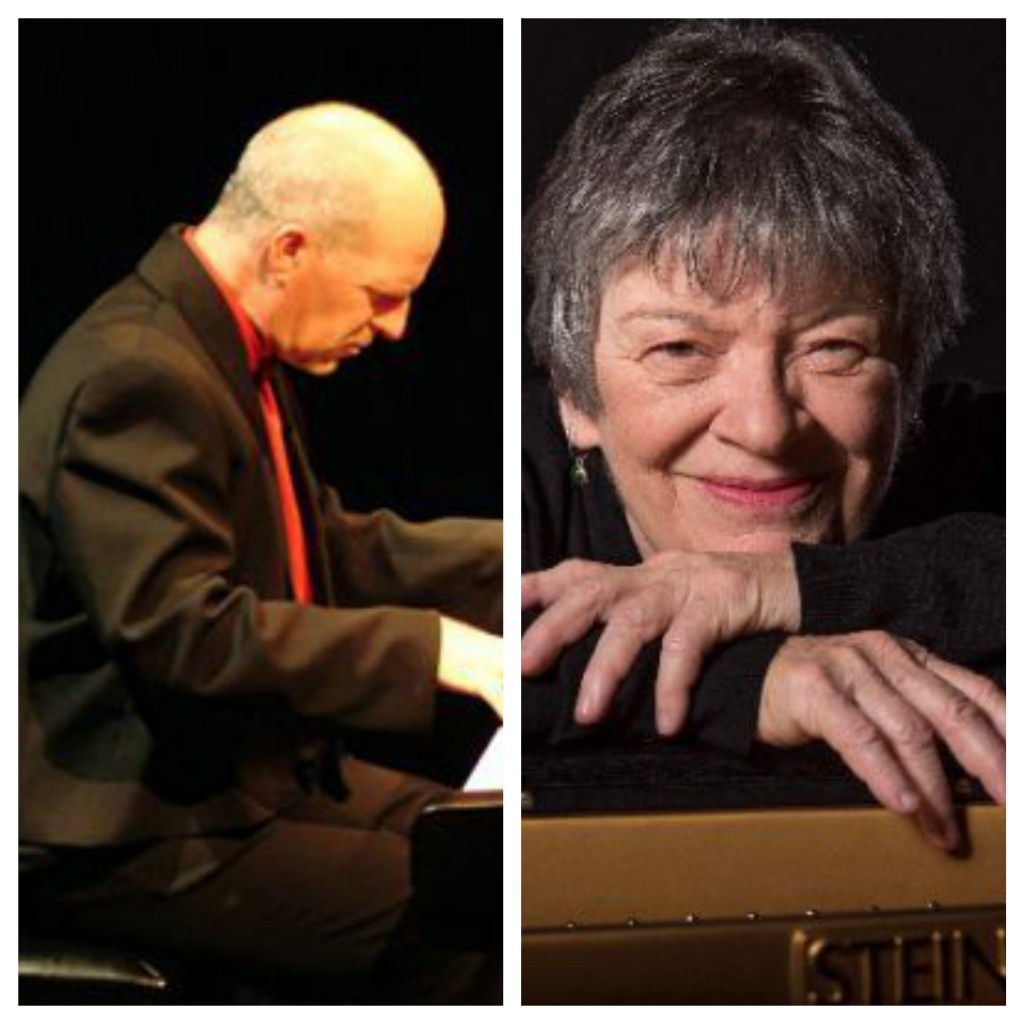
Michael Houstoun and Diedre Irons
Categories
Reviews, News and Commentary

Jae Hoon Lee

Jae Hoon Lee, Tilting The Horizon

Visions, Level 9, 10 Lorne St

Until July 11

Reviewed by John Daly-Peoples

Jae Hoon Lee’s latest exhibition at Visions is of work he produced as the Artist in Residence at the Tylee Cottage in Whanganui  and the works in the show use the landscapes of the Whanganui area

The works are  focussed on the landscape, seeing it from new perspectives as a physical entity as well as the its connections with mythology, history and the imagination.

His work often features multiple images which are manipulated and combined  to create work which brings together the real world and a surreal version, in which the study of the natural world including geology, atmospheric effects, are examined,

There is an enigmatic quality to these works, full of ambiguity and visual invention along with the constant play between reality and fabrication, between deception and objectivity.

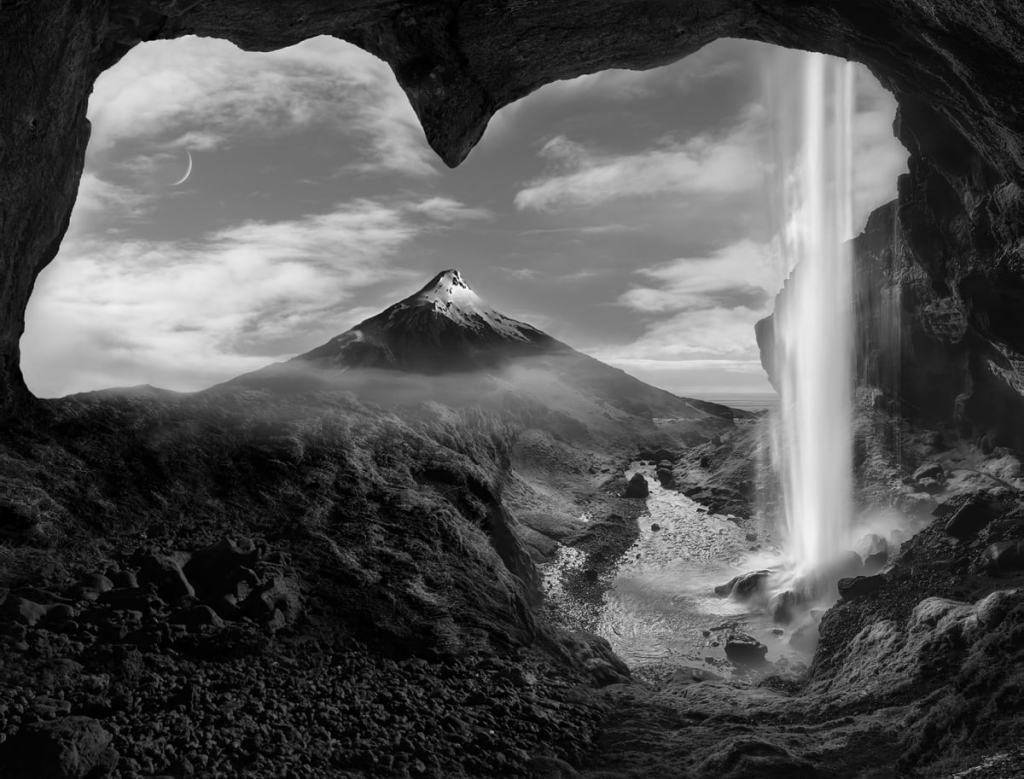
“Waterfall – Cave ($7000) presents an image of a mountain resembling Taranaki / Egmont which is framed by the opening of a cave and includes a waterfall.

The work connects with the various depictions of the mountain from  Heaphy to Perkins where the image is not just of the mountain itself but also providing a mythic and symbolic status.  It has an ethereal quality reminiscent of scenes from Lars van Trier’s  film Melancholia with its apocalyptic atmosphere.

With “Lightning – Sea Storm” ($15,000) the artist’s depiction of storm clouds and lighting captures the power and beauty of nature the extravagant of the  image could function as the background setting for a Baroque version of the Last Judgement.

In “Sunset Kai Iwi” ($15,000) the artist has employed a drone to produce an elevated view of the coast south from Whanganui with a distant view of Mt Egmont reminiscent of the photographs of Laurence Aberhart. The birds eye view  which shows the sun slipping below the horizon  is engaging both for the drama of the landscape as well as its technical cleverness.

“Sunset – Whanganui” ($11,000) is  lightly connected to the landscape with a church spire and a telegraph pole just visible below a massive, evening sunlit cloud. The cloud itself is obviously manipulated as though the photographers has stretched it out making it into a tortured mushroom cloud shape.

“Virginia Lake” ($12,500) which is a high view of five lakes is presumably some sort of cut and paste assemblage made up from Whanganui’s single Virginia Lake. As with the previous three images Lee has created  a new environment.

In all  these works he has not merely “tilted the horizon”, he has reset it relocated it presenting us with images which are both recognisable and disorientating.

Categories
Reviews, News and Commentary

Roberta Thornley

Roberta Thornley, My Head on your Heart

Tim Melville

Until July 4

Reviewed by John Daly-Peoples

Roberta Thornley’s latest exhibition “My Head on your Heart at the Tim Melville Gallery features images of balloons – Pink, orange, black, red, green, blue and silver. Set against a black background as though portraits, they have a simplicity and abstraction  which is both intriguing and imposing.

For the artist these are more than mere images of balloons as she says in notes to the exhibition

 “Mum’s waiting to get an angioplasty procedure. I picture a tiny balloon filling her arteries. I imagine the surgeon sitting bent over with pursed lips, trying to blow it up. ….I always feel sad seeing a balloon floating away in the sky….The only thing to lighten my thoughts is to think of it landing in the backyard of a home where children live.

Such personal thoughts make the title of the show more meaningful and poignant as the balloons trigger memories and emotions for the artist. For other viewers there will be other interpretations.

As with much her previous work it is not merely the obvious superficiality of the person or object which she is concerned with as each of them act as symbols or a means of conjuring up abstract ideas or emotions. These images also have a sense of narrative or a back story linking to other ideas about balloons, the tangible and the elusive.

In many cases the images lead us to make connections with other  objects and events so the  orange work “My Head on your Heart” ($6950) with its  free-floating balloon appears to connects with  historical balloons such as those of the Montgolfier’s conjuring up a sense of freedom and release. This connection to the idea of flight is  also reinforced by the background to the work which is of a vague landscape while all the other works have a black background.

“Pink Balloon and Floss” ($5500) which is probably a water filled balloon is a contrast to “My Head on your Heart” having a sense of weight and gravity.

In “Green and Blue Balloons” ($5500) there is a sense of  intimacy, the two balloons nudging each other and connected by a white umbilical cord. The “Two Black Balloons” ($5500) by contrast is a mysterious composition, the two balloons merging with the black background but connected by the white cords.

The  deflated “Silver Balloon” ($5500) which looks like some biological creature or organ has a tactile quality and there is a sense of distress and collapse with its puckered surface  as the air is seeps from the object.

With all these works the radiance of each of the balloons and the intensity of the colour demonstrates the photographers focus on colour and light, a feature of most of her previous work.