Categories
Reviews, News and Commentary

Gretchen Albrecht – between gesture and geometry

Reviewed by John Daly-Peoples

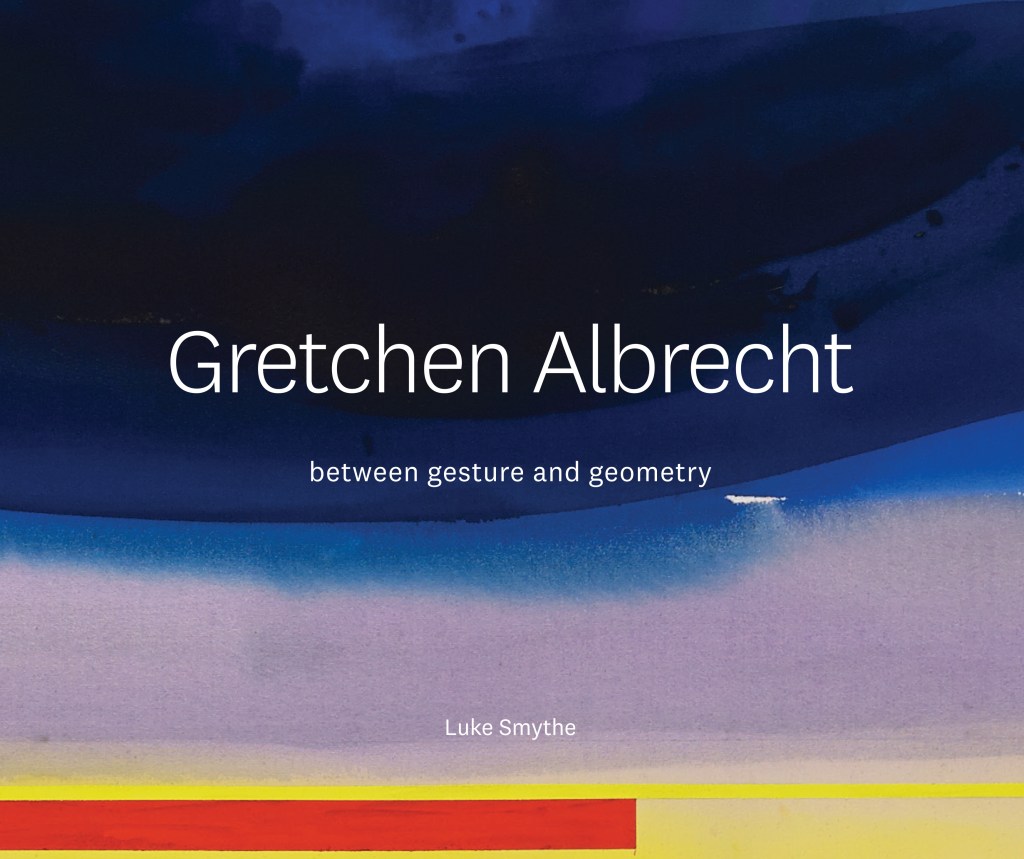
Gretchen Albrecht

between gesture and geometry

Luke Smythe

Massey University Press

RRP $85.00


Reviewed by John Daly-Peoples


The hemisphere works of Gretchen Albrecht which she has developed since the 1980’s have become the stylist  hallmark of the artist, its shape referencing the curved lunette window, the architectural arch and the dome of heaven.


The evolution of these works has been over many years and it is interesting and rewarding to look back at her progress as an artist and see the various threads which led to these major works.


“Gretchen Albrecht, between gesture and geometry” by Luke Smythe  first published in 2019 and now republished with extended writing provides a detailed examination of the artists life and
work and the various catalysts; art historical, art history, landscape, natural forces
and a range of other sources which have had an impact on her work,  creating vivid, intellectually persuasive and deeply affecting paintings.


Albrecht is one of the country’s most significant  painters whose work is to be found in all the
major private and public collections in New Zealand.


She has had over 50 solo exhibitions in New Zealand and internationally as well as being  included in numerous group exhibitions including the New Zealand exhibition Distance looks our way: 10
artists from NZ
 that was displayed at the 1992 Seville Expo


Albrecht graduated from Elam School of Fine Arts with a Diploma in Fine Arts with Honours in 1963.  She established herself and was seen as a leading artist in New Zealand with her first solo
exhibition being opened by Colin McCahon.


She is most well known as an abstractionist and  colourist  who  uses intense colours applied with dramatic gestural strokes on a range of shaped canvasses including the hemisphere and
ovals. Her work over the years has also included  watercolours, figurative paintings, prints and
sculptures.


Her first major survey exhibition was AFTERnature: a survey of 23 years at the Sarjeant Gallery, Wanganui in 1986.  She was also part of the important before being toured throughout New Zealand.  The retrospective exhibition Illuminations, that investigated two decades of Albrecht’s hemisphere and oval paintings, was held at the Auckland Art Gallery in 2002.


Other work has encompassed large-scale, stainless steel sculpture, multi-panelled rectangular paintings featuring a rectangular ‘threshold’ motif that has also been a key presence in
recent oval works.


Her development as an artist is also carefully outlined including the influence s on her work by local artists  and more importantly international artists such as Morris Louis and Helen  Frankenthaler.


Smythe provides ways of looking at the artist’s work notably with the earlier stained canvas paintings seeing the connections to the natural forms of nature – clouds, water, the various states
of the sky,


In her later work there is also the more cerebral influences of the Italian Renaissance and artists such as Piero Della Francesca. With these paintings there was an evolving interest in geometry
which manifests itself not only in the shaped canvasses but also the subject matter.


A number of her works have also drawn inspiration from artists such as Goya and his female portraits. More recently there have been a series based on the Cistercian liturgy and the  concepts of The Hours where the days are divided into seven traditional periods. Produced during the pandemic they reference notions of time and reflection.


As she has said of her work ‘I think I paint to still the anguish I feel in my heart, to order the chaos I sense is just outside the magic circle I draw around me with my painting.’


The hemisphere shapes she uses have provided a consistent physical template, a standard shape with which to survey the world. On this shape she is able to apply her dramatic painted gestures
which themselves are influenced by the artists experience of the world.

She employs a rigorous abstraction to achieve this, but her works have a basis in the world around her referring to landscapes, art history, the natural world  and her personal encounters with events and emotional reactions.


The book is illustrated with 260 images which provide  visual survey of the artists evolving  work as it has been created, developed and transformed. These illustrations also make one aware of the
artist great sense of colour which she uses as a means of  subtly exploring the boundary between chaos and control.


Smythe’s text is clear and perceptive combining aspects of the artist life, the influence son her work and the evolving emotional and intellectual approach of the artist.


Gretchen Albrecht’s current exhibition “Lighting the Path” will be exhibited at Two Rooms Gallery November 17 until December 22.


To subscribe or follow New Zealand Arts Review site – www.nzartsreview.org.

The “Follow button” at the bottom right will appear and clicking on that button  will allow you to followthat blog and all future posts will arrive on your email.

Or go to https://nzartsreview.org/blog/, Scroll down and click “Subscribe”


Gretchen Albrecht

between gesture and geometry

Luke Smythe

Massey University Press

RRP $85.00


Reviewed by John Daly-Peoples


The hemisphere works of Gretchen Albrecht which she has developed since the 1980’s have become the stylist  hallmark of the artist, its shape referencing the curved lunette window, the architectural arch and the dome of heaven.


The evolution of these works has been over many years and it is interesting and rewarding to look back at her progress as an artist and see the various threads which led to these major works.


“Gretchen Albrecht, between gesture and geometry” by Luke Smythe  first published in 2019 and now republished with extended writing provides a detailed examination of the artists life and
work and the various catalysts; art historical, art history, landscape, natural forces
and a range of other sources which have had an impact on her work,  creating vivid, intellectually persuasive and deeply affecting paintings.


Albrecht is one of the country’s most significant  painters whose work is to be found in all the
major private and public collections in New Zealand.


She has had over 50 solo exhibitions in New Zealand and internationally as well as being  included in numerous group exhibitions including the New Zealand exhibition Distance looks our way: 10
artists from NZ
 that was displayed at the 1992 Seville Expo


Albrecht graduated from Elam School of Fine Arts with a Diploma in Fine Arts with Honours in 1963.  She established herself and was seen as a leading artist in New Zealand with her first solo
exhibition being opened by Colin McCahon.


She is most well known as an abstractionist and  colourist  who  uses intense colours applied with dramatic gestural strokes on a range of shaped canvasses including the hemisphere and
ovals. Her work over the years has also included  watercolours, figurative paintings, prints and
sculptures.


Her first major survey exhibition was AFTERnature: a survey of 23 years at the Sarjeant Gallery, Wanganui in 1986.  She was also part of the important before being toured throughout New Zealand.  The retrospective exhibition Illuminations, that investigated two decades of Albrecht’s hemisphere and oval paintings, was held at the Auckland Art Gallery in 2002.


Other work has encompassed large-scale, stainless steel sculpture, multi-panelled rectangular paintings featuring a rectangular ‘threshold’ motif that has also been a key presence in
recent oval works.


Her development as an artist is also carefully outlined including the influence s on her work by local artists  and more importantly international artists such as Morris Louis and Helen  Frankenthaler.


Smythe provides ways of looking at the artist’s work notably with the earlier stained canvas paintings seeing the connections to the natural forms of nature – clouds, water, the various states
of the sky,


In her later work there is also the more cerebral influences of the Italian Renaissance and artists such as Piero Della Francesca. With these paintings there was an evolving interest in geometry
which manifests itself not only in the shaped canvasses but also the subject matter.


A number of her works have also drawn inspiration from artists such as Goya and his female portraits. More recently there have been a series based on the Cistercian liturgy and the  concepts of The Hours where the days are divided into seven traditional periods. Produced during the pandemic they reference notions of time and reflection.


As she has said of her work ‘I think I paint to still the anguish I feel in my heart, to order the chaos I sense is just outside the magic circle I draw around me with my painting.’


The hemisphere shapes she uses have provided a consistent physical template, a standard shape with which to survey the world. On this shape she is able to apply her dramatic painted gestures
which themselves are influenced by the artists experience of the world.

She employs a rigorous abstraction to achieve this, but her works have a basis in the world around her referring to landscapes, art history, the natural world  and her personal encounters with events and emotional reactions.


The book is illustrated with 260 images which provide  visual survey of the artists evolving  work as it has been created, developed and transformed. These illustrations also make one aware of the
artist great sense of colour which she uses as a means of  subtly exploring the boundary between chaos and control.


Smythe’s text is clear and perceptive combining aspects of the artist life, the influence son her work and the evolving emotional and intellectual approach of the artist.


Gretchen Albrecht’s current exhibition “Lighting the Path” will be exhibited at Two Rooms Gallery November 17 until December 22.


To subscribe or follow New Zealand Arts Review site – www.nzartsreview.org.

The “Follow button” at the bottom right will appear and clicking on that button  will allow you to followthat blog and all future posts will arrive on your email.

Or go to https://nzartsreview.org/blog/, Scroll down and click “Subscribe”


Gretchen Albrecht

between gesture and geometry

Luke Smythe

Massey University Press

RRP $85.00


Reviewed by John Daly-Peoples


The hemisphere works of Gretchen Albrecht which she has developed since the 1980’s have become the stylist  hallmark of the artist, its shape referencing the curved lunette window, the architectural arch and the dome of heaven.


The evolution of these works has been over many years and it is interesting and rewarding to look back at her progress as an artist and see the various threads which led to these major works.


“Gretchen Albrecht, between gesture and geometry” by Luke Smythe  first published in 2019 and now republished with extended writing provides a detailed examination of the artists life and
work and the various catalysts; art historical, art history, landscape, natural forces
and a range of other sources which have had an impact on her work,  creating vivid, intellectually persuasive and deeply affecting paintings.


Albrecht is one of the country’s most significant  painters whose work is to be found in all the
major private and public collections in New Zealand.


She has had over 50 solo exhibitions in New Zealand and internationally as well as being  included in numerous group exhibitions including the New Zealand exhibition Distance looks our way: 10
artists from NZ
 that was displayed at the 1992 Seville Expo


Albrecht graduated from Elam School of Fine Arts with a Diploma in Fine Arts with Honours in 1963.  She established herself and was seen as a leading artist in New Zealand with her first solo
exhibition being opened by Colin McCahon.


She is most well known as an abstractionist and  colourist  who  uses intense colours applied with dramatic gestural strokes on a range of shaped canvasses including the hemisphere and
ovals. Her work over the years has also included  watercolours, figurative paintings, prints and
sculptures.


Her first major survey exhibition was AFTERnature: a survey of 23 years at the Sarjeant Gallery, Wanganui in 1986.  She was also part of the important before being toured throughout New Zealand.  The retrospective exhibition Illuminations, that investigated two decades of Albrecht’s hemisphere and oval paintings, was held at the Auckland Art Gallery in 2002.


Other work has encompassed large-scale, stainless steel sculpture, multi-panelled rectangular paintings featuring a rectangular ‘threshold’ motif that has also been a key presence in
recent oval works.


Her development as an artist is also carefully outlined including the influence s on her work by local artists  and more importantly international artists such as Morris Louis and Helen  Frankenthaler.


Smythe provides ways of looking at the artist’s work notably with the earlier stained canvas paintings seeing the connections to the natural forms of nature – clouds, water, the various states
of the sky,


In her later work there is also the more cerebral influences of the Italian Renaissance and artists such as Piero Della Francesca. With these paintings there was an evolving interest in geometry
which manifests itself not only in the shaped canvasses but also the subject matter.


A number of her works have also drawn inspiration from artists such as Goya and his female portraits. More recently there have been a series based on the Cistercian liturgy and the  concepts of The Hours where the days are divided into seven traditional periods. Produced during the pandemic they reference notions of time and reflection.


As she has said of her work ‘I think I paint to still the anguish I feel in my heart, to order the chaos I sense is just outside the magic circle I draw around me with my painting.’


The hemisphere shapes she uses have provided a consistent physical template, a standard shape with which to survey the world. On this shape she is able to apply her dramatic painted gestures
which themselves are influenced by the artists experience of the world.

She employs a rigorous abstraction to achieve this, but her works have a basis in the world around her referring to landscapes, art history, the natural world  and her personal encounters with events and emotional reactions.


The book is illustrated with 260 images which provide  visual survey of the artists evolving  work as it has been created, developed and transformed. These illustrations also make one aware of the
artist great sense of colour which she uses as a means of  subtly exploring the boundary between chaos and control.


Smythe’s text is clear and perceptive combining aspects of the artist life, the influence son her work and the evolving emotional and intellectual approach of the artist.


Gretchen Albrecht’s current exhibition “Lighting the Path” will be exhibited at Two Rooms Gallery November 17 until December 22.


To subscribe or follow New Zealand Arts Review site – www.nzartsreview.org.

The “Follow button” at the bottom right will appear and clicking on that button  will allow you to followthat blog and all future posts will arrive on your email.

Or go to https://nzartsreview.org/blog/, Scroll down and click “Subscribe”


Gretchen Albrecht

between gesture and geometry

Luke Smythe

Massey University Press

RRP $85.00


Reviewed by John Daly-Peoples


The hemisphere works of Gretchen Albrecht which she has developed since the 1980’s have become the stylist  hallmark of the artist, its shape referencing the curved lunette window, the architectural arch and the dome of heaven.


The evolution of these works has been over many years and it is interesting and rewarding to look back at her progress as an artist and see the various threads which led to these major works.


“Gretchen Albrecht, between gesture and geometry” by Luke Smythe  first published in 2019 and now republished with extended writing provides a detailed examination of the artists life and
work and the various catalysts; art historical, art history, landscape, natural forces
and a range of other sources which have had an impact on her work,  creating vivid, intellectually persuasive and deeply affecting paintings.


Albrecht is one of the country’s most significant  painters whose work is to be found in all the
major private and public collections in New Zealand.


She has had over 50 solo exhibitions in New Zealand and internationally as well as being  included in numerous group exhibitions including the New Zealand exhibition Distance looks our way: 10
artists from NZ
 that was displayed at the 1992 Seville Expo


Albrecht graduated from Elam School of Fine Arts with a Diploma in Fine Arts with Honours in 1963.  She established herself and was seen as a leading artist in New Zealand with her first solo
exhibition being opened by Colin McCahon.


She is most well known as an abstractionist and  colourist  who  uses intense colours applied with dramatic gestural strokes on a range of shaped canvasses including the hemisphere and
ovals. Her work over the years has also included  watercolours, figurative paintings, prints and
sculptures.


Her first major survey exhibition was AFTERnature: a survey of 23 years at the Sarjeant Gallery, Wanganui in 1986.  She was also part of the important before being toured throughout New Zealand.  The retrospective exhibition Illuminations, that investigated two decades of Albrecht’s hemisphere and oval paintings, was held at the Auckland Art Gallery in 2002.


Other work has encompassed large-scale, stainless steel sculpture, multi-panelled rectangular paintings featuring a rectangular ‘threshold’ motif that has also been a key presence in
recent oval works.


Her development as an artist is also carefully outlined including the influence s on her work by local artists  and more importantly international artists such as Morris Louis and Helen  Frankenthaler.


Smythe provides ways of looking at the artist’s work notably with the earlier stained canvas paintings seeing the connections to the natural forms of nature – clouds, water, the various states
of the sky,


In her later work there is also the more cerebral influences of the Italian Renaissance and artists such as Piero Della Francesca. With these paintings there was an evolving interest in geometry
which manifests itself not only in the shaped canvasses but also the subject matter.


A number of her works have also drawn inspiration from artists such as Goya and his female portraits. More recently there have been a series based on the Cistercian liturgy and the  concepts of The Hours where the days are divided into seven traditional periods. Produced during the pandemic they reference notions of time and reflection.


As she has said of her work ‘I think I paint to still the anguish I feel in my heart, to order the chaos I sense is just outside the magic circle I draw around me with my painting.’


The hemisphere shapes she uses have provided a consistent physical template, a standard shape with which to survey the world. On this shape she is able to apply her dramatic painted gestures
which themselves are influenced by the artists experience of the world.

She employs a rigorous abstraction to achieve this, but her works have a basis in the world around her referring to landscapes, art history, the natural world  and her personal encounters with events and emotional reactions.


The book is illustrated with 260 images which provide  visual survey of the artists evolving  work as it has been created, developed and transformed. These illustrations also make one aware of the
artist great sense of colour which she uses as a means of  subtly exploring the boundary between chaos and control.


Smythe’s text is clear and perceptive combining aspects of the artist life, the influence son her work and the evolving emotional and intellectual approach of the artist.


Gretchen Albrecht’s current exhibition “Lighting the Path” will be exhibited at Two Rooms Gallery November 17 until December 22.


To subscribe or follow New Zealand Arts Review site – www.nzartsreview.org.

The “Follow button” at the bottom right will appear and clicking on that button  will allow you to followthat blog and all future posts will arrive on your email.

Or go to https://nzartsreview.org/blog/, Scroll down and click “Subscribe”


Categories
Reviews, News and Commentary

APO’s stunning Mahler 5

Reviewed by John Daly-Peoples

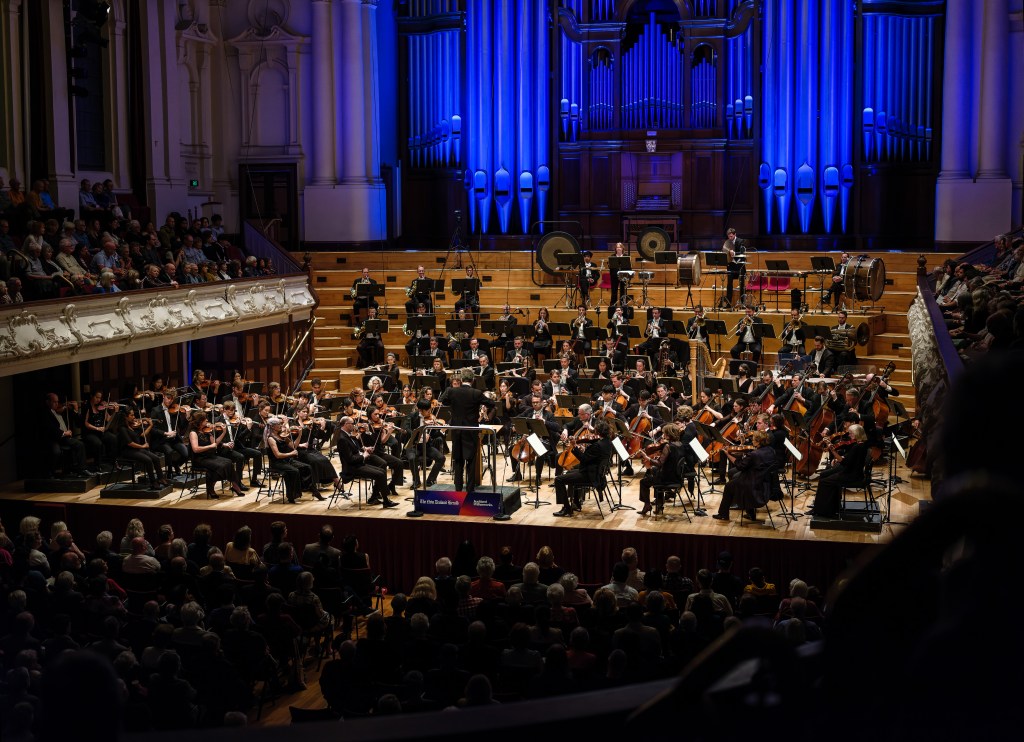
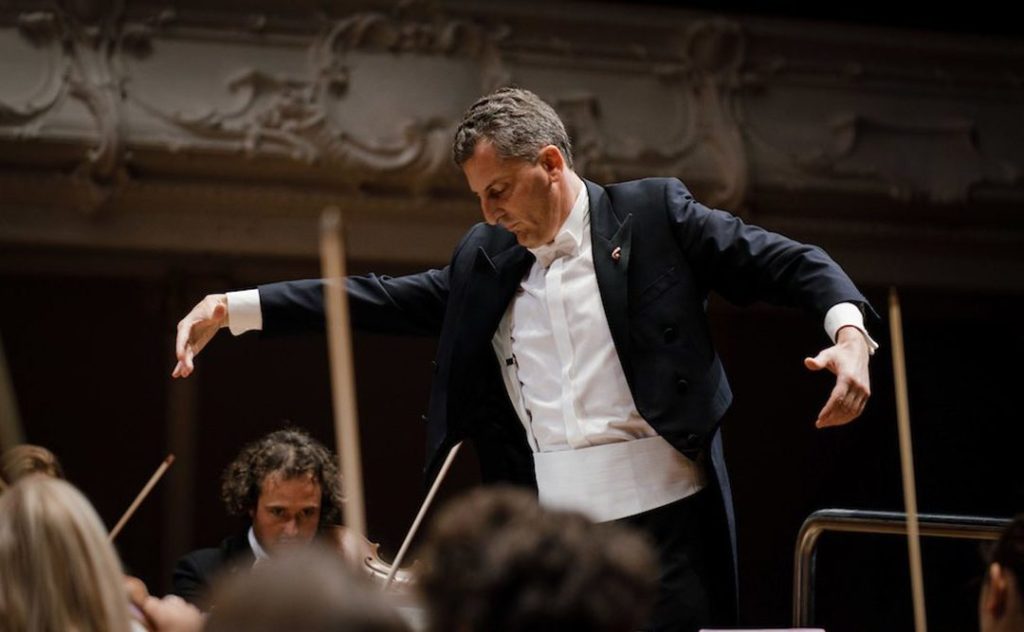
The Auckland Philharmonia performing alongside musicians from the Australian National Academy of Music (ANAM). Photo by Adrian Malloch.

Auckland Philharmonia Orchestra

Mahler 5

Auckland Town Hall

November 11

Reviewed by John Daly-Peoples

One of the impressive things about Mahler’s music is that the man looms out of the music. He is present at these performances not only in the music , but also with the conductor becoming his alter ego. We are presented with the man and his struggle to express himself through his music in a way few other composers manage to achieve.

Later in life Mahler had a relationship with Sigmund Freud both as a client as well as friend but his relationships, family tragedies and psychological issues associated with these had disturbed him for most of his life. In many of his symphonies and particularly in his Symphony No 5  the music is an attempt to understand and explore his inner psychological struggles.

While it is an autobiographical work exploring the composer’s personality, there are parallel themes as he depicts narratives, landscapes and explores emotion states.

The measure of a great performance is the way in which these twin aspects of the composer’s life is realized by the conductor and the orchestra. Conductor Giordano Bellincampi and the APO certainly achieved it with an intelligent and emotional performance.

Giordano Bellincampi

Bellincampi was firmly in control of the orchestra, understanding the drama, inventions and contrasts of the music. Subtle nuances were made evident and individual instruments were allowed to shine. Even the long silences between the movements became part of the music, allowing the audience to reflect on each of the previous movements.

Bellincampi managed to give the blaring, brass opening funereal march a sense of desolation while the singing strings provided a sense of optimism. This  romantic reflective mood depicted the man trapped between despair and hope.

In the second movement Bellincampi seemed to be battling the ferocious sounds of the orchestra and the nightmarish, reckless drama of the music before it morphed into quiet reverie, bringing out nuances and subtleties that seemed to explore the tragedy and triumphs of human and personal history and he allowed the interweaving of the solo violin, the brass and the strings to give the work an intense melancholy.

The final two movements, which included the famous adagio for strings which is considered to be something of a love letter to his wife Alma Schindler, were delivered perfectly filled with an aching sense of love and loss.

The finale was filled with changing moods, alive with bight woodwinds and brass. Bellincampi led the orchestra  in a brilliantly controlled finale where the doors of perception open and the funeral tones of much of the work are replaced by more exultant sounds offering hope and renewal.

The first half of the concert featured Richard Wagner’s work from two of his operas; the overture to Rienzi and Prelude and Liebestod from Tristan and Isolde.

Wagner’s music had a major influence on Mahler with Mahler’s work reflecting a Wagnerian aesthetic. Their music was dramatic and their  orchestras were correspondingly  large and often made use of massed  brass instruments. Both composers  liked big contrasts, periods of silence as well as extended  melodies.

The two works showed these Wagner / Mahler characteristics although where Wagner conveyed the Nietzschean idea of the Super Man, Mahler was more focused on the flawed Common Man.

The major haunting theme from Tristan which has had a more recent exposure in “Melencholia”, the brooding apocalyptic film by von Trier with its notions of end-time and renewal.

To subscribe or follow New Zealand Arts Review site – www.nzartsreview.org.

The “Follow button” at the bottom right will appear and clicking on that button  will allow you to follow that blog and all future posts will arrive on your email.

Or go to https://nzartsreview.org/blog/, Scroll down and click “Subscribe”
Categories
Reviews, News and Commentary

Pamela Wolfe’s “Entangled Bank”

Reviewed by John Daly-Peoples

Pamela WolfeThe Entangled Bank
Artis Gallery
Until November 27

Reviewed by John Daly-Peoples

In the catalogue accompanying her recent exhibition The Entangled bank Pamela Wolfe quotes from Charles Darwin’s The Origin of Species by Means of Natural Selection,

“It is interesting to contemplate an entangled bank, clothed with many plants of many kinds, with birds singing on the bushes, with various insects flitting about, and with worms crawling through the damp earth, and to reflect that these elaborately constructed forms, so different from each other, and dependent upon each other in so complex a manner, have all been produced by laws acting around us.”

Later in life when Darwin retired to the country where he took an intense interest in botany acquiring specimens and corresponding with other botanists. He was particularly interested in the question of why flowers had developed their many shapes, sizes and colours.

The plants depicted in Wolfe’s exhibition could well have been ones which Darwin might have grown and examined in his gardens.

Wolfe  has a similar enquiring mind about the plants she paints and there is a Romantic quality to them. In her introduction to the works, she mentions her early encounters with plants – “I recall walking through a tangled mass of wildflowers and towering weeds that bordered a large meadow near a small English village in spring”. It’s a  description which was similar to the lines of  Wordsworth.

When all at once I saw a crowd,

A host, of golden daffodils;

Beside the lake, beneath the trees,

Fluttering and dancing in the breeze.

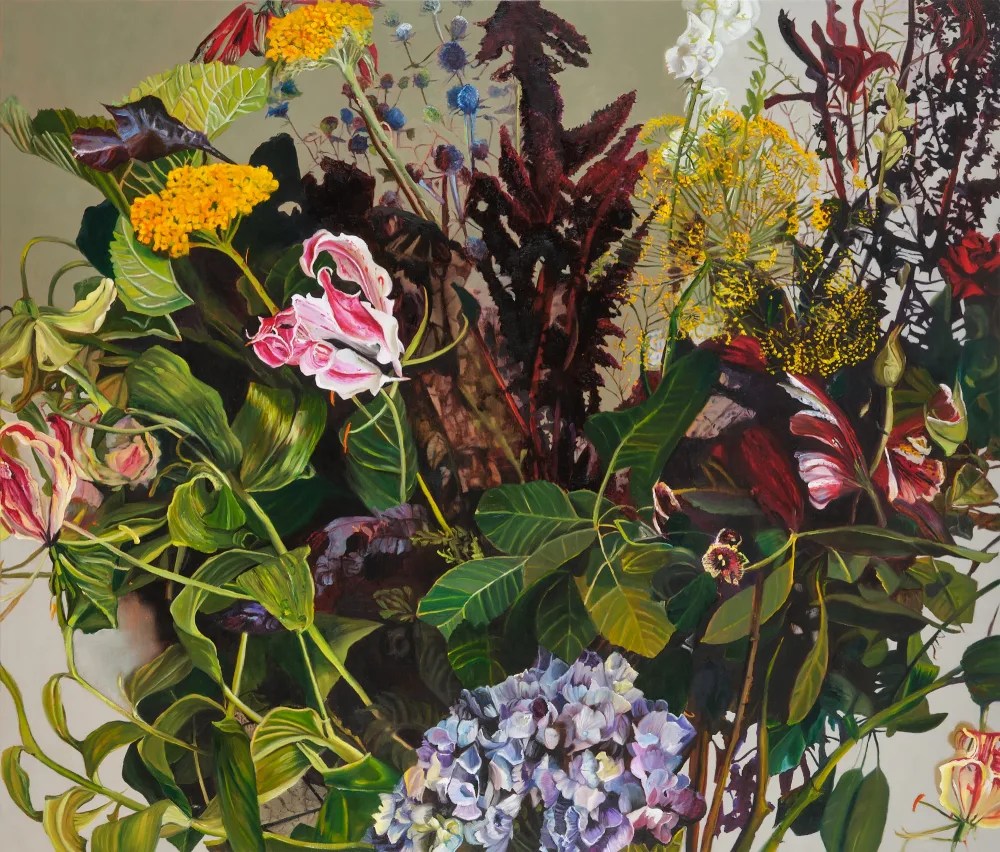
Entangled ($24,000) is  a reference to Wolfe’s quote from The Origin of Species  with the dark centre to the work giving a sense of damp earth.

Other works have references to Darwin’s interest in tropical plants which he raised in his hothouse at Down House such as Tropical 1 ($19,500)  and Tropical 2 ($22,000) with bright amaryllis and other exotic plants.

Dark Orchid ($24,000) is also an acknowledgement of Darwin’s work in collecting these exotic plants.

While the plants in Variation ($19.500) are clearly arranged in a vase, the other works present the plants as though they are specimens arranged for study.

With most of the paintings the plants are carefully modelled emphasising contrasts in colour, shapes and texture. Wolfe has depicted the voluptuous petals of the blooming flowers and buds in tightly cropped masses almost filling  the frame as with Entangled and  Late Summer Echinacea and Zinnias ($19,500).

Pamela Wolfe, Entangled

To subscribe or follow New Zealand Arts Review site – www.nzartsreview.org.

The “Follow button” at the bottom right will appear and clicking on that button  will allow you to follow that blog and all future posts will arrive on your email.

Or go to https://nzartsreview.org/blog/, Scroll down and click “Subscribe”

Categories
Reviews, News and Commentary

Skin Hunger: A play about death, guilt, sex and fulfillment

Reviewed by John Daly-Peoples

Eva (Tatiana Hotere) Image John Rata

Skin Hunger by Tatiana Hotere

Presented by Hout Houz Creative and Todd the Creative

Q Theatre

Until November 11

Reviewed by John Daly-Peoples

Tatiana Hotere’s Skin Hunger is a semi autobiographic exploration of the aftermath of Eva’s partners  death and the impacts on her sexual, social and personal life. Forty something,  Brazilian born, Catholic Eva has married a  Māori, had two children, lost her husband and now three years on is trying to deal with her sexual  desires, while still mourning her husband

Her situation raises the issue of guilt or rather Catholic guilt, not helped by her puritanical sister Julia who espouses the Catholic line on sex and marriage as well as a her  more lecherous friend Lorraine who, among other thing, helpfully orders a box dildos for Eva.

Tatiana Hotere who lost her own husband tragically has written the play as well as playing the sole role. If this was playing  at a comedy club she would be billed as one of the great stand-up comedians. If she was performing at a grief counselling conference she would be considered as a perceptive specialist and any newspaper or magazine would welcome her writing a sex advice column.

She is able to write intelligently and  perceptibly with wit about death, guilt and sex, linking the past and present with skill and compassion.

As well as presenting the complex character of Eva she also takes on the voices of Julia and Lorraine along with those of  her mother, the parish priest and an assortment of other characters who interfere with her life.

She manages the characters seamlessly, giving them each a distinct personality with various tones and body language. Through these other conversations Hotere  / Eva is able to deal with the endless platitudes she has to deal with about the loss of a partner and the need to move on.

She also encounters the social  and religious issue of the Madonna / Whore concept that many women face.

At the heart of all these conflicts and conundrums is Eva’s search for the plays title – Skin Hunger, the desire to physically touch another person in her quest for a  fuller life.

The play shifts continuously  between comedy and serious commentary, with Hotere crying, laughing, screaming at her predicaments. Sometimes she is completely caught up in herself while at other times she is totally engaged with the audience, even sharing her dildos.

There are some brilliant sequences as when she talks to her various dildos who all have special characteristics and her conversations with God who she realises is not much help.

It’s a play which God should go and see; he might learn something about how his churches could help women.

To subscribe or follow New Zealand Arts Review site – www.nzartsreview.org.

The “Follow button” at the bottom right will appear and clicking on that button  will allow you to follow that blog and all future posts will arrive on your email.

Or go to https://nzartsreview.org/blog/, Scroll down and click “Subscribe”
Categories
Reviews, News and Commentary

Ki Mua, Ki Muri: The transformation of contemporary Māori art

Reviewed by John Daly-Peoples

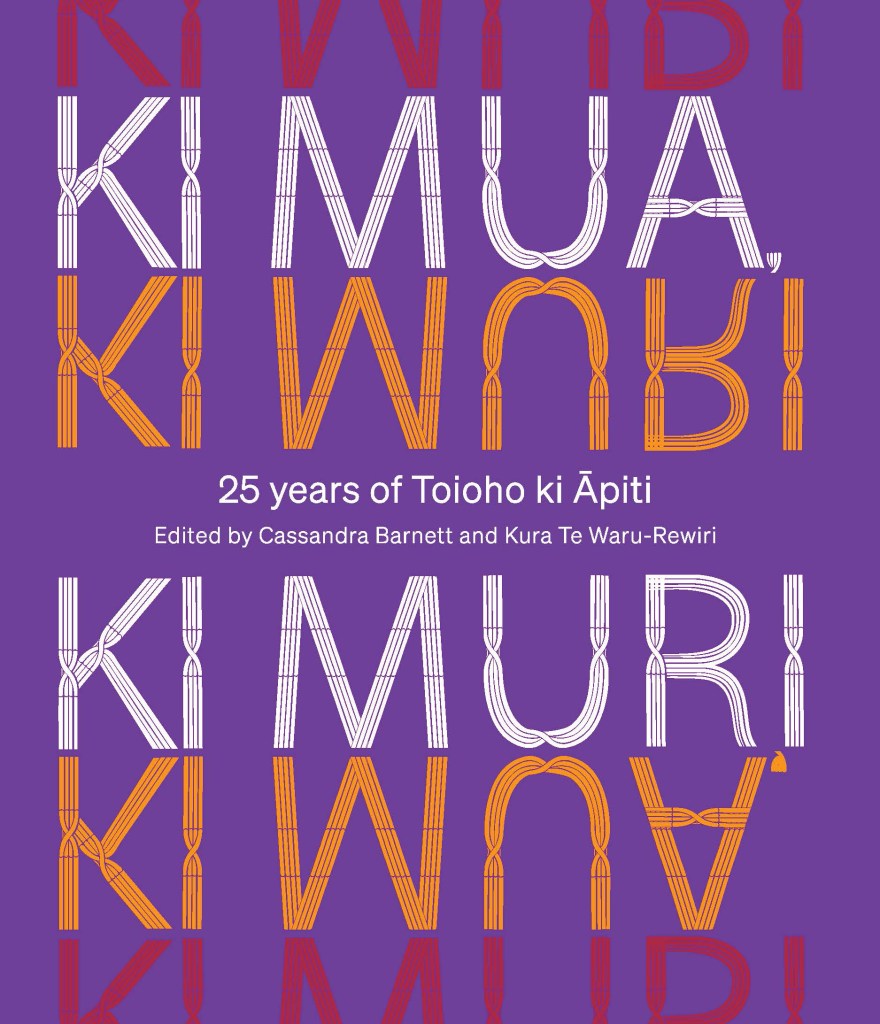
Ki Mua, Ki Muri

25 years of Toiohi ki Āpiti

Massey University Press

Edited by Cassandra Barnett and Kura Te Waru-Rewiri

With forwards by Ngāhuia Te Awekōtuku  and  Nigel Borell

RRP $70

Reviewed by John Daly-Peoples

When the exhibition Toi Tū Toi Ora: Contemporary Māori Art opened at the Auckland Art Gallery three years ago many people were surprised at the range and depth of the contemporary Māori art on view providing new insights into Māori culture as well as an understanding of New Zealand culture.

One of the catalysts behind the exhibition and much of  the new contemporary Māori art was “Toioho ki Āpiti” the Māori Arts programme which has been offered at Massey University,

The importance of these courses can be appreciated in the new book “Ki Mua, Ki Muri”, which details  the establishment and development of the Māori arts programme at the University which now has a  global reach, with impacts on national and international contemporary art and culture.

Nigel Borell, the curator of the Toi Tū Toi Ora:  exhibition was a graduate of “Toioho ki Āpiti” and also  a contributor to Ki Mua, Ki Muri says in a forward, “the exhibition’s  thesis and political will to centre a Māori framework and cultural paradigm as a way to discuss contemporary Māori art was directly shaped by the theoretical and conceptual teachings of the Toioho ki Āpiti programme”.

Toioho ki Āpiti’s Māori-led programme and its educational model is structured around Māori notions of Mana Whakapapa (inheritance rights), Mana Tiriti (treaty rights), Mana Whenua (land rights) and Mana Tangata (human rights) and is unique in Aotearoa.

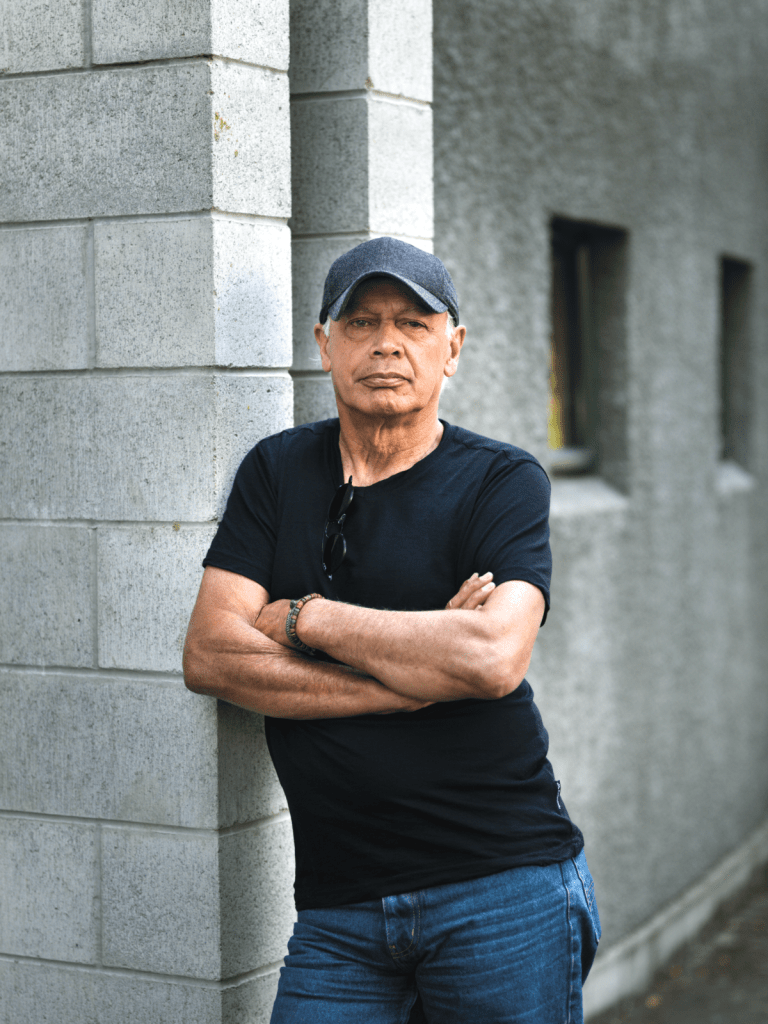
Robert Jahnke Image, Jane Ussher

Central to the courses is Robert  Jahnke, Professor of Māori Art at Massey University. He has been there since 1991 when he started Toioho ki Āpiti, under the direction of Professor Mason Durie’s. It was an arts programme which offered the first bachelor of Māori visual art.

Over three decades he has guided the course which has seen many of the most important New Zealand artists study, thrive and succeed. He has been the lynch pin or anchor for the students who have attended the courses.

Some of the graduates have had international shows such as Anton Forde who is currently showing his work at Sculpture by the Sea in Sydney as well as Brett Graham and Rachael Rakena who exhibited their collaborative work “Āniwaniwa at the 2007 Venice Biennale.

The book is a record of  25 years of the Toioho ki Āpiti programme, its influence on indigenous education, and the impact of its many graduates  on the contemporary art of New Zealand as well as internationally.

The book includes an introduction by Jahnke which is a record of his development as an artist as well as  providing an overview of the course, its geneses and development.

The staff and graduates, who include Shane Cotton, Brett Graham, Rachael Rakena, Kura Te Waru-Rewiri, Israel Birch and Ngatai Taepa, are some of the most exciting, thought-provoking and influential figures in contemporary New Zealand art. Through a series of intimate conversations and essays, Ki Mua, Ki Muri describes the unique environment that has helped form them as artists.

The book is also something of a history of recent contemporary Māori  art with a chapter on each of the nineteen artists or in a couple of cases, pairs of artists and they are each given 2500 – 6000 words plus images of half a dozen of their works. In these interview / essays the artists give accounts of their development as artists and teachers.

Some of these take a very personal approach with a wide-ranging acknowledgement of their individual growth before attending the course, the impact of the course on their approach to artmaking and their development since then.

In the chapter featuring Huhana Smith and Kura Te Waru-Rewiri the two artists engage in a spirited conversation reflecting on their individual careers and work, the development of their art practice, comments about the art market and acknowledgment of the impact of their students and teachers.

Shane Cotton, Gesture (2021)

The work of Shane Cotton which spans nearly 30 years from his early sepia to recent work featuring decorative pots / urns talks about the transformative nature of the course and the way the course has helped artists in reclaiming the often-contested history of Māori and Māori art.

The ceramicist Wi Te Tua Pirika Taepa speaks about his experience of growing as an artist through other institutions and his connections through artists / teachers such as Sandy Adsett and Robyn Stewart and the links back Gordon Tovey. He makes all sorts of connection back to his childhood, marae and even to his time in the Vietnam War. All  these experiences and ideas seem to be cast into his ceramic work.

The book provides an insight into the flowering of contemporary Māori art, the development of a contemporary imagery. It also shows the links and connections between the various Māori artists, both those who have been involved in the  course and others so there is a web of interlinked knowledge, practice and ideas.

Editors Cassandra Barnett and Kura Te Waru-Rewiri have compiled and engaging and set of interviews and essays along with their own perceptions which are informative and rewarding.

Cassandra Barnett is writer and artist of Raukawa, Ngāti Huri and Pākehā descent. She writes poetry, essays and short fiction about cultural and ecological futures. She worked as an art theorist and lecturer (fine arts/critical and contextual studies) for 15 years at institutions including Wintec Unitec and Massey University (Wellington). She is currently Pouako/Educator at Te Whare Taonga o Waikato Waikato Museum. She was a founding member of the publishing collective Taraheke.

Kura Te Waru-Rewiri (Ngāpuhi, Ngāti Kahu, Ngāti Rangi, Ngāti Kauwhata) studied at the Ilam School of Fine Arts and at teachers’ training college, and then taught art in schools, tertiary institutions, universities and whare wananga, and was one of the first Māori appointments to Elam School of Fine Arts in 1993. Her work is held in collections in both Aotearoa New Zealand and overseas and she has been a key contributor to contemporary Māori exhibitions both in New Zealand and abroad. She is the chair of the Mangaiti Marae Trust, a board member of Te Rūnanga o Whaingaroa and an arts director on the Toi Ngāpuhi Board.

To subscribe or follow New Zealand Arts Review site – www.nzartsreview.org.

The “Follow button” at the bottom right will appear and clicking on that button  will allow you to follow that blog and all future posts will arrive on your email.

Or go to https://nzartsreview.org/blog/, Scroll down and click “Subscribe”
Categories
Reviews, News and Commentary

Hiria Anderson-Mita and Daniel Unverricht paint distinctive environments

Reviewed by John Daly-Peoples

Ki roto, ki waho

DANIEL UNVERRICHT,  FULL DARK

{SUITE} PONSONBY

Until November 18

HIRIA ANDERSON-MITA, KI ROTO, KI WAHO

Tim Melville Gallery

Until   November 25

Two Auckland exhibitions are  presenting very two different environments, Hiria Anderson-Mita  at Tim Melville depicting a neighbourhood which offers community and hope while Daniel Unverricht’s showing at Suite suggests isolation and hopelessness.

Hiria Anderson-Mita has never had to look far for subject matter. She only has to look around the room, out the window or down the road. Her paintings are essentially documentation of her daily life, painting what she sees, the people she encounters and her immediast5e experiences.

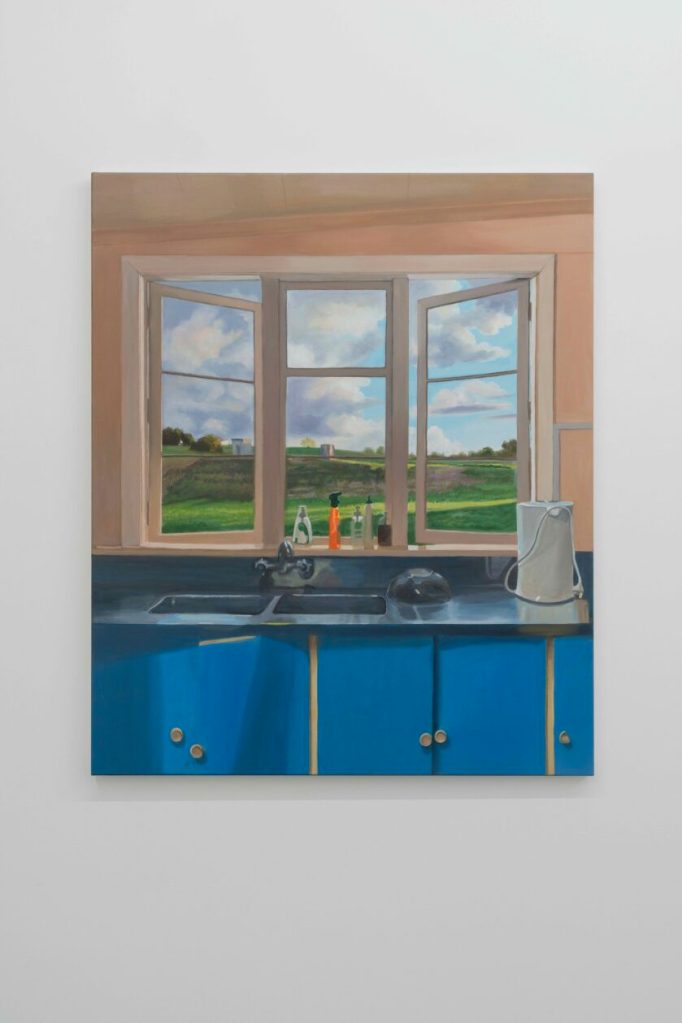
The large work “Ki roto, ki waho” ($16,500) is of the kitchen bench and a view to the surrounding land, a combination of the domestic interior and the local environment. The view through the window is itself like a landscape triptych, both mundane and intriguing.

This incongruity in many of her works gives the images both a simplicity and sophistication. In works such as “Marae Reflections” ($4500) she demonstrates a technical refinement in showing the marae façade as well as the depiction of a distance suburban landscape.

The three small works  each entitled “Stop Bank (Otorohanga)” ($2750 each) owe much to French Impressionist paintings as well as the rural paintings of David Hockney, in creating timeless views of the landscape.

 “Ka haere the wa” ($8500), presumably a form of memento mori related to one of her deceased relatives has its own sophistication with the representation of several objects which have symbolic meaning to the artist or the departed.

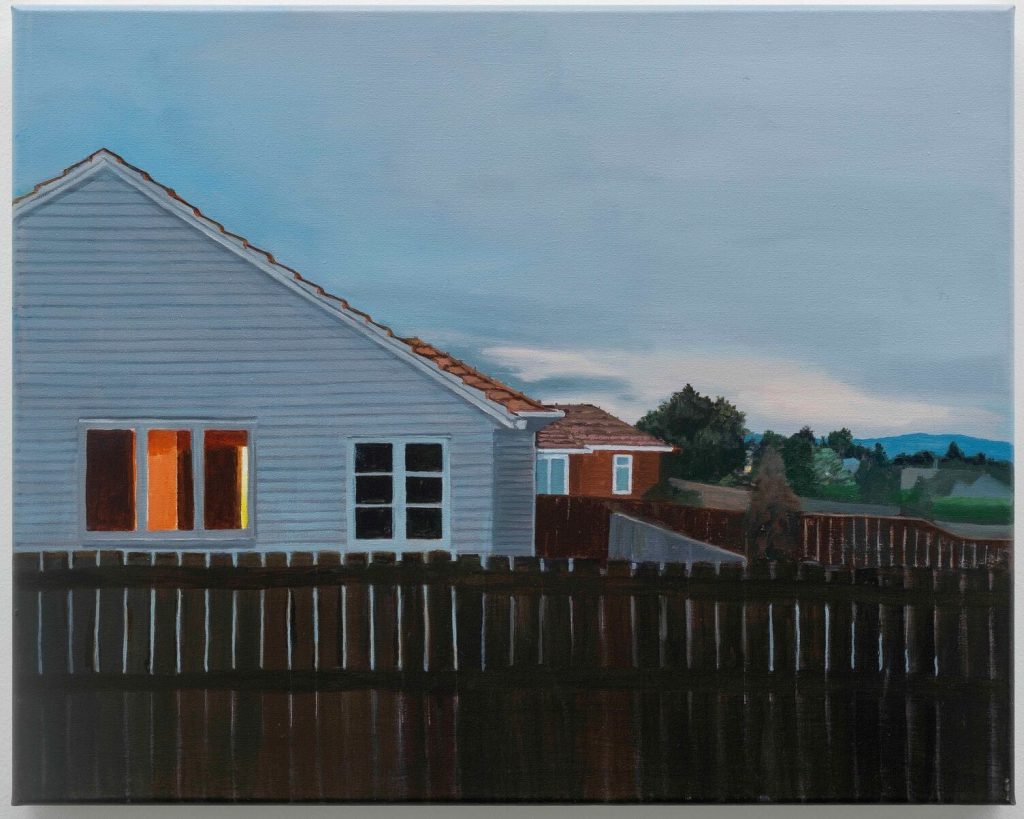
Looking over at the neighbours

“Looking over at the neighbours” ($5500) has something of the feel of  a Peter Siddell painting with its lack of human presence while “Māori, Male, 49, Folds his washing” ($3750) where we see a similiar house along with a more intimate portrait.

This intimacy can also be seen in “In my mother’s hands” ($4000) showing a small bird cupped in a pair of hands and “Aboard Te Huia” ($4000) where she observes a person lost in thought on a train.

Wick

The nighttime views of Daniel Unverricht’s small town  New Zealand present a  very different ethos from that of Anderson-Mita.  

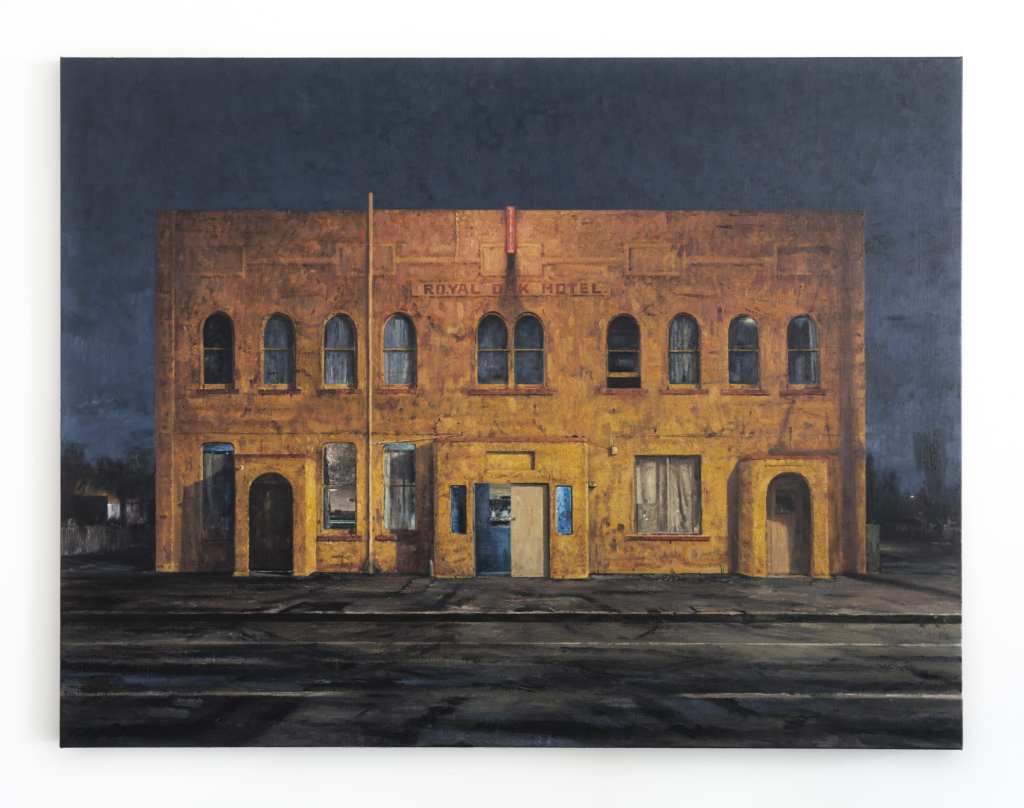
The paintings in his latest exhibition, “Full Dark” have  a gothic atmosphere to them. The mean, empty streets with buildings  bleached of colour have a melancholic beauty to them. While the views of streets and building hint at a human presence, there is no sense of welcoming, we are excluded and we observe with a mixture of fascination and foreboding.

Even with the large painting “Wick” ($25,000) of the Royal Oak Hotel where the front door is open and we see there is  activity within there is a feeling of menace. At the same time there is a fascination with the artists depiction, for in one window we see a reflection of a landscape illuminated by the  twilight.

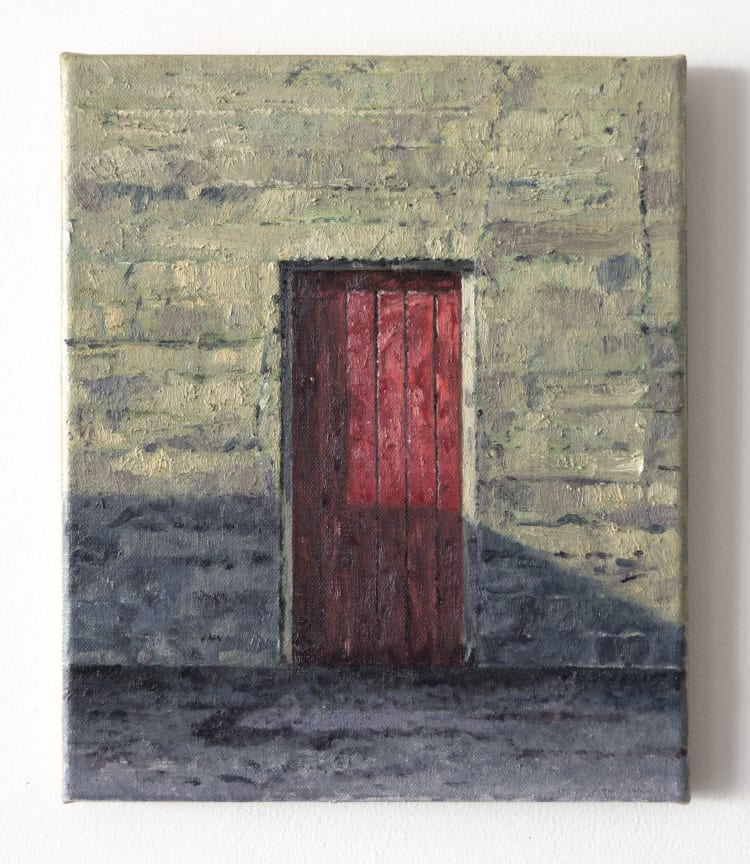
This ambivalence about entry and exclusion can be seen in “Shelter” ($3500)  with its scrappy red door set in a peeling concrete wall. It may offer shelter but the door seems firmly closed. Equally the glowing light in “Gateway” ($3500) suggests a welcome but the black silhouette of a house is unnerving.

Shelter

In most of the works the artist plays with the rendering of light. Often the light source is out of the picture frame as  in “Valentine” ($3000), in others it is central as in “Gateway”. In “Gloam” ($10,000) the artist has stripped way the light both in the distant sky and the fading road surface.

To subscribe or follow New Zealand Arts Review site – www.nzartsreview.org.

The “Follow button” at the bottom right will appear and clicking on that button  will allow you to follow that blog and all future posts will arrive on your email.

Or go to https://nzartsreview.org/blog/, Scroll down and click “Subscribe”

Categories
Reviews, News and Commentary

Joy, Love and Dreams in NZSO’s “Poem of Ecstasy” concert

Reviewed by John Daly-Peoples

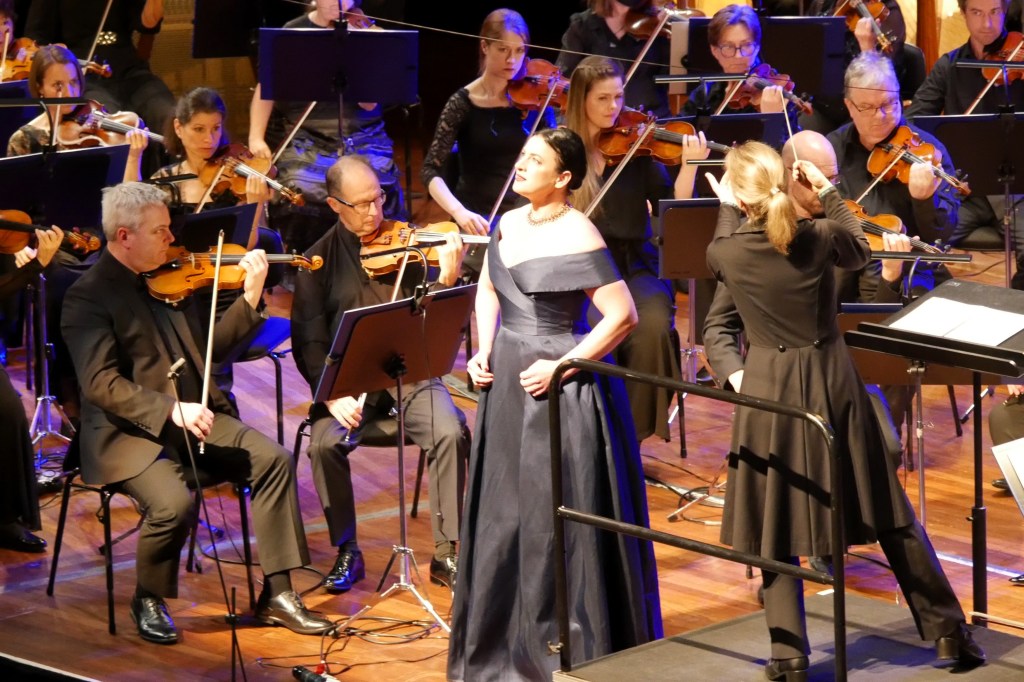
Madeleine Pierard and Gemma New

Poem of Ecstasy

New Zealand Symphony Orchestra

Auckland Town Hall

October 27th

Reviewed by John Daly-Peoples

In introducing the NZSO’s Poem of Ecstasy, con doctor Gemma New noted that the concert was filled with work suggesting Joy, Love and Dreams

The five works all showed composers grappling with the often deeply emotional nature of states of euphoria  and love. These ranged from the familial “Dance” of Kenneth Young which he sees as reflecting the innocent joy of having a two-year-old daughter through to Ravels huge symphonic “Daphnis et Chloe”, one of the great pastoral romances telling the tale   of two foundlings who fall in love at an early age, are kidnapped and separated, but are eventually reunited.

Scriabin’s work “The Poem of Ecstasy” which gave its name to the concert was based on a poem which the composer wrote and was linked to his beliefs in Theosophy where the greatest calling was to escape the physical world and enter a oneness with the cosmos. The work is filled with images of spirits, figures dancing in light, chimera and even monsters. It was a work with symphonic dimensions and clout.

This depiction of a spirit world is reflected in the music. Initially with the sweeping sounds of the woodwinds creating wistful themes followed by huge surges of emotion punctuated by the intrusive voice of the brass.

The  work reached a peak at the same time as the lights in the hall blazed red like some passionate monument and the audience were drenched in waves of lush emotion.

The finale of the work saw the light turn bright yellow along with a vibrant spotlight which referenced the final lines of the Scriabin poem.

“Thence the universe resounds

With a joyful cry I AM”

In the central part of the concert the audience was treated to two marvellous soloists – flautist Bridget  Douglas and soprano Madeleine Pierard.

The darkened Town Hall saw a  spotlit Douglas playing her flute while standing high above the orchestra. The solo work , Debussy’s “Syrinx” was delivered with brilliant technique which provided  a warm graceful sound.

Madeleine Pierard sang the Sibelius tone poem “Luonnotor” which was inspired by a Finnish  creation myth where a young woman is depicted adrift in the vastness of space.

The work is something of a challenge with the singer having to perform across a wide vocal range.

From the opening, Pierard’s piercing voice seemed to be in a battle with the orchestra which was like a ferocious force whirling around her then at other times she was carried along by the sinuous music. Her voice was complemented by the heavenly harps as her voice soared and then she would be swamped by the orchestra and her singing would take on a desperate edge.

There was an operatic dimension to her dramatic  singing and her stage presence conveyed the drama of the young woman buffeted by the forces of nature and the elements.

The major work was Ravels huge symphonic “Daphnis et Chloe”. Like the other works on the programme which were inspired by various forms of ecstatic states, this ballet the piece is focussed on the love between the two protagonists and the music reflects that passionate encounter.

The work opened with the orchestra creating images of Nature, the woodwinds taking on the sounds of an idyll –  birds tweeting, leaves rustling and rushing waters.

Much of the music reflected the notion of two characters communicating with each other as  divine-like spirits. These emotional interchanges were a mixture of operatic and film music which was always evolving. There were several sequences where Bridget Douglas and the other woodwinds unleashed some romantic themes.

Gemma New led the orchestra with a precision to detail and the sumptuous music provided a sense of an enveloping tenderness and sensuality.

To subscribe or follow New Zealand Arts Review site – www.nzartsreview.org.

The “Follow button” at the bottom right will appear and clicking on that button  will allow you to follow that blog and all future posts will arrive on your email.

Or go to https://nzartsreview.org/blog/, Scroll down and click “Subscribe”
Categories
Reviews, News and Commentary

Living Between Land and Sea – The Bays of Whakaraupō Lyttelton Harbour

Reviewed by John Daly-Peoples

Living Between Land and Sea

The Bays of Whakaraupō Lyttelton Harbour

Jane Robertson

Massey University Press

RRP $75.00

Reviewed by John Daly-Peoples

The early history of New Zealand apart from that of the major centres was a history of small, often remote communities who developed physical, economic and social infrastructure to establish develop and organise their communities.

One such community was centred around the many bays of Whakaraupō Lyttelton Harbour and a new book by Jane Robertson, “Living Between Land and Sea – The Bays of Whakaraupō Lyttelton Harbour” provides such a history of the settlements of the harbour.

The area and the surrounding hills have a long history of Māori activity. The islands of Aua / King Billy Island  and Ōtamahua / Quail Island were important sources of resources for local Māori, despite being uninhabited. Ngāi Tahu and Ngāi Mamoe used the islands as a source of shellfish, bird’s eggs and flax, as well as stone for use in tools.

This wide raging and superbly illustrated history tells of the settlements which developed in the bays of Whakaraupō Lyttelton Harbour. Each of the bays is given a chapter which the author details with extensive photographs from both the nineteenth and twentieth century  as well as details about the people, the history, the jetties and the activities  in each of them.

The various settlements include the larger areas of Lyttelton itself, Governors Bay, and Diamond Harbour as well as the smaller places such Purau and the military establishment and lighthouse at Godley Head / Taylors Mistake.

Many of the chapters deal with the history and myth of local Māori as well as the impact of the European settlements which gives a background to the unique development of each area of the harbour.

Robertson provides interesting historical facts and events which enliven the history making the book immensely readable and rewarding.

She writes about the torpedo boat which was stationed in the harbour at the time of the Russian Scare of the 1880’s and the development of military installations in the area.

There are the events around the establishment of the leper colony on Quail Island  in the early twentieth century as well as the whaling station at Waitata.

There are accounts of the tsunamis which occurred in 1868 and 1960 which did much damage to jetties and buildings in the harbour.

The  individuals and events of the area are woven together into a tapestry of intersecting threads covering both the European period of settlement and that of Māori going back many years, providing a history which is common to many areas of the country.

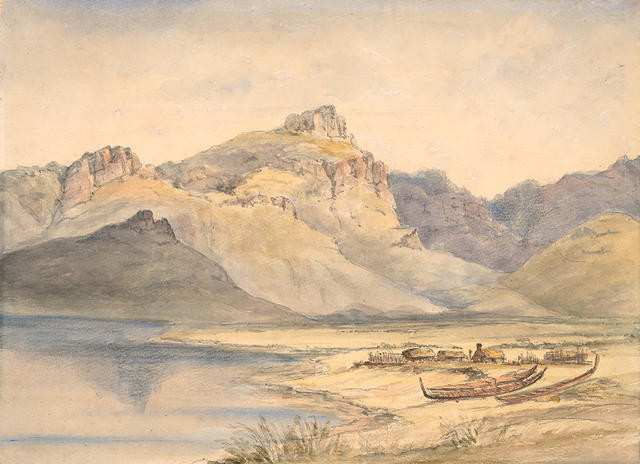
The book is richly illustrated with photographs from the nineteenth and twentieth century as well as some nineteenth paintings of the area including an 1850 work by Richard Oliver showing the Māori settlement and waka at Purau and  one by J M  Gibbs of Rapaki painted in 1877.

Richard Oliver, Maori settlement at Purau

The book explores the history of Te Hapū o Ngāti Wheke and their guardianship of this place,  describing the early history of Māori in the region. It also takes a geographical sweep around the harbour from the signal station at Te Piaka Adderley Head to the lighthouse at Awaroa Godley Head. In between, the stories of the bays and islands of this picturesque and historic harbour are described with fascinating details of early and contemporary life including maritime history and dramatic rescues, farming and trade, wartime experiences and quarantine stations, tourism and recreation.

Talking about her motivation for writing the book Robertson says “Whakaraupō Lyttelton Harbour is my home, the place I love, my tūrangawaewae. I wanted to understand this place better and then share that with others. When I completed Head of the Harbour: A History of Governors Bay, Ōhinetahi, Allendale and Teddington, in 2016, friends and local residents were interested in what was to follow. (I wasn’t, I just wanted a break!) When I was ready to write again, I started thinking about the Governors Bay and Teddington jetties, whose stories had so intrigued me. I thought I could extend that curiosity to all the jetties in the harbour — those still extant, those now derelict and those long ago dismantled and/or swallowed by the sea. While jetties were the physical starting point, I realised that they were just a portal — a way of stepping back into harbour communities whose reliance on the sea was so much greater than ours today.

I also believe strongly in the value of local history, of capturing voices and memories before they are lost for good.”.

“Living Between Land and Sea” adds greatly to our knowledge and understanding of the development of New Zealand and is an outstanding example of documentation about local communities.

To subscribe or follow New Zealand Arts Review site – www.nzartsreview.org.

The “Follow button” at the bottom right will appear and clicking on that button  will allow you to follow that blog and all future posts will arrive on your email.

Or go to https://nzartsreview.org/blog/, Scroll down and click “Subscribe”
Categories
Reviews, News and Commentary

The APO’s sensational Symphonic Dances

Reviewed by John Daly-Peoples

Chloé van Soeterstède conducting the APO Photo. Adrian Malloch

Symphonic Dances

Auckland Philharmonia Orchestra

Auckland Town Hall

October 19

Reviewed by John Daly-Peoples

The APO’s latest concert, Symphonic Dances opened with a welcome from the new CEO of the orchestra Diana Weir who was previously the Director of the Hamilton Philharmonic Orchestra in Ontario. She said it was a unique experience to be working with the orchestra which made phenomenal music possible. She also noted that she was announcing the orchestra’s programme for next year which included a superb range of music.

Conducting the programme was Chloé van Soeterstède who has been attracting the attention of orchestras across the globe. She has been praised for her intuitive, sensitive, expressive, music-making and attention to detail.

The major work on the programme was Mendelssohn’s  Violin Concerto, a work he had spent nearly ten years writing. The concerto adheres to the classical style of Beethoven while containing much of  the romantic ethos which leads on to the music of Brahms.  In several ways he  broke with tradition such as having the violin make an instant introduction to the work .

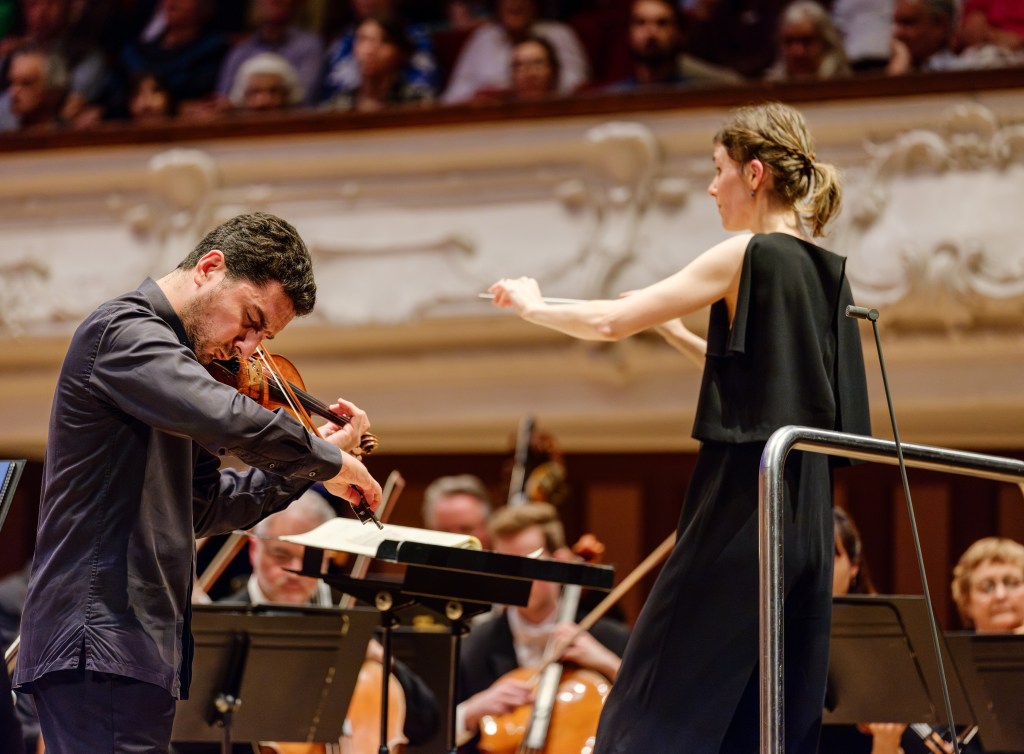
Violinist Sergey Khachatryan opened the turbulent first movement with a  relentless vigour, grappling with the music  as though he were in competition with the orchestra. At times his playing was raw, almost feral while at other times  he exposed the delicate and sensual elements of the music.

Sergey Khachatryan and Chloé van Soeterstède Photo. Adrian Malloch

He tackled the work with a  lively self-confidence, expertly managing the passages which Mendelssohn must have written to  technically challenge any performer.

In the second movement where the violinist can be dominated by the orchestra Chloé van Soeterstède ensured that even when he played softly his sound still rose above the orchestra and some of these whispered moments were tantalising. Equally his dramatic displays were achingly emotive.

There was a precision and focus throughout as though he was thinking his way through the music, thinking and contemplating.

In the third movement in which many of the motifs of the first movement were restated he responded in an almost playful way, engaging with the music in a very physical manner.

Throughout he managed to conjure up some graceful unforced tones with crisp articulation heightening the romantic  sweep of the music and discovering emotional depths in the music.

The concert opened with Prokofiev’s Classical Symphony, composed in 1916 and  the first of his seven symphonies.

It might seem incongruous that Prokoviev composed a work which hints at the music of a century before at the same time as the Russian revolution. In many ways the work is revolutionary in that it alludes to the work of Mozart whose symphonies and opera were revolutionary in their time.

The symphony is also revolutionary in term of Prokovievs own work being a major change from his dramatic First Piano Concerto which had marked him out as revolutionary only a few years before.

Van Soeterstède opened the first movement which is full of joyous music demonstrating why she is valued as a conductor. She conducted with dramatic gestures and a style which was balletic.

The dance-like whimsey of the second  movement had hints of the composers later ballet music while the third movement had a recognisable theme which would end up in his ballet music for Romeo and Juliet two decades later.

The Symphonic Dances was the last music Rachmaninov wrote, and the third movement features musical references to the Roman Catholic Requiem “Dies Ires”.  It is a  theme which recurs in many of his compositions reminding listeners of the terrors of the day of judgment. Mozart had previously employed the same melody in his “Requiem”, both  composers using the setting as premonition of their death.

The work saw van Soeterstède conducting with more feline gestures  as she led the orchestra in  the vigorous opening with its march-like music and an exquisite  passage featured featuring the woodwinds, the piano merging with the strings and an intrusive clarinet.

The elaborate music of the  second movement was enriched by Concertmaster Andrew Beer leading the orchestra in a slow, almost filmic  dance  theme.

In the third movement there were a range of innovative sounds, notably from the percussion, a disturbing clarinet and after an appearance of the Dies Irie theme a dramatic martial finale.

To subscribe or follow New Zealand Arts Review site – www.nzartsreview.org.

The “Follow button” at the bottom right will appear and clicking on that button  will allow you to follow that blog and all future posts will arrive on your email.

Or go to https://nzartsreview.org/blog/, Scroll down and click “Subscribe”
Categories
Reviews, News and Commentary

Urgent Moments: The power of art to make a difference

Reviewed by John Daly-Peoples

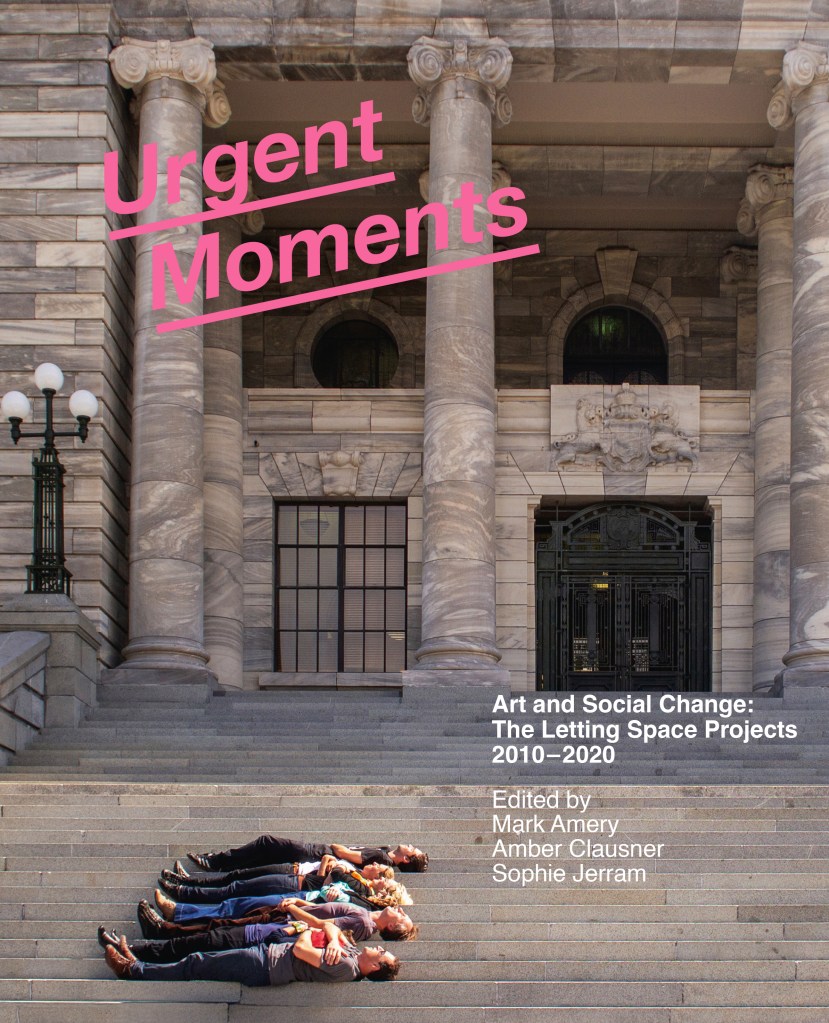
Urgent Moments

Art and Social Change: The Letting Space projects 2010–2020

Edited by Mark Amery, Amber Clausner and Sophie Jerram

Massey University Press

RRP $ 65.00

Reviewed by John Daly-Peoples

The recent elections showed that political parties appear to have little interest in developing arts policies which engage with communities. While there were major efforts made in the late 1980’s with the creation of Community Arts Councils which had funding from Creative New Zealand there have been few initiatives which not only help artists but strengthen local communities

Examples of communities engaged in transformative activities, often led by artists can articulate ideas and desires so that art becomes a catalyst for change and community cohesion.

The new book “Urgent Moments” provides examples of individuals and groups creating art environments or situations which address aesthetic, social and political  issues making use of non-gallery spaces.

in the mid-1990s, the public art curators Letting Space began occupying vacant spaces in post-stock-market-crash Auckland. The social conditions of the time in the wake of the 2008 global financial crisis led many to question the prevailing dealer gallery system and the way in which art was produced, marketed and commented on.

The book is written and edited  by Mark Amery, Amber Clausner and Sophie Jerram with contributions from leading New Zealand writers and thinkers, including Pip Adam and Chris Kraus, Urgent Moments demonstrates the vital role artists can play in the pressing discussions of our times.

Letting Space worked  in Wellington and Dunedin with property managers, individuals and community groups to broker the temporary use of vacant space for projects.

The idea was to use public art as a way to regenerate and rejuvenate communities and urban spaces.

In  Wellington some designer-artists turned an old bank building into a ”mood bank” for three weeks. Instead of depositing money individuals deposited one’s idea of their personal mood of the day. A deposit slip  was filled out and this mood slip was stamped and authenticated.

Another project, Free Store featured a grocery shop where everything was free with much of the produce donated by local businesses. of the  area.

The group also created  TEZAs (Transitional Economic Zone of Aotearoa) which brought a community-based approach to public art. The first TEZA was in New Brighton, Christchurch, after the suburb’s shopping centre was destroyed by earthquakes.

They set up an encampment on the shopping area and welcomed artists and locals to come and be creative. Installations cropped up, a school documented itself with photography, and locals biked around the suburb singing as part of a ‘Bicycle Choir’.

In Porirua as part of a local arts festival people could create their own coffins or design urns for their own remains as well as baking bread to create a Porirua Loaf.

Projected Fields

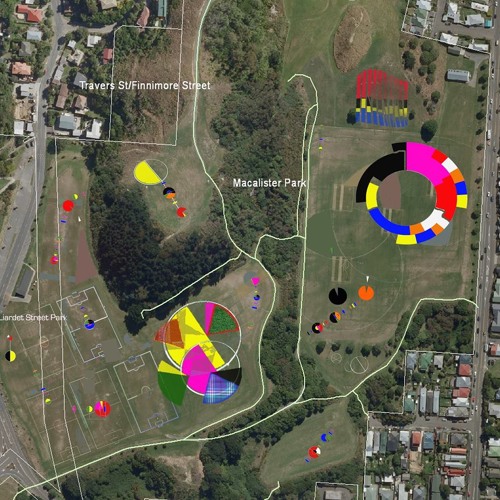
One of the more ephemeral works was Projected Fields,  a temporary contemporary public art project that involved contributions from the public, local communities, sporting groups and businesses, mixing the worlds of physical and digital community interaction, as well as expanding on the notion of public art. 

The playing fields of Macalister Park in Wellington were painted with coloured charts which reflected the community use of the area as well as identifying the geographical and historical aspects of the area.

The book feature dozens of projects undertaken by the group over  a decade as well as photographic documentation along with essays by noted artists and writers on the impact of these projects.

One of the editors of the book, Sophie Jerram says, “ What’s important with this book is that we’re documenting amazing ideas created years before they became mainstream. For example, Free Store is an accepted institution now; discussions about employment and productivity and the UBI have become serious; single-use plastics are practically outlawed.

“Urgent Moments” shows the unique power of art to unite, transform and revitalise communities and how individuals collectively can become artists.

To subscribe or follow New Zealand Arts Review site – www.nzartsreview.org.

The “Follow button” at the bottom right will appear and clicking on that button  will allow you to follow that blog and all future posts will arrive on your email.

Or go to https://nzartsreview.org/blog/, Scroll down and click “Subscribe”