
Photo: Andi Crown
Reviewed by Malcom Calder
Tiri: Te Araroa Woman Far Walking
He Kōpara: Haare Williams
By: Witi Ihimaera
Auckland Theatre Company
Dir: Katie Wolfe
Kaihapa Reo Māori & Translation: Maioho Allen
Mātanga Whakaari & Editor: Katie Wolfe
Set: John Verryt
Lighting: Jane Hakaraia
Costumes: Te Ura Taripo-Hoskins
Composition and Sound: Kingsley Spargo
Vision: Owen McCarhy
Movement and Assitant Director: Katrina George
With Miriama McDowell and Nī Dekkers-Reihana
ASB Waterfront Theatre
Until 23 November
Reviewer Malcolm Calder
Witi Ihimaera’s original words inclined, as he has himself has said, towards a blast of frustration and anger. This stunning contemporary production 25 years later remains true to those same frustrations but Katie Wolfe has rounded and matured them. The result is a stunning, and brilliantly executed production laced with personality and humanity that never loses sight of its own message while addressing them with a 21st century appreciation of all things treaty – from a uniquely maori perspective.
A good friend has bemoaned that fact that there is no script. And there’s not. Rather Tiri: Te Araroa Woman Far Walking is a deeply-felt, personalised memoir delivered bi-lingually as a rather different take on mainstream history. It is filled with pride, with joy and with a sense of fun that never loses sight of its primary concerns – what lies in peoples’ hearts, just beneath the surface.
With significant input from rangatira Sir Haare Williams and nuanced te reo from Maioha Allen, coupled with a dramatic staging and a cast that more than just shines, the result is something profoundly remarkable.
As such it stands as something not only relevant to audiences in Aotearoa New Zealand today but, just as Neil Ieremaia has done with dance, so Katie Wolfe has now done with theatre – placed a stake firmly in the ground with a serious work that is exportable to the world at large. It is something of which all New Zealanders should be proud.
I happen to be a fourth-generation kiwi of Scots descent who claims no te reo at all. Yet I surprised myself at how many words and phrases I actually know and understand. That is New Zealand today.
In my own case too, I vividly recall as a child some very aged kuia who would sit, shrouded in blankets and smoking their long pipes outside the Te Awamutu post office back in the 1950s. Just as Tiri does in this production, they were sharing their own past memories and I recall being staggered to come to the realisation that many had actually been at the nearby Orakau pa and the retreat across the river – albeit as children at the time – nearly 90 years previously.
It is all about memoirs and the memories that fuelled those kuia. Just as it is popular today for many of increasing years to write their own personalised memoirs, that is precisely what those kuia were doing. And it is what Ihimaera borrowed and expanded as a device for Tiri – albeit over a rather longer spread of years of which she constantly reminds us with a warmth and an irrepressible twinkle in her eyes putting her own literary longevity down to regular bowel movements and sex. Sex every day.
Miriama McDowell is a truly accomplished actor with an ever-increasing number of roles and accomplishments to her credit. But, as Te Tiriti o Waitangi Mahana, she has moved to another level where stunning is to devalue her performance. Here she can only be described as magisterial. The eyes have it and say so much. One wonders where her career will lead – it has a long way to go.
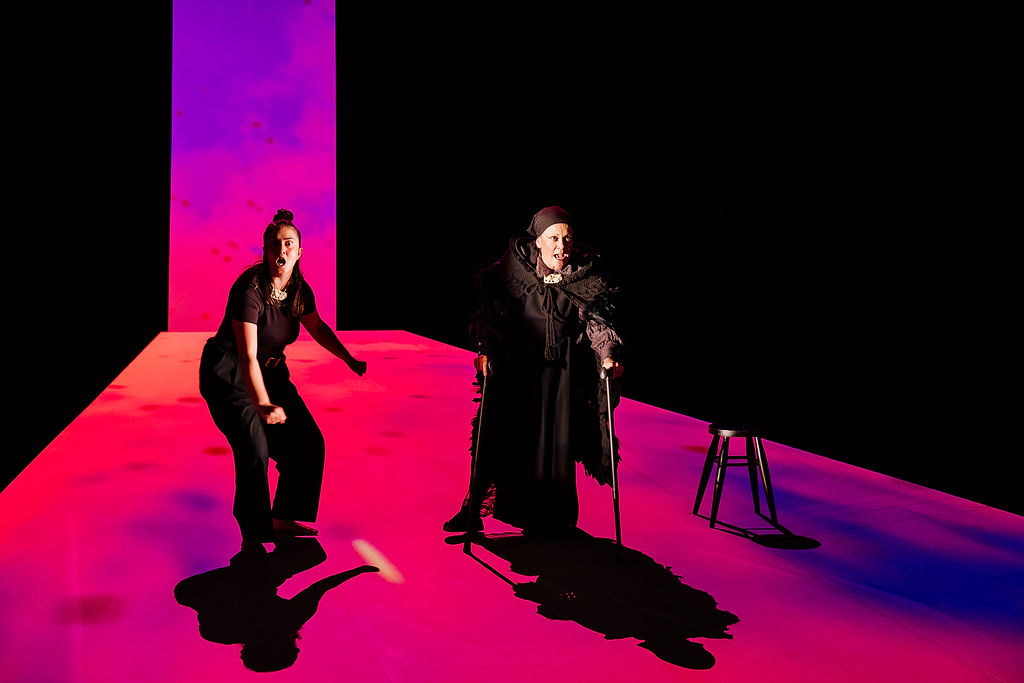
Photo: Andi Crown
Offsetting her and drawing attention to Tiri’s strengths, weaknesses, and other attributes is Nī Dekkers-Reihana as her foil Tilly. Perhaps interestingly one definition of the word suggests it came from the practice of mounting a gem on a metal foil to make it shine more brightly. Nī does so irrepressibly.
Production values have been a feature of ATC’s work this year and this time around they can only be described as brilliantly understated abstraction. John Verryt’s set is simple, clean and cleverly focussed. It is enhanced by Jane Hakaraia’s dramatic lighting, and an ominous, murmuring soundscape created by Kingsley Spargo.
There were a couple of awkward moments on Opening Night –the introduction of the only prop, a stool, being one – but these very minor indeed.
Suffice to say that the audience response was celebratory. A haka indeed !
To subscribe or follow New Zealand Arts Review site – www.nzartsreview.org.
The “Follow button” at the bottom right will appear and clicking on that button will allow you to follow that blog and all future posts will arrive on your email.
Or go to https://nzartsreview.org/blog/, Scroll down and click “Subscribe”

 New Zealand Arts Review