Reviewed by John Daly-Peoples

Felicity Jones and Mark Smith
Case Studies: A story of plant travel
Massey University Press
RRP $85.00
Reviewed by John Daly-Peoples
Case Studies Exhibition
Silo Park
October 9 – 19
The movement of plants and foods between countries and around the globe has been going on for centuries, linked to human migration, creating new trading routes, altering the appreciation of plants and changing diets.
The rose which is so central to English culture originated in Asia while the now staple food of the potato and the tomato came from South Ameruca. Even the kūmara was brought to New Zealand by Polynesian voyagers around 700-800 years ago.
Since the voyages of Captain Cook and other European explorers in the eighteenth and nineteenth century there has been a huge increase in the movement of plants species between Europe and New Zealand and a new book “Case Studies” explores this activity.
The book explores how the British Empire came to dominate the globe linked to the intriguing story of how the Wardian Case designed by Nathaniel Bagshaw Ward. The case was an early type of terrarium, a sealed protective container for protecting foreign plants imported to Europe from overseas.

However the book is much more than an historic account of the Wardian case, plant movement and transfer. It is also a catalogue of an exhibition featuring numerous ‘Installations’ by Jones of plants in small glass cases placed in various environments. It is also a journal of the journey of artist / writer Felicity Jones and photographer Mark Smith as they research the book and exhibition.
As the two say about the project “What started as quite a personal exploration has definitely grown into something much larger. Each new idea and road trip revealed another layer, presenting deeper questions about the entanglement of people and plants. We started to realise the work was limitless as it moved backwards and forwards in time, and as we explored notions of beauty and dislocation, systems of knowledge and science, hierarchies of value in the botanical world and the motivations, aspirations, attitudes and beliefs that lay behind plant travel. Early on, we sat down and made a kind of wish list — plants and locations that had always interested us or that linked back to Dr Ward in some way”.
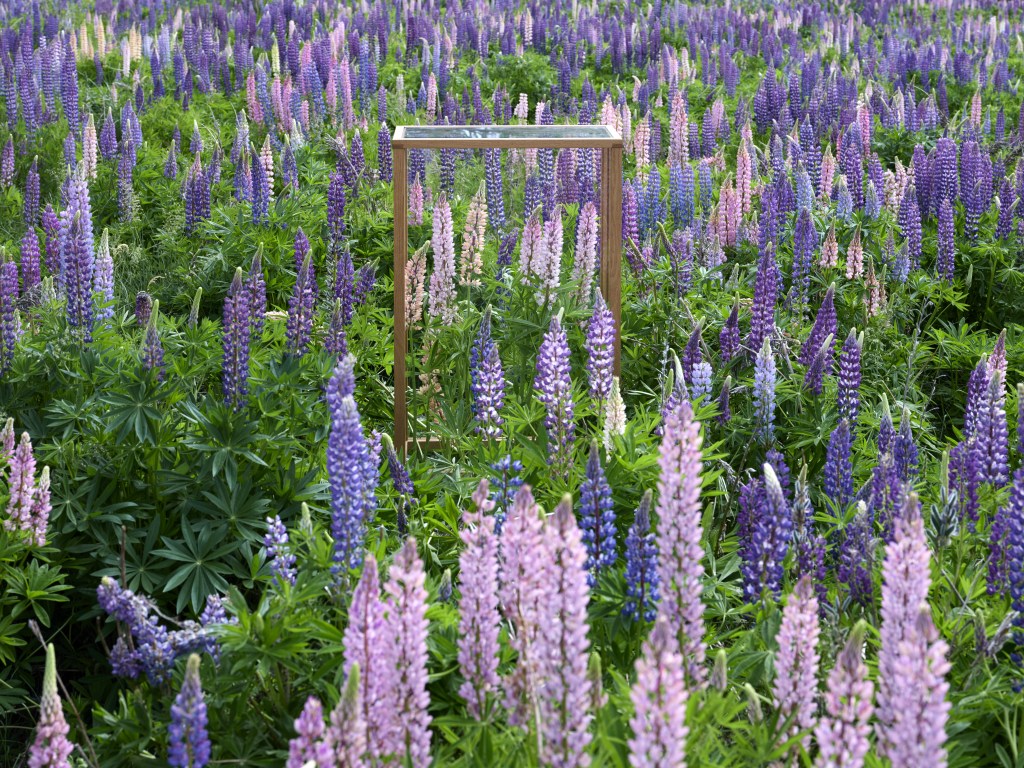
Over the seven years of the project, Jones and Smith created and photographed evocative case installations in Aotearoa New Zealand and the United Kingdom. Their journey took them from the forest and beach of Auckland West Coast, Central Otago and the Lindis River to Oxford punts, London’s Natural History Museum and the Chelsea Physic Garden.
The book traces that story through photographs and essays with reflections on the implications of plant transfer/movement. Across six essays by Gregory O’Brien, Dame Anne Salmond, Luke Keogh, Mark Carine, Markman Ellis and Huhana Smith, the book considers not only the scientific and colonial ambitions that drove botanical exchange, but also its consequences: ecological disruption, the spread of invasive species, and the marginalisation of Indigenous knowledge systems.
The book tells of the way in which many of the plants species which were sent to the UK are now being returned. The ngutukākā or kakabeak is now one of New Zealand’s most endangered plants but seeds taken to Kew by Banks and Solander are being now being used to reestablish the plant.
Then there are the more surreal settings of Tower Bridge in London, The Natural History Museum and Kew Gardens.

There are also photographs which are intriguing for their wider history as well. Many of the plants collected by Banks and Solander were wrapped in printers discarded paper with some having been wrapped in copies of the Spectator including an article entitled “Notes upon the 12 books of Paradise” by Joseph Addison. This was an early eighteenth version of Milton’s “Paradise Lost” with illustrations by William Blake.
It is a handsomely designed book thanks to designer Murray Dexter which includes two page spreads with smaller photographs, mixing the descriptive and documentary with the quirky, thoughtful and reflective. It is an unusual and slightly surreal book in many ways. While the text and many of the photographs provide both an historical and personal narrative these same photographs of the glass cases in the environment convey a strange dreamlike vision, somehow disconnected from the physical worlds.
The launch of the book will coincide with an exhibition of many of the photographs.
Exhibition title: Here, There, Now
Venue: Silo 6, Silo Park Wynyard Quarter
Exhibition dates: October 9-19, 11am-6pm daily, free, open to the public.
To subscribe or follow New Zealand Arts Review site – www.nzartsreview.org.
The “Follow button” at the bottom right will appear and clicking on that button will allow you to follow that blog and all future posts will arrive on your email.
Or go to https://nzartsreview.org/blog/, Scroll down and click “Subscribe”

 New Zealand Arts Review