Reviewed by John Daly-Peoples
The Monster in the Maze by Jonathan Dove (music) and Alasdair Middleton (libretto)
NZ Opera
Aotea Centre
September 19
Reviewed by John Daly-Peoples
The community opera The Monster in the Maze has just finished its three-centre (Christchurch, Wellington and Aucklanldrun to full houses and going on the opening night in Auckland) it seems to have attracted a new audience. If that was one of the intentions of putting on a more experimental / community work, it may well have achieved its purpose.
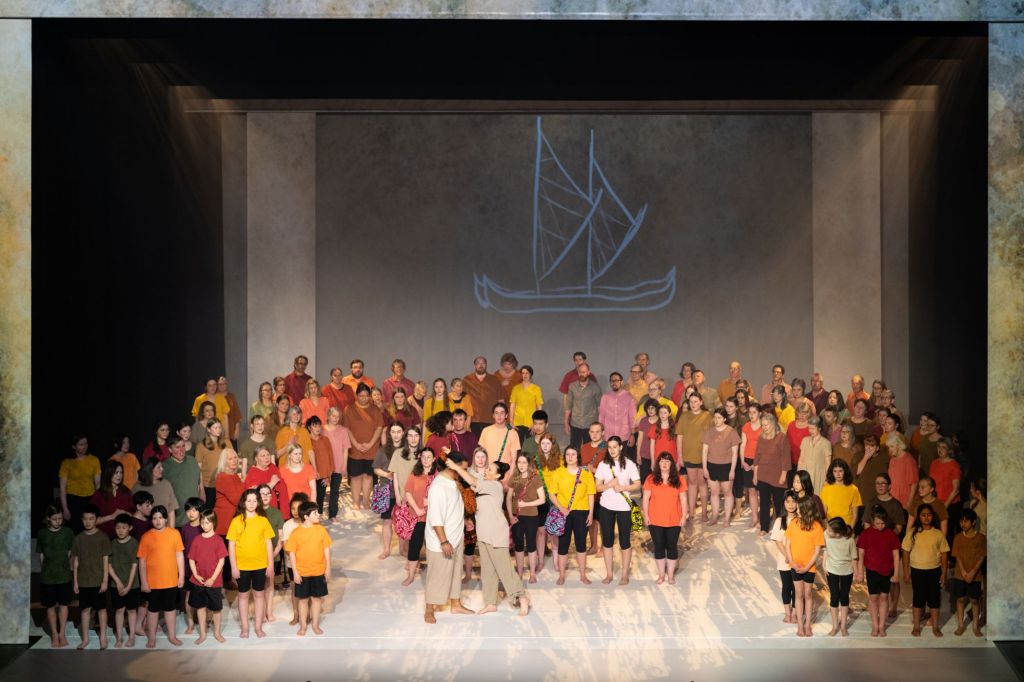
Certainly, having a just a few well defined characters, a clear narrative, straightforward sets, melodic music and a huge group of singers meant it was very accessible even if it had a mythical setting.
When the legendary King Minos of Crete defeats the Athenians, he metes out his punishment in the cruellest way possible: by destroying their hope for the future. Every year, the king compels the conquered Athenians to send him their youth, to be fed to the terrible beast at the centre of his island’s maze – the Minotaur.
Hearing the cries of the Athenians, Theseus (tenor Ipu Laga’aia) who is actually a demigod as well as human decides to go with the group of children to Crete intending to kill the creature. His mother (mezzo-soprano Sarah Castle) pleads with him not go, expressing the anguish of all mothers whose sons go off to battle. The children are led through the maze by Daedalus (bass-baritone Joel Amosa) where Theseus finds and battles the Minotaur. Having killed the creature, he returns the children to Athens having destroyed the Cretan ships.
Like most mythical tales the legend of the Minotaur, half man, half bull has several layers of meaning and interpretation, functioning as a cautionary tale against hubris. The story in an allegory and a symbolic representation of the human psyche’s inner turmoil and the journey of self-discovery. It can also be seen as a contemporary allegory of the desire to overthrow oppressors.
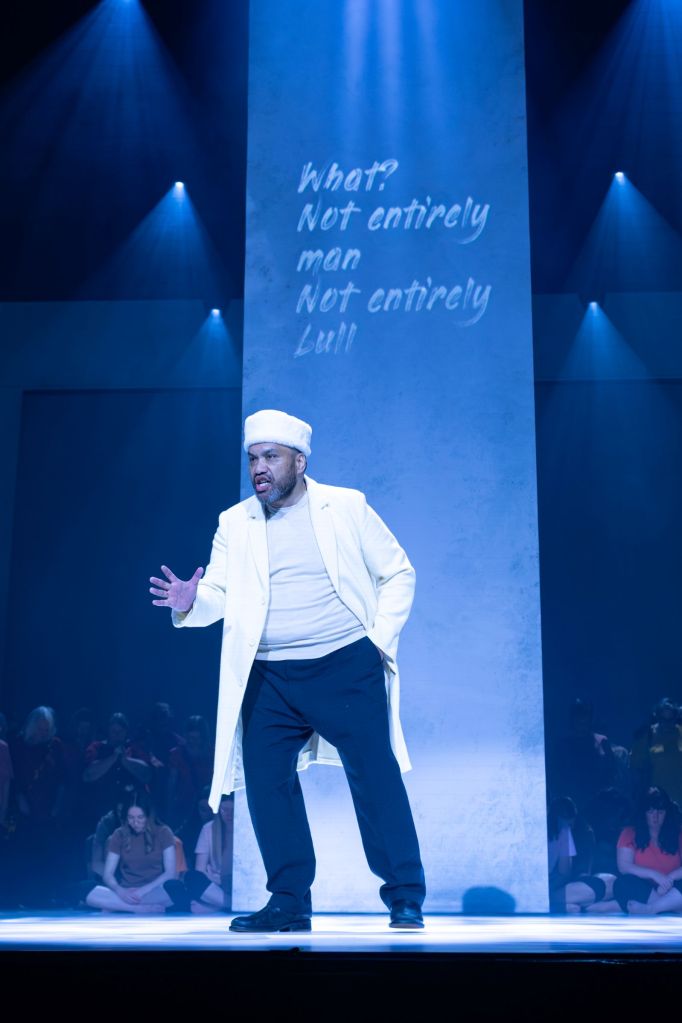
Much of the staging seems to have taken inspiration from Marvel Comic heroes particularly King Minos and Theseus. As King Minos, Maaka Pohatu conducts himself like a fascist leader filled with anger and ruthlessness. In contrast Ipu Laga’aia as Theseus displays all the qualities of the moral protagonist.

Dove’s music was animated and mainly percussive, the brass and woodwind representing the darker elements of the tale including the brooding Minotaur while blasts of triumphant brass represented Theseus’s victory and the return of the children.
The staging was simple and effective notably the fight sequence between Theseus and The Minotaur where projected words in a comic book style – Punch, Fight, Stab, Thwack- reinforced the dramatic encounter with Thesus fighting an unseen opponent.
While the text of libretto is simple, carrying the tale along smoothly, it is the singing of over 150 Adult, Youth and Children’s choir members, their swirling sounds along with their serpentine movements around the stage that make the most impact. While the children deserve much praise it is the Creative Team which trained and led the singers who were the real force behind the production and deserve loads of credit.
The only disappointment for some of the audience would have been the cursory introduction to the QR code which would have given them access to the libretto though their phones. The take-up of this facility was patchy as the code was only available for a few minutes at the beginning of the performance and instruction were not included in the programme.
To subscribe or follow New Zealand Arts Review site – www.nzartsreview.org.
The “Follow button” at the bottom right will appear and clicking on that button will allow you to follow that blog and all future posts will arrive on your email.
Or go to https://nzartsreview.org/blog/, Scroll down and click “Subscribe”

 New Zealand Arts Review