Reviewed by John Daly-Peoples

Feathers of Aotearoa: An Illustrated Journal
Niels Meyer-Westfeld
Potton & Burton
RRP $59.99
Published October 1
Reviewed by John Daly-Peoples
We all know that godwits undertake an annual marathon migration to Siberia, but the bar-tailed godwit or kuaka owes much of its successful flight to its feathers. While its high metabolic rate and other factors add to its remarkable ability to make the journey, it is actually its feathers and their design which are significant. The feather’s unique design keep it warm and provide protection from rain as well as having flight surfaces designed for long distance flight.

The importance of feathers in the evolutionary development of birds is the focus of a new book “Feathers of Aotearoa” by artist / illustrator Niels Meyer-Westfeld who has focussed on the plumage of New Zealand birds. It follows on from his previous book “Land of Birds” (Craig Potton Publishing) published in 2014. Inspired by the tradition of naturalist journals, he has created a very personal and sensitive tribute to Aotearoa’s remarkable birdlife.
Born in Germany he initially studied graphic design at the University of Hannover, before completing a Masters in communication design at Central St Martin’s in London.
However, it was his early exposure to the natural world which motivated his interest in birds. “My father is a passionate lepidopterist and botanist and growing up in Germany, I was lucky enough to accompany him on trips around Europe while he pursued his interest,” says Niels. “His love of nature inspired me artistically and I’ve always drawn the flora and the fauna that surrounds me.”
Having moved to New Zealand he has spent nearly twenty years in a variety of creative endeavours with a particular interest in the bird life of New Zealand.
Like other New Zealand artists such as Ray Ching and Russell Jackson he has the ability to meticulously render his subjects, seemingly able to give his subjects anthropomorphic characteristics.
The book illustrates thirty birds which the artist lists under six categories – Flightless, Ground Dwelling, Skilled Flyers, Swift, Wanderers, Divers and Swimmers. Under the heading of flightless we find Kakapo, Kiwi, Moa, Weka and Takahe. Each of the birds is given several pages of illustration with full page renderings of the bird in its habitat or perched on native foliage. So, there is a tui atop a flax and a kereru in a kowhai bush. There are also drawings of the feathers, not one or two as most birds have more than a dozen separate feathers.
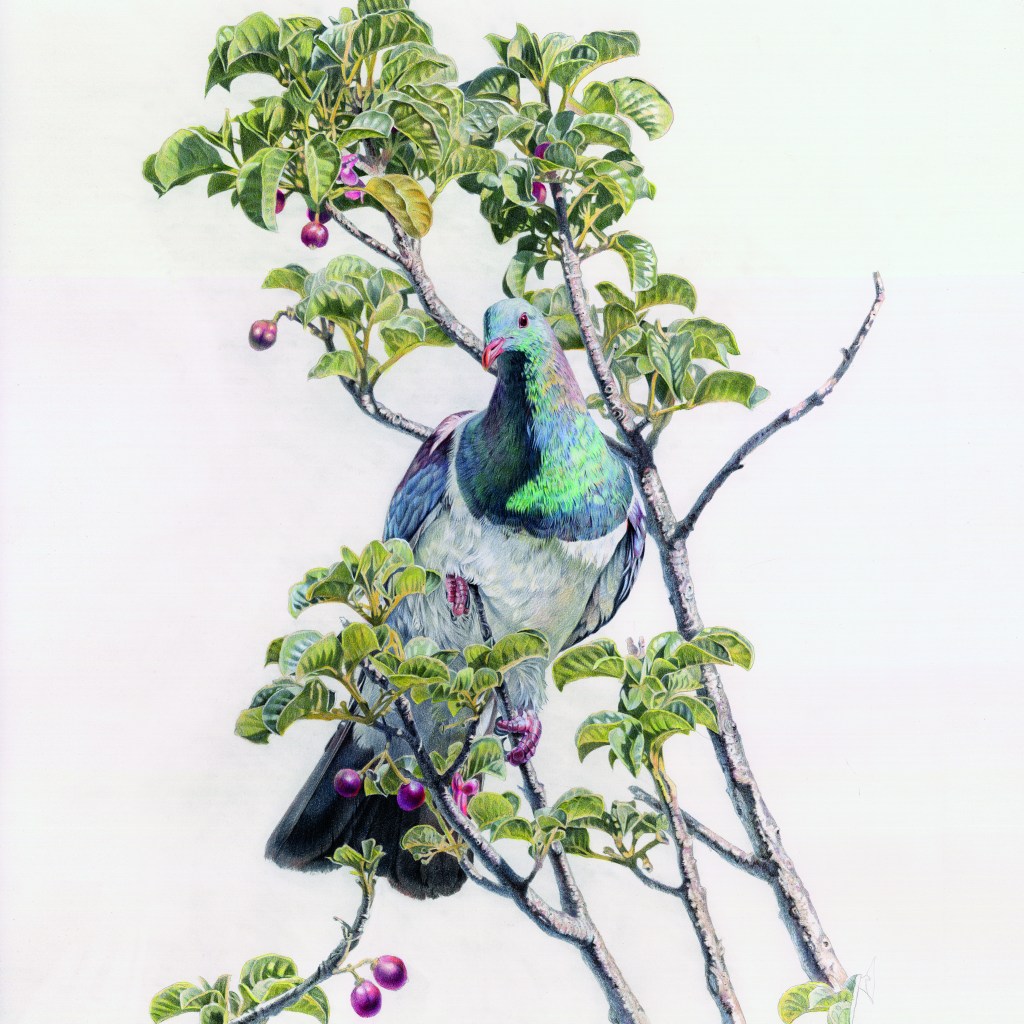
We are provided with information about each of the bird’s plumage as well as general information. We learn that the colours found in the feathers are formed in one of two ways, either from pigmentation or from light refraction caused by the structure of the feather.
We also learn about the evolution of the feather the science of which has been evolving since the 1990’s when fossil evidence revealed that several lineages of dinosaur had primitive forms of feather which have evolved into the contemporary form such as the tiny, insulating feathers of a penguin.
The artist illustrates and explains in the accompanying text aspects of the unique nature of many of the feathers found in New Zealand native birds. He explains how the feathers of the tui which initially appear to be black but on closer inspection have a shimmering quality with the microscopic scales on the feather creating a range of changing colour rather than relying on pigmentation.
Accompanying the images of birds are illustrations of the bird’s feathers, at least dozen for each bird which show the different colours, shapes and designs, demonstrating the myriad types of feather.

The book is very much like an artist’s notebook or diary, some of the drawing fully coloured with others in simple black pencil of ink with accompany description. Most of the illustrations are of birds the artist has observed in the wild but other are of dead birds where he has captured their limp form.
It is a beautifully designed book, with a particularly impressive cover, the whole production being as striking as many of the birds the artist has illustrated.

To subscribe or follow New Zealand Arts Review site – www.nzartsreview.org.
The “Follow button” at the bottom right will appear and clicking on that button will allow you to follow that blog and all future posts will arrive on your email.
Or go to https://nzartsreview.org/blog/, Scroll down and click “Subscribe”

 New Zealand Arts Review