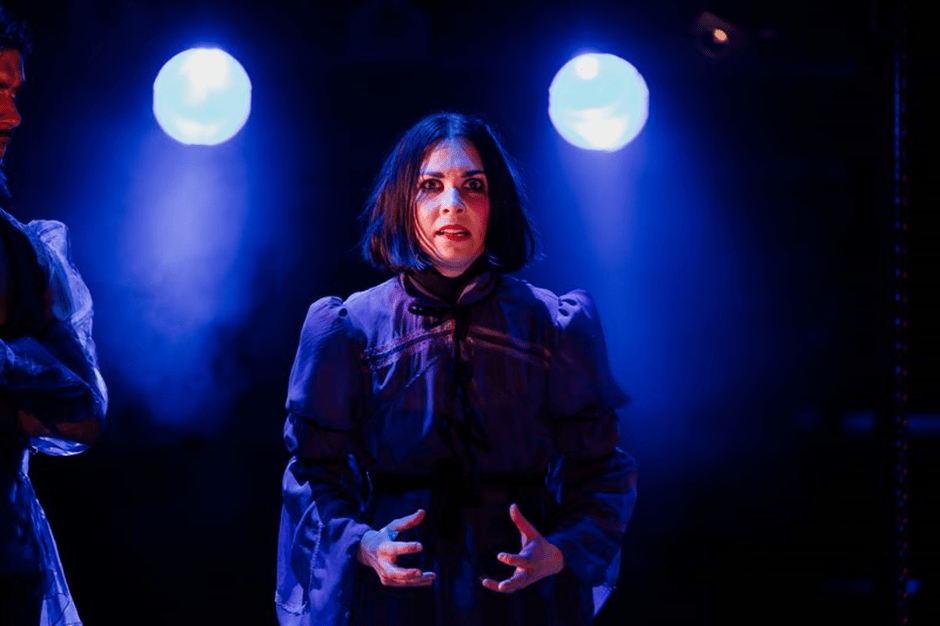
MARY THE BIRTH OF FRANKENSTEIN
By Jess Sayer
Auckland Theatre Company
Director – Oliver Driver
Set – John Verryt
Costume – Sarah Voon
Sound – Leon Radojkvic
Lighting – Jo Kilgour
Choreography – Ross McCormick
With Emily Adams, Timmie Cameron, Tom Clarke, Arlo Green, Dominic Ona-Ariki and Mary Graham
ASB Waterfront Theatre, Auckland
Until 7 September
Reviewer Malcolm Calder
If you were expecting a history lesson, or a literary feast, at Mary the Birth of Frankenstein forget it. With only loosely based smatterings of actuality, the mind of playwright Jess Sayerand has really gone to work concocting a remarkable horror story that is pure gothic.
Imagine if you will, five friends sitting around one evening housebound because of a fairly vicious storm outside. They know each other well and each has a distinct personality. They are a highly intelligent, articulate and radically argumentative group. Their idle chat turns to intellectual sparring and rivalry abounds. There are references to literature and science and to their driving needs to make a mark on the world – individually and collectively. Alcohol and social drugs are in abundance and, as the evening passes passions grow, each becomes increasingly assertive about their own viewpoint– at best regarding those of others as only partially so. I fondly recall not dissimilar late-night parties in my own student days a couple of centuries later. Many of us do.
In this outstanding work however, Jess Sayer turns the wick up a bit. She casts the well-credentialled, slightly older and highly opinionated literary scion Lord Byron as the prime catalyst. The most articulate of his protagonists gradually becomes Mary Godwin, the lover of Percy Bysshe Shelley. Around Byron, and particularly around the rather distasteful and insensitive Shelley there is initially jocular chatter. But this gives way to friction. Soon minor differences of opinion appear as each addresses Byron’s challenge to tell a ghost story. Differences grow and violent disagreements flare. Mary becomes more and more vehement about women – their place and role in society, and their contribution to literature. Thus Sayers reveals a dramatic work that is really about anger. Mary’s anger.
And it takes the form of the repulsive figure she concocts that will forever take its place in the annals of literary.
Using a collective and collaborative approach, Director Oliver Driver has knitted together a cast that is strong, dynamic and impassioned. The laconically supercilious Byron (Tom Clarke) creates a strong and rightly pivotal presence sparring well with the self-admiring Shelley (Dominic Ona-Ariki). Both establish things well with their counterpoints – the yes-man Polidor (Arlo Green) and Claire (Timmie Cameron), Mary’s sightly dizzy sister and lover of Byron.
However, it is Mary (Olivia Tennet) who becomes the ultimate pivot, growing in stature just as her viewpoints do. Initially fighting for her right to have any voice at all about the role and place of women, her character matures, and her anger becomes overt until she concocts something totally and horrifically outrageous – in the form of Frankenstein.
It is almost as if Mary has said – OK, you bunch of blowhards. Try THIS on for size!
And, very very importantly, Emily Adams (initially an arthritic a more-than-humble home help Marta), evolves into the slithering sinuosity of a something that can only be described as a ‘thing’ – a kind of conscience or fading last gasp on reality. Her movement alone remains memorable with her dance training clearly evident.
Despite the occasional accent slip, muddy delivery and balance between the two acts, high ATC production standards and a stunning creative team allow director Oliver Driver to indulge and support this strong cast.
Conversely the second act changes course and presentation completely and quickly becomes an insane exploration of the world she has invented for her Frankenstein and his dastardly deeds. One might say that the proverbial hits the whirly-gig in second act and that the first was merely a scene-setting precursor.
The result is a madness and a mayhem that unrolls that becomes, in some ways. the highlight of the show. And I use the word advisedly because a ‘show’ it certainly is, rather than a mere ‘production’. The creative team have generated an extravaganza that is mind-boggling in its complexity. So, production team take a bow.
John Verryt’s set is simple yet complex at the same time. It has depth and variance enabling changes that are both subtle and nuanced and in your face at others. Similarly, Sarah Voon’s costumes echo those at the end bearing little in common with the play’s opening. But it is Jo Kilgour’s lighting and Leon Radojkvic’s sound that truly make this production remarkable. They must have had a lot of fun dreaming things up.
Mary the Birth of Frankenstein is a highly promising work from a highly promising writer.

 New Zealand Arts Review