Reviewed by John Daly-Peoples
Emperor
Auckland Philharmonia
Conductor, Giordano Bellincampi
Piano, Haochen Zhang
Claire Cowan My Alphabet of Light
Beethoven Piano Concerto No.5 ‘Emperor’
R. Strauss Ein Heldenleben
Auckland Town Hall
February 13
Reviewed by John Daly-Peoples
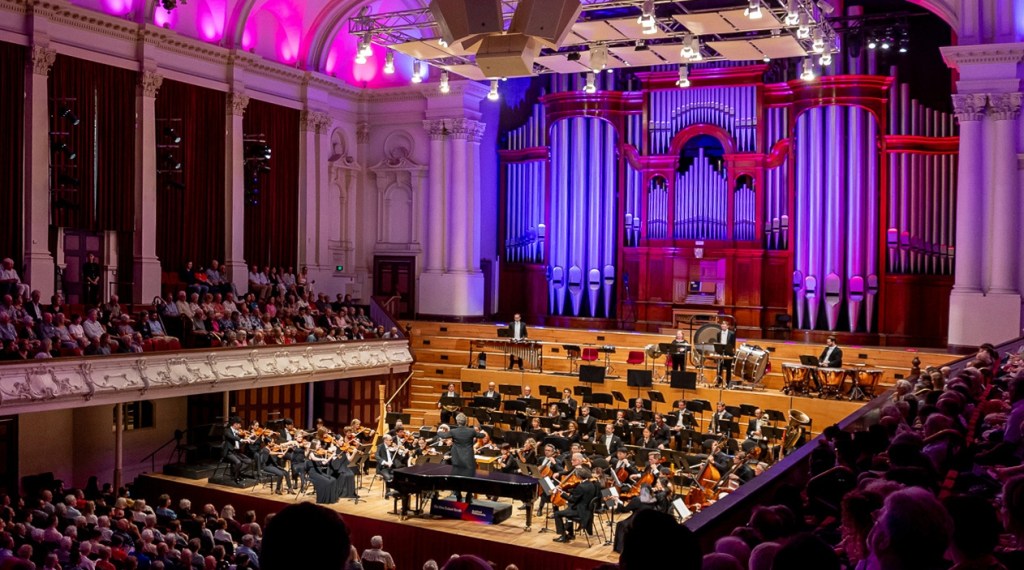
The Auckland Philharmonia’s “Emperor” concert marked the tenth anniversary of Giordano Bellincampi’s position as Music Director of the orchestra and for the concert he reprised Richard Strauss’ “Ein Heldenleben” (A Heros Life), a work he had conducted at his first outing withe orchestra ten years ago.
It was a fitting work, acknowledging the conductor’s monumental contribution to the development of the orchestra over the last decade.
Opening the programme was Claire Cowan’s :My Alphabet of Life, a piece she had written in 2005 when she was 21. With this revised version she presented short musical phrases or conversations about the language of music and how compositions are structured. These ranged in tempo and style from the formal to the more abstract – from the simple to elaborate. These were conveyed by the various instruments – brass, percussion strings woodwinds as they experiment with their individua voices.
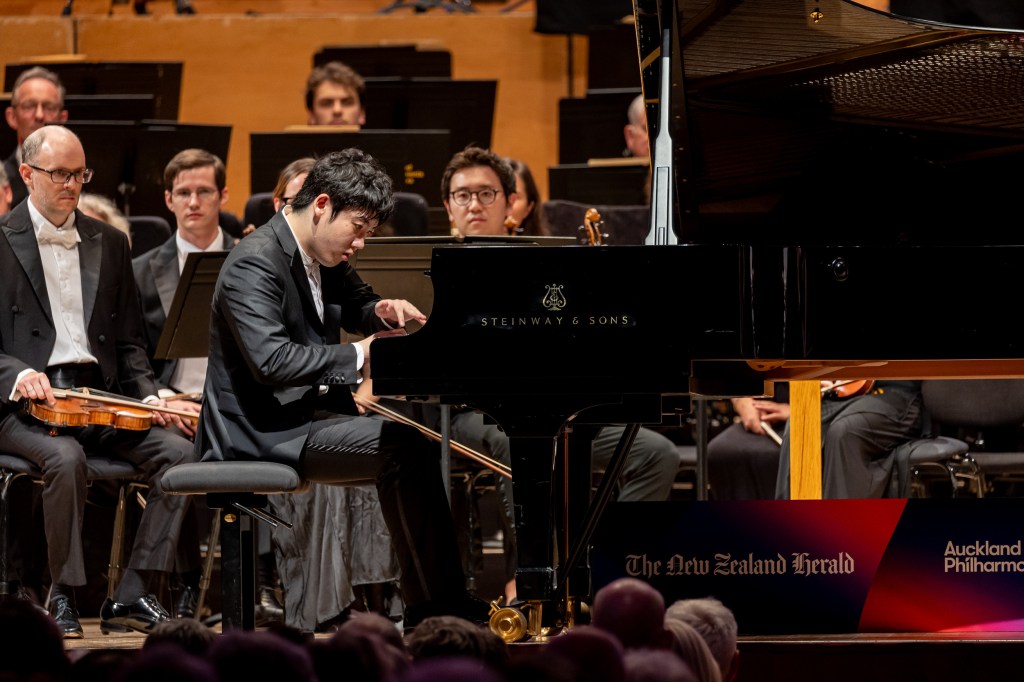
Playing Beethoven’s Piano Concerto No 5 pianist Haochen Zhang gave an agile performance as he carefully negotiated the work.
His playing at times was at times lethargic, at other times precise and refined and then he would appear to be chasing the orchestra with bravura displays. He managed to express what Beethoven intended, balancing the memorable themes played by the orchestra with the passionate displays of the soloist, allowing the drama of the piano to evolve out of the landscape of the orchestra.
The second movement was full of magical moments At the opening his slow delicate approach to the music made every single note seem special and with his other raised hand he appeared to conduct the orchestra himself. In another passage the woodwinds provided an exhilarating accompaniment to Zhang. Midway through this movement comes one of the great moments where the pianist always seems to stall as the tempo changes before returning with thundering chords, a passage which Zhang handled superbly.
Zhang’s mastery of the work was his ability to provide a real sense of cohesion and an understanding of the structure of each of the movements as well as the work as a whole. He never allowed the simple demonstration of his own technical facility to obscure his larger purpose.
He fully captured the textures, scope and power of the work and the heroic spirit as conceived by Beethoven is revealed to be both physically robust and spiritually refined.
Throughout the work Zhang and the orchestra took the audience on an emotional roller coaster, as the work fluctuates from being a sonata to more like a symphonic work. One is also conscious of the nature of Beethoven / pianist conveying the sense of the heroic struggle.
Richard Strauss’ “Ein Heldenleben” was his response and update to Beethoven’s notion of the heroic struggle with this six-movement tone poem. It is both a wide-ranging tribute to the German notion of the Übermensch or Superman as well as an autobiographical work in which the composer portrays elements of himself, his work, his critics and his wife becoming something of picaresque account of his life.
It is a beguiling and charming work, musically impressive with many wonderful sounds recalling some of his earlier pieces such as “Thus Sprach Zarathustra” and “Till Eulenspiegel”.
Strauss can be very good at big atmospheric works and with “Ein Heldenleben” the orchestra was boosted with lots of brass – horns, trumpets, trombones, tuba, tenor tuba as well as percussion and harps. Under the direction of conductor Bellincampi the orchestra made full use of their massive sound
Along with the monumental sounds there were more playful moments such as Andrew Beere’s various interventions with his gypsy-like solos where Strauss’ own voice punctuated the musical landscape. Another intervention saw three trumpet players delivering a brassy anthem from offstage.
The music ranged from the expansive and belligerent to the meditative and ethereal Some of the passages having the terse drama of his later operatic works like Electra while other had the charm of Der Rosenkavalier, all carefully controlled by Bellincampi.

Forthcoming Concert
February 20th
Ehnes & Bellincampi
Conductor Giordano Bellincampi
Violin James Ehnes
Schumann Manfred: Overture
Brahms Violin Concerto
Mendelssohn Symphony No.3 ‘Scottish’
One of the world’s supreme violinists, James Ehnes playing Brahms’ Violin Concerto
It is framed by Mendelssohn at his most romantic, inspired by the tragic history of Scotland, and Schumann at his most Gothic, painting a portrait of Byron’s hero.
Playing the Brahms Violin Concerto with the Houston Symphony Orchestra the reviewer Everett Evans noted “Ehnes again proved notable not only for technical proficiency, but also for the warmth and understanding of his playing. His decisive bowing and precise attack lent definition and drama to the work’s more emphatic statements, and he flew through the trickiest effects with alacrity and ease. Yet the delicacy and restraint of his pianissimo moments proved just as impressive.
He was at his most expressive in the adagio, his graceful phrasing and soulful tone lending an elegiac quality. He gave the right zest and exuberance to the finale, whose main theme advances by leaps and bounds.
Graf kept the interplay of orchestra and soloist lively and neatly balanced. The orchestra sustained a warm, rich sound, smoothly legato in lyrical passages, matching Ehnes’ solo work for irrepressible energy in the finale”.

 New Zealand Arts Review