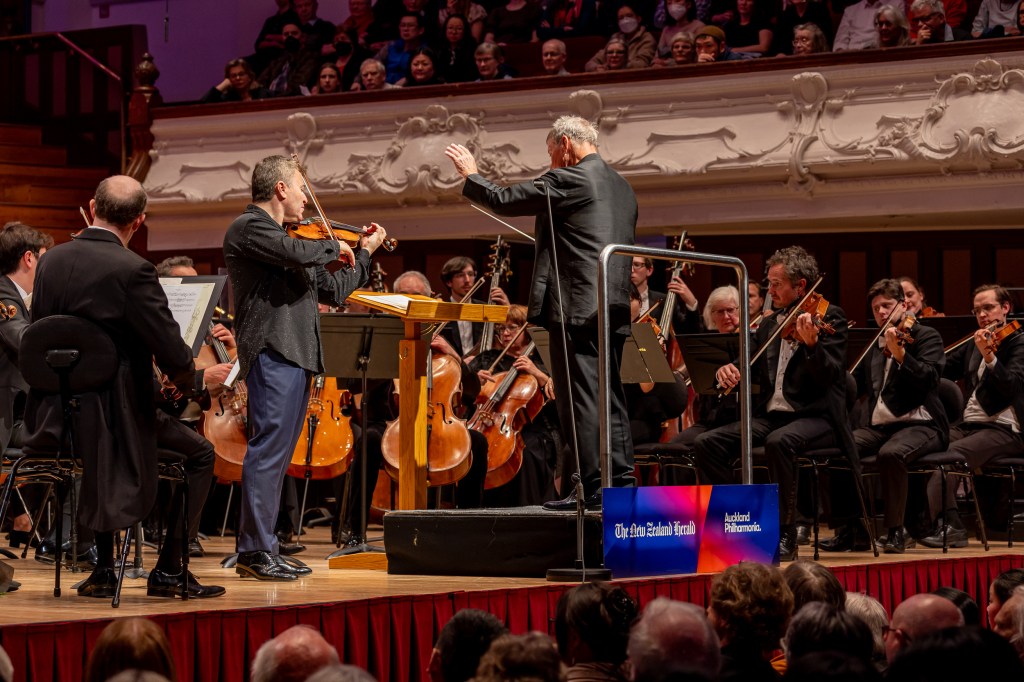
Reviewed by John Daly-Peoples
Vengerov & Sibelius
Auckland Philharmonia
Auckland Town Hall
August 24
Reviewed by John Daly-Peoples
After a rapturous ovation given to the Russian violinist Maxim Vengerov for his playing of the Sibelius Violin Concerto he thanked the audience and New Zealand for its “wonderful, mysterious weather”.
That description of “wonderful and mysterious” could have equally been applied to his stunning performance of the violin concerto with its mixture of dark energy, sublime beauty and ever-changing dynamic forces.
From the outset of the first movement as his melancholic violin rose about the whispering strings the audience was in his thrall and with his increasingly feversish playing he dominated the orchestra. His was a spectacular example of a violinist fully understanding the music and he was able to convey the emotions and yearnings imbedded in the piece.
Often Vengerov seemed to be taking his cue from the orchestra while at other times he seemed to be playing independently, rising above the orchestra, and then he would allow its forces to overwhelm him, his body and violin buffeted by the orchestra.
He played with an intensity and anguish in response to the tormenting sounds of the orchestra which was conveyed by his rapid playing and his skilful techniques such as vigorously playing two strings at once.
At the close of the first movement, he distanced himself frpm the orchestra as though playing in a reverie before bursting out with a frenzied, dance-like sequence.
The tension and angst of the first movement was followed by a transcendental slow movement filled with an electrifying urgency. He delivered a sinuous sound, with rapid bowing which slowly unfolded into a romantic sequence. Here the orchestra seemed to taunt him with dramatic waves of sound before violinist and orchestra shared some exquisitely intertwined music.
In the third movement Vengerov’s frenetic playing rose above the tempestuous sounds of the orchestra and timpani and there was a fascinating interplay between violinist and orchestra where he produced thrilling high notes as they joined in the fast-paced race to the finish.
Much of the concerto sees the violinist buffeted by the orchestra, the single musician resisting the domination of the surging power of the orchestra. This is a musical representation of the oppression felt by many Finns of the Russian occupiers, denying them a voice.
This struggle of the Finns against the Russian occupiers featured in two of the other works on the programme – “En Saga” of 1892/1902) and Finlandia (1900). These two works book-ended the concert, both featuring rousing and turbulent music, a covert protest against the Russian Empire.
“En Saga” opened with shimmering strings suggesting water and scudding clouds along with the woodwinds suggesting forests while the brushed cymbals hinted as a landscape in peril.
The work tells of the sounds and narrative of a Norse saga but also the saga of more recent times.
In order to avoid Russian censorship Finlandia was performed under alternative names at such as “Happy Feelings” and “A Scandinavian Choral March”…
The work opened with the menacing sounds of blaring horns and growling timpani, followed by a gentler sequence featuring strings and woodwinds which conjure up images of landscape, in a hymn to Finland’s history and myths.
The work also heralds the idea of a new Finland with sprightly music full of new colours and textures. There was also a sense of despair or resignation conveyed by flute and woodwinds as well as a riotous Wagnerian assertion before closing off with a soulful clarinet – an image of the composer alone in the landscape.
The middle part of the work is slow and uplifting strings, woodwinds, brass all playing together in a celebration of country and beauty with some obsessive playing.
The composers interest in capturing his own and his country’s feelings in these works show how an idea can inspire a composer and how a musical idea can inspire a nation.
The concert also featured the composers Symphony No 6 which was composed in 1923 after Finland gained its independence for the first time in over 500 years. The work does not have the same angst as many of the composer’s previous works. There is a more cheerful and celebratory tone with some beautifully sustained music full of life and pleasure although there were also underlying darker element.

 New Zealand Arts Review