Reviewed by John Daly-Peoples
Mozart: The Great
New Zealand Symphony Orchestra
Auckland Town Hall
August 16
Reviewed by John Daly-Peoples
The NZSO’s recent “Mozart: The Great” concert makes one realize that all orchestra should be having at least one Mozart concert each year to emphasise the importance of the composers work within the classical music tradition.
His compositions have had a major impact on the evolution of classical music, providing a bridge between Baroque and Romanticism as well as more contemporary composers. They were notable for their structural balance, inventive melodies, rich harmonies and complex orchestration. Mozart’s mastery of orchestration.
The concert offered two Mozart works – Piano Concerto No 21 and his Symphony No 40 conducted by the visiting German conductor Andre de Ridder.
Mozart’s works are filled with drama, humour and emotion and de Ridder ensured that these qualities were expressed through his conducting where his gestures displayed a physical response to the music,
He made one aware of Mozart’s evolving contrasts and changing dynamics with a precise attention to detail. He also drew attention to Mozart’s innovative ways of using instruments and the inventive ways in which he made transitions between themes and instrumentation.
De Ridder seemed intent on using the orchestra to create a luxurious world full of narrative, landscape and structure. He achieved this with his elaborate gestures, seemingly moulding the music’s dynamic conversations in the robust drama of the third movement and in the frenetic final movement.
He also drew attention to the music in having long, contemplative breaks between the movements as though stressing both independence of each movement as well as their connections.
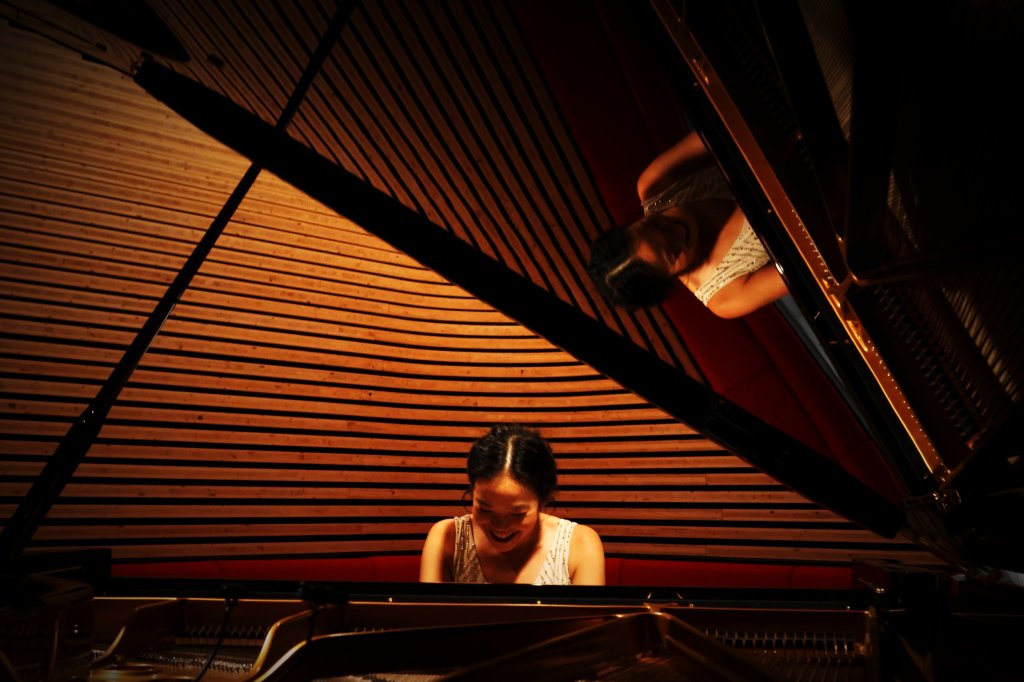
The Piano Concerto was played by the Australian pianist Andre Lam who gave a sophisticated reading of the work, playing with a stylish elegance and at times appeared to be captivated by the sounds she was producing,
After the initial sprightly opening and a series of trembling notes her playing evolved into more detached and considered sequence. This was followed by some exquisitely beautiful passages which also revealed some darker elements. At the close of the first movement Lam performed a dramatic cadenza with an almost meditative approach before leading the orchestra to a brilliant finale.
With the second movement made famous by the Elvira Madigan movie she expressed the romantic nature of the piece playing with a sinuous line as though floating above the orchestra with de Ridder ensuring the orchestra never overwhelmed the pianist’s delicate touch.
In the third movement she displayed a brilliance and bravado as she and the orchestra competed and complemented each other in passages which were almost Beethovian. In the finale of the last movement, studiously bent over the keys she gave a rigorous performance full of drama and wit.
The first work on the programme was Gyorgy Ligeti’s “Concerto Romanesc” written in 1951 but initially banned by the soviet authorities because of its dissonant folk sounds.
Influenced by the music of Bela Bartok and with traces of Aaron Copland the work opened with cello and woodwind providing a sense of romanticism and open spaces .
The second movement with its folk-dance melodies morphed into more abstract bursts of sounds with hints of exotic music among the surging sounds and dramatic percussion.
De Ridder firmly controlled the various instruments and their unfamiliar sounds which ranged from the violinists playing on the bridge to Eastern sounds and a gunshot.
The work highlighted the place of Romanian music at the cultural crossroads between Eastern and Western music as well as the place of folk music within that tradition.
Forthcoming NZSO concerts in Auckland
La Mer
Nielsen Tchaikovsky, Sibelius and Debussy
Auckland Town Hall, August 29
Jupiter
Copland, Cresswell and Mozart
Auckland Town Hall, September 21
To subscribe or follow New Zealand Arts Review site – www.nzartsreview.org.
The “Follow button” at the bottom right will appear and clicking on that button will allow you to follow that blog and all future posts will arrive on your email.
Or go to https://nzartsreview.org/blog/, Scroll down and click “Subscribe”

 New Zealand Arts Review