Reviewed by John Daly-Peoples
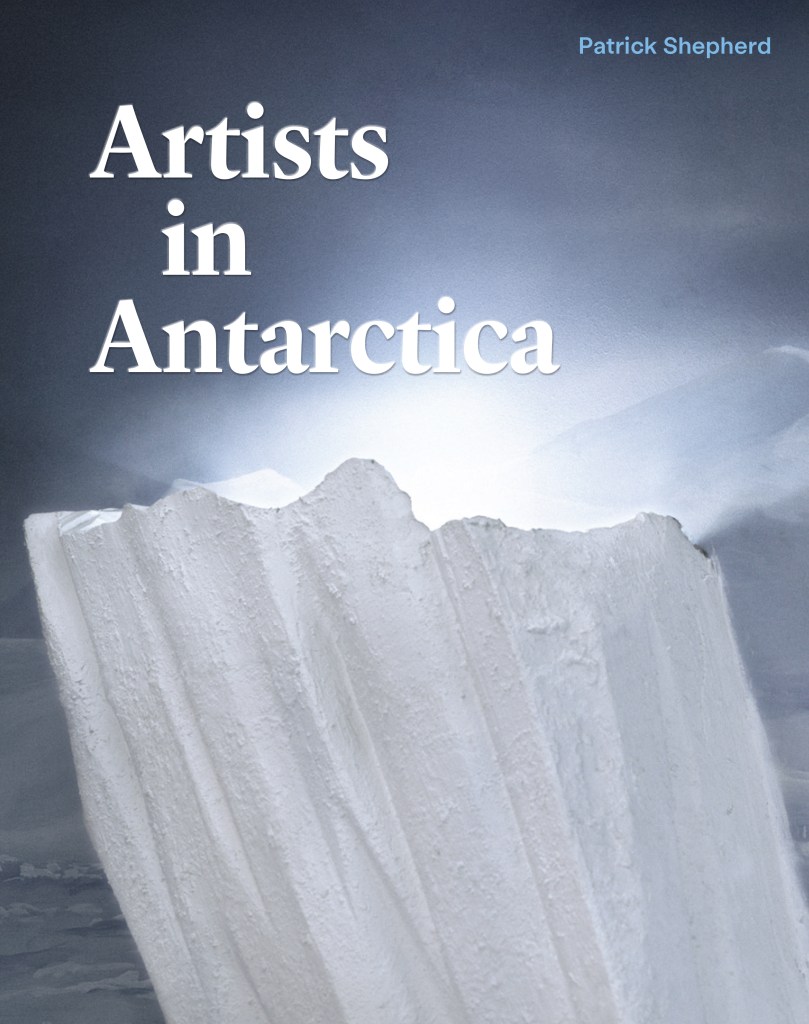
Artists in Antarctica
Edited by Patrick Shepherd
Massey University Press
RRP $80.00
Reviewed by John Daly-Peoples
Most people have a vision of Antarctica. It is huge, bleak, cold and white – just white snow and white ice – and penguins. But that is a superficial view because the area has many dimensions and holds secrets which explorers and scientists have been searching for and uncovering for more than a century.
Also, for more than half a century, artists have been looking at the continent and seeing the landscape and its history through new lenses. They have been helped by Antarctica New Zealand’s Community Engagement Programme, originally called Artists to Antarctica and Invited Artists Programme along with assistance from Creative New Zealand.
Over 100 artists, writers, dancers, designers and composers have travelled to Scott Base with the programme since 1957. They have returned home and through exhibitions, performances and publications have brought their experiences to the wider public. Their work has played a crucial part in informing and influencing the public’s understanding of Antarctica.
A new book “Artists in Antarctica” edited by Patrick Shepherd has brought together the work of thirty-seven of these artists with images of their work along with their experience of being on the ice.
The list of artist incudes: Photographers Laurence Aberhart and Anne Noble, Sound Artists Phil Dadson and Chris Cree Brown, Painters Nigel Brown and John Walsh, Choreographers Corey Baker and Bronwyn Jones Poets Chris Orsman and Bill Manhire, Writes Lloyd Jones and Owen Marshall, Sculptors Virginia King and Martin Hill & Phillipa Jones

Each of these artists has brought a different vision to bear on the landscape, ecology and history of place. Some emphasise the mystery and vastness such as Stuart Robertson while Anne Noble has looked at the everyday business of maintaining Scott Base with her portraits of trucks.

A lot of the works, particularly the landscape images are very white such as the photographs of Grahame Sydney and Jae Hoon Lee which capture the immensity of the place.
On the other hand, the interiors of Shackleton’s Hut by Dick Frizzel, Sean Garwood and Jonathan White are dark, highlighting the bleakness of the confined space.

Nigel Brown’s paintings include a self-portrait along with fellow artists Chris Orsman and Bill Manhire as well as an historical portrait study of the early explorers, Ponting and Oates.
Several artists have included the few human constructions on the ice such as the various monuments – the cross on Observation Hill, the Memorial Cross at Cape Evans and Vinces Cross on Hutt Point. Other artists have taken inspiration from the rocks and core sample of the area (Raewyn Atkinson), electron microscope images (Virginia King) and hydroponics. (Chris Cree Brown).
The paintings of John Walsh allude to the underlying spiritual nature of the place with his mythological or spiritual figures while Margaret Elliot’s Pyramid paintings hint at a parallel landscape.
Also included in the introductory chapters along with background information are some of the earlier depictions of the Antacticac by William Hodges (1777), John Wilson Carmichael ($1847) and Peter McIntyre (1957)
The various writers have provided different perspectives on their experience with Lloyd Jones capturing a sense of passing through the empty land .
“Here it is so white. It is so still and silent. Why, it is beautiful>
We move on, and before long stop again to admire the view.
It does not appear to have changed. It is still white. It is
Astonishingly white. It is so still, so still.”
While Bernadett Hill provides a slightly surreal take
“A woman is standing under Erebus.
She has wrapped all her gifts around her,
Including caritas.”
Collectively the thirty-seven artists contribute to a jigsaw-like portrait of the Antarctica with each artist providing a different piece of the environment. Along with the images and writing about the area the book also offers insights into the many dimensions of the Antarctic, the people who work there and the range of scientific enquiry undertaken.

 New Zealand Arts Review