Reviewed by John Daly-Peoples
Gretchen Albrecht
between gesture and geometry
Luke Smythe
Massey University Press
RRP $85.00
Reviewed by John Daly-Peoples
The hemisphere works of Gretchen Albrecht which she has developed since the 1980’s have become the stylist hallmark of the artist, its shape referencing the curved lunette window, the architectural arch and the dome of heaven.
The evolution of these works has been over many years and it is interesting and rewarding to look back at her progress as an artist and see the various threads which led to these major works.
“Gretchen Albrecht, between gesture and geometry” by Luke Smythe first published in 2019 and now republished with extended writing provides a detailed examination of the artists life and
work and the various catalysts; art historical, art history, landscape, natural forces and a range of other sources which have had an impact on her work, creating vivid, intellectually persuasive and deeply affecting paintings.
Albrecht is one of the country’s most significant painters whose work is to be found in all the
major private and public collections in New Zealand.
She has had over 50 solo exhibitions in New Zealand and internationally as well as being included in numerous group exhibitions including the New Zealand exhibition Distance looks our way: 10
artists from NZ that was displayed at the 1992 Seville Expo
Albrecht graduated from Elam School of Fine Arts with a Diploma in Fine Arts with Honours in 1963. She established herself and was seen as a leading artist in New Zealand with her first solo
exhibition being opened by Colin McCahon.
She is most well known as an abstractionist and colourist who uses intense colours applied with dramatic gestural strokes on a range of shaped canvasses including the hemisphere and
ovals. Her work over the years has also included watercolours, figurative paintings, prints and
sculptures.
Her first major survey exhibition was AFTERnature: a survey of 23 years at the Sarjeant Gallery, Wanganui in 1986. She was also part of the important before being toured throughout New Zealand. The retrospective exhibition Illuminations, that investigated two decades of Albrecht’s hemisphere and oval paintings, was held at the Auckland Art Gallery in 2002.
Other work has encompassed large-scale, stainless steel sculpture, multi-panelled rectangular paintings featuring a rectangular ‘threshold’ motif that has also been a key presence in
recent oval works.
Her development as an artist is also carefully outlined including the influence s on her work by local artists and more importantly international artists such as Morris Louis and Helen Frankenthaler.
Smythe provides ways of looking at the artist’s work notably with the earlier stained canvas paintings seeing the connections to the natural forms of nature – clouds, water, the various states
of the sky,
In her later work there is also the more cerebral influences of the Italian Renaissance and artists such as Piero Della Francesca. With these paintings there was an evolving interest in geometry
which manifests itself not only in the shaped canvasses but also the subject matter.
A number of her works have also drawn inspiration from artists such as Goya and his female portraits. More recently there have been a series based on the Cistercian liturgy and the concepts of The Hours where the days are divided into seven traditional periods. Produced during the pandemic they reference notions of time and reflection.
As she has said of her work ‘I think I paint to still the anguish I feel in my heart, to order the chaos I sense is just outside the magic circle I draw around me with my painting.’
The hemisphere shapes she uses have provided a consistent physical template, a standard shape with which to survey the world. On this shape she is able to apply her dramatic painted gestures
which themselves are influenced by the artists experience of the world.
She employs a rigorous abstraction to achieve this, but her works have a basis in the world around her referring to landscapes, art history, the natural world and her personal encounters with events and emotional reactions.
The book is illustrated with 260 images which provide visual survey of the artists evolving work as it has been created, developed and transformed. These illustrations also make one aware of the
artist great sense of colour which she uses as a means of subtly exploring the boundary between chaos and control.
Smythe’s text is clear and perceptive combining aspects of the artist life, the influence son her work and the evolving emotional and intellectual approach of the artist.
Gretchen Albrecht’s current exhibition “Lighting the Path” will be exhibited at Two Rooms Gallery November 17 until December 22.
To subscribe or follow New Zealand Arts Review site – www.nzartsreview.org.
The “Follow button” at the bottom right will appear and clicking on that button will allow you to followthat blog and all future posts will arrive on your email.
Or go to https://nzartsreview.org/blog/, Scroll down and click “Subscribe”
Gretchen Albrecht
between gesture and geometry
Luke Smythe
Massey University Press
RRP $85.00
Reviewed by John Daly-Peoples
The hemisphere works of Gretchen Albrecht which she has developed since the 1980’s have become the stylist hallmark of the artist, its shape referencing the curved lunette window, the architectural arch and the dome of heaven.
The evolution of these works has been over many years and it is interesting and rewarding to look back at her progress as an artist and see the various threads which led to these major works.
“Gretchen Albrecht, between gesture and geometry” by Luke Smythe first published in 2019 and now republished with extended writing provides a detailed examination of the artists life and
work and the various catalysts; art historical, art history, landscape, natural forces and a range of other sources which have had an impact on her work, creating vivid, intellectually persuasive and deeply affecting paintings.
Albrecht is one of the country’s most significant painters whose work is to be found in all the
major private and public collections in New Zealand.
She has had over 50 solo exhibitions in New Zealand and internationally as well as being included in numerous group exhibitions including the New Zealand exhibition Distance looks our way: 10
artists from NZ that was displayed at the 1992 Seville Expo
Albrecht graduated from Elam School of Fine Arts with a Diploma in Fine Arts with Honours in 1963. She established herself and was seen as a leading artist in New Zealand with her first solo
exhibition being opened by Colin McCahon.
She is most well known as an abstractionist and colourist who uses intense colours applied with dramatic gestural strokes on a range of shaped canvasses including the hemisphere and
ovals. Her work over the years has also included watercolours, figurative paintings, prints and
sculptures.
Her first major survey exhibition was AFTERnature: a survey of 23 years at the Sarjeant Gallery, Wanganui in 1986. She was also part of the important before being toured throughout New Zealand. The retrospective exhibition Illuminations, that investigated two decades of Albrecht’s hemisphere and oval paintings, was held at the Auckland Art Gallery in 2002.
Other work has encompassed large-scale, stainless steel sculpture, multi-panelled rectangular paintings featuring a rectangular ‘threshold’ motif that has also been a key presence in
recent oval works.
Her development as an artist is also carefully outlined including the influence s on her work by local artists and more importantly international artists such as Morris Louis and Helen Frankenthaler.
Smythe provides ways of looking at the artist’s work notably with the earlier stained canvas paintings seeing the connections to the natural forms of nature – clouds, water, the various states
of the sky,
In her later work there is also the more cerebral influences of the Italian Renaissance and artists such as Piero Della Francesca. With these paintings there was an evolving interest in geometry
which manifests itself not only in the shaped canvasses but also the subject matter.
A number of her works have also drawn inspiration from artists such as Goya and his female portraits. More recently there have been a series based on the Cistercian liturgy and the concepts of The Hours where the days are divided into seven traditional periods. Produced during the pandemic they reference notions of time and reflection.
As she has said of her work ‘I think I paint to still the anguish I feel in my heart, to order the chaos I sense is just outside the magic circle I draw around me with my painting.’
The hemisphere shapes she uses have provided a consistent physical template, a standard shape with which to survey the world. On this shape she is able to apply her dramatic painted gestures
which themselves are influenced by the artists experience of the world.
She employs a rigorous abstraction to achieve this, but her works have a basis in the world around her referring to landscapes, art history, the natural world and her personal encounters with events and emotional reactions.
The book is illustrated with 260 images which provide visual survey of the artists evolving work as it has been created, developed and transformed. These illustrations also make one aware of the
artist great sense of colour which she uses as a means of subtly exploring the boundary between chaos and control.
Smythe’s text is clear and perceptive combining aspects of the artist life, the influence son her work and the evolving emotional and intellectual approach of the artist.
Gretchen Albrecht’s current exhibition “Lighting the Path” will be exhibited at Two Rooms Gallery November 17 until December 22.
To subscribe or follow New Zealand Arts Review site – www.nzartsreview.org.
The “Follow button” at the bottom right will appear and clicking on that button will allow you to followthat blog and all future posts will arrive on your email.
Or go to https://nzartsreview.org/blog/, Scroll down and click “Subscribe”
Gretchen Albrecht
between gesture and geometry
Luke Smythe
Massey University Press
RRP $85.00
Reviewed by John Daly-Peoples
The hemisphere works of Gretchen Albrecht which she has developed since the 1980’s have become the stylist hallmark of the artist, its shape referencing the curved lunette window, the architectural arch and the dome of heaven.
The evolution of these works has been over many years and it is interesting and rewarding to look back at her progress as an artist and see the various threads which led to these major works.
“Gretchen Albrecht, between gesture and geometry” by Luke Smythe first published in 2019 and now republished with extended writing provides a detailed examination of the artists life and
work and the various catalysts; art historical, art history, landscape, natural forces and a range of other sources which have had an impact on her work, creating vivid, intellectually persuasive and deeply affecting paintings.
Albrecht is one of the country’s most significant painters whose work is to be found in all the
major private and public collections in New Zealand.
She has had over 50 solo exhibitions in New Zealand and internationally as well as being included in numerous group exhibitions including the New Zealand exhibition Distance looks our way: 10
artists from NZ that was displayed at the 1992 Seville Expo
Albrecht graduated from Elam School of Fine Arts with a Diploma in Fine Arts with Honours in 1963. She established herself and was seen as a leading artist in New Zealand with her first solo
exhibition being opened by Colin McCahon.
She is most well known as an abstractionist and colourist who uses intense colours applied with dramatic gestural strokes on a range of shaped canvasses including the hemisphere and
ovals. Her work over the years has also included watercolours, figurative paintings, prints and
sculptures.
Her first major survey exhibition was AFTERnature: a survey of 23 years at the Sarjeant Gallery, Wanganui in 1986. She was also part of the important before being toured throughout New Zealand. The retrospective exhibition Illuminations, that investigated two decades of Albrecht’s hemisphere and oval paintings, was held at the Auckland Art Gallery in 2002.
Other work has encompassed large-scale, stainless steel sculpture, multi-panelled rectangular paintings featuring a rectangular ‘threshold’ motif that has also been a key presence in
recent oval works.
Her development as an artist is also carefully outlined including the influence s on her work by local artists and more importantly international artists such as Morris Louis and Helen Frankenthaler.
Smythe provides ways of looking at the artist’s work notably with the earlier stained canvas paintings seeing the connections to the natural forms of nature – clouds, water, the various states
of the sky,
In her later work there is also the more cerebral influences of the Italian Renaissance and artists such as Piero Della Francesca. With these paintings there was an evolving interest in geometry
which manifests itself not only in the shaped canvasses but also the subject matter.
A number of her works have also drawn inspiration from artists such as Goya and his female portraits. More recently there have been a series based on the Cistercian liturgy and the concepts of The Hours where the days are divided into seven traditional periods. Produced during the pandemic they reference notions of time and reflection.
As she has said of her work ‘I think I paint to still the anguish I feel in my heart, to order the chaos I sense is just outside the magic circle I draw around me with my painting.’
The hemisphere shapes she uses have provided a consistent physical template, a standard shape with which to survey the world. On this shape she is able to apply her dramatic painted gestures
which themselves are influenced by the artists experience of the world.
She employs a rigorous abstraction to achieve this, but her works have a basis in the world around her referring to landscapes, art history, the natural world and her personal encounters with events and emotional reactions.
The book is illustrated with 260 images which provide visual survey of the artists evolving work as it has been created, developed and transformed. These illustrations also make one aware of the
artist great sense of colour which she uses as a means of subtly exploring the boundary between chaos and control.
Smythe’s text is clear and perceptive combining aspects of the artist life, the influence son her work and the evolving emotional and intellectual approach of the artist.
Gretchen Albrecht’s current exhibition “Lighting the Path” will be exhibited at Two Rooms Gallery November 17 until December 22.
To subscribe or follow New Zealand Arts Review site – www.nzartsreview.org.
The “Follow button” at the bottom right will appear and clicking on that button will allow you to followthat blog and all future posts will arrive on your email.
Or go to https://nzartsreview.org/blog/, Scroll down and click “Subscribe”
Gretchen Albrecht
between gesture and geometry
Luke Smythe
Massey University Press
RRP $85.00
Reviewed by John Daly-Peoples
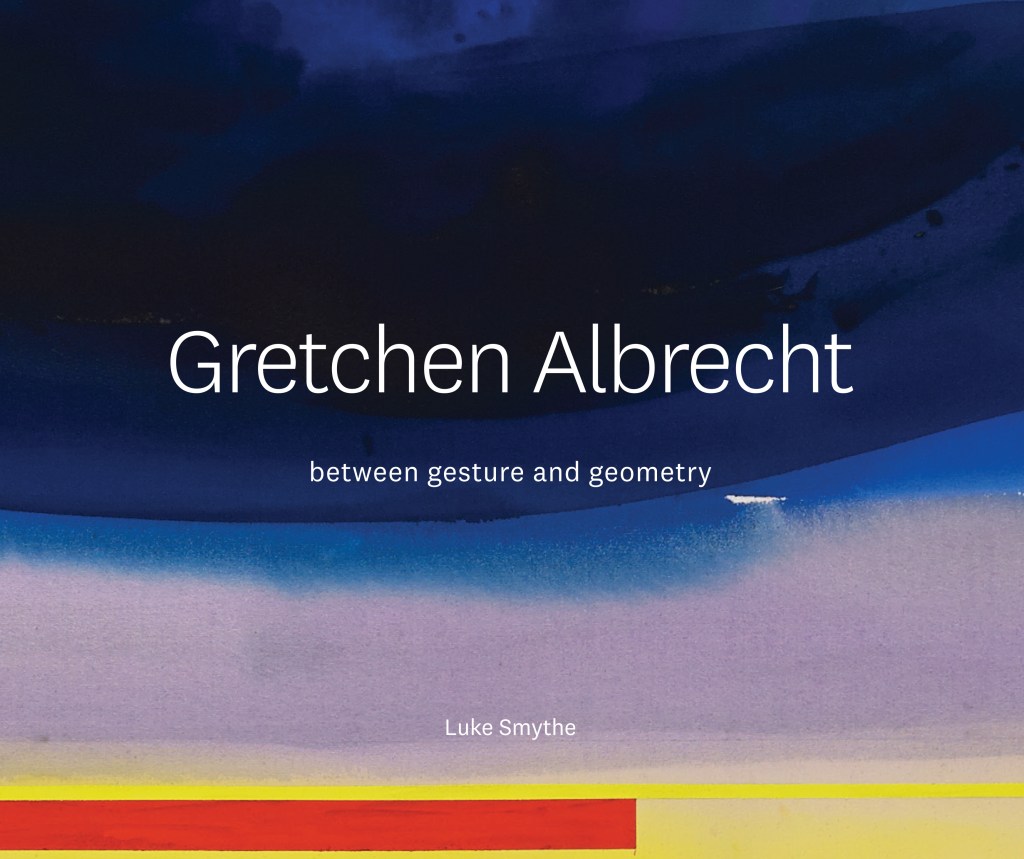
The hemisphere works of Gretchen Albrecht which she has developed since the 1980’s have become the stylist hallmark of the artist, its shape referencing the curved lunette window, the architectural arch and the dome of heaven.
The evolution of these works has been over many years and it is interesting and rewarding to look back at her progress as an artist and see the various threads which led to these major works.
“Gretchen Albrecht, between gesture and geometry” by Luke Smythe first published in 2019 and now republished with extended writing provides a detailed examination of the artists life and
work and the various catalysts; art historical, art history, landscape, natural forces and a range of other sources which have had an impact on her work, creating vivid, intellectually persuasive and deeply affecting paintings.
Albrecht is one of the country’s most significant painters whose work is to be found in all the
major private and public collections in New Zealand.
She has had over 50 solo exhibitions in New Zealand and internationally as well as being included in numerous group exhibitions including the New Zealand exhibition Distance looks our way: 10
artists from NZ that was displayed at the 1992 Seville Expo
Albrecht graduated from Elam School of Fine Arts with a Diploma in Fine Arts with Honours in 1963. She established herself and was seen as a leading artist in New Zealand with her first solo
exhibition being opened by Colin McCahon.
She is most well known as an abstractionist and colourist who uses intense colours applied with dramatic gestural strokes on a range of shaped canvasses including the hemisphere and
ovals. Her work over the years has also included watercolours, figurative paintings, prints and
sculptures.
Her first major survey exhibition was AFTERnature: a survey of 23 years at the Sarjeant Gallery, Wanganui in 1986. She was also part of the important before being toured throughout New Zealand. The retrospective exhibition Illuminations, that investigated two decades of Albrecht’s hemisphere and oval paintings, was held at the Auckland Art Gallery in 2002.
Other work has encompassed large-scale, stainless steel sculpture, multi-panelled rectangular paintings featuring a rectangular ‘threshold’ motif that has also been a key presence in
recent oval works.
Her development as an artist is also carefully outlined including the influence s on her work by local artists and more importantly international artists such as Morris Louis and Helen Frankenthaler.
Smythe provides ways of looking at the artist’s work notably with the earlier stained canvas paintings seeing the connections to the natural forms of nature – clouds, water, the various states
of the sky,
In her later work there is also the more cerebral influences of the Italian Renaissance and artists such as Piero Della Francesca. With these paintings there was an evolving interest in geometry
which manifests itself not only in the shaped canvasses but also the subject matter.
A number of her works have also drawn inspiration from artists such as Goya and his female portraits. More recently there have been a series based on the Cistercian liturgy and the concepts of The Hours where the days are divided into seven traditional periods. Produced during the pandemic they reference notions of time and reflection.
As she has said of her work ‘I think I paint to still the anguish I feel in my heart, to order the chaos I sense is just outside the magic circle I draw around me with my painting.’
The hemisphere shapes she uses have provided a consistent physical template, a standard shape with which to survey the world. On this shape she is able to apply her dramatic painted gestures
which themselves are influenced by the artists experience of the world.
She employs a rigorous abstraction to achieve this, but her works have a basis in the world around her referring to landscapes, art history, the natural world and her personal encounters with events and emotional reactions.
The book is illustrated with 260 images which provide visual survey of the artists evolving work as it has been created, developed and transformed. These illustrations also make one aware of the
artist great sense of colour which she uses as a means of subtly exploring the boundary between chaos and control.
Smythe’s text is clear and perceptive combining aspects of the artist life, the influence son her work and the evolving emotional and intellectual approach of the artist.
Gretchen Albrecht’s current exhibition “Lighting the Path” will be exhibited at Two Rooms Gallery November 17 until December 22.
To subscribe or follow New Zealand Arts Review site – www.nzartsreview.org.
The “Follow button” at the bottom right will appear and clicking on that button will allow you to followthat blog and all future posts will arrive on your email.
Or go to https://nzartsreview.org/blog/, Scroll down and click “Subscribe”

 New Zealand Arts Review