Reviewed by John Daly-Peoples
DANIEL UNVERRICHT, FULL DARK
{SUITE} PONSONBY
Until November 18
HIRIA ANDERSON-MITA, KI ROTO, KI WAHO
Tim Melville Gallery
Until November 25
Two Auckland exhibitions are presenting very two different environments, Hiria Anderson-Mita at Tim Melville depicting a neighbourhood which offers community and hope while Daniel Unverricht’s showing at Suite suggests isolation and hopelessness.
Hiria Anderson-Mita has never had to look far for subject matter. She only has to look around the room, out the window or down the road. Her paintings are essentially documentation of her daily life, painting what she sees, the people she encounters and her immediast5e experiences.
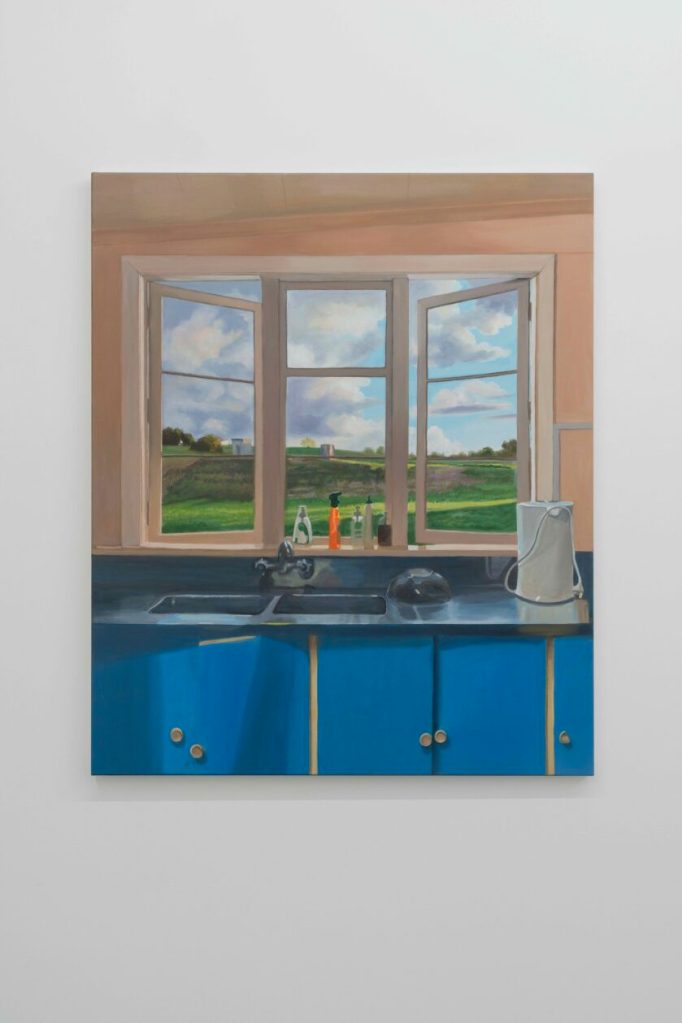
The large work “Ki roto, ki waho” ($16,500) is of the kitchen bench and a view to the surrounding land, a combination of the domestic interior and the local environment. The view through the window is itself like a landscape triptych, both mundane and intriguing.
This incongruity in many of her works gives the images both a simplicity and sophistication. In works such as “Marae Reflections” ($4500) she demonstrates a technical refinement in showing the marae façade as well as the depiction of a distance suburban landscape.
The three small works each entitled “Stop Bank (Otorohanga)” ($2750 each) owe much to French Impressionist paintings as well as the rural paintings of David Hockney, in creating timeless views of the landscape.
“Ka haere the wa” ($8500), presumably a form of memento mori related to one of her deceased relatives has its own sophistication with the representation of several objects which have symbolic meaning to the artist or the departed.
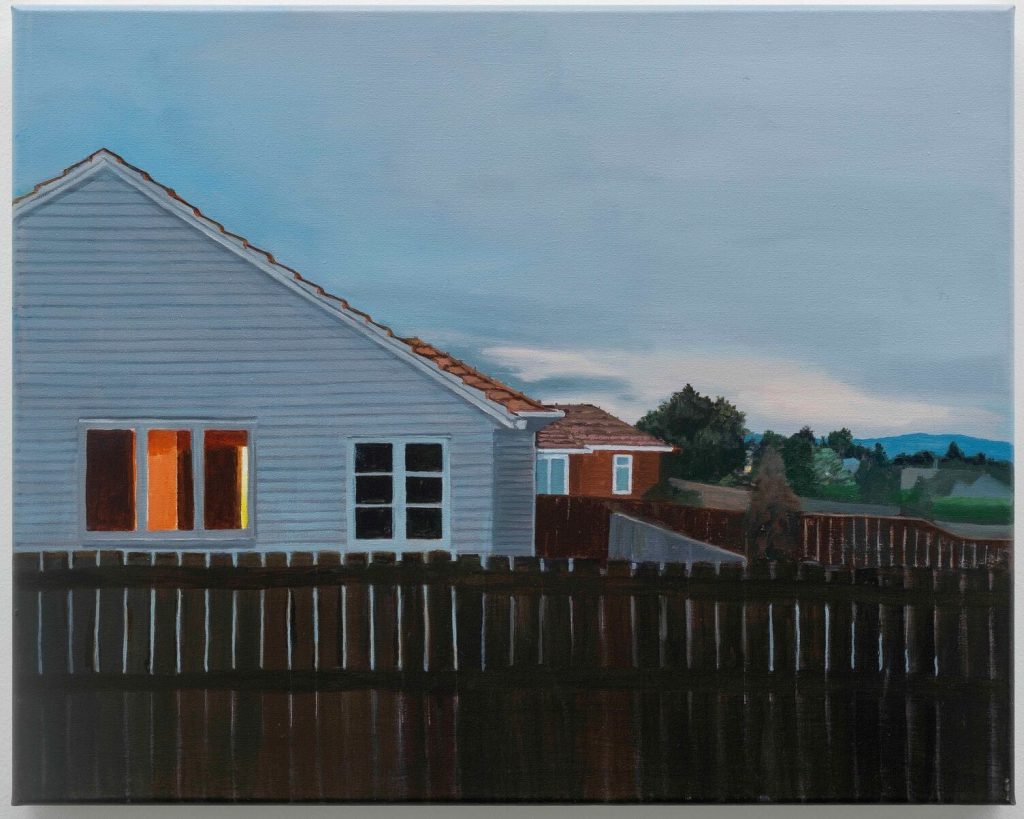
“Looking over at the neighbours” ($5500) has something of the feel of a Peter Siddell painting with its lack of human presence while “Māori, Male, 49, Folds his washing” ($3750) where we see a similiar house along with a more intimate portrait.
This intimacy can also be seen in “In my mother’s hands” ($4000) showing a small bird cupped in a pair of hands and “Aboard Te Huia” ($4000) where she observes a person lost in thought on a train.
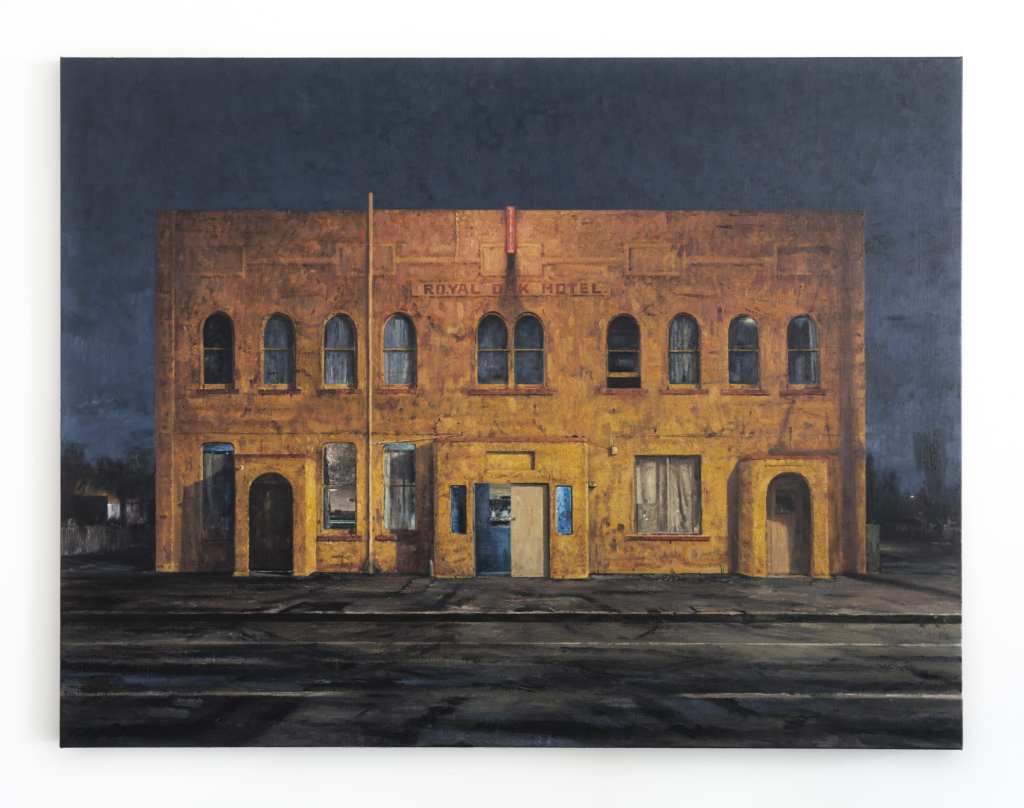
The nighttime views of Daniel Unverricht’s small town New Zealand present a very different ethos from that of Anderson-Mita.
The paintings in his latest exhibition, “Full Dark” have a gothic atmosphere to them. The mean, empty streets with buildings bleached of colour have a melancholic beauty to them. While the views of streets and building hint at a human presence, there is no sense of welcoming, we are excluded and we observe with a mixture of fascination and foreboding.
Even with the large painting “Wick” ($25,000) of the Royal Oak Hotel where the front door is open and we see there is activity within there is a feeling of menace. At the same time there is a fascination with the artists depiction, for in one window we see a reflection of a landscape illuminated by the twilight.
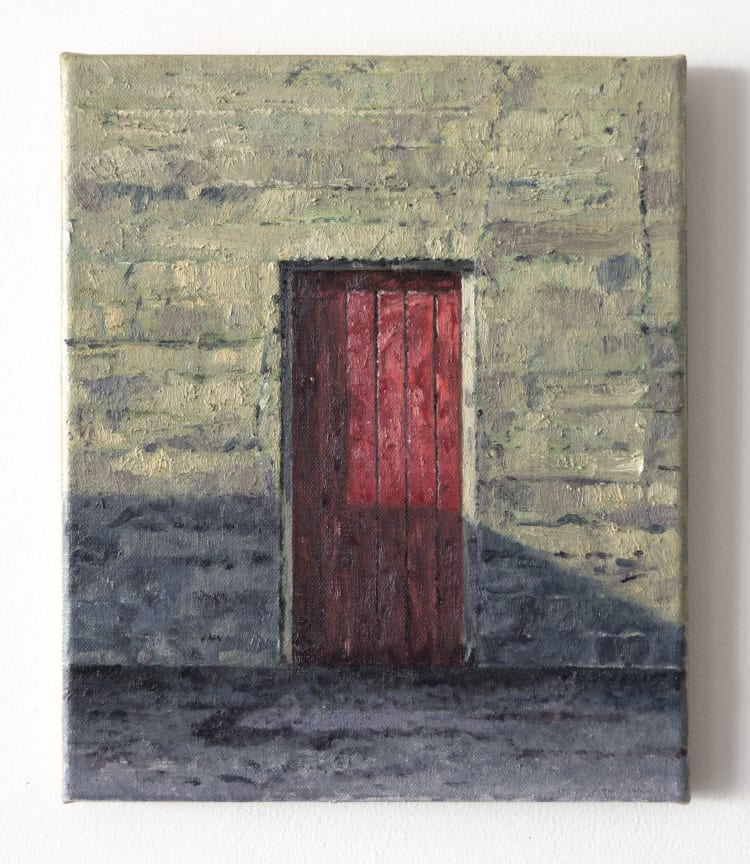
This ambivalence about entry and exclusion can be seen in “Shelter” ($3500) with its scrappy red door set in a peeling concrete wall. It may offer shelter but the door seems firmly closed. Equally the glowing light in “Gateway” ($3500) suggests a welcome but the black silhouette of a house is unnerving.
In most of the works the artist plays with the rendering of light. Often the light source is out of the picture frame as in “Valentine” ($3000), in others it is central as in “Gateway”. In “Gloam” ($10,000) the artist has stripped way the light both in the distant sky and the fading road surface.
To subscribe or follow New Zealand Arts Review site – www.nzartsreview.org.
The “Follow button” at the bottom right will appear and clicking on that button will allow you to follow that blog and all future posts will arrive on your email.
Or go to https://nzartsreview.org/blog/, Scroll down and click “Subscribe”

 New Zealand Arts Review