Reviewed by John Daly-Peoples

Living Between Land and Sea
The Bays of Whakaraupō Lyttelton Harbour
Jane Robertson
Massey University Press
RRP $75.00
Reviewed by John Daly-Peoples
The early history of New Zealand apart from that of the major centres was a history of small, often remote communities who developed physical, economic and social infrastructure to establish develop and organise their communities.
One such community was centred around the many bays of Whakaraupō Lyttelton Harbour and a new book by Jane Robertson, “Living Between Land and Sea – The Bays of Whakaraupō Lyttelton Harbour” provides such a history of the settlements of the harbour.
The area and the surrounding hills have a long history of Māori activity. The islands of Aua / King Billy Island and Ōtamahua / Quail Island were important sources of resources for local Māori, despite being uninhabited. Ngāi Tahu and Ngāi Mamoe used the islands as a source of shellfish, bird’s eggs and flax, as well as stone for use in tools.
This wide raging and superbly illustrated history tells of the settlements which developed in the bays of Whakaraupō Lyttelton Harbour. Each of the bays is given a chapter which the author details with extensive photographs from both the nineteenth and twentieth century as well as details about the people, the history, the jetties and the activities in each of them.
The various settlements include the larger areas of Lyttelton itself, Governors Bay, and Diamond Harbour as well as the smaller places such Purau and the military establishment and lighthouse at Godley Head / Taylors Mistake.
Many of the chapters deal with the history and myth of local Māori as well as the impact of the European settlements which gives a background to the unique development of each area of the harbour.
Robertson provides interesting historical facts and events which enliven the history making the book immensely readable and rewarding.
She writes about the torpedo boat which was stationed in the harbour at the time of the Russian Scare of the 1880’s and the development of military installations in the area.
There are the events around the establishment of the leper colony on Quail Island in the early twentieth century as well as the whaling station at Waitata.
There are accounts of the tsunamis which occurred in 1868 and 1960 which did much damage to jetties and buildings in the harbour.
The individuals and events of the area are woven together into a tapestry of intersecting threads covering both the European period of settlement and that of Māori going back many years, providing a history which is common to many areas of the country.
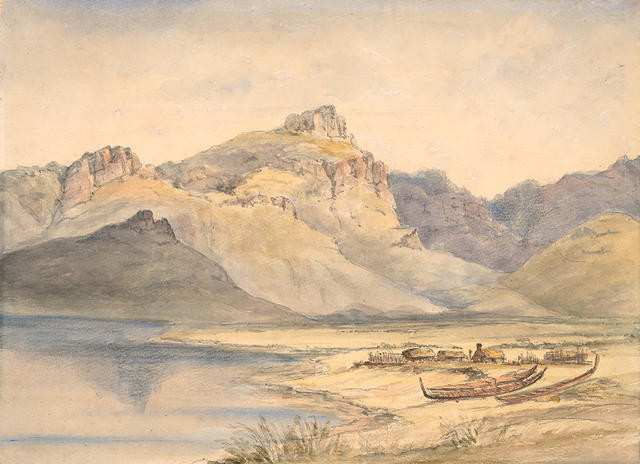
The book is richly illustrated with photographs from the nineteenth and twentieth century as well as some nineteenth paintings of the area including an 1850 work by Richard Oliver showing the Māori settlement and waka at Purau and one by J M Gibbs of Rapaki painted in 1877.
The book explores the history of Te Hapū o Ngāti Wheke and their guardianship of this place, describing the early history of Māori in the region. It also takes a geographical sweep around the harbour from the signal station at Te Piaka Adderley Head to the lighthouse at Awaroa Godley Head. In between, the stories of the bays and islands of this picturesque and historic harbour are described with fascinating details of early and contemporary life including maritime history and dramatic rescues, farming and trade, wartime experiences and quarantine stations, tourism and recreation.
Talking about her motivation for writing the book Robertson says “Whakaraupō Lyttelton Harbour is my home, the place I love, my tūrangawaewae. I wanted to understand this place better and then share that with others. When I completed Head of the Harbour: A History of Governors Bay, Ōhinetahi, Allendale and Teddington, in 2016, friends and local residents were interested in what was to follow. (I wasn’t, I just wanted a break!) When I was ready to write again, I started thinking about the Governors Bay and Teddington jetties, whose stories had so intrigued me. I thought I could extend that curiosity to all the jetties in the harbour — those still extant, those now derelict and those long ago dismantled and/or swallowed by the sea. While jetties were the physical starting point, I realised that they were just a portal — a way of stepping back into harbour communities whose reliance on the sea was so much greater than ours today.
I also believe strongly in the value of local history, of capturing voices and memories before they are lost for good.”.
“Living Between Land and Sea” adds greatly to our knowledge and understanding of the development of New Zealand and is an outstanding example of documentation about local communities.
To subscribe or follow New Zealand Arts Review site – www.nzartsreview.org.
The “Follow button” at the bottom right will appear and clicking on that button will allow you to follow that blog and all future posts will arrive on your email.
Or go to https://nzartsreview.org/blog/, Scroll down and click “Subscribe”

 New Zealand Arts Review