Reviewed by John Daly-Peoples

Symphonic Dances
Auckland Philharmonia Orchestra
Auckland Town Hall
October 19
Reviewed by John Daly-Peoples
The APO’s latest concert, Symphonic Dances opened with a welcome from the new CEO of the orchestra Diana Weir who was previously the Director of the Hamilton Philharmonic Orchestra in Ontario. She said it was a unique experience to be working with the orchestra which made phenomenal music possible. She also noted that she was announcing the orchestra’s programme for next year which included a superb range of music.
Conducting the programme was Chloé van Soeterstède who has been attracting the attention of orchestras across the globe. She has been praised for her intuitive, sensitive, expressive, music-making and attention to detail.
The major work on the programme was Mendelssohn’s Violin Concerto, a work he had spent nearly ten years writing. The concerto adheres to the classical style of Beethoven while containing much of the romantic ethos which leads on to the music of Brahms. In several ways he broke with tradition such as having the violin make an instant introduction to the work .
Violinist Sergey Khachatryan opened the turbulent first movement with a relentless vigour, grappling with the music as though he were in competition with the orchestra. At times his playing was raw, almost feral while at other times he exposed the delicate and sensual elements of the music.
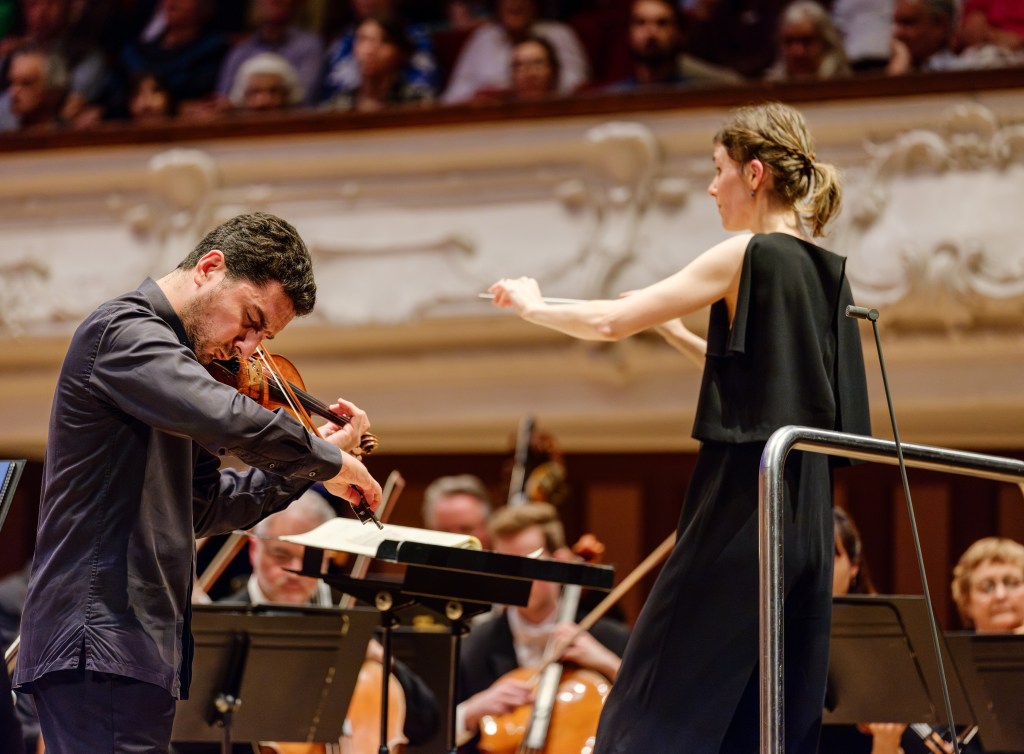
He tackled the work with a lively self-confidence, expertly managing the passages which Mendelssohn must have written to technically challenge any performer.
In the second movement where the violinist can be dominated by the orchestra Chloé van Soeterstède ensured that even when he played softly his sound still rose above the orchestra and some of these whispered moments were tantalising. Equally his dramatic displays were achingly emotive.
There was a precision and focus throughout as though he was thinking his way through the music, thinking and contemplating.
In the third movement in which many of the motifs of the first movement were restated he responded in an almost playful way, engaging with the music in a very physical manner.
Throughout he managed to conjure up some graceful unforced tones with crisp articulation heightening the romantic sweep of the music and discovering emotional depths in the music.
The concert opened with Prokofiev’s Classical Symphony, composed in 1916 and the first of his seven symphonies.
It might seem incongruous that Prokoviev composed a work which hints at the music of a century before at the same time as the Russian revolution. In many ways the work is revolutionary in that it alludes to the work of Mozart whose symphonies and opera were revolutionary in their time.
The symphony is also revolutionary in term of Prokovievs own work being a major change from his dramatic First Piano Concerto which had marked him out as revolutionary only a few years before.
Van Soeterstède opened the first movement which is full of joyous music demonstrating why she is valued as a conductor. She conducted with dramatic gestures and a style which was balletic.
The dance-like whimsey of the second movement had hints of the composers later ballet music while the third movement had a recognisable theme which would end up in his ballet music for Romeo and Juliet two decades later.
The Symphonic Dances was the last music Rachmaninov wrote, and the third movement features musical references to the Roman Catholic Requiem “Dies Ires”. It is a theme which recurs in many of his compositions reminding listeners of the terrors of the day of judgment. Mozart had previously employed the same melody in his “Requiem”, both composers using the setting as premonition of their death.
The work saw van Soeterstède conducting with more feline gestures as she led the orchestra in the vigorous opening with its march-like music and an exquisite passage featured featuring the woodwinds, the piano merging with the strings and an intrusive clarinet.
The elaborate music of the second movement was enriched by Concertmaster Andrew Beer leading the orchestra in a slow, almost filmic dance theme.
In the third movement there were a range of innovative sounds, notably from the percussion, a disturbing clarinet and after an appearance of the Dies Irie theme a dramatic martial finale.
To subscribe or follow New Zealand Arts Review site – www.nzartsreview.org.
The “Follow button” at the bottom right will appear and clicking on that button will allow you to follow that blog and all future posts will arrive on your email.
Or go to https://nzartsreview.org/blog/, Scroll down and click “Subscribe”

 New Zealand Arts Review