Reviewed by John Daly-Peoples

Tongariro National Park
An artist’s field guide
By Desmond Bovey
Potton & Burton
Publication Date: November 2023
RRP $39.99
Reviewed by John Daly-Peoples
To many people driving across the Volcanic Plateau, the landscape can seem bland apart from the views of the mountains which are always impressive. However, when there is volcanic activity, the views can be spectacular making one aware that the area has hidden depths and dimensions, that Nature isn’t always silent and lacking in interest.
For the hiker, the hunter and the skier who get closer to the land the area reveals its many hidden treasures – the plant life, the animals the birds, the fish and the geology.
A new book Tongariro National Park : An artist’s field guide by Desmond Bovey explores the various aspects of the area. While this is an artist’s exploration of the park’s plants, animals and landscapes Bovey is also very knowledgeable about the flora and fauna. He writes in a detailed, informative style describing how the various elements of the ecosystem have developed an interconnected system where plants and animals depend upon each other for survival on the often harsh and inhospitable Volcanic Plateau. He also refers to the introduced species which have made their home in the area often to the detriment of the local species.
While the writing often takes a broad-brush approach to the subject we are also given detailed information of some aspects of the animals who live there. For instance, he notes the difference between the pellet droppings of red deer and the local hare.
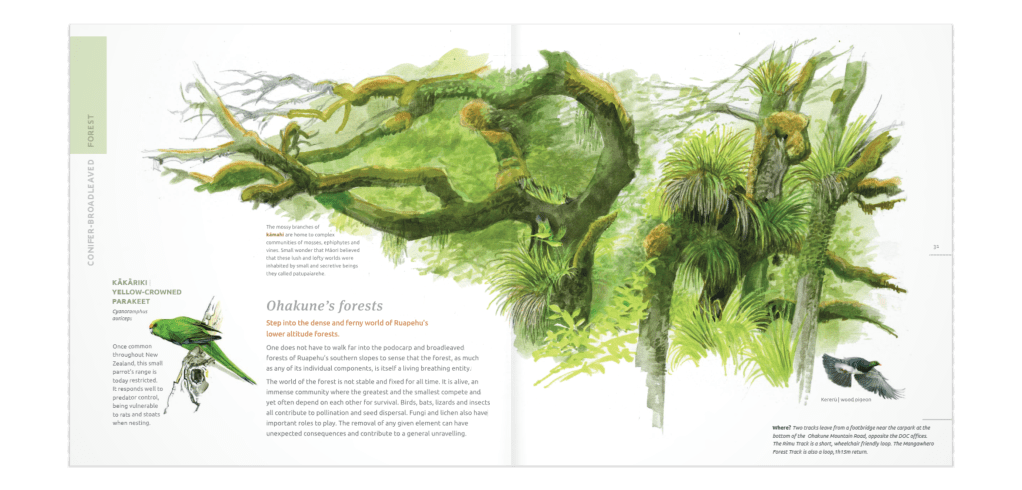
The text is accompanied by a four hundred illustration which vary from postage stamp size to double page spreads.
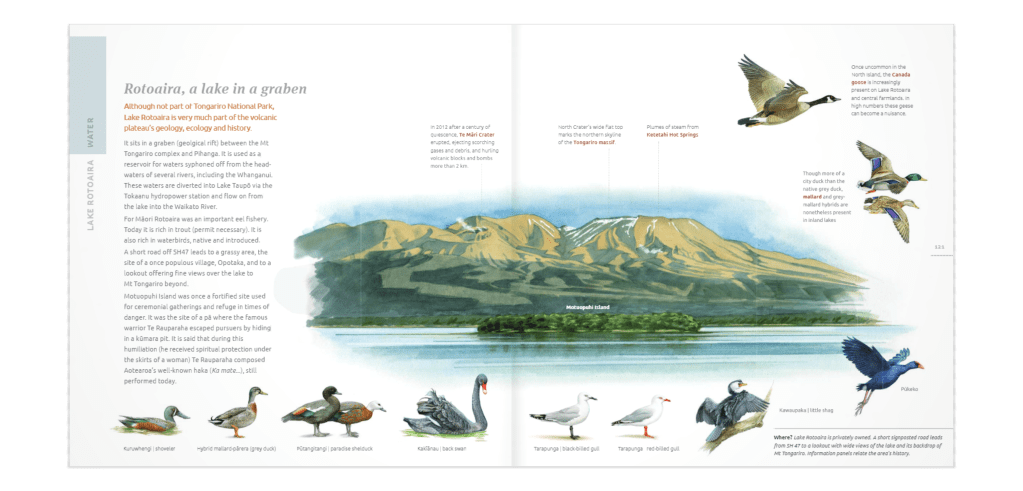
Bovey has a keen eye for the animals and plants he depicts. The artists ability to render the details of nature requires careful attention to the shape and line of the specimens but also the colour which with many of the plants can be quite subtle.
The book shows just how extensive the flora and faua of the area is and he meticulously paints all the plants and animals including all the larger introduced animals – red deer, fallow deer, the sika or Asian deer feral pigs and goats, along with the possums, rabbits, hares stoats, feral cats and ship rats.
He pays much attention to the birds of the area including kareara, fantail, kaka, matata, skylarks and dotterels He also examines the bees, moths, grasses and trees, depicting them in their habitats with a varsity of illustration which are much more informative than a photograph.
The author also provides something of a travel guide not only showing and describing the habitats but also explaining why the area looks as it is, taking account of the influence of climate, history and evolution. He also provides a few pointers as to finding interesting trails and locations. He mentions in particular Lake Rotopounamu which is located high on the flank of Pihanga, one of the smaller volcanoes. The lake’s name refers to its blue green colour and Pihanga in Māori tradition was a beautiful mountain fought over by the larger ones.
The lake is protected so bird life is abundant including papango, weweia, kotare and black shags and thanks to Project Tongariro bush Robins are making their re-appearance.
While the author makes a few references to the impact of man on the environment he gives an account of John Cullen the honorary warden of the Tongariro National Park who in the early part of the 20th century tried to create his vision of a grouse hunting landscape by seeding the slopes of Tongariro with heather and then introducing red grouse. The grouse didn’t survive but the heather has been a pest ever since although an introduced beetle has made some impact in reducing its growth.
Bovey who has dual nationality has worked as an art director and illustrator in Besançon, France, for 30 years. For many years he travelled to Africa pursuing his interest in photography of traditional arts and ceremonies. In 2011 he returned to live in his hometown, Whanganui.
On his return he felt a need to reconnect with the landscapes of his youth. He chose Tongariro National Park, inspired by a chance encounter with a kārearea, the New Zealand falcon. He returned again and again, sketchbook in hand, applying his delicate brush as he reacquainted himself with the dramatic landforms and ecology of the volcanic plateau.

 New Zealand Arts Review