Reviewed by John Daly-Peoples
Shostakovich 5
Auckland Philharmonia Orchestra
Auckland Town Hall
August 17
Reviewed by John Daly-Peoples
The APO’s Shostakovich 5 concert opened with “The Enchanted Lake”, a short work by the Russian composer Anatol Liadov. The work is a musical descriptive of a landscape most likely a lake view by the Russian painter Arseny Meshchersky.
Here the shimmering strings, the tinkling piano along with the brass and woodwinds all contributed to the whispering, atmospheric sounds which created a lush vision as the orchestra took the audience on a journey through a romantic landscape.

Next up was Ravel’s Piano Concerto in G where the composer linked his Spanish / Basque heritage to his interest in post war jazz.
From the opening sharp whip crack this was a work which was full of surprise and contrasts While the orchestra took on the role of the Big Jazz Band, pianist Steven Osborne was like a barroom piano player cleverly combining the Spanish themes and the lively, experimental music of the 1920’s. He skilfully played the various themes as they pursued each other with changing pace and intensity. At the same time conductor Shiyeon Sung worked hard to control the almost out of control orchestra.
Then second movement saw Osborne playing a serene romantic piece which slowly increased in intensity but maintaining a fluidity which contrasted with the first and last movements. Osborne showed a sensitivity in the way that he brought out the nuances of colour and texture. The dramatic third movement where jazz elements again enter along with all the instruments. Here Osborne was conscious of the conductor and the various instruments which seemed to energize him. At times his playing was delicate and meditative while at other time there was a more ferocious quality
The big work on the programme was Dmitri Shostakovich’s Symphony No 5
In the 1930s the purges of Joseph Stalin meant that contemporary music and many composers were declared decadent and Dmitri Shostakovich saw the need to adapt to the current political climate. In a cynical nod to political correctness, he subtitled his Symphony No 5 “A Soviet Artist’s Response to Just Criticism.” While there are many lyrical and heroic aspects to the work which were favoured by the cultural critics, and saved him from criticism there is a sense of brooding despair beneath the almost romantic melodies.
The symphony feels as though it is contemplation of the battlefield, the drama and horror of battle and its eerie aftermath. But this is not some reimagining of Tchaikovsky’s triumphant 1812 and it sems very relevant to the present day as Ukraine had been focus of Russian territorial ambition in WWI and the site of much fighting and destruction.
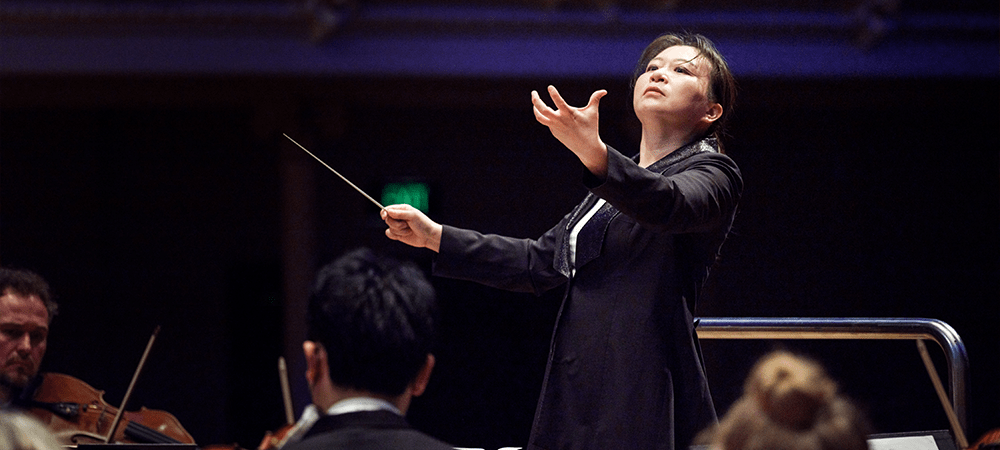
The work opens with the great percussive roar of war and destruction followed by the various colours and moods of the battlefield landscape mixed with desperate pleas of the souls and spirits of the dead. Then there are themes which could be derived from folk melodies which seem to speak of a coming Spring and a renewal, but it is a bleak Spring interrupted by pounding militaristic brass which had conductor Shiyeon Sung conducting with feverish gestures
The second movement which has some links to dance, but this is not folk dance or the waltz but rather a dance of death. Then there was some bright and colourful tunes along with a delightful pizzicato sequence from the strings which expressed contrasting feelings of tension and fragility in the music before eventually returning to the militaristic the dramatic and the chaotic.
The slow third movement was almost a requiem with Sung conducting with surging gestures and at times she seemed to struggler with herself as she coped with the tortured, mournful sounds provided by flute and harp and the work eventually moves to a transcendental mood conveyed by the flute with music derived from Orthodox prayers.
In the fourth movement Sung extracted nuance and subtly, giving the work a lightness and innocence before erupting into a reworking of the opening theme with a lightness streaming through the bleak sounds of the battlefield
At times throughout the work Sung’s elaborate conducting style saw her more as a magician than conductor and her baton more of a wand. She seemed to be encouraging the orchestra, beseeching and inspiring them with, drive, aggression and reflection.
The concert had opened with a farewell to Barbara Glaser who has been the CEO of the orchestra for the past seventeen years. Her leaving was acknowledged by chairman Geraint Martin who spoke of her many accomplishments ending with announcing that she would now become a patron the orchestra.

 New Zealand Arts Review