Reviewed by John Daly-Peoples
Peter James Smith – On Writing On painting On Objects
5 – 31 August 2023
OREX Gallery
Reviewed by John Daly-Peoples
Peter James Smith latest exhibition “On Writing on Paintings on Objects” continues the artists interests which combine painting, mathematics, history and romanticism.
His paintings are intended to be read in several ways. There is the pictorial aspect in which we are provided with visual descriptions of landscape which often are built on the Romantic landscape tradition as well as colonial descriptions of the land.
The diagrammatic symbols and marks he uses are abstractions of natural forces and aspects of scientific enquiry such as concepts of the angle of sunlight, speed of tide or ocean currents.
The marks can also be cartographic indicating the outlines of landscape, the ideal passages into harbours or the recording of rainfall.
Then there are the written description of the landscape giving the location, the dates of original or important events as well as a references to writers (Milton) or philosopher (Plato).
Accompanying the exhibition are notes by the artists which gives further detailed historical information which are like curator’s commentaries.
One of the simpler works is “Limelight” ($7000) which shows a streetlight at sunset. The artist notes that the work “presents the world as a stage at the end of the day with the title referring to the theatre footlights that produced radiant energy from the heated lime”. The theatre arched proscenium is suggested by a drawn curved line with the streetlight and foliage becoming props in his imagined scene.
The other works in the show have similar level of explanation which gives the exhibition a depth and relevance.
“The Divided Line” ($12,000) is an example of his more complex work. Using a romantic view of Mitre Peak and Milford Sound he overlays it with Plato’s concept of “the divided line” which imagines two worlds – the visible world and the intellectual world of ideas and concepts. The division is close to notion of The Golden Section which many artists, notably Billy Apple have used in their work. Smith’s use of the line can be applied to the artwork image in understanding that much of our appreciation or conceptualising of the view may be an intellectual understanding rather than a visual comprehension.
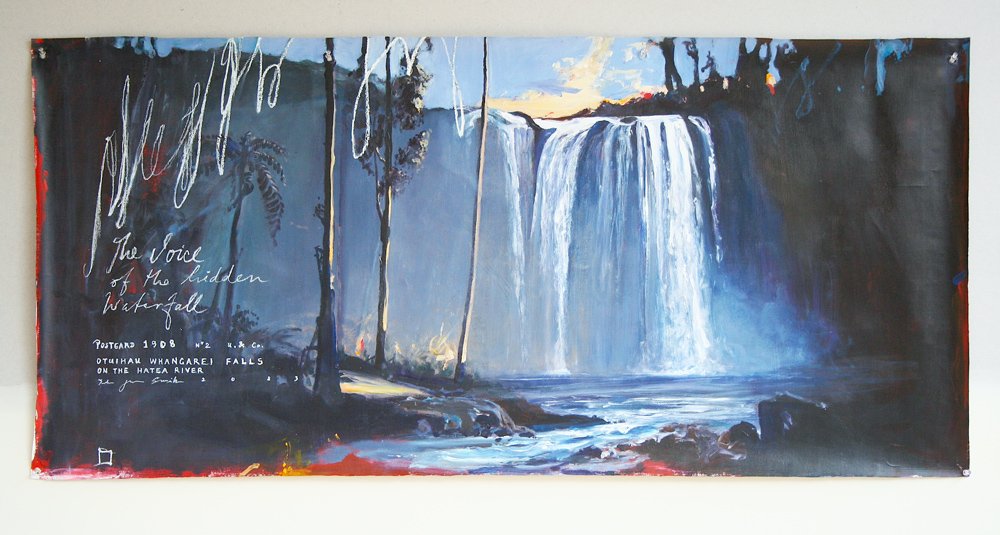
He has based “The Voice of the Hidden Waterfall” ($12,000) on an old postcard of the Whangarei Falls and the actual post card is collaged into the work “Films Urgent (The Hidden Waterfall) ($2500) which imagines a roll of film taken of the falls.
With both these works he reflects on the way in which information about an event or location is appreciated and passed down. So, there are visual recordings of the photograph, the film the painting and the written record while the painting also refers to the sound of the waterfall itself,
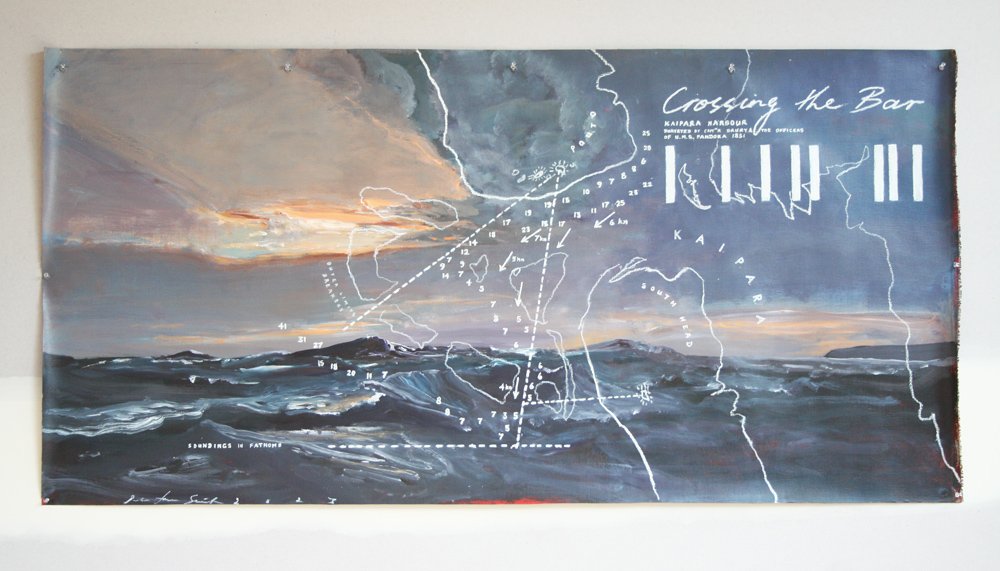
“Crossing the Bar” ($12,000) features four observations of the Kaipara Bar. There is the plan of the bar and the surrounding physical features, a painting of a dramatic sky and the rough seas between the two headlands and the cartographic information detailing the survey by the HMS Pandora in 1852. There is also an abstract addition of several white bars which refer to the various channels which run through the area between the two headlands. These bars can be seen as a musical notation, echoing the rhythm of nature or the keyboard of a piano with its reference to the film The Piano and the treacherous West Coast.

 New Zealand Arts Review