Reviewed by John Daly-Peoples
Auckland Philharmonia Orchestra
Brahms 1
Auckland Town Hall
August 3
Reviewed by John Daly-Peoples
The APO’s latest concert opened with the premiere of Ross Harris’s Symphony No 7, a one movement work based on three fragments of Gregorian chant, a medieval style of music which has a single melodic line with the singers following the single melody in unison.
The work felt as though it was constructed from faintly remembered phrases which are slowly pieced together before collapsing to reappear again overlaid with other phrases.
While much of the playing featured the strings there were several passages where the percussion instruments played as major part – tubular bells, timpani, gongs brass and harp were all intertwined. In other sequences the various parts of the orchestra took on jarring and discordant voices.
Halfway through the work the orchestra seems to go in search of the forgotten themes and then slowly restructures the work with traces of the original themes. Here there were some delightful passages as when the harp and xylophone were joined in with almost primitive drumming which seemed close to the fairground music of Stravinsky’s Petrushka, a sequence which then morphed into what was a Medieval Dance of Death supported by some robust frantic playing.
The finale of the work saw some elegant flute playing which led the orchestra into a percussion fuelled passage before the music became more lyrical as the orchestra discovered the final remnants of the original Gregorian chant theme.
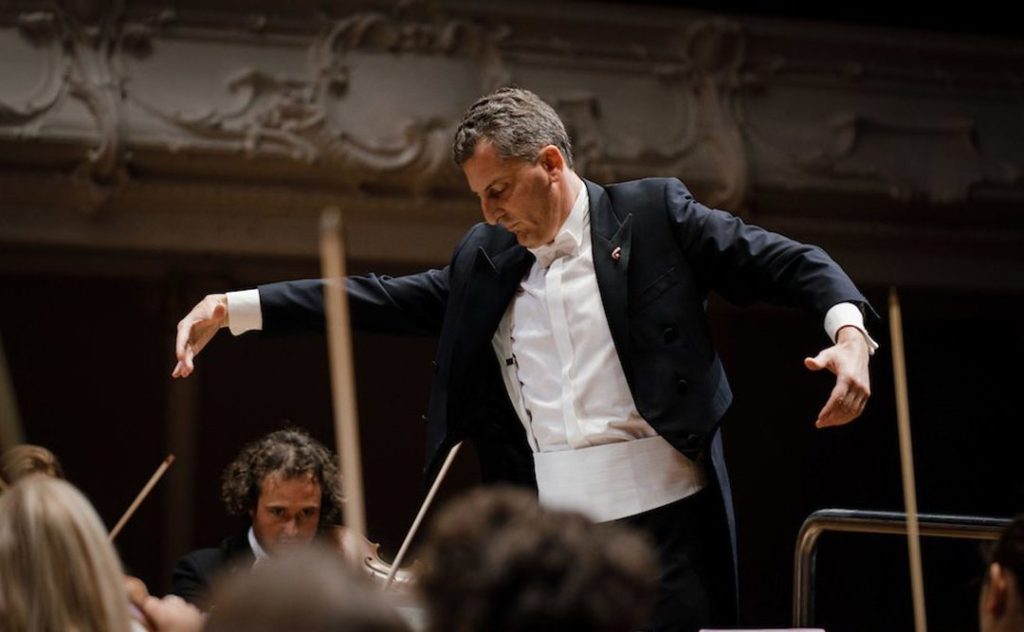
Throughout the work one was aware of the composers intelligent use of the instruments as he experimented with sounds and contrasts, a feature which conductor Giordano Bellincampi was aware of ensuring they were used to maximum effect.
The major work on the programme was Brahms’s Symphony No 1, a work often referred to as Beethoven’s 10th symphony mainly because it makes use of one of the themes of Beethoven Symphony No 9 and also because Brahms himself always felt he lived in the shadow of the great composer.
There were fifty years between the two compositions and over that time there were big changes in music and in the zeitgeist of the times. The late nineteenth century saw a growth in psychological studies and an awareness of human psychology. Where Beethoven created music for the revolutionary, heroic man Brahms and composers such as Mahler were writing about personal experiences and personal emotions and feeling.
Brahms was also having to create a new musical language which built on that of Beethoven giving it a more personal style.
From the first we enter a brooding landscape of the mind filled with mystery. This is not the place of the noble, universal man of Beethoven but the the inner life of Brahms himself with all its flaws and desires.
In the second movement we encounter a more idyllic view and an awakening in the mind of the composer. Here conductor Bellincampi was almost dancing on the podium with his hands performing pirouettes as he led the orchestra. Concertmaster Andrew Beer with his refined solo performance at the end of the end of the movement added to the sense elation.
In the final movement with its reference to Beethoven’s ninth symphony a fog sems to lift from the composers’ ruminations and he encounters a new age of reflection. The words of Beethoven’s “Ode to Joy” took on a new contemporary meaning symbolising hope, unity and fellowship of the new revolutionary age.
Throughout the work Bellincampi was able to provide balance and nuance as he skilfully guided the orchestra, ensuring that the various highlight such as an enchanting passage from the flutes and woodwinds were clearly delivered.
Also on the programme and reflecting the musical changes happening at the end of the ninetieth century was a performance of Mahler’s “Songs of a Wayfarer” sung by baritone Benson Wilson
With these four songs Mahler envisaged a wayfarer, reflecting on his past life and his destiny as he travels the land. The first depicted his despair that his lover has married someone else while in the In the second Wilson expressed the joy of the wayfarer with a bird-like thrill as he sang from the bird’s perspective.
With the third which opens with the word “I feel a knife burning in my breast” the singer dwells on his thoughts of suicide and Wilson managed to convey the wayfarer’s anguish with a soulful expression
In the fourth song he expresses an anger and defiance with a voice which seems to grow out of the orchestra and his pleading voice railed against the orchestra and its dark funereal march.
To subscribe or follow New Zealand Arts Review site – www.nzartsreview.org.
The “Follow button” at the bottom right will appear and clicking on that button will allow you to follow that blog and all future posts will arrive on your email.
Or go to https://nzartsreview.org/blog/, Scroll down and click “Subscribe”

 New Zealand Arts Review