Reviewed by John Daly-Peoples

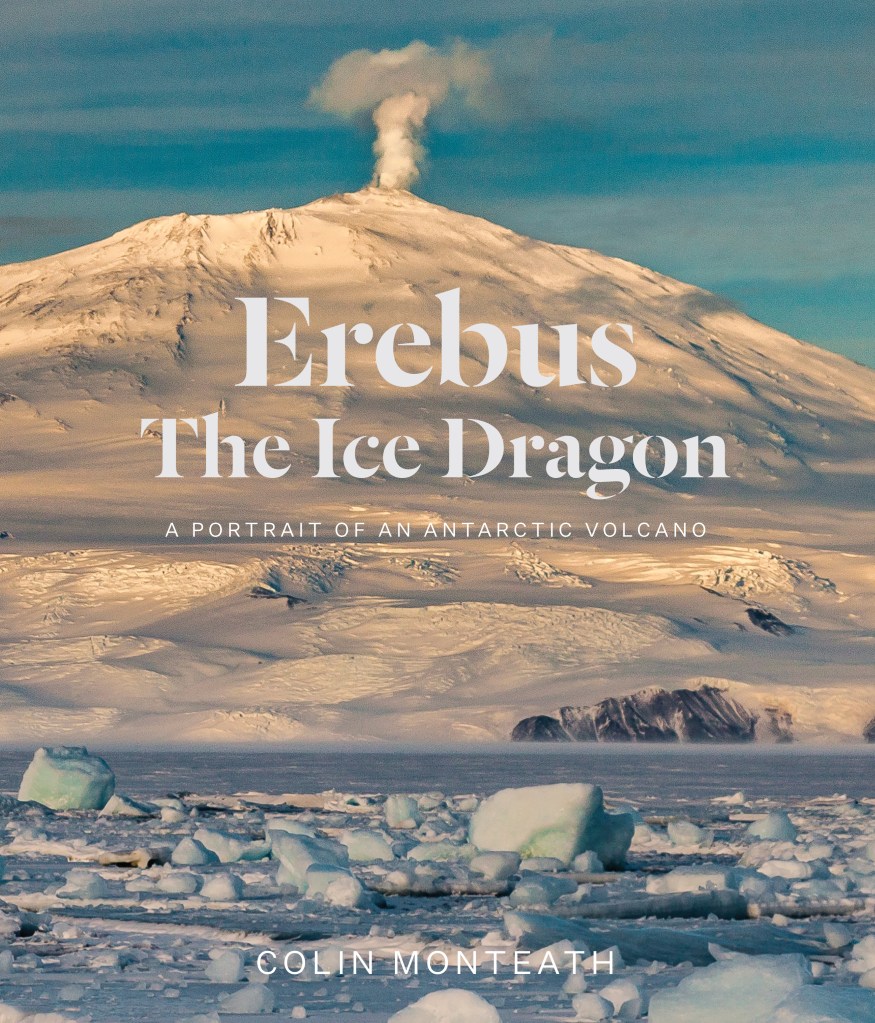
Erebus, The Ice Dragon
A Portrait of an Antarctic Volcano
Colin Monteath
RRP $65.oo
Reviewed by John Daly-Peoples
The name Erebus for most New Zealanders is associated with tragedy after the fatal crash of flight TE901 in 1979. In many ways that is appropriate as Erebus, in Greek myth was the son of Chaos, the god of the dark region of the underworld and the personification of darkness.
Erebus has excited explorers, scientists , artists, climbers and tourists, all attracted by various aspects of the mountain. It is an extraordinary feature of Antarctica being an active volcano with dozens of ice caves, a lava lake and home to amazing ecosystem.
A new book” Erebus The Ice Dragon” by Antarctic veteran Colin Monteath brings together the history, science, art and feats of adventure which make the Erebus and Antarctica a place of amazing beauty filled with secrecy and new areas to be explored and understood.
The book is a broad history about Erebus and Antarctica but also about the adventures and explorations from its earliest discovery though to the present-day. The extraordinary tales featuring extraordinary characters are accompanied by superb images of the explorations from the earliest sketches to the present. These images illustrate the landscape, the men , and their equipment which have travelled to this white continent.
Erebus was discovered by James Clark Ross who was one of the great explorers of his time. Before journeying to the Antarctic, he had made many voyages to the Arctic and discovered North Magnetic Pole. It was his ship Erebus, along with Terror which discovered Erebus on January 28th, 1841.
The book is filled with the stories about the amazing characters who followed Ross in pursuit of adventure and discovery These included men like the geologists from Shackleton’s Nimrod expedition who made the first ascent of Erebus in 1908 and the second ascent in 1912 during Scott’s Terra Nova expedition.
The exploders and scientists who came after them spent years in the dangerous scientific searches. The range of scientific inquiry included the study of fossils, meteorological studies, upper atmosphere research as well as the geological and volcanic studies which continue to provide valuable information about the Antarctic but also about global future changes and adaptations,
The author was one of the mountaineers involved in supporting the authorities after the crash of Flight TE901 and the chapter on the disater is written from the perspective of Monteath as well as fellow mountaineers , Rex Hendry, Hugh Logan and Harry Keys, who each of whom was involved in the recovery operation. The four accounts help bring an understanding to what actually happened in the build-up to the tourist flights as well as the recovery phase.

There is also a chapter by Dr Adele Jackson looking at the artists who have visited the area inspired by the landscape, its history and the Southern Lights. Probably the first artist to record Erebus was J E Davis the second master of the Terror whose painting is a remarkable plein air work done with supreme skill. Since then, numerous writers, musicians and artists have visited the continent under the auspices of many agencies including the Antarctica New Zealand Artists and Writers Programme. Artist under the programme have included artist Nigel Brown, poets Bill Manhire and Chris Orsman and Musician Chis Cree Brown.
In previous years major artists such as the Australian Sidney Nolan and New Zealander Peter McIntyre journeyed to south adding to the pictorial record of the area.
Monteath’s portrait of Erebus is filled with his own personal experiences which provides a unique understanding of the history and allure of the volcano exploring the mysteries of this extraordinary place.

 New Zealand Arts Review