Reviewed by John Daly-Peoples
Ever Present: First Peoples Art of Australia
Auckland Art Gallery
July 29 – October 29
“Ever Present: First Peoples Art of Australia” is a survey show of over 160 artists spanning more than a century of art making in aboriginal communities. While the artworks have been drawn from period 1890 up to the present they span time and place across many centuries connecting histories through stories and experiences.
The exhibition celebrates First Nations Australian art exploring the interlinking themes of Ancestors, Community, Culture, Colonisation, and Identity. Knowledge systems are passed down through oral histories, dancing, stories and songlines or songspirals that tell the creation stories that cross the country and put all geographical and sacred sites into place in Aboriginal culture. These come together to evoke Ancestral creation stories as well as describing the laws and culture of individual communities often known as The Dreaming.
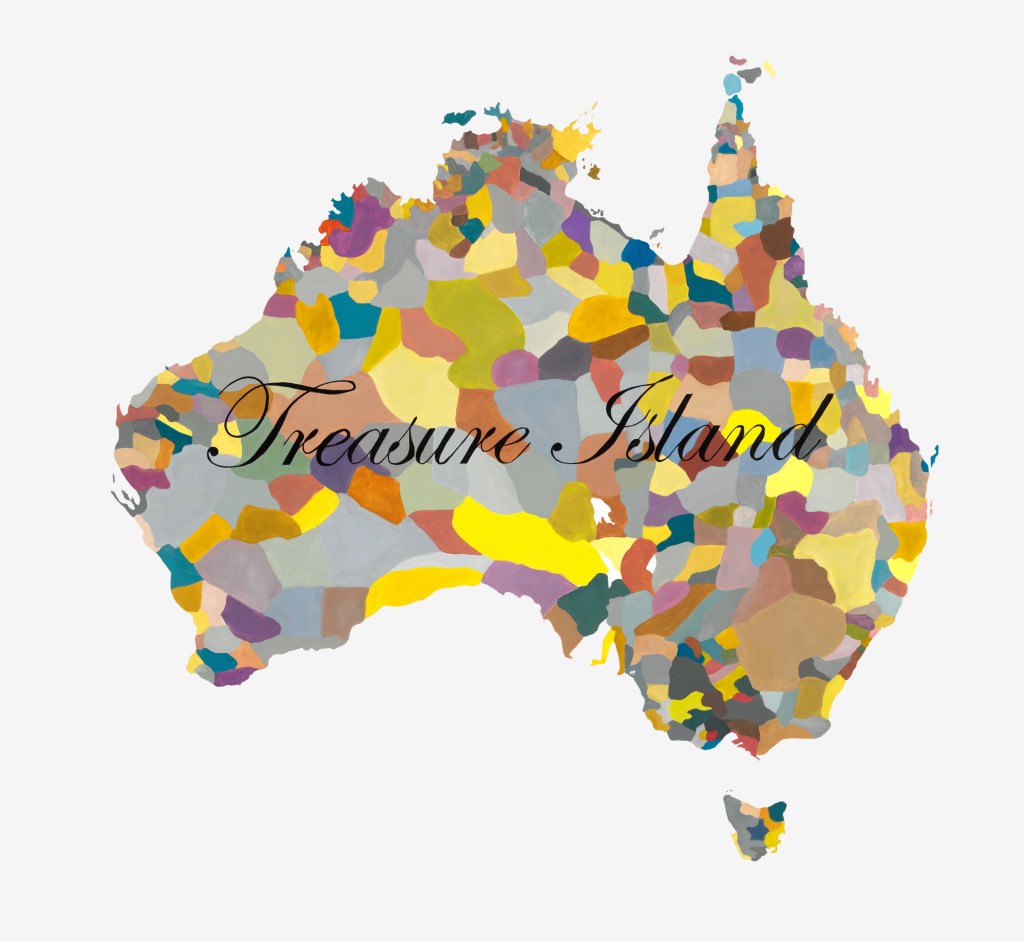
There a no early example of pre-European aboriginal cave, rock or bark art works but some of works in the show display many of the characteristics of the classical period. The more recent works deal with urgent political, social and personal issues such as Daniel Boyd’s “Treasure Island” with its multi-coloured map of Australia which is a visual reminder of the richness and diversity of the hundreds of Aboriginal and Torres Strait Islander communities, as opposed to the early colonial maps which presented the continent as holding mineral treasures and land suitable for exploitation.
In the adventure stories such as Robert Louis Stevenson’s “Treasure Island” those seeking treasures had a map, where X marked the spot and other symbols were used to indicate landmarks, dangers and resources.
In many ways the mark making of aboriginal artists is similar to early European methods of communication. The lines, dots and colour link to the semaphore flag system of communication or the primitive morse code system composed of dots and dashes.
As in aboriginal art the ideas or information is in a coded form and only by understanding the code system does the observer get to understand the message.
Some of the classical aboriginal style works which use chevron shapes and lines are similar to the European methods of geological description using distinctive symbols, patterns and colours.
While these designs are similar, the aboriginal artworks are also able to carry notions of history, myth and community.

One of the interesting inclusions in the exhibition is the work of Albert Namatjira who was largely ignored in the middle of last century as it was thought that his work showed he had given way to the European pictorial tradition and by implication to the of European privilege over the land. His landscapes have now been reassessed and rehabilitated and seen as another form of expression which acknowledge sacred sites and knowledge.

Another work in the European tradition is Christopher Pearce’s “Beyond the Hay” which reverses the idea of European imposition of the ideal and the exotic. Pearce based his work on a hand-coloured engraving by the British artist John Sykes “A deserted Indian village” which he had made of an aboriginal settlement in Western Australia. In the nineteenth century anyone caught within the area (beyond the Hay River) faced the possibility of being shot.
Julie Dowling explores the idea of European with her work which has the surreal qualities of a Magritte painting while Yvonne Koolmatrie’s “Eel Trap”, uses traditional weaving techniques to create art works which transcend their original utilitarian purposes.
In the work of Yhonnie Scarce the dark glass objects in the shapes of the traditional bush fruit and vegetables eaten by Aboriginal become metaphors for the Aboriginal people and the forceps represent the experiments and invasions by medical and other institutions.
The abstract expressionist works of Emily Kam Kngwarray which trace the lines of travel in the dreamtime also represent the tangled underground root system of the tuber plants such as the yam. These complex twinning lines can also be seen as the representing the complex communication of the cables and lines of our contemporary network of our underground service such as telephone and internet.

The severe abstraction of Mabel Juli with her “Garnkiny Ngarrangkarni” is able to use simple symbols to encapsulate the complex myths about the relationship between the heavens and humans.
The exhibition provides endless opportunities for discovery about the techniques and range of aboriginal art. They also allow the viewer to explore connections with art of the European tradition as well as those of the Pacific and Māori.
The National Gallery of Australia’s Curator of Aboriginal and Torres Strait Islander Art, Tina Baum, Gulumirrgin (Larrakia)/Wardaman/Karajarri peoples, says ‘The National Gallery is the custodian to the largest collection of Aboriginal and Torres Strait Islander art in the world and through partnering with overseas galleries to present touring exhibitions like Ever Present, we elevate First Nations voices on a global stage. To fully understand the richness, diversity and depth of Aboriginal and Torres Strait Islander art and culture would take many generations and many lifetimes – but to appreciate it only takes a moment.’
The exhibition includes some of the most influential First Nations Australian artists including Brook Andrew, Richard Bell, Bindi Cole, Karla Dickens, Jonathan Jones, Mabel Juli, Vernon Ah Kee, Kunmanara Ray Ken, Emily Kam Kngwarray, Yvonne Koolmatrie, Alex Mingelmanganu, Archie Moore, Albert Namatjira, Dorothy Napangardi, Christopher Pease, r e a, Yhonnie Scarce, Damien Shen, Christian Thompson and Clifford Possum Tjapaltjarri.
To subscribe or follow New Zealand Arts Review site – www.nzartsreview.org.
The “Follow button” at the bottom right will appear and clicking on that button will allow you to follow that blog and all future posts will arrive on your email.
Or go to https://nzartsreview.org/blog/, Scroll down and click “Subscribe”

 New Zealand Arts Review