Reviewed by Malcolm Calder
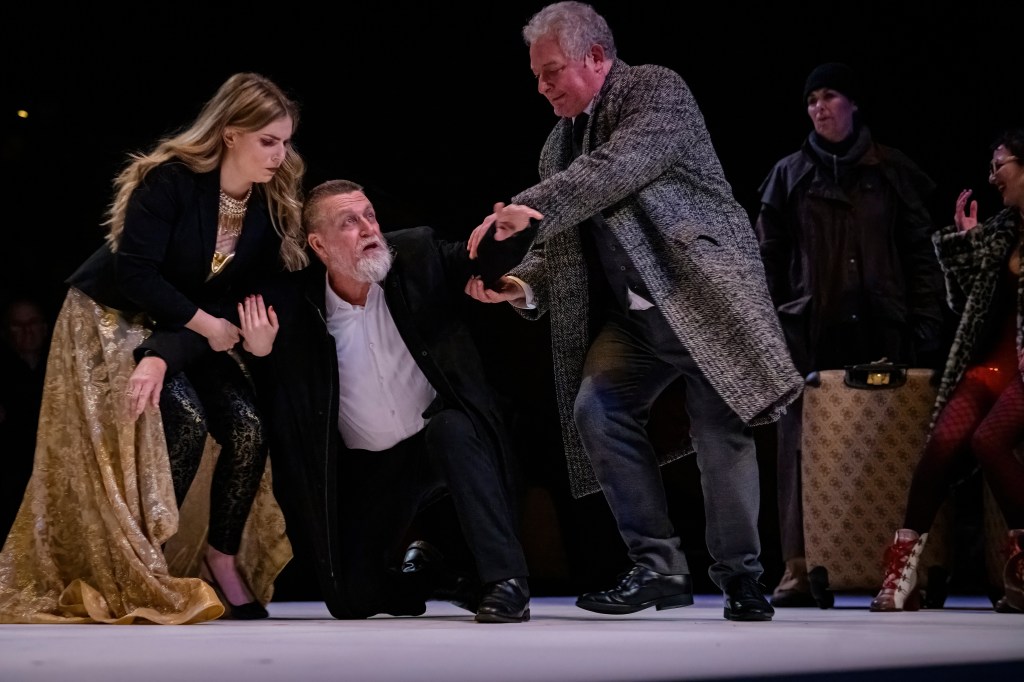
King Lear
By William Shakespeare
Director – Michael Hurst
Co-director – Benjamin Kilby-Henson
Set Design – John Verryt
Lighting Design – Vanda Karolczak
Costume Design – Elizabeth Whiting
Composer and Sound design – John Gibson
An Auckland Theatre Company production
ASB Waterfront Theatre
Until July 9
Reviewed by Malcolm Calder
Oh what a joy to see a well produced Shakespeare on an Auckland stage. And an aptly-chosen tragedy at that.
Pre-show, someone confessed they had never actually seen King Lear and what was all about. Blindness, I replied rather elliptically, with a throwaway line that rather a lot of completely dead bodies were likely to wind up littering the stage.
What I avoided was the follow-up question – why. And what I witnessed on Opening Night provided Mr Hurst’s answer.
His King Lear has a timelessness. At a superficial level Shakespeare’s words are of an ageing king who has accomplished quite a few things in his time. However, he is growing older, as one does, and considering what to bequeath to which of his daughters and supporters. But he is blind to their shortcomings, is wilfully ignorant of change that is taking place all around him and completely unaware of the rate at which that change is happening. In a sort of non-specific modern setting this production remains true to Shakespeare but, at a deeper level, creates an interpretation that is just as valid an observation of today’s contemporary world. That is what makes any play great.
Whether in a traditional or contemporary world this Lear has a smug sense of achievement, of entitlement and of hubris even. Through it all he remains ignorant of the plotting and the scheming behind his back. He neither sees nor hears the groundswell of those who are missing out and the rise of greed amongst the many. His long-held vision of himself is of a once-great king that is sadly out of touch. This limited vision simply expects things of others and when his assumptions start to go awry, then confusion, disbelief and self-castigation drive him off his rocker. It is a descent from which he can never recover.
And that gets us rather neatly back to those eyes. What they can see – or not – and, more specifically, what the mind makes of what they perceive.
However, this King Lear is also about far more than an old bloke divvying up a realm. It is really a parable about the world we live in today. Some might even say that it’s about the end of an age or the end of a generation or, if we’re feeling particularly miserable, even about the end of the world as we have known it.
While some boomers are still hanging on by their fingertips to what they know and hold dear, their footsteps are being dogged by successive generations who have never lived a life without Wikipedia in the palm of the hand; where rising standards of living have made for a ‘must-have’ mentality that edges ever-closer to greed; where war and serious economic hardships have simply never existed; where sexual roles and affiliations have become blurred; where inter-marriage (or more correctly inter-breeding) is slowly blurring ethnic divides; where the seven-second media grab has become a distillation of complex economic policy; and, most importantly, where shouting or ridiculing, rather than listening, have become an increasingly normal means of social interaction. Arguably, with an election looming this process of change, acceptance and the way ahead is becoming even more acute for when truth is banished, people become blind.
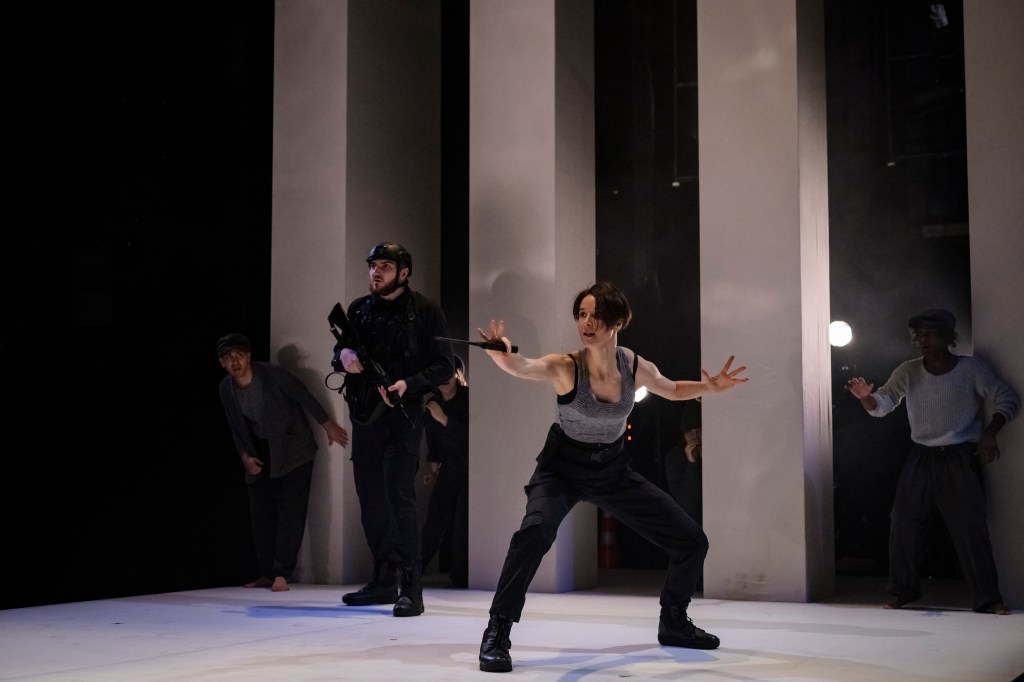
It might be argued that cross-casting three roles in this production serves to reinforce the element of ‘change’ but that had very little to do with the ‘gender twisting’ in this production. It sat very easily with me. That Gloucester (Cameron Rhodes) should have an illegitimate daughter rather than a bastard son (Edmund – Beatriz Romilly) was of little moment. Even when their relationship was falling apart, these two generated some delightful interaction with the strength of Gloucester being unexpectedly matched by that of his progeny. But Gloucester too is blind to the tension between Edgar and Edmund and he too will join the ranks of those who did not see and did not perceive.
Similarly, Lear’s Fool (Hester Ullyart) adds and arguably enhances the slightly distanced voice of reason that she carries throughout the play. Jennifer Ward-Lealand was of course simply outstanding as the Duchess of Kent. And an amazing ability to modify her vocal range as the alter ego Caius only served to further reinforce her role as one of our country’s finest actors.
Hurst himself is incomparable in the role of Lear.
Goneril (Andi Crown) and Regan (Jessie Lawrence) Lear’s older daughters somehow echoed with me as being escapees from one of those dreadful TV series usually entitled ‘the Real Bossy Housewives of wherever’ with their spouses following meekly behind. While looking stunning. Yes, to complete my analogy from above – they had the aura of being spoiled, corrupt and living off their parent’s wealth. Hannah Tayeb (Cordelia) looked and sounded very meek and young in comparison.
Edgar (Joe Dekkers-Reihana) grew into his pivotal role as a considered voice of understanding, compassion and tolerance. Perhaps his voice was the voice of the future.
As expected, the highlight of this production was undoubtedly the storm or madness scene. It came a little quickly for me as I felt that Lear suddenly ‘flipped’ instead of showing us a more gradual disintegration into madness. But once there Hurst’s madness was unforgettable. Water on a stage was once unthinkable. Here, it is flung about with great abandon, sprinkling those sitting in the front row and mixing with sweat, tears and general mayhem. One can imagine interval being a busy time in the dressing rooms.
This is a relatively high-tech show enhanced by its white brilliance, moving to near darkness of occasions and also showed off the intricacies of John Verryt’s design. His mirrored wall serving its several purposes and echoing those audience faces that are bleacher-seated upstage in the traverse position, while becoming a storm scene when called for. Vanda Karolczak’s moody, sensitive lighting as atmospheric and the whole was further enhanced with Elizabeth Whiting’s timeless costuming and the creative soundscape of John Gibson.
Lear is not the easiest of Shakespeare’s plays and has not been done on this scale in New Zealand for some years. The late David McPhail gave Christchurch’s Court Theatre a Lear about 15 years ago but even when the Pop-up Globe was still doing wall-to-wall Shakespeare it shied away from the tragedies – especially where eyes are put out and dead bodies are everywhere. Either way congratulations to Jonathan Bielski for convincing Michael Hurst to put together what can only be regarded as one of his finest accomplishments.
To subscribe or follow New Zealand Arts Review site – www.nzartsreview.org.
The “Follow button” at the bottom right will appearand clicking on that button will allow you to follow that blog and all future posts will arrive on your email.
Or go to https://nzartsreview.org/blog/, Scroll down and click “Subscribe”

 New Zealand Arts Review